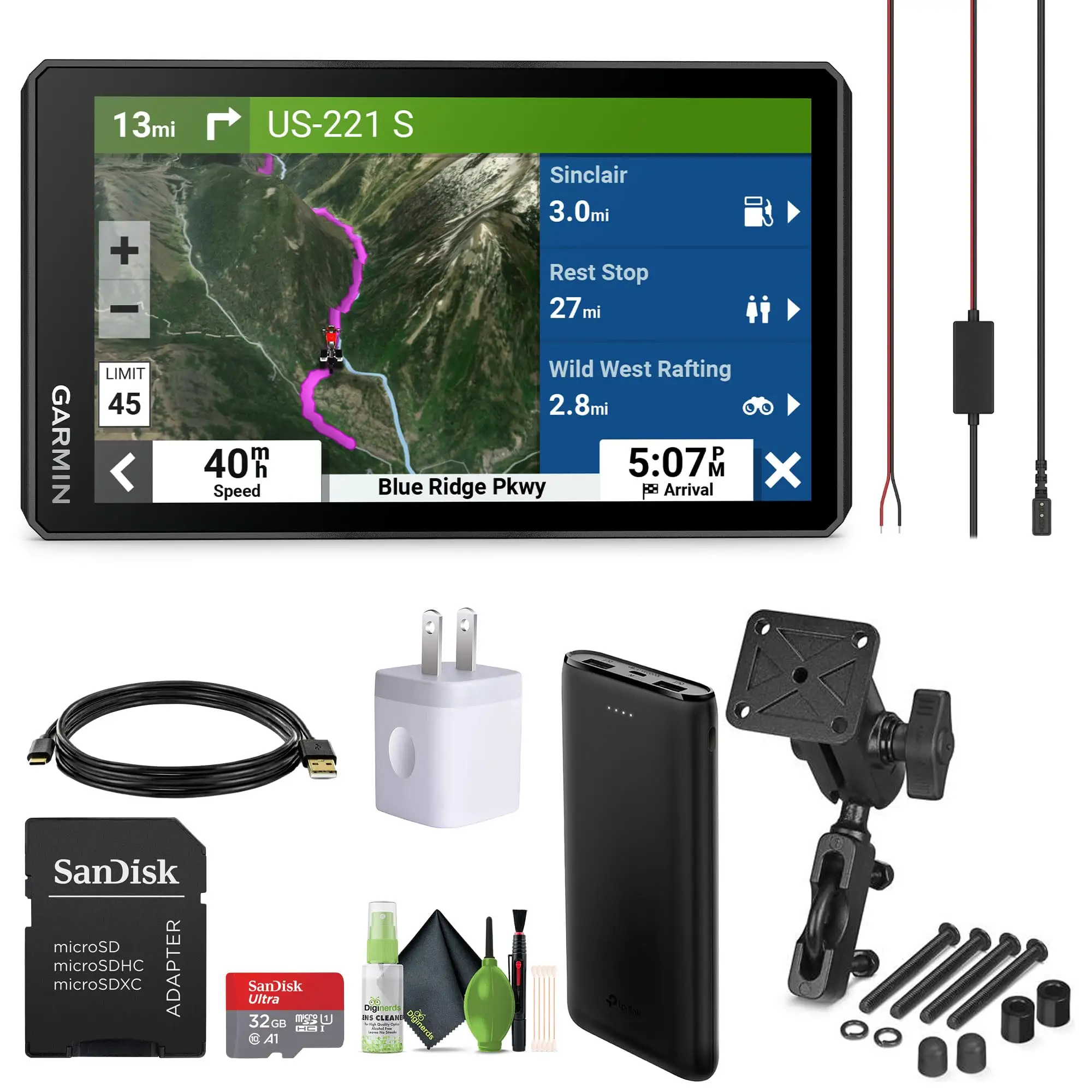
Garmin zūmo XT2 Review: Conditional Buy (8/10)
A “rugged, all-terrain” GPS that one rider called a “life saver” — and another returned after it “stopped working after one ride on a rough road.” That tension defines the Garmin zūmo XT2 All-Terrain Motorcycle Navigator: extremely capable when everything clicks, occasionally maddening when it doesn’t. Verdict: Conditional buy, 8.0/10.
Quick Verdict
Conditional
| What stands out | Evidence from users | Who it impacts most |
|---|---|---|
| Sunlight visibility is a real upgrade | Best Buy reviewers repeatedly call the screen “easy to see in direct daylight” and “fantastic” | ADV riders, touring riders, anyone riding full sun |
| Routing feels fast and feature-rich | Best Buy: “bright screen and fast routing… good upgrade” | Riders doing mixed highway + backroads |
| Bluetooth can be finicky | Best Buy: “lag you get through the bluetooth connection”; Zumo User Forums: “music… becomes garbled” | Helmet headset users, music streamers |
| Mount/power setup isn’t universally loved | Best Buy: “the mount is not the best” | Riders who park in public, theft-conscious commuters |
| Reliability complaints exist under vibration | Best Buy 1-star: “stopped working after one ride on a rough road… kept resetting itself” | Off-road, rough pavement, vibration-heavy bikes |
Claims vs Reality
Garmin positions the Garmin zūmo XT2 All-Terrain Motorcycle Navigator around readability, durability, and connected features. Digging deeper into user reports, the “headline claims” often land—just not for everyone, and sometimes with caveats that only show up once it’s bolted to a vibrating handlebar and paired to multiple Bluetooth devices.
Claim 1: “Ultrabright, sunlight-readable 6-inch display.”
On this point, rider feedback aligns strongly with marketing. A Best Buy reviewer who mounted it on an enduro emphasized real-world glare: “to days full sun was easy to read.” Another rider replacing an older model praised that you “can actually see it in the daylight,” framing the XT2 as a meaningful step up from earlier Zumo units. Even riders who mention other downsides rarely dispute visibility; one summed it up plainly: “screen is easy to see, even in direct sunlight.”
Claim 2: “Built to withstand rain, vibration, and rough terrain (IPX7).”
Here, the story splits. Some riders report exactly what Garmin promises. A Best Buy reviewer described stress tests that sound like marketing copy: “poured rain for half a day no issues… crossed multiple rivers and creeks and no water issues.” But another Best Buy customer reported the opposite kind of “rugged” experience: “worked a few rides, stopped after 1st rough road… kept resetting itself and losing power.” While officially positioned as vibration-ready, at least one user’s experience suggests rough pavement can expose power or stability issues.
Claim 3: “Connected features and Bluetooth convenience.”
Real-world feedback suggests Bluetooth is useful, but not frictionless. A Best Buy reviewer liked the connected cockpit concept—“phone notifications so you can decide if you need to pull over to respond is awesome”—yet still flagged “the lag you get through the bluetooth connection.” On the Zumo User Forums, a rider running a multi-device setup (two XT2 units, Samsung phones, Sena headsets) summarized the theme as: “bluetooth isn’t always your friend,” describing how one unit behaved fine while the other produced “garbled” audio unless phone Bluetooth was turned off.
Cross-Platform Consensus
A recurring pattern emerged across Best Buy reviews and long-form forum posts: riders who already live in Garmin’s ecosystem tend to be delighted with the upgrade, while riders expecting “phone-like” simplicity are more likely to hit frustration points around pairing, routing persistence, or planning workflows.
Universally Praised
The screen is the closest thing to a cross-platform slam dunk. For riders who spend hours staring at a navigation device at 70 mph, visibility isn’t a nice-to-have; it’s safety. A Best Buy reviewer who upgraded from a Zumo 660 wrote that the “screen is easy to see in direct daylight,” and another rider upgrading from a Zumo 396 said the same improvement in even sharper terms: “you can actually see it in the daylight.” For touring riders and commuters, this translates to less squinting, fewer missed turns, and less time with eyes off the road.
Dedicated GPS reliability—at least in terms of “not needing cell service”—also shows up as a recurring real-world win. A Best Buy customer riding in the mountains called it “a life saver… I had no service,” highlighting the core use case of a motorcycle GPS navigator versus Google Maps. Another reviewer framed the value similarly, saying they “prefer the dedicated gps for adv bike,” and emphasized pairing to a Cardo headset so they “can hear it,” pointing to the XT2 as part of a full riding setup rather than a standalone gadget.
Installation and day-to-day usability earn praise when expectations are aligned. A Best Buy reviewer called it “very easy to install” and “works great with gloves,” while another described it as “easy to use, 500 mile off road trip no issues.” For long-distance riders, this isn’t just convenience—it’s fewer fiddly moments at stops, less time troubleshooting, and more time riding.
Common Complaints
Bluetooth issues are the most detailed, most “lived-in” complaints. From Best Buy, one reviewer pointed to “lag… through the bluetooth connection,” suggesting that audio/controls may not feel instantaneous. On the Zumo User Forums, the complaints are more scenario-specific: the rider’s own setup worked, but their wife’s unit experienced audio corruption—“the sound becomes garbled and cannot be recovered unless a full power off and on cycle occurs.” The workaround—turning off the phone’s Bluetooth—helps, but it also undercuts the connected features that many buyers assume will be the default experience.
Route continuity and planning workflow can become pain points, particularly for riders who plan routes carefully and expect the device to “remember” state between stops. A forum user described a recurring annoyance: after shutting down during “stop / fuel break,” “the route needs to be ‘reloaded’ again, rather than picking up where you just stopped.” For touring riders doing long days with frequent fuel and food stops, that’s more than a minor inconvenience—it’s the difference between a smooth day and repeated menu-diving in gloves.
Mount and theft concerns also show up in buyer language. One Best Buy reviewer praised the concept of a purpose-built GPS but bluntly said: “the mount is not the best and i wish it was anti theft or lockable.” That complaint isn’t about navigation accuracy—it’s about real-world ownership: parking at restaurants, hotels, trailheads, and wondering whether the unit will still be there when you come back.
Finally, hardware stability under rough conditions is the harshest negative when it appears. A Best Buy reviewer who returned the unit wrote: “stopped working after one ride on a rough road… kept resetting itself and losing power.” While that’s not the dominant story, it’s a high-severity one for riders who bought the XT2 specifically for rough pavement, ADV, or off-road vibration.
Divisive Features
Being “in Garmin’s ecosystem” is a dividing line. One Best Buy reviewer framed their rating around expectations: “my star rating is based off what garmin said this product does vs what it actually gives… it does everything advertised.” They also warned that if you’re more of a “(google maps, waze) interface kind of person then this isn’t for you.” In other words, riders who like Garmin’s way of doing routes, maps, and apps tend to rate it highly; riders expecting phone-like UX may struggle.
The Tread app and multi-device planning workflow draws both appreciation and friction depending on how you travel. A long-time Garmin user called the companion app “well worth the cost,” using it for “plotting routes easier.” But forum feedback highlights awkward edges—especially for riders trying to replace laptops/tablets with phone-based planning—where interface limitations (like zoom controls in Samsung DeX-like modes) become “another pita.”
Trust & Reliability
The strongest “trust signals” in this dataset come from riders describing real miles and real weather. A Best Buy reviewer reported “500 mile off road trip no issues,” plus direct sun readability, heavy rain, and even water crossings. Those stories align with the rugged branding and will reassure riders who need an all-weather motorcycle GPS navigator.
At the same time, long-form forum feedback shows that reliability isn’t only about surviving rain; it’s about predictable software behavior on long trips. One Zumo User Forums rider described a pattern where shutting down at stops causes routes to be “unloaded,” forcing reloading later. Another rider in that same thread criticized the traffic and POI freshness, saying “the garmin traffic provider is still way below par” and that the “poi motel database is seriously out of date,” to the point they ran “an instance of tom tom go on an old android phone next to the xt 2.” Those aren’t failures of the screen or waterproofing—they’re trust issues in the data and services.
Alternatives
Only a few competitors are directly mentioned in user-provided data. One forum rider effectively uses TomTom GO as a backup when Garmin’s traffic/POI data falls short, describing it running “next to the xt 2” on an old Android phone. For riders who mainly want live services and up-to-date POIs, that behavior suggests a real-world alternative strategy: phone-based navigation for data freshness, dedicated GPS for sunlight readability and offline reliability.
Within Garmin’s own lineup (as mentioned by users), the XT2 is repeatedly framed as an upgrade from earlier Zumos. A verified Best Buy reviewer replaced a “zumo 660” and praised new features and daylight readability. Another rider compared it to the original Zumo XT: “the xt2 is ‘better’… because the screen is bigger… a little brighter… uses usb-c,” suggesting owners of the XT may see the XT2 as an incremental, screen-forward evolution rather than a total reinvention.
Price & Value
At Best Buy, the device is listed at $599.99 with an average rating of 4.4/5 across 17 reviews, positioning the Garmin zūmo XT2 All-Terrain Motorcycle Navigator as premium but still within the “serious rider” band rather than ultra-luxury pricing. On eBay, listings show new units commonly clustered around $599.99–$639.99, suggesting resale demand and a relatively stable market price for a current-gen Garmin motorcycle GPS.
Value depends heavily on whether you’ll actually use the Garmin-specific ecosystem features. One Best Buy reviewer argued the XT2 is a “nice addition” if you’re already in Garmin’s world, but cautioned that “google maps, waze” users may be happier elsewhere. Another rider framed value through wiring and convenience, praising reduced “clutter of the wiring harness” and calling the Tread app workflow “well worth the cost.”
Buying tips drawn from user experience
- Riders running complex Bluetooth setups (phone + headset + music) may want to validate pairing behavior early; a forum user solved garbled audio by disabling phone Bluetooth.
- Theft-conscious riders may want to plan for security; one Best Buy reviewer wished the mount were “anti theft or lockable.”
- If you rely on curated routes, test stop/start behavior on a local ride; a forum rider found routes needed to be “reloaded” after shutdowns.
FAQ
Q: Is the Garmin zūmo XT2 screen actually readable in full sunlight?
A: Yes, multiple Best Buy reviewers explicitly confirm it. A verified Best Buy reviewer said “to days full sun was easy to read,” and another noted the “screen is easy to see in direct daylight.” Across upgrades from older Zumos, daylight visibility is repeatedly described as a major improvement.
Q: Does it hold up in rain and rough riding?
A: Many riders report strong weather performance, including one Best Buy reviewer who said it “poured rain for half a day no issues” and even handled “rivers and creeks.” But one Best Buy customer reported it “stopped working after one ride on a rough road” and kept resetting, so vibration tolerance appears inconsistent.
Q: How is Bluetooth pairing with helmet headsets?
A: It can be great, but it’s not always smooth. A Best Buy reviewer mentioned “lag… through the bluetooth connection,” and a Zumo User Forums rider wrote “bluetooth isn’t always your friend,” describing “garbled” music on one setup unless phone Bluetooth was turned off. Multi-device setups may require troubleshooting.
Q: Is it worth upgrading from an older Zumo (660/396/595/XT)?
A: Many upgraders say yes, mainly for the bigger/brighter display and modern connectivity. A Best Buy reviewer replacing a “zumo 660” said it “works great” and has “lots of features the 660 didn’t have,” and another upgrading from a 396 said the display is “great” and easier to route power due to less bulky wiring.
Final Verdict
Buy if you’re a touring/ADV rider who needs a Garmin zūmo XT2 All-Terrain Motorcycle Navigator for sunlight readability, glove-friendly use, and navigation that doesn’t depend on cell service—especially if you’re already comfortable with Garmin’s ecosystem. Avoid if you’re highly sensitive to Bluetooth quirks or you expect phone-level simplicity without setup time.
Pro tip from the community: A Zumo User Forums rider dealing with audio corruption found that disabling phone Bluetooth prevented “garbled” music when playing from the XT2—an example of how small pairing tweaks can determine whether the experience feels flawless or frustrating.