Garmin DriveSmart 55 EX Review: Conditional Buy (7.6/10)
“Full charge gives me just shy of 1 hour of usage,” one Walmart reviewer wrote—then immediately added it was “not a deal breaker” at the right price. That tension—strong day-to-day navigation benefits paired with a few sharp frustrations—captures the real-world story of the Garmin DriveSmart 55 EX GPS Navigator. Verdict: Conditional buy — 7.6/10 for drivers who want a dedicated screen and offline-friendly routing, especially for road trips and older cars.
Quick Verdict
The Garmin DriveSmart 55 EX GPS Navigator is a Conditional Yes: it’s widely praised for a bright, easy-to-read screen, fast GPS lock, and lane guidance—yet dinged for weak battery life, voice features that disappoint some, and confusion around traffic/update setup.
| Decision | Pros (from users) | Cons (from users) |
|---|---|---|
| Conditional Yes | Bigger screen than a phone | Battery “just shy of 1 hour” |
| Yes (road trips) | Works where cell signal fails | Traffic alerts can feel unreliable |
| Yes (older cars) | Built-in hands-free calling | Bluetooth won’t pair to car audio/headsets |
| Conditional | Fast lock + rerouting | Voice recognition/voice modulation complaints |
| Conditional | Wi‑Fi map updates (no computer) | Some users report update/setup headaches |
Claims vs Reality
Garmin’s marketing positions the Garmin DriveSmart 55 EX GPS Navigator as a “simplify your drive” device with voice help, traffic, and wireless updates. Digging deeper into user reports, the biggest gaps aren’t about basic navigation—it’s about how certain “smart” features behave in the messy real world of heat, signal, and setup friction.
Claim: “Wireless updates… without using a computer.”
On Walmart, multiple buyers echoed that promise in plain language. One Walmart reviewer celebrated that it’s “very easy to use” and “you don't have to use a computer to update… just connect to wi fi and update right from the truck.” That story fits the official pitch: set it up, let Wi‑Fi do the work, keep rolling.
But another Walmart reviewer described an opposite experience—less “no computer,” more “why is this so complicated?” They wrote: “i couldn't get it to update… even though it was connect to my wifi,” and only later realized they “had to get an app on my phone, then register and sync it to the gps.” While the product pages emphasize built-in Wi‑Fi updates, this user’s journey reads like a detour through registration and phone pairing that they didn’t expect or want.
Claim: “Traffic… ready to use right out of the box.”
Traffic is one of the most argued-about parts in the community discussion. On Reddit (Slickdeals thread), Reddit user canti sama pushed back on the idea that the EX variant is “stripped down,” arguing: “the traffic cable is just for units that don't have the receiver built-in. it doesn't make the traffic any better.” Another Reddit user cited Garmin documentation and concluded: “this thing has the traffic receiver built into the unit. you do not need your phone to get traffic.”
Yet real drivers sometimes experienced traffic as weak or inconsistent. A Walmart reviewer said the “traffic cable was almost non-existent” and described a major slowdown that the device didn’t meaningfully warn about: “i did not get any advanced notice of stop and go traffic… it took 50 minutes to go that 10 miles.” While marketing frames traffic as a reliable time-saver, this account suggests it may miss meaningful backups depending on conditions and location.
Claim: “Voice assistant” and hands-free calling.
The promise is convenience—talk to the device, get directions, keep hands on the wheel. Some owners do enjoy the broader “smart” feel. One Walmart reviewer described a modern set of features: “you can add your phone to it, use it as bluetooth to take calls, it has voice command.”
But voice quality and usefulness are inconsistent across reports. On Best Buy, a reviewer praised the hardware—“bright screen, fast gps lock on”—but called out “voice controlled” as part of a “terrible drawback” package, focusing on Bluetooth limitations and support outcomes. Another Best Buy reviewer said the “voice modulation… is bad,” and a different one concluded “voice recognition is almost useless.” The marketing claim isn’t false—voice features exist—but user feedback suggests they don’t always deliver the hands-free polish buyers expect.
Cross-Platform Consensus
A recurring pattern emerged across Walmart, Best Buy, and Reddit: people who want a dedicated GPS love the clarity and predictability of a purpose-built screen—while those comparing it directly to Google Maps sometimes find Garmin’s routing and data less compelling in dense cities.
Universally Praised
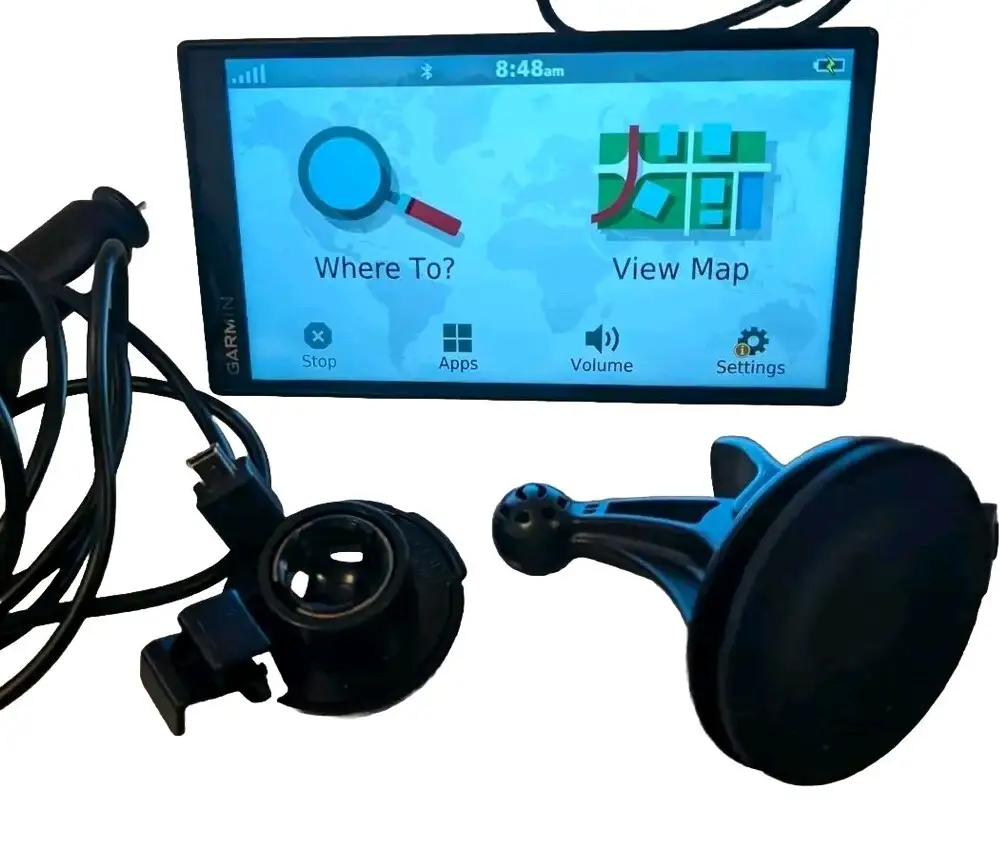
The Garmin DriveSmart 55 EX GPS Navigator earns steady praise for screen readability and general usability—especially from drivers who feel cramped on small phones or want a dashboard-first device. A Walmart reviewer framed it simply: “i have a small phone. so having a bigger screen to see where i'm going is a big help.” They even highlighted the joy of interacting with the map: “you can zoom out, it's very smooth, and you can see the whole globe.”
Long-distance travelers show up repeatedly as the “ideal user.” One Walmart reviewer tied the purchase to poor coverage between states: “cell phone signal isn't the greatest between states,” then praised performance: “the gps is quick and it loads fast.” On Best Buy, a reviewer echoed the offline value proposition with near-policy language: “it doesn't depend on the cellular data network to function and the big screen makes it easy to navigate by a glance.” For road trippers, the implication is clear: fewer dead zones, fewer “No Service” navigation failures.
Lane guidance and early heads-up cues are another frequent win, especially for highway merges and complex junctions. A Walmart reviewer credited it with preventing wrong turns through major corridors: “good lane directions getting on and off us 75 through atlanta…” and added: “i could have gone miles out of the way without the gps.” On Best Buy, another user compared timing directly while running both phone nav and Garmin, saying: “the garmin would give me the lane change… a 1/2 mile before it was needed,” while “the cell phone would respond 10 seconds before it was needed.” For cautious drivers—or anyone who hates sudden lane cutting—those earlier prompts are a concrete quality-of-life benefit.
Summary of top praise:
- Bigger, sharper screen for easier glances
- Fast satellite lock and responsive rerouting
- Strong lane assist and junction guidance
- Road-trip friendly when cell signal drops
Common Complaints
Battery life is the most consistent “yeah, but” across platforms—and it aligns with official specs that list about an hour. One Walmart reviewer who otherwise loved the upgrade wrote: “full charge gives me just shy of 1 hour of usage.” On Reddit, Reddit user bobley was even harsher about real-world battery usefulness in heat: “they all have batteries but they effectively don't work when you leave the gps in your hot car. you're lucky to get 5 mins.” For drivers who expect to pop it off the mount and keep navigating on foot or during long stops, that’s a real mismatch in expectations.
Voice features also draw recurring criticism, not because they’re absent, but because they don’t meet the standard set by smartphone assistants. A Best Buy reviewer called the unit “much technological advanced” yet complained “the voice modulation… is bad.” Another Best Buy reviewer went further: “voice recognition is almost useless.” For buyers who consider voice control a core reason to upgrade, these accounts suggest testing your tolerance early—especially if you’re used to Google Maps voice prompts.
Traffic is a third recurring complaint, especially when drivers expect it to prevent big slowdowns. The Walmart reviewer who got one accident alert but missed a long lane closure summed up the frustration: “this should have been known about, and an alternative given!” Meanwhile, another Walmart reviewer said built-in traffic “seems slow to get running” and the controls were “a bit cryptic,” including needing to “plug in the antenna wire” to configure it. The common theme: traffic can work, but it may require specific setup and still won’t feel as “alive” as phone-based traffic in some regions.
Summary of top complaints:
- Battery life is short, worse in heat
- Voice recognition/modulation disappoints some
- Traffic alerts can be slow, limited, or confusing to set up
- Setup/documentation frustrations (manuals, cards, updates)
Divisive Features
The biggest split is Garmin vs smartphone navigation. On Reddit, Reddit user justin 1983 said: “the smartphone is leagues better… the directions that the garmin would give in los angeles were not good compared to google maps.” They also complained about address accuracy: “garmin address numbering system is completely wrong… it thinks my house is on the other end of the street.” For city drivers in dense metro areas, this story frames the risk: if local map logic is off, the dedicated device can feel behind the phone.
Yet other users are buying Garmin precisely to escape phone dependency. Reddit user tkepongo argued for remote travel: “a dedicated gps is essential since cell coverage is most likely non-existent in those areas.” On Best Buy, a reviewer praised it for not needing cellular data, and Walmart road-trippers echoed the same motivation. The implication is that the “better” tool depends heavily on where and how you drive: urban real-time optimization vs predictable offline-friendly routing.
Another divisive point is Bluetooth expectations. Best Buy reviewers praised pairing with a phone for calling, but one review warns about a major limitation: “not compatible with headsets or car radios,” adding “there is no a2dp protocol.” Garmin’s own Best Buy response reinforced it: “this gps will not pair to the bluetooth in your vehicle… or any type of headset.” If your goal is to pipe navigation audio into a motorcycle headset or car stereo, user feedback suggests this model may disappoint—despite having “Bluetooth.”
Trust & Reliability
The verified-review pattern (Best Buy and Walmart) is less about scams and more about expectation gaps: people assume “Bluetooth” means it will connect to anything, or assume “Wi‑Fi updates” means no phone/app/account steps. When those assumptions break, ratings drop sharply—like the Walmart reviewer who felt misled: “i should not have to have a phone in order for this gps to update.”
Long-term durability stories in the provided Reddit excerpts lean toward heat-related concerns rather than electronics failure over months. Reddit user bobley tied battery usefulness to leaving it in a hot car, saying batteries “effectively don't work” in that scenario. Another Reddit participant in the deal thread warned that some recent Garmin units “are very hot when using” and may shut down to prevent overheating on sunny days. The consistent reliability theme: keep it powered properly and manage windshield heat exposure if you drive in hot climates.
Alternatives
Only competitors mentioned in the data are Google Maps (smartphone navigation) and TomTom (older dedicated GPS). The feedback paints clear lanes for each.
If you’re choosing between the Garmin DriveSmart 55 EX GPS Navigator and Google Maps, the trade is real-time intelligence versus early, glanceable guidance and reduced cell dependence. Reddit user justin 1983 favored the phone: “smartphone is leagues better” and “voice instruction of google maps is a lot better.” But a Best Buy reviewer valued Garmin’s earlier lane prompts, saying it gave lane guidance “a 1/2 mile before it was needed” compared to the phone’s last-second timing.
Against TomTom, the Best Buy reviews often frame Garmin as an upgrade. One reviewer replaced a TomTom that failed dramatically: their TomTom “separated from it's magnetic base… ended up in pieces,” and they called Garmin “far superior.” Another shopper bluntly summarized their motivation: “needed new gps as tomtom is dumb, not smart,” praising Garmin’s better graphics and “especially traffic without having to use an app.”
Price & Value
Price sensitivity shows up constantly, and it changes the tone of the reviews. In the Reddit deal thread, the $99 sale is treated as a tipping point, with Reddit user justin 1983 saying: “$ 99 really pushes it” into competition with other solutions, even suggesting used devices can be much cheaper. Yet that same user’s “dad” experience was positive at the deal price: “really nothing to complain about at $ 100,” praising “routing / rerouting faster” and “nice screen and speakers.”
Walmart reviewers also anchor satisfaction to pricing. The battery-criticism reviewer still concluded it was “well worth it at that price.” On the resale side, eBay listings in the data show used pricing often far below new—one example lists $69.99 + shipping for a used unit, while another listing advertises $99.00 + $1.99 shipping. For buyers worried about theft or breakage, Reddit user justin 1983 even suggested the economics of buying used GPS units: “if they get stolen or breaks, you can buy 2-3 for the price of 1 new one.”
Buying tips reflected in community chatter:
- Deal hunters treat ~$99 as “sweet spot” pricing
- Used-market pricing can be significantly lower (eBay listings vary)
- Heat management matters if windshield-mounted in sun

FAQ
Q: Does the Garmin DriveSmart 55 EX work well for road trips with poor cell service?
A: Yes—many reviewers buy it for that exact reason. A Walmart reviewer said “cell phone signal isn't the greatest between states” and praised that “the gps is quick and it loads fast.” Best Buy reviewers also liked that it “doesn't depend on the cellular data network.”
Q: How is the battery life in real use?
A: Expect roughly an hour or less. A Walmart reviewer wrote that a “full charge gives me just shy of 1 hour of usage,” and Reddit user bobley warned batteries can feel unusable after being left in a hot car: “you're lucky to get 5 mins.”
Q: Is traffic actually useful without a smartphone?
A: Sometimes, but experiences vary. Some Reddit users argue traffic works without the phone when powered correctly, while a Walmart reviewer said the “traffic cable was almost non-existent” and described missing major stop-and-go traffic. Setup and local coverage seem to affect results.
Q: Does Bluetooth let you play navigation audio through your car stereo or headset?
A: No, according to Best Buy feedback. One Best Buy reviewer warned it’s “not compatible with headsets or car radios,” and Garmin’s Best Buy product expert replied that it “will not pair to the bluetooth in your vehicle… or any type of headset.”
Q: Is it easier than using Google Maps?
A: It depends on what “easy” means to you. A Best Buy reviewer liked earlier lane warnings (“a 1/2 mile before it was needed”), while Reddit user justin 1983 said “the smartphone is leagues better” in Los Angeles and found Google’s voice instructions “a lot better.”
Final Verdict
Buy the Garmin DriveSmart 55 EX GPS Navigator if you’re a road-tripper, rural driver, or older-car owner who wants a bigger dedicated screen, early lane guidance, and navigation that doesn’t fall apart when cell service drops. Avoid it if you expect Google Maps-level city routing, best-in-class voice control, or Bluetooth audio to your car stereo/headset.
Pro tip from the community: if you rely on traffic features, keep it powered with the proper vehicle cable—multiple discussions revolve around traffic and power/antenna requirements, and one Best Buy reviewer advised: “be sure to use the car charger designed for this unit.”