Escort MAX 360c Review: Worth It? Conditional Buy (8.1/10)
A “quiet ride” is the promise—yet one Best Buy reviewer still called it “overpriced” with “lots of false alarms.” That tension sits at the center of the Escort MAX 360c Laser Radar Detector story: elite features and directional arrows that impress many owners, paired with app frustrations and cost skepticism. Verdict: Conditional buy — 8.1/10.
Quick Verdict
For drivers who want directional arrows, strong range, and GPS-based lockouts, Escort MAX 360c Laser Radar Detector gets frequent praise as a “top of the line” tool that “has saved me more times than I can count.” But if you’re buying primarily for app-connected features, multiple reviewers warn the phone experience can be unreliable.
| Call | Evidence from users | Who it’s for |
|---|---|---|
| Yes (conditional) | Best Buy reviewer: “best radar detectors on the market… saved me more times than i can count.” | Daily highway commuters, enthusiasts |
| Strong range | Best Buy reviewer: “detects from far range.” | Long-distance drivers |
| Useful arrows | Best Buy reviewer: “alerts you… with an arrow pointing in the direction.” | Drivers in complex city radar environments |
| App can be a deal-breaker | Best Buy reviewer: “bad smart app link… constantly lose communication… returned.” | App-dependent users |
| Price sting | Best Buy reviewer: “very expensive product.” | Budget shoppers may balk |
| False alerts still exist | Best Buy reviewer: “lots of false alarms.” TechGearLab: “not void of false alerts.” | Urban drivers near BSM-heavy traffic |
Claims vs Reality
Escort’s marketing leans hard on “360° directional awareness” and a quieter, smarter drive through AutoLearn/filters. Digging deeper into user feedback, the arrows and general detection competence show up repeatedly as a real-world win—especially for people upgrading from older detectors. A Best Buy reviewer described it as “best in class,” adding it “has saved me more times than i can count.” Another called it “perfect” and said it “does exactly what i bought it for.”
But the “quieter drive” narrative isn’t universal. TechGearLab’s review still flags the device as “not void of false alerts,” and a Best Buy reviewer went further: “very expensive product, lots of false alarms.” RadarTest also points out a specific cause: the unit’s strong K-band sensitivity “can sometimes work against the max 360c, making it more sensitive to blind spot monitoring (bsm),” to the point where “drivers may want to consider shutting off k band to kill the din.” That’s a meaningful gap between “smart filtering” and what some owners experience in modern traffic.
Escort also positions connectivity (app/community alerts and updates) as a major value driver. Yet some of the sharpest dissatisfaction comes from people who expected the connected features to “just work.” One Best Buy reviewer wrote: “great radar detector! bad smart app link… they contantly lose communication… i ended up returning this item.” Automoblog similarly describes the Escort Live experience as useful “in theory,” but says “customer reviews of the escort live app are mixed at best.” In other words: as a standalone detector, many users sound happy; as a connected ecosystem, reliability is contested.
Cross-Platform Consensus
Universally Praised
Directional awareness is where Escort MAX 360c Laser Radar Detector earns its reputation. RadarTest describes how the arrows “are generally accurate,” with a common pattern: “when approaching a radar the front spots it… once passed the rear arrow lights up.” For drivers who struggle to interpret “is it ahead or behind?” this is framed as real practical clarity, especially in town where RadarTest found it “more accurate” than a competing detector in how it groups threats.
Range gets repeated applause, often in “it saved me” stories. On Best Buy, one owner wrote: “great radar detector with amazing range highly recommended.” Another framed the benefit in daily-ticket-avoidance terms: “works really well. has saved me from at least 4 citations.” Even when users don’t quantify miles or feet, the story stays consistent: earlier warning equals time to react, which is exactly why many buy a premium detector.
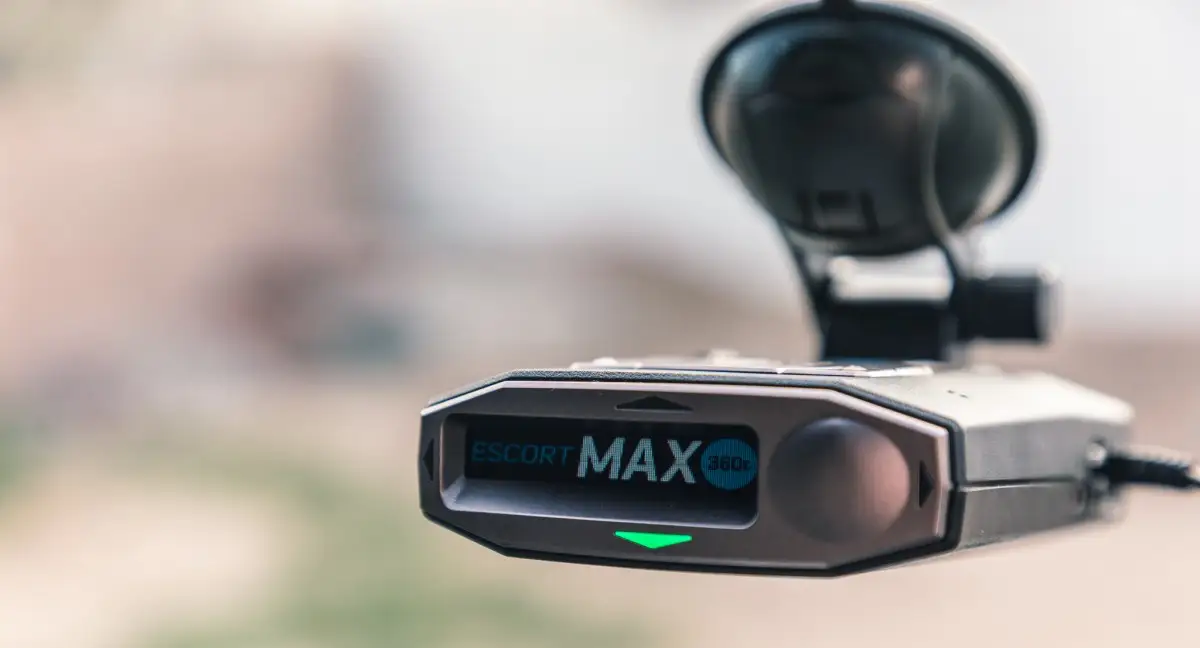
The mount and day-to-day usability also show up as steady positives across review-style sources. RadarTest highlights the “magnetic windshield mount” as “effortless,” and TechGearLab echoes the appeal of a magnetic mount that makes it easier to remove an expensive unit when parked. For drivers who take the device down frequently (theft avoidance, swapping vehicles), this small hardware choice becomes a recurring quality-of-life advantage.
Finally, the “learning” and lockout concept resonates with people who drive the same routes. A Best Buy reviewer described a tangible change over time: “detector has learned repeat signals along my normal routes and my ride is much quieter.” That’s the ideal AutoLearn story—fewer repeated nuisance alerts once the device recognizes the pattern.
Common Complaints
Price is the complaint that never fully disappears. Even satisfied users mention the cost indirectly (“worth it,” “investment”), while unhappy buyers say it plainly. A Best Buy reviewer’s headline is simply: “overpriced,” followed by “very expensive product.” TechGearLab frames the same theme more analytically: you’re “paying for the features,” and for some people, it’s fair to ask what you’re really using if you turn extras off.
False alerts—especially in modern traffic—are the second recurring pain point. RadarTest warns that strong K-band sensitivity can amplify “blind spot monitoring (bsm)” noise. TechGearLab agrees the unit “does tend to throw some false alerts.” That matters most for urban commuters driving near dense late-model traffic, where BSM systems are constant and the signal environment is messy.
The connected experience can be frustrating enough to trigger returns. One Best Buy reviewer praised the standalone detector but still returned it: “excellent as a stand-alone radar detector… unfortunately… the smart-phone app leave a lot to be desired… constantly lose communication… i ended up returning.” Automoblog adds that the app sentiment is “mixed,” reinforcing the idea that connectivity isn’t guaranteed to feel premium even when the hardware is.
There are also hints (though fewer) about hardware issues. One Best Buy reviewer noted: “having to exchange it because of a power issue,” though they still said “i love it” after replacement. That kind of story suggests most buyers won’t see failures, but when they do, it’s memorable because of the price tier.
Divisive Features
Auto lockouts and community-driven filtering are powerful—yet not everyone trusts them. TechGearLab highlights a downside: locations can become “permanently muted” after repeated false-alert learning, which “poses a problem if a police officer with a k-band radar gun decides to clock people in that same location.” For power users, that’s a philosophical divide: fewer alerts vs. fear of muting a real threat.
Connectivity itself is another split. Some owners are happy with app-based control—Best Buy: “the app works great so you can set it up to how you want it to work.” Others describe the exact opposite, with repeated re-pairing and lost communication. That means buyers who want CarPlay/Android Auto-style integration and “set-and-forget” stability may feel the most polarized depending on their phone, settings, and tolerance for troubleshooting.
Trust & Reliability
The provided Trustpilot slot doesn’t contain verified Trustpilot user feedback; the only “Trustpilot” content shown repeats an editorial-style RadarTest write-up rather than user posts. So the clearest trust signals here come from retailer reviews and repeated ownership claims.
On long-term confidence, several Best Buy reviewers lean on brand history as a proxy for reliability. One writes: “I have owned escort detectors since early 90's and this model continues to deliver excellent results.” Another says, “my last one was fantastic and the one before that was fantastic.” Those aren’t durability lab results, but they are real buyer narratives suggesting repeat purchasing and perceived consistency over years.
At the same time, the few failure notes (like the Best Buy “power issue” exchange) highlight the reality of buying expensive electronics: even a small defect can feel bigger at this price. Escort’s visible engagement in Best Buy replies (support phone number, troubleshooting suggestions) also shapes perceived trust for some shoppers, though it doesn’t replace user reliability data.
Alternatives
Only a few competitors are explicitly mentioned in the data, and they come up in telling ways. A Best Buy reviewer who liked the MAX line still said: “i actually upgraded to the redline and its quite a bit better in terms of long-range detection.” That positions Escort’s own Redline 360c as the “if you want more range” step-up, especially for highway-heavy drivers.
Automoblog proposes value alternatives for people who don’t need every connected feature: it suggests the Uniden R3 or Uniden R4, stating they offer “good long-range detection and solid false filtering for less,” while acknowledging they don’t match the MAX 360c’s full capability set. For buyers focused on bang-for-buck rather than a feature-maxed ecosystem, that’s the clearest “consider this instead” signal in the provided sources.
RadarTest also mentions Valentine One as a comparison point, noting it can report many threats at once, while they found the MAX 360c “more accurate” in how it interprets and reports a single source in town. That implies a user-type split: those who want maximal raw reporting vs. those who want calmer, clearer interpretation.
Price & Value
Current pricing signals vary by model and market, but “expensive” is a constant theme. The Amazon listing shown is for the MAXcam 360c bundle at $749.95 (with additional shipping/import fees in the excerpt), reinforcing that Escort’s top-tier ecosystem sits in premium territory. Even for the MAX 360c family, TechGearLab repeatedly frames it as an “investment,” and Best Buy reviewers call it “very expensive” or “overpriced.”
Resale data from eBay shows meaningful secondary-market demand: used/certified-refurb units frequently appear in the $300–$500 range (examples shown include ~$329.99 used and ~$449.99 certified refurbished, among many listings). That gap suggests a common community “buying tip” pattern: shoppers who want the device but can’t justify MSRP often look to refurbished or used listings to soften the price hit.
The value case depends on what you actually use. If you’re buying for “directional arrows,” range, and quieter commuting through learned lockouts, multiple owners imply it “pays for itself” in avoided tickets: Best Buy reviewer: “has saved me from at least 4 citations.” But if you’re paying mainly for connected features and the app experience becomes a hassle, the premium can feel wasted—Best Buy reviewer: “returned this item due to this inconvenience.”
FAQ
Q: Does the Escort MAX 360c really reduce false alerts?
A: It can, but results vary. A Best Buy reviewer said it “has learned repeat signals… and my ride is much quieter,” while another complained of “lots of false alarms.” RadarTest also warns strong K-band sensitivity can trigger blind-spot-monitoring noise.
Q: Is the Escort app/phone connection reliable?
A: Not consistently, based on the provided reviews. One Best Buy reviewer wrote: “bad smart app link… constantly lose communication… i ended up returning,” while another said “the app works great” for customizing settings. Expect mixed experiences.
Q: Are the directional arrows actually useful in real driving?
A: Many sources say yes. RadarTest reports the arrows are “generally accurate,” flipping from front to rear as you pass a radar source. A Best Buy reviewer also highlighted it “alerts you… with an arrow pointing in the direction,” which helps identify where the threat is.
Q: Is the MAX 360c worth the price?
A: It depends on your use case. Enthusiasts describe it as “top of the line” and say it has “saved me more times than i can count,” but others call it “overpriced.” If you won’t use the connected features, Automoblog suggests cheaper options like Uniden R3/R4.
Q: What’s a realistic upgrade path if I want more range?
A: Some owners move within Escort’s lineup. A Best Buy reviewer said they “upgraded to the redline” and it’s “quite a bit better in terms of long-range detection.” That implies Redline 360c is a common “more range” alternative mentioned in the data.
Final Verdict
Buy the Escort MAX 360c Laser Radar Detector if you’re an enthusiast or frequent highway driver who values directional arrows and long-range warning—and you’re comfortable treating app features as a bonus, not the core reason to purchase. Avoid it if you’re price-sensitive or you specifically want a flawless phone-app connection, because multiple users describe repeated disconnects and even returns. Pro tip from the community: if the MSRP stings, eBay listings show a lively used/refurb market that can bring the cost down while keeping the core hardware experience.