Energizer Recharge Universal Charger Review: Worth It? 8.2/10
A one-star rant calling it “useless product with terrible flaws for 2018” sits in the same ecosystem as thousands of largely positive ratings—and that whiplash pretty much defines the Energizer Recharge Universal Charger. Verdict: strong everyday convenience with some dated design gripes and slow-charge frustrations for certain battery types. Score: 8.2/10
Quick Verdict
Conditional — Yes, if you want one charger for multiple NiMH sizes and can live with imperfect indicators and slower charges on bigger cells/9V. No, if you need independent channels for single AA/AAA or clear per-battery status.
| What matters | What people liked | What people didn’t | Best for |
|---|---|---|---|
| Multi-size support | “works great for varieties of batteries” (Best Buy) | Some models require AA/AAA “recharged in pairs” (LDLC; Amazon) | Homes with mixed devices |
| Charging speed | “charges batteries quickly… in a few hours” (Best Buy) | “17 plus hours slow… any battery” (Amazon) | Moderate, not urgent needs |
| Status/indicator clarity | “led… status of the charging state” (Best Buy) | “doesn’t have any indication light” / “light colors mean” unclear (Best Buy) | Users who can follow a timer |
| Build/fit | “works as expected” (Best Buy) | “springs are not as tight” / “flimsy plastic” (Best Buy) | Light household rotation |
| Reliability & savings | “saves a ton of money” (Best Buy) | “terminals corrode” (Best Buy) | Frequent battery users |
Claims vs Reality
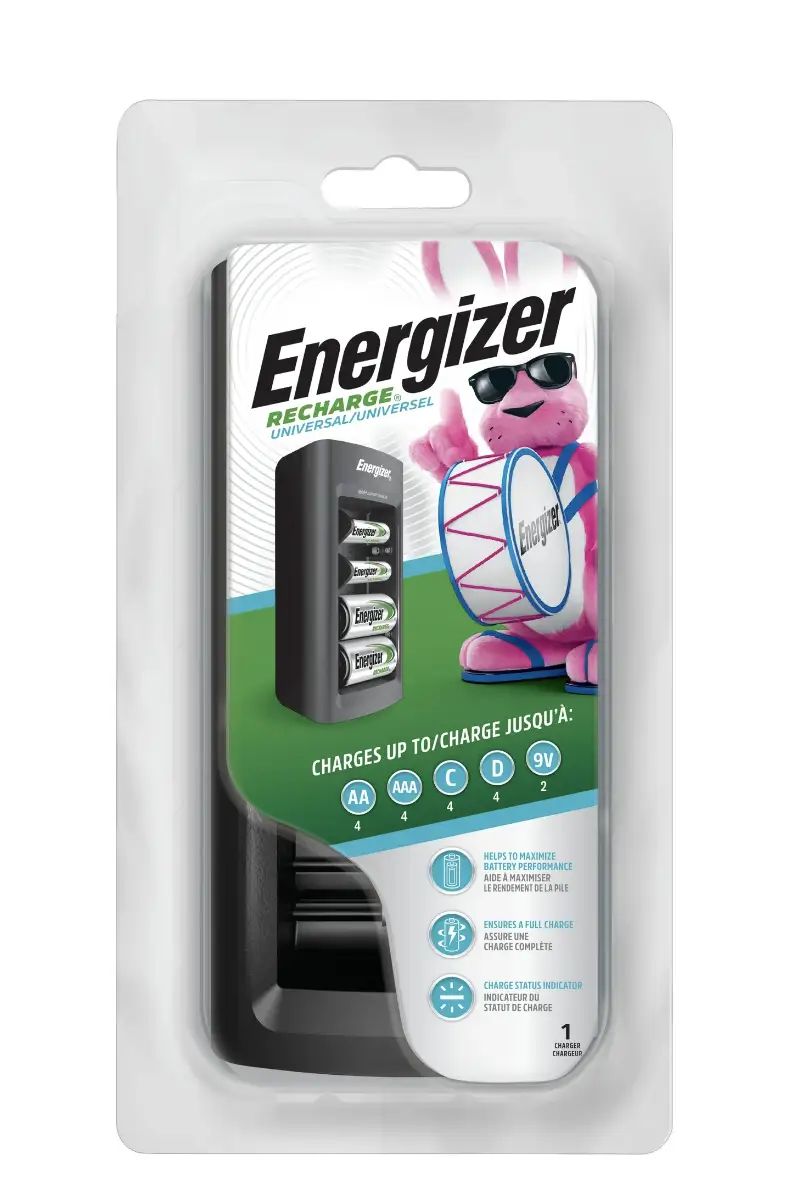
Claim 1: “Charges all standard rechargeable battery sizes… AAA to 9V.”
Marketing positions Energizer Recharge Universal Charger as the one-device solution, and a recurring pattern emerged across retailer reviews: people bought it specifically to stop juggling chargers. A Best Buy reviewer framed it simply: “has ability to charge multiple sizes of batteries,” while another called it “very useful all in one charger” for “varieties of batteries.”
Digging deeper into user reports, the “universal” promise lands—but not always with the flexibility some expect. On LDLC, a customer complaint was blunt: “AA/AAA batteries have to be recharged in pairs… this charger is not suitable for my purposes!” An Amazon reviewer echoed the limitation: “you must… must have a pair of batteries to charge. it will not charge single cells.” For someone with a headset that takes three AAA batteries or a lone AA in a mouse, that “universal” label can feel conditional.
Claim 2: “LED status indicator updates you in real time when charging is complete.”
Official Amazon specs highlight an “LED light bar status indicator,” implying clarity. Yet multiple Best Buy buyers describe the opposite experience on certain variants: “it doesn't have any indication light to tell you when it's done charging,” and “needs to have an indicator light to let you know when the battery is fully charged.” Another reviewer complained that the “notification light is not clear… and I did not see instructions telling me what the light colors mean.”
While marketing suggests a real-time status readout, the data suggests that indicator behavior varies by model/version and that some users fall back to manual timing. One person summed up the workaround: “you can go by the hours as described in the user’s guide” (Best Buy).
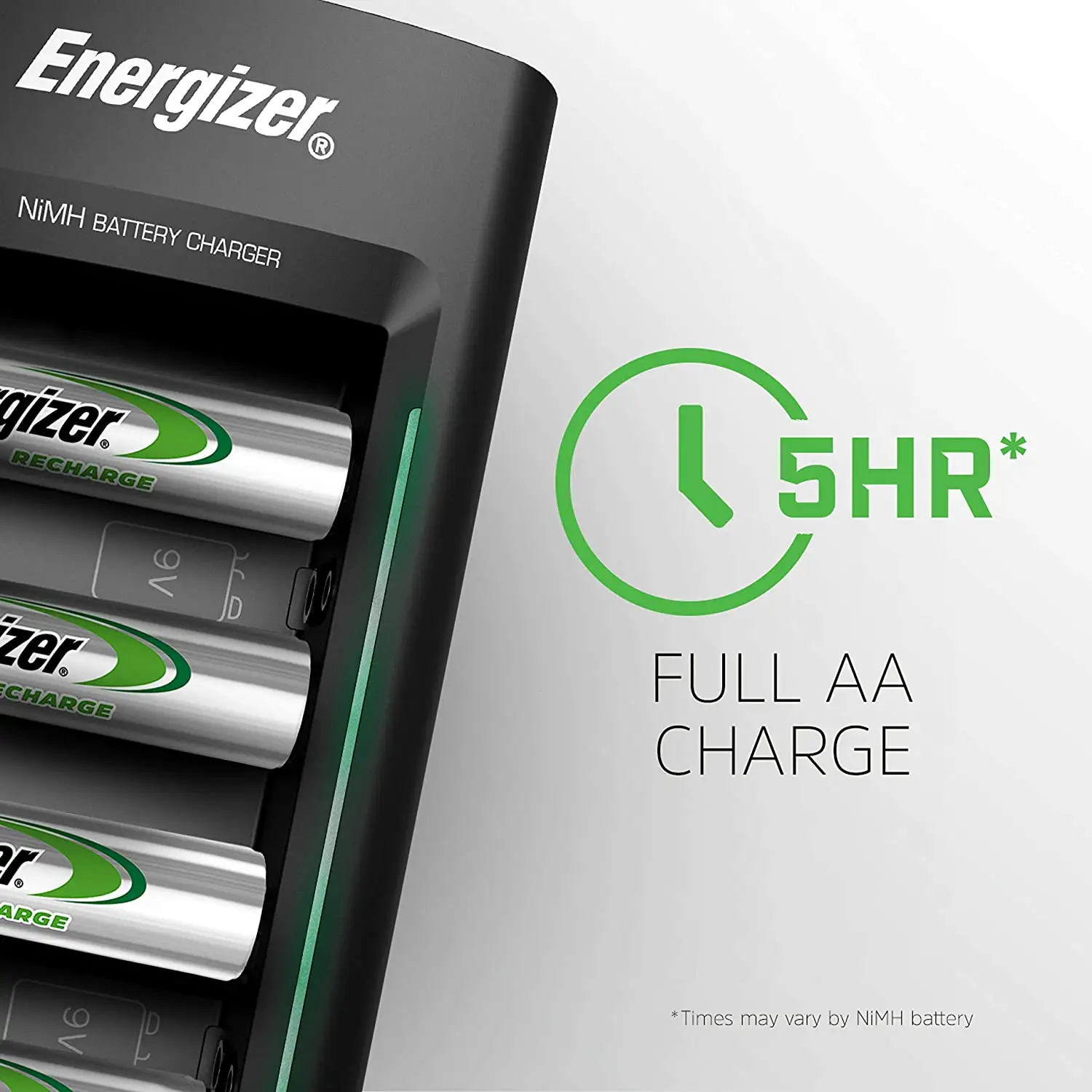
Claim 3: “Full-capacity charge to 4 AA batteries in 5 hours.”
Amazon’s listing emphasizes speed for common AA loads. Some buyers do mirror that experience, describing it as fast enough for everyday use. A Best Buy review praised: “charges batteries quickly, from no charge to full in a few hours,” and another said it “charges quickly” and “does the job.”
But the gap shows up when users shift to 9V, C, or D cells—or when expectations are set by faster chargers. An Amazon review complained the charger is “17 plus hours slow,” while another said 9V took “10-13 hours.” A Best Buy reviewer with kids expecting instant toy power wrote it “doesnt charge them in a timely manner espically… with young kids wanting to play.” For parents, church tech volunteers, or anyone rotating many batteries, speed becomes the dividing line between “convenient” and “too slow.”
Cross-Platform Consensus
Universally Praised
The most consistent praise is about household practicality: one device, lots of battery sizes, less shopping for disposables. That theme shows up in plain-spoken, lived-in contexts—work flashlights, kids’ toys, church microphones. A Best Buy customer said, “this keeps all of the main battery type devices fully charged… replacement always on stand by,” while another celebrated the lifestyle shift: “saved so much money using rechargeable batteries. won't ever use regular again.”
For frequent battery users, the charger becomes a “routine” tool rather than a gadget. A Best Buy reviewer using a flashlight daily wrote: “works well for my needs… come in handy.” Another buyer tied it directly to religious events: “this charge has made my life easier at church. the microphone will always be ready.” The implication is clear: if you’re the person responsible for keeping devices running—mics, flashlights, controllers—“universal” convenience can matter more than shaving off an hour.
Users also repeatedly frame it as a sensible investment. One Best Buy review described it as “great product if you reuse batteries over and over again… saves a lot of money.” Another called it “good quality… good investment.” Even when they’re not gushing about features, people like that it simply turns rechargeable batteries into a predictable household resource.
After those stories, the praise clusters into a few recurring positives:
- Versatility: “works great for varieties of batteries” (Best Buy)
- Savings: “saves a ton of money” (Best Buy)
- Straightforward function: “works as expected” (Best Buy)
Common Complaints
The most frequent frustration is the lack of clear, satisfying feedback while charging—especially for people who expect per-battery status. Digging deeper into user reports, the annoyance isn’t that charging fails; it’s that users don’t trust what the charger is telling them. One Best Buy reviewer said, “it doesn't have any indication light to tell you when it's done charging,” and another insisted it “needs to have an indicator light.” A separate review complained the “notification light is not clear,” leaving them to guess.
Battery fit and physical design also generate low-grade irritation. A Best Buy buyer noted “odd battery placement” and said the AA “racks” didn’t feel “snug enough,” while another wrote, “the springs are not as tight as i would wish.” For someone cycling batteries daily—parents with baby gear, workers with meters—small contact issues can feel like reliability risks, even if the batteries ultimately charge.
Then there’s the speed debate, where expectations collide with real-world patience. An Amazon reviewer trashed the pace: “not kinda slow. i mean 17 plus hours slow.” Another called out 9V times: “10-13 hours.” Best Buy users sometimes split the difference, describing it as “charges batteries relatively fast,” but the complaints show up most for larger batteries and time-sensitive households.
Common pain points, in reviewers’ own words:
- Indicator confusion: “light colors mean” unclear (Best Buy)
- Fit/contacts: “springs are not as tight” (Best Buy)
- Slow charging: “17 plus hours slow” (Amazon)
Divisive Features
Size and portability are polarizing. Some customers describe it as easy to store—“handy and small enough to store easily” (Best Buy)—while others call it “a little bulky” or say they “did expect the unit to be a little smaller” (Best Buy). The same physical footprint reads as “compact” if you’re replacing a larger station, and “bulky” if you expected a travel charger.
Charging speed is similarly split by use case and what batteries people prioritize. A Best Buy reviewer praised that it charges “in a few hours,” but another said it’s not timely for “9 v, d and c” when kids want toys “asap.” For someone charging AA batteries for remotes, it can feel fast; for someone feeding D cells into flashlights or toys, it can feel slow.
Trust & Reliability
A recurring pattern emerged around “trust” being less about scams and more about longevity and build quality: buyers worry whether the device will last years or degrade quickly. One Best Buy reviewer said they “always buy a few of these, because they last,” suggesting repeat purchases based on durability. But the harshest critique went straight at materials and corrosion risk: “terminals corrode” and “sort of flimsy plastic” (Best Buy). That kind of complaint typically shows up when users compare it to older hardware they remember as sturdier.
Digging deeper into long-term expectations, some shoppers explicitly prefer slower chargers because they fear heat from fast chargers. A Best Buy review contrasted it with a “15-minute charger” they avoid because “batteries get really hot,” adding that batteries “stay relatively cool in this charger.” While that’s not a “6 months later” Reddit durability post, it reveals a reliability mindset: some users equate slower, cooler charging with battery longevity and safer operation.
Alternatives
Only a few competitors are explicitly mentioned in the provided data, but they’re telling. In the Reddit thread about an Energizer inductive phone charger, the poster compared pricing against “tylt” and “the official orb,” deciding to avoid them due to cost. That conversation isn’t about AA batteries, but it shows how Energizer buyers often approach charging gear: price-sensitive, wary of premium branding, and looking for “good enough” reliability.
Within Energizer’s own ecosystem, Amazon also lists an “Energizer Recharge, Basic Charger,” described with longer “7-13 hours” charge times. For buyers deciding between models, user stories suggest paying for the more capable “universal” unit makes sense if you need 9V/C/D support, while a basic charger might fit someone who only cycles AA/AAA overnight.
Price & Value
On Amazon, the Energizer Recharge Universal Charger listing shows a discounted price around $34.19 from a higher list price, alongside a large review base (6,400+ reviews) and a 4.3/5 rating. Meanwhile, Best Buy reviews repeatedly mention clearance pricing like $12.99, shaping the value narrative: at clearance, even mild annoyances feel forgivable; at full price, people scrutinize indicators, fit, and speed.
Resale listings on eBay show a wide spread—from single-digit untested chargers to brand-new units priced closer to retail. The takeaway from market pricing is that these chargers circulate heavily: they’re common enough to be found used, and buyers can often reduce cost by shopping pre-owned if they’re comfortable with “tested” vs “untested” uncertainty.
Buying tips implied by user feedback:
- If you need 9V charging, multiple buyers bought this specifically “needed this for 9v” (Best Buy).
- If you require charging single AA/AAA cells, multiple users warn it may require pairs: “have to be recharged in pairs” (LDLC; Amazon).
- If indicator clarity matters, look closely at the model/version: some say “status… is very nice,” others say “no indication light” (Best Buy).
FAQ
Q: Does the Energizer Recharge Universal Charger charge AA, AAA, C, D, and 9V batteries?
A: Yes—buyers and the official listing both describe it as a multi-size NiMH charger, including AA/AAA/C/D and 9V. Best Buy reviewers praised that it “has ability to charge multiple sizes of batteries,” while others bought it because they “needed this for 9v.”
Q: Can it charge just one AA or one AAA battery at a time?
A: Not always. Multiple users report AA/AAA charging requires pairs. An LDLC customer wrote, “AA/AAA batteries have to be recharged in pairs,” and an Amazon reviewer said it “will not charge single cells.” If you often charge odd numbers, this can be a dealbreaker.
Q: How fast does it charge in real life?
A: Experiences vary by battery type and expectations. Some Best Buy reviewers said it charges “from no charge to full in a few hours,” while Amazon reviewers complained it can be “17 plus hours slow.” For 9V, one Amazon review cited “10-13 hours.”
Q: Does it clearly tell you when charging is done?
A: That’s inconsistent across user reports. Amazon marketing highlights an LED status indicator, but some Best Buy customers said it “doesn't have any indication light to tell you when it's done charging,” and others found the “notification light… not clear.” Several people rely on timing.
Q: Is it bulky or compact?
A: Both descriptions appear. One Best Buy reviewer liked that it was “small enough to store easily,” while others called it “a little bulky” or expected it to be smaller. Whether it feels compact seems tied to what charger you’re upgrading from and where you plan to store it.
Final Verdict
Buy if you’re a frequent battery household—parents cycling toy batteries, church AV volunteers keeping cordless mics ready, or anyone who wants one charger for AA/AAA/C/D/9V and values savings over perfect UI. Avoid if you need true independent channels for single AA/AAA cells or demand crystal-clear per-battery status lights.
Pro tip from the community: if the indicators don’t inspire confidence, follow the manual’s timing guidance—one Best Buy reviewer put it plainly: “you can go by the hours as described in the user’s guide.”