DEERC D20 Mini Drone Review: Conditional Buy (7/10)
A drone that’s marketed as “up to 20 minutes” can, in some households, feel like a five-minute novelty. DEERC D20 Mini Drone with Camera for Kids (Blue) lands as a fun, durable starter toy with real frustrations around app stability, range, and battery consistency. Verdict: Conditional buy — 7/10.
Quick Verdict
DEERC D20 Mini Drone with Camera for Kids (Blue): Conditional (best for indoor learning and calm-weather backyard flights; not for serious FPV or reliable outdoor range).
| What the data suggests | Evidence from user feedback | Who it affects most |
|---|---|---|
| Surprisingly crash-tough | A verified buyer on Amazon wrote it “survived several crashes admirably (even a 20-foot drop to pavement).” | Kids, first-time pilots |
| Battery time often below “up to 20 min” | A verified buyer on Amazon downgraded after “less than 5 minutes per charge.” Another reported “5–7 minutes” depending on flips/speed. | Anyone expecting long sessions |
| Indoor > outdoor performance | A verified buyer on Amazon said it “worked far better indoors than outdoors.” | New pilots, windy areas |
| App/FPV experience can be frustrating | A verified buyer on Amazon called the app “the worst drone app I’ve ever used” and reported it “crashes constantly.” | Buyers wanting phone FPV/camera |
| Good beginner features (when stable) | A verified buyer on Amazon: “all functions…headless mode, and one touch take off/land have functioned perfectly.” | Beginners learning controls |
Claims vs Reality
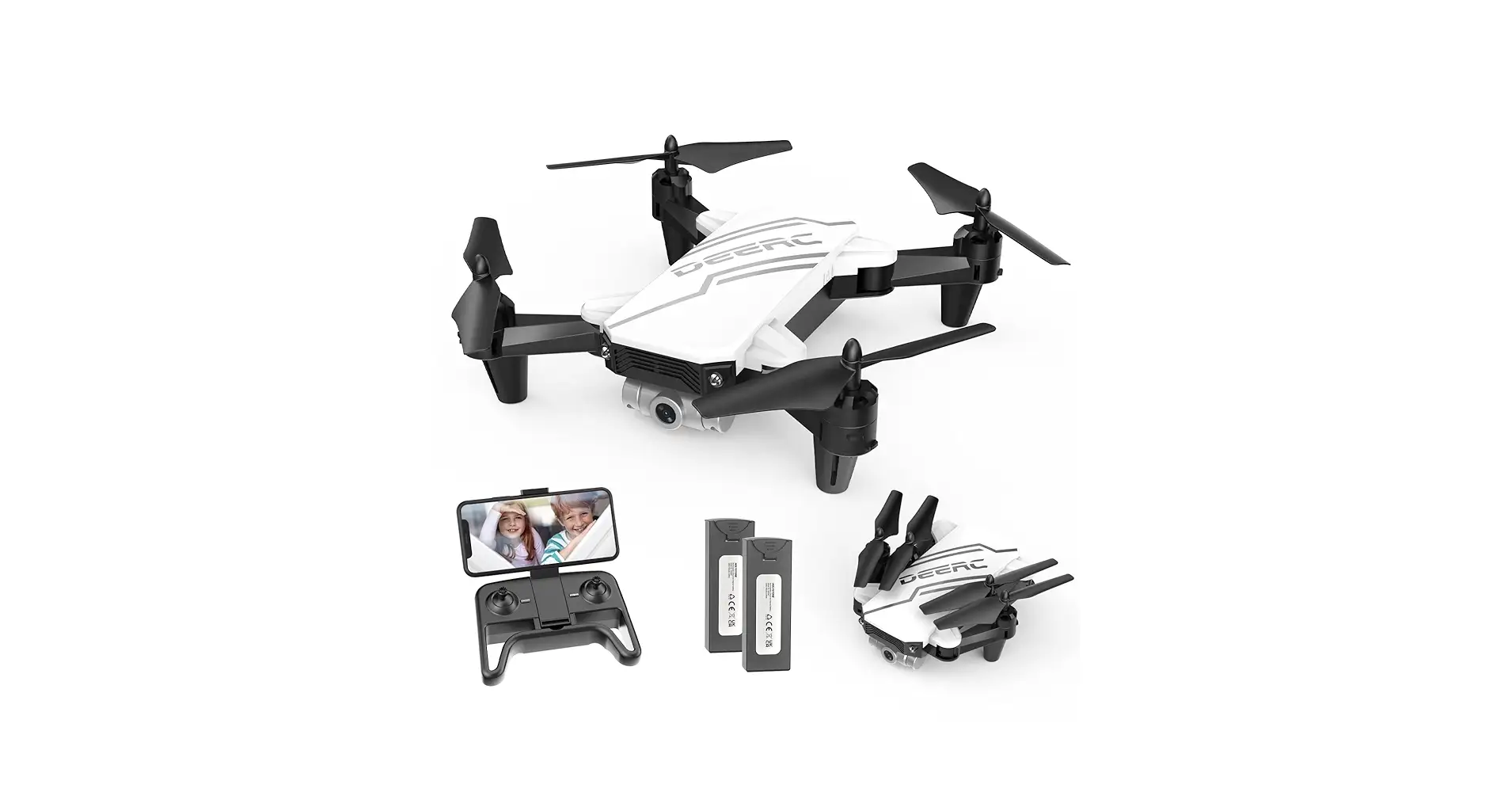
Marketing materials for DEERC D20 Mini Drone with Camera for Kids (Blue) emphasize a “720p HD FPV camera,” “voice control,” and “up to 20 minutes” with two batteries. Digging deeper into user reports, the lived experience splits into two camps: people treating it as a resilient indoor trainer and people trying to use it like a “real” FPV/camera drone—often running into limitations quickly.
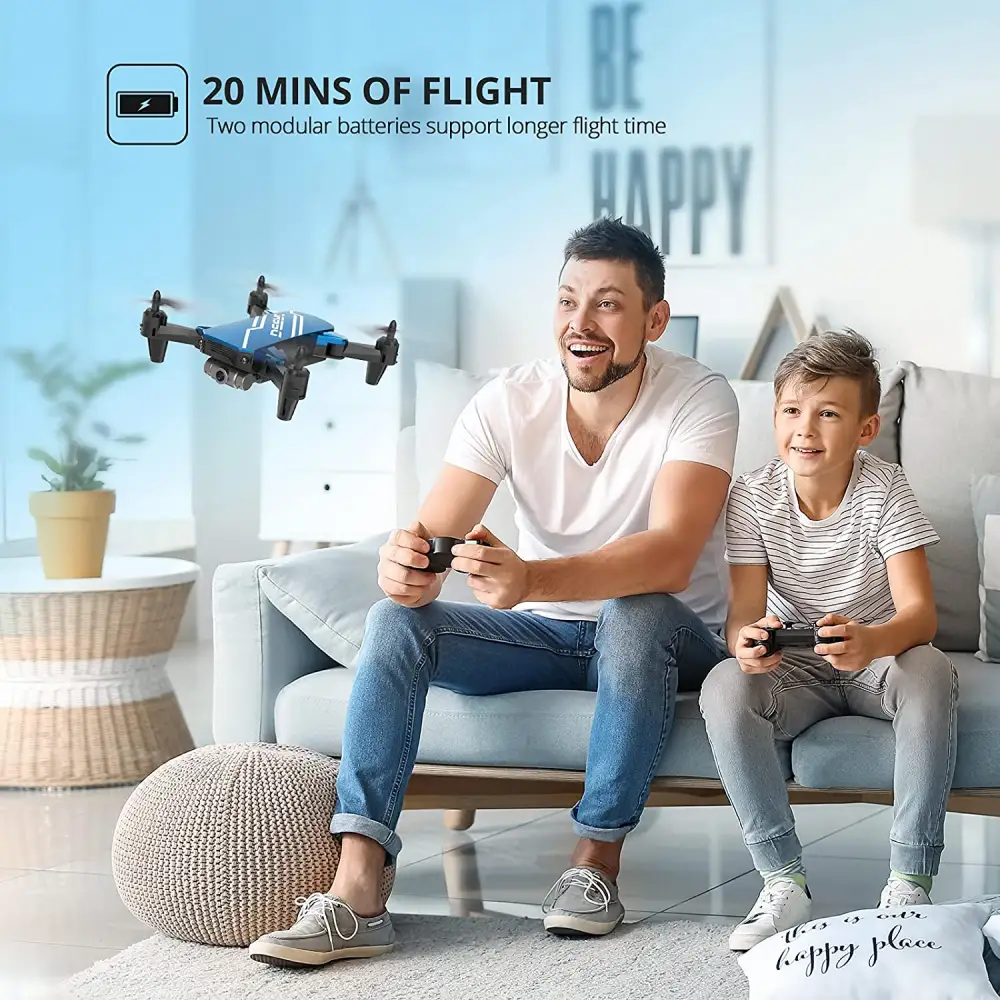
Claim: “Up to 20 minutes flight (2 batteries).” While the listing language frames the two-battery bundle as extended playtime, multiple Amazon reviewers describe much shorter real-world sessions. A verified buyer on Amazon updated their review specifically because “the battery flight time is very short. less than 5 minutes per charge,” concluding that “even with two batteries you can only fly 10 minutes or less.” Another verified buyer on Amazon gave a more moderate range: “the batteries last about 5–7 minutes depending on how many 360° flips and the speed you use.” For kids, that can mean frequent breaks and more time charging than flying—unless expectations are set properly.
Claim: “720p HD FPV camera / fly by app.” The product positioning suggests real-time FPV fun, but user narratives repeatedly describe lag and unstable connections. A verified buyer on Amazon described the FPV experience bluntly: “it is just not possible to fly this fpv… the video lag is over a second,” adding they “just choose not to use the camera or app.” Another verified buyer on Amazon said the app “crashes constantly,” and even when it worked, “the connection was lost” and the drone crashed. That gap matters most to parents buying it specifically for “camera drone” novelty—or adults hoping to inspect roofs.
Claim: “Easy beginner drone for kids & beginners.” Here, the data is more supportive—within a narrower context. A recurring pattern emerged: learning basic controls indoors goes better than attempting outdoor missions. A verified buyer on Amazon said setup was “fairly easy” and it “responded to commands decently,” but also warned that it has “very little stabilization assistance aside from auto takeoff,” which can lead to disorientation and crashes. For a first drone, that combination—simple features plus limited stabilization—creates a learning tool that rewards slow practice, not ambitious flights.
Cross-Platform Consensus
Universally Praised
The most consistent praise for DEERC D20 Mini Drone with Camera for Kids (Blue) is durability—particularly as a “learner drone” that can survive the mistakes beginners will inevitably make. One verified buyer on Amazon recounted repeated crashes and still sounded impressed: it “survived several crashes admirably (even a 20-foot drop to pavement).” Another verified buyer on Amazon echoed that resilience after multiple connection mishaps: “this thing is nearly indestructible,” noting it kept flying with “only minor body scratches.” For parents buying a first quadcopter for kids, that kind of “it didn’t shatter instantly” story is often the difference between a weekend of fun and a same-day return.
Ease of entry also shows up repeatedly—especially when users treat it as a toy-grade trainer rather than a camera platform. A verified buyer on Amazon framed it as an on-ramp: “perfect starter drone,” explaining they bought it to “learn and understand the basics” while staying “budget friendly and durable enough to withstand” early errors. Another verified buyer on Amazon described a quick learning curve: “you can learn to fly successfully in minutes,” emphasizing basic controller familiarity and drift correction. For a first-time pilot—kid or adult—features like one-key takeoff/landing and trim controls can turn “intimidating gadget” into something you can actually manage in a living room.
Finally, the “fun factor” is real when expectations are aligned: small size, flips, and quick sessions. A verified buyer on Amazon described it simply: “it’s a fun toy.” Another highlighted the trick element: they had “some fun with…360° flips,” calling the experience “a lot of fun.” For families looking for an indoor-friendly RC toy with stunts, the stories line up: this is less “aerial photography tool,” more “mini stunt quad.”
After those narratives, the praise clusters into a few repeat themes:
- Crash resistance and guard effectiveness (multiple Amazon buyers describe surviving hard impacts).
- Beginner-friendly controls when flown line-of-sight (one-key takeoff/landing, trim, headless mode).
- Compact size that suits indoor practice and “tiny hands.”
Common Complaints
Battery life is the complaint that most directly clashes with purchase expectations—especially because the product language highlights two batteries and “up to 20 minutes.” Digging deeper into user reports, people aren’t just saying “short”; they’re changing ratings over it. A verified buyer on Amazon wrote an update: “I want to downgrade my initial rating… battery flight time is very short. less than 5 minutes per charge.” Others report slightly better but still toy-grade endurance: “about 5–7 minutes” depending on flips and speed, or “about 8 minutes of ‘gentle’ flying.” For kids, that can mean frustration mid-play; for adults hoping to do a simple roof check, it can mean never finishing the task before the drone needs a swap.
The app/connection experience is the second major friction point, and it affects the very features that differentiate it from cheaper toy drones: FPV feed, photos, videos, and “smart” controls. One verified buyer on Amazon didn’t mince words: “the app… is the worst drone app I’ve ever used,” adding it “crashes constantly.” Another described the practical impact: “controlling via iphone didn’t work beyond 8 feet,” calling it “a shame” because relying on touchscreen/camera “you’d lose it or crash it” beyond a couple yards. Even reviewers who like the drone often end up recommending the physical controller and line-of-sight flying instead of phone control.
Outdoor flight and wind sensitivity come up as a consistent limitation tied to the drone’s lightweight design. A verified buyer on Amazon said it “worked far better indoors than outdoors,” and another described trying outside in light wind and it “just could not keep up and blew away” until they could land it. For a child practicing in a yard on a breezy day, this becomes less “confidence-building trainer” and more “why won’t it stay where I put it?”
After those narratives, the recurring complaints look like this:
- Real-world battery time often lands around 5–10 minutes total across both packs for some users.
- App instability and lag make FPV/camera features unreliable for many.
- Lightweight build struggles outdoors, especially with wind or at distance.
Divisive Features
Headless mode and “beginner assists” are oddly polarizing in the lived reports. Some users describe core functions as reliable: a verified buyer on Amazon said “headless mode, and one touch take off/land have functioned perfectly.” But another reported headless mode can drift into confusion: “it can sometimes lose calibration while using headless mode,” forcing the pilot to “figure out how to get the drone to fly back.” For kids, that difference can look like “easy mode” versus “why is it going the wrong way?”—and it often depends on calibration habits and flying environment.
Control methods also split experiences: some praise phone setup, others abandon it entirely. A verified buyer on Amazon called it “easy to set up in the app and use your phone,” but another said phone control didn’t work beyond “8 feet,” and others stopped trying because the FPV lag was too high. In practice, the drone’s “multiple control options” can either feel like flexibility or like a feature list that only works partially.
Trust & Reliability
Safety and reliability concerns surface most sharply around charging. One verified buyer on Amazon issued a direct warning: “monitor closely while charging,” describing “an overwhelming smell of burning plastic” and saying “the charger itself was completely melting.” That’s not a performance nitpick—it’s the kind of story that changes how a parent supervises use, where charging happens, and whether the product stays in rotation at all. The same reviewer also described a customer-service recovery: “customer service is top notch… offered sending a completely new drone,” suggesting responsiveness when things go wrong.
Longer-term reliability stories are mixed, but the pattern is familiar for budget mini drones: some hold up, others raise durability questions beyond crash resistance. A verified buyer on Amazon compared it to a prior cheap drone that died quickly and said, “hopefully this one will have a longer lifespan.” Another parent-style report framed ongoing enjoyment: “my 10 year old loves it… customer service is great too.” Meanwhile, loss-of-control and flyaway anxiety appear in short, resigned accounts—one verified buyer on Amazon wrote, “flew away and kept going,” attributing it partly to inexperience. For cautious buyers, these reports push the “indoor/calm-weather” recommendation from preference into near-requirement.
Alternatives
Only one direct competitor appears in the user-provided feedback: the Holy Stone HS110D. A verified buyer on Amazon compared speeds and claimed DEERC D20 Mini Drone with Camera for Kids (Blue) felt faster: on speed level 3 it seemed “faster than my holy stone hs110d” even when the HS110D was on a higher speed setting. That story positions the D20 as a “speedy mini” for line-of-sight fun rather than a stable camera platform.
The same user’s narrative also hints at the tradeoff: they were impressed with responsiveness but repeatedly frustrated by app and connection glitches, ultimately not trusting it in risky environments: “definitely wouldn’t trust flying it over water.” So the alternative conversation here isn’t “better camera,” but “different feel”: if someone already owns an HS110D, the D20 may feel like a smaller, zippier indoor trainer—provided they accept the app limitations.
Price & Value
At roughly the $49.99 level in the provided listings, DEERC D20 Mini Drone with Camera for Kids (Blue) is positioned as an entry-level bundle: two batteries, controller, and a camera that’s more “proof of concept” than creator-grade. Digging deeper into user reports, value depends heavily on what you’re buying it for.
For buyers who want a durable practice drone, the “price-to-crash-survival” ratio is frequently defended. A verified buyer on Amazon said, “for the price, I am not dissatisfied,” emphasizing survivability after repeated impacts. Another framed it as budget-friendly learning: they wanted “to gain some experience without it costing an arm and a leg,” and praised how well it tolerated beginner mistakes.
For buyers who equate “camera drone” with reliable FPV, the value argument weakens quickly. Reports of “over a second” video lag, “crashes constantly” app behavior, and phone control limited to “8 feet” change the purchase from “cheap camera drone” to “toy you mostly fly without the camera.” Community buying wisdom, implied through these narratives, points toward using the controller, keeping it close, and treating camera features as a bonus when they work—not the main reason to buy.
FAQ
Q: How long does the DEERC D20 actually fly per battery in real use?
A: Reports vary widely. A verified buyer on Amazon downgraded their rating because it was “less than 5 minutes per charge,” while another said “5–7 minutes” depending on flips and speed. Some users describe around “8 minutes” with gentle flying, so expectations should be toy-grade.
Q: Is the DEERC D20 good for indoor flying for beginners?
A: Yes, especially indoors. A verified buyer on Amazon said it “worked far better indoors than outdoors,” and several describe it as a “perfect starter drone” with one-touch takeoff/landing and trim adjustments. The small size and prop guards also come up as practical for learning in tight spaces.
Q: Can you rely on the app and FPV camera feed?
A: Many users say no. A verified buyer on Amazon reported the app “crashes constantly,” and another said FPV isn’t practical because “the video lag is over a second.” Some people still find the app easy to connect, but several end up flying line-of-sight with the controller.
Q: Does it handle wind well outdoors?
A: Not really. A verified buyer on Amazon said it struggled outdoors and another reported it “blew away” in light wind until they could land it. Multiple stories suggest it’s best outdoors only on calm days and at close range.
Q: Are there any safety concerns mentioned by buyers?
A: Yes, specifically charging. A verified buyer on Amazon warned to “monitor closely while charging,” describing a burning smell and saying “the charger itself was completely melting.” That user also noted strong customer service afterward, but the charging story stands out as a supervision requirement.
Final Verdict
Buy DEERC D20 Mini Drone with Camera for Kids (Blue) if you’re shopping for a small, crash-tolerant starter drone for indoor practice and quick backyard flights on calm days. Avoid it if the main goal is stable FPV, dependable app control, or consistently long flight sessions—multiple Amazon reviewers describe app crashes, lag, and battery time as low as “less than 5 minutes per charge.” Pro tip echoed by user behavior: treat the camera/app as optional, fly line-of-sight with the controller, and keep it close—especially outdoors.