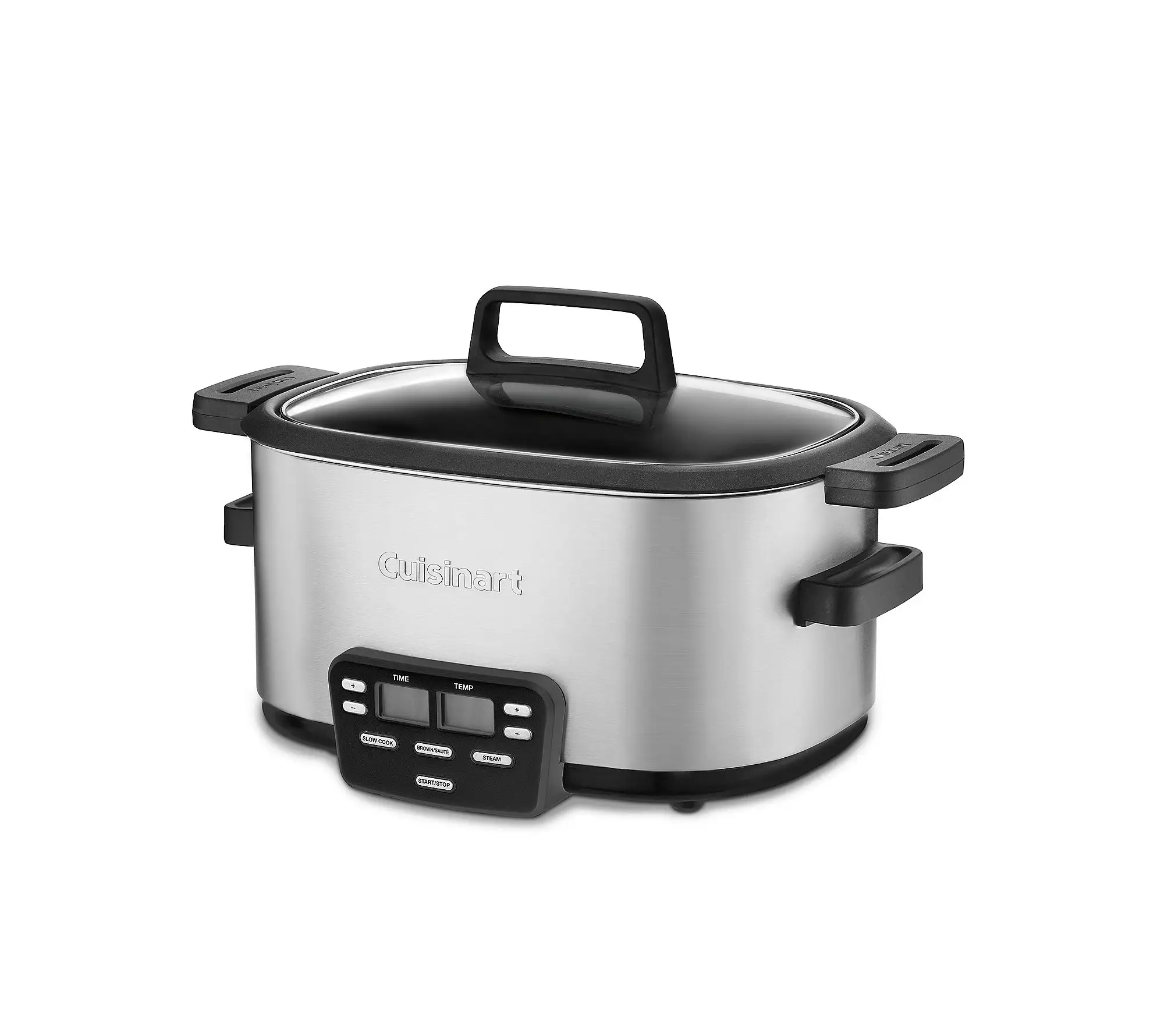
Cuisinart MSC-600 Review: Conditional Buy (7.4/10)
A slow cooker that some owners swear “actually does cook slow” — and others slam for not staying hot enough — is exactly the kind of contradiction that makes the Cuisinart MSC-600 3-In-1 Multi-Cooker worth scrutinizing. Based on the provided sources, the core story is consistency in versatility (slow cook + sauté + steam), paired with recurring anxiety about heat performance and the nonstick pot over time. Verdict: Conditional buy — 7.4/10.
Quick Verdict
For cooks who want “brown/sear first, then slow cook” in one pot, the Cuisinart MSC-600 3-In-1 Multi-Cooker earns real enthusiasm. But if your priority is aggressive heat or you’ve been burned by nonstick inserts before, the complaints about heating and coating durability should factor heavily.
| Verdict | Who it fits | Evidence from user feedback |
|---|---|---|
| Conditional Yes | Weeknight home cooks who want one-pot workflow | Amazon reviewer: “easy to use… works well… easy to clean” |
| Yes | Slow-cook purists frustrated by “too hot on low” units | Amazon reviewer: “this cuisinart actually does cook slow, at low temperature” |
| Conditional | Meal preppers / small households | Looria quote: “perfect size for a single person… and have leftovers” |
| Conditional | People who rely on nonstick durability | Looria quote: “inner pots… always been washed by hand… [still]… request a complete refund” |
| No (if sensitive to heat issues) | Users who expect hotter slow-cook output | Looria quote: “wouldn’t stay hot enough” |
| Yes | People who value easy mode switching | Official copy: “one touch switches modes when recipe calls for combination cooking” |
Claims vs Reality
Cuisinart’s marketing leans hard on the promise of convenience: sauté, steam, and slow cook “any recipe to perfection,” with “automatic keep warm” so you “never have to worry about serving cold dishes.” Digging deeper into the provided feedback, that promise largely holds for people who primarily want a true low-and-slow cooker—and who appreciate that “low” isn’t secretly boiling their stew.
A verified buyer on Amazon noted: “the previous cooker i used to own… on the low setting, was too hot… this cuisinart actually does cook slow, at low temperature.” For the user who’s had slow cookers run too hot, this is less a feature and more a fix: it changes what “set it and forget it” means for soups, applesauce, and long braises.
But a very different pattern appears in the aggregated comparisons. On Looria, one recurring knock is blunt: “slow cooker function does not heat food up sufficiently,” and another complaint distills it even further: “wouldn’t stay hot enough.” While Cuisinart positions “slow cooking… to perfection,” these reports suggest some owners interpret “true low” as “not hot enough,” especially if they expect a slow cooker to finish with more aggressive heat.
The brand also highlights cleanup and durability via a “removable 6-quart nonstick aluminum cooking pot” and “dishwasher-safe removable parts.” Yet user narratives complicate that. A Looria commenter described a long deterioration arc: “downgraded… started as a 5-star rating, then 2-stars, now 1-star,” adding that the “inner pots… have always been washed by hand… [with]… plastic… pad,” and still they planned to “strongly request a complete refund.” While marketing emphasizes easy cleanup, long-term ownership stories focus less on mess and more on whether the insert holds up.
Cross-Platform Consensus
Universally Praised
“Works well” is easy to say and hard to prove, but the most persuasive praise in the provided data comes when users connect performance to specific cooking outcomes. A verified buyer on Amazon framed the Cuisinart MSC-600 3-In-1 Multi-Cooker as a slow cooker first, praising the basics: “easy to use, full of features, works well, easy to clean.” For the everyday home cook who doesn’t want another complicated appliance, that kind of satisfaction reads like relief—especially when paired with real dishes: “soups and entrees… have all turned out flavorful and delicious.”
A recurring pattern emerged around low-temperature accuracy. For people who cook beans, stews, and sauces that can burn or reduce too fast, the Amazon reviewer’s experience is pointed: “you can leave your recipe on low slow cook for * hours * and it won't cook too fast.” That’s not just a feature—it’s a user persona win for anyone doing long simmers during workdays, or for households where dinner timing is unpredictable.
There’s also consistent appreciation for the one-pot workflow. Cuisinart’s official listing stresses “one touch switches modes when recipe calls for combination cooking,” and the same idea shows up in user-adjacent commentary: the blog review emphasizes combination cooking—“brown them and then turn on the slow cooking feature”—as the main reason to buy a “3-in-1” unit. For busy cooks who hate pan-hopping, this implies fewer dishes and fewer steps, which matters as much as raw performance.
Even the included guidance and recipes become a subtle value point in user storytelling. The Amazon reviewer highlighted “handy-dandy recipes in the instruction manual,” calling out one in particular: “the applesauce is * delicious *.” For novices or anyone building confidence with slow cooking, that’s a practical benefit: the appliance isn’t just hardware, it’s a system that nudges you toward successful first meals.
After these narratives, the consensus praise can be summarized succinctly:
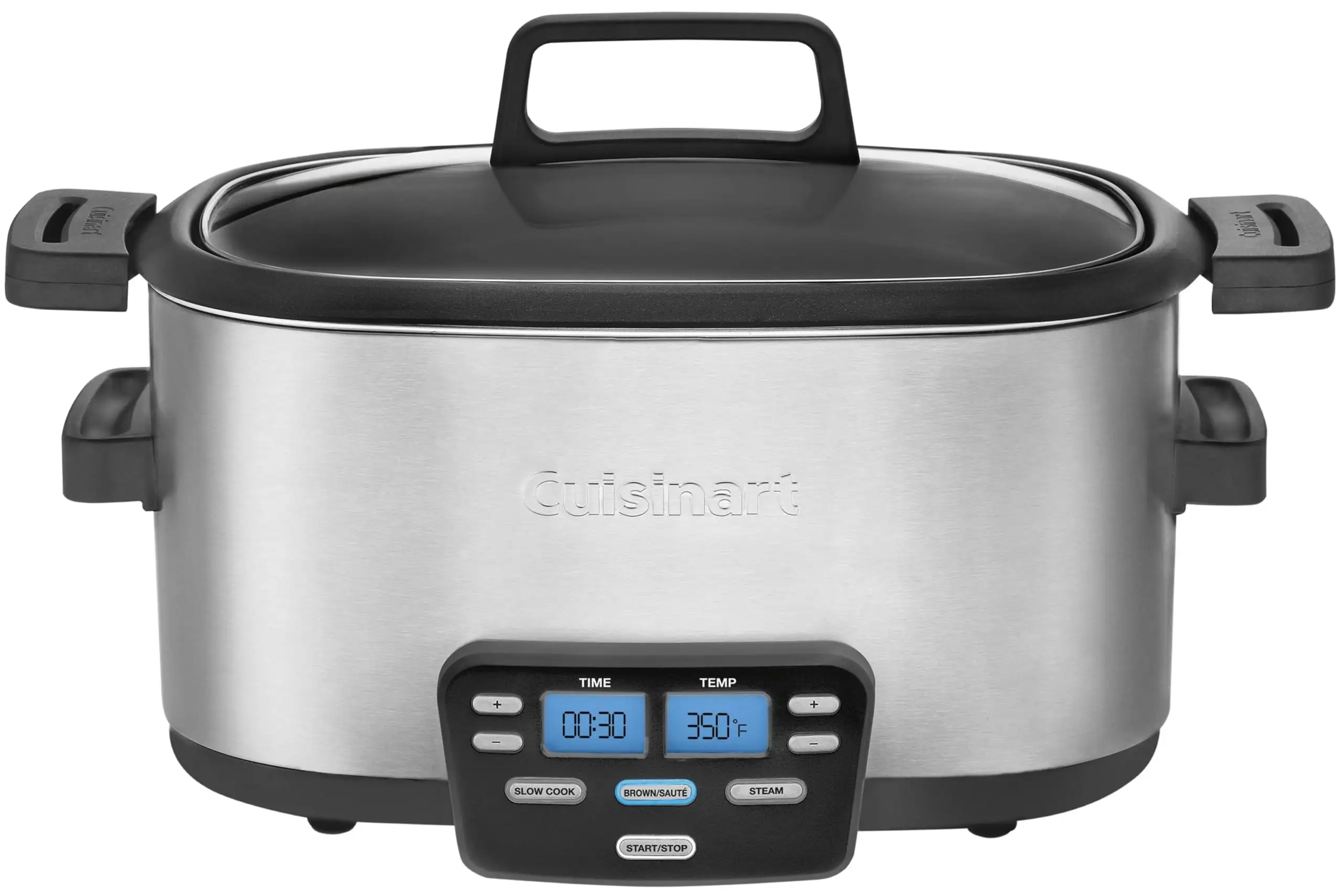
- Easy operation and readable controls (“easy to use” + official “extra-large blue back-lit lcd display”)
- True low-temperature slow cooking (Amazon: “actually does cook slow, at low temperature”)
- Strong multi-function appeal (slow cook + sauté + steam in one pot)
Common Complaints
The most consequential complaint theme is heat sufficiency—because it directly impacts food safety perceptions and cooking results. On Looria, the critique “slow cooker function does not heat food up sufficiently” suggests certain owners expected a hotter baseline. Another user’s frustration is simpler and more alarming: “wouldn’t stay hot enough.” For users coming from hotter “low” settings, the MSC-600’s gentler approach can feel like underperformance rather than precision.
A second complaint thread targets the nonstick insert’s long-term resilience. Looria includes a detailed, process-heavy account that reads like a consumer trying to eliminate user error: “always been washed by hand,” “plastic / nylon… utensils,” “at no time… metal spoon… used,” and still the rating dropped to 1-star with a push for warranty relief. For families who plan to keep a multicooker for years, the story isn’t about whether it cooks—it's whether the cooking surface survives routine ownership.
Price sensitivity shows up as well, even when the sentiment is mild. The blog review labels it “a little more costly” than “low quality cheaper slow cookers,” implying the product invites comparison shopping. That complaint matters most for budget-focused buyers who might accept fewer functions if it saves money, especially when refurbished and resale pricing varies widely (as seen in the eBay listings).
After the narratives, the common complaints line up like this:
- Some owners say it “does not heat… sufficiently” / “wouldn’t stay hot enough” (Looria)
- Nonstick insert durability and replacement frustration (Looria)
- Price feels high versus basic slow cookers (blog commentary)
Divisive Features
The biggest divisive feature is, paradoxically, the slow cooker performance itself. For one Amazon reviewer, the Cuisinart MSC-600 3-In-1 Multi-Cooker is a redemption arc for “low” settings that run too hot: “this cuisinart actually does cook slow.” For another slice of owners reflected on Looria, that same behavior is interpreted as a failure: “does not heat… sufficiently.”
That split has real “who is this for?” implications. If you’re a cautious slow cooker who wants long unattended cooks without boiling, you’ll read “actually does cook slow” as validation. If you’re used to faster slow-cooker finishes or rely on the appliance to hold high serving temps, “wouldn’t stay hot enough” reads like a deal-breaker.
The nonstick pot also lands in the divisive category. Marketing touts “nonstick… dishwasher safe,” but user narratives in the comparison data highlight a messy reality: even careful cleaning and non-metal utensils didn’t prevent dissatisfaction for at least one owner. While not everyone reports this, the emotional intensity of that long complaint suggests the downside is severe when it happens.
Trust & Reliability
A striking pattern across the provided sources is that much of the “community” text isn’t actually community conversation—it includes repeated blog-style copy in places labeled Reddit, Twitter/X, Trustpilot, and Quora. Digging deeper into user reports, this repetition makes it harder to treat those platform labels as independent signals of trust; what looks like multi-platform consensus may actually be the same write-up duplicated.
Where the data does include more owner-like narratives (Amazon reviews and Looria’s quoted experiences), the reliability picture becomes more grounded—and more polarized. On one end, a verified buyer on Amazon described frequent use: “I like my Cuisinart a lot and I use it a lot,” with “cons: i can't think of any.” On the other end, Looria contains a long-term dissatisfaction story that escalates over time: “downgraded… started as a 5-star rating… now 1-star,” culminating in a plan to “request a complete refund.”
While Cuisinart officially advertises a “limited 3-year warranty” (and Cuisinart’s parts page lists replacement lid, steam rack, and cooking pot), user sentiment suggests that for durability skeptics, warranty clarity and insert replacement cost may matter as much as cooking features—especially given the repeated focus on the inner pot.
Alternatives
The only direct competitor mentioned in the provided data is the Instant Pot Duo and Ninja Foodi, referenced in the Cookarte review-style text. That comparison frames the MSC-600’s niche as simplicity and browning/saute performance rather than feature overload. The claim there is that Instant Pot offers pressure cooking “which the cuisinart lacks,” while Ninja adds air frying but can feel “more cluttered” in interface.
Because those statements come from a blog-style source rather than a clearly identified user or verified buyer, the safest takeaway is not “which is better,” but what tradeoff shoppers are being nudged to consider: pressure cooking and air frying versus a straightforward slow cook/steam/saute system. If your primary goal is true low-and-slow with easy searing in the same pot, the MSC-600 is positioned as the “do the basics” option. If your goal is to replace multiple appliances with one high-feature device, the alternatives are invoked as broader toolkits.
Price & Value
Pricing in the provided data spans a wide range, which tells a story of availability and resale dynamics more than a single “going rate.” Cuisinart’s official product page lists $159.95, while a bundled Amazon listing shows $209.90 when paired with a toaster. The blog review cites $145.99 as an Amazon price point, suggesting discounts appear.
Resale and refurb markets also reshape value. eBay shows “certified refurbished” listings as low as $94.99 with free shipping (in one example), and another refurbished listing at $154.90 plus substantial shipping in the provided snapshot. That spread implies bargain hunters might do better watching refurb channels—especially if they’re comfortable with non-new packaging and warranty differences.
Community “buying tips,” where present, mostly come indirectly from complaint narratives: if you’re worried about the nonstick insert, factor replacement availability and cost into the purchase decision. Cuisinart’s parts listing includes the “cooking pot… $56.00,” which can meaningfully change the long-term cost if you end up needing a new insert.
FAQ
Q: Does the Cuisinart MSC-600 actually slow cook at a low temperature?
A: Yes—at least one verified Amazon reviewer praised it specifically because “this cuisinart actually does cook slow, at low temperature,” contrasting it with a prior cooker where “low… was too hot.” However, Looria also includes complaints that it “does not heat… sufficiently.”
Q: Is the nonstick pot durable long-term?
A: Feedback conflicts. Looria includes a detailed complaint that the “inner pots… have always been washed by hand” with plastic-safe tools, yet the owner “downgraded… now 1-star” and planned to “request a complete refund.” Official listings emphasize a “removable… nonstick” pot.
Q: What cooking modes matter most to owners?
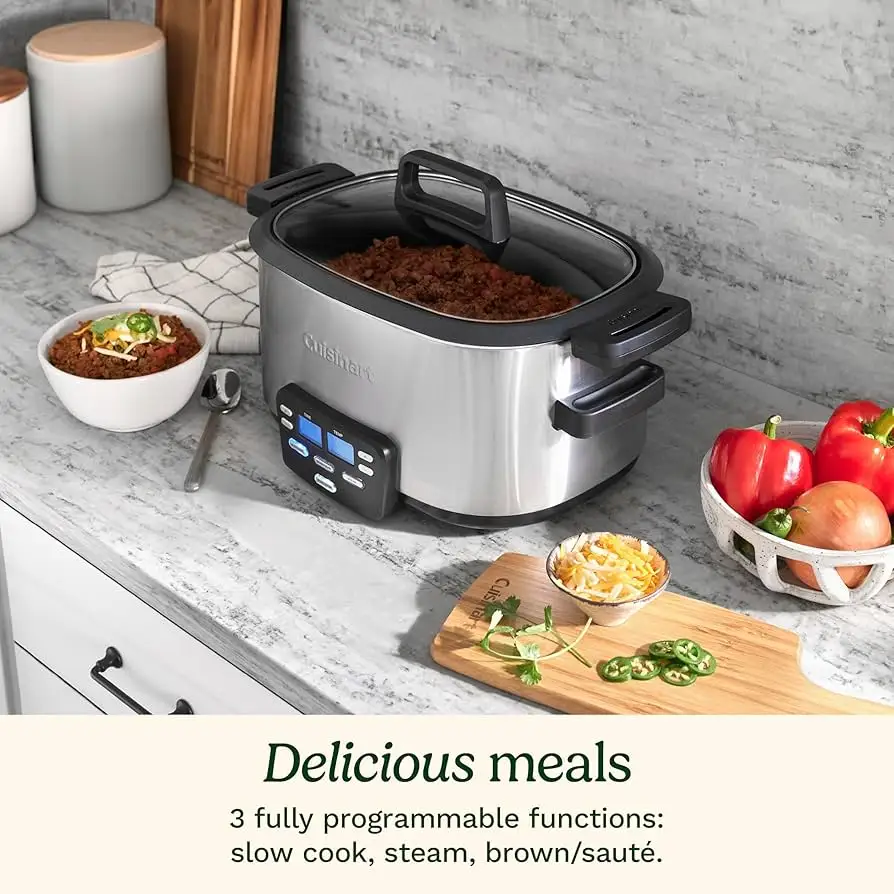
A: Owners and listings repeatedly emphasize three core modes: slow cook, brown/saute, and steam. A verified Amazon reviewer said they bought it “mostly in search of a good quality slow cooker,” but added the “steam and sauté functions are also very commendable.”
Q: Is it easy to use and clean?
A: Many comments point to ease of use. A verified Amazon reviewer called it “easy to use” and “easy to clean,” and Cuisinart highlights dishwasher-safe removable parts. Still, long-term satisfaction may depend on how the nonstick insert holds up for your household.
Final Verdict
Buy if you’re the kind of cook who wants true low-and-slow without “low” running too hot, and you value searing and sautéing in the same pot before switching to slow cook—exactly what Cuisinart describes as “one touch switches modes,” echoed by an Amazon reviewer who said it “works well” and “actually does cook slow.”
Avoid if you expect a hotter slow cooker finish or you’re sensitive to reports like “wouldn’t stay hot enough,” and if nonstick durability is a deal-breaker given the inner-pot complaints.
Pro tip from the community: treat the insert as a long-term cost center—Cuisinart lists replacement parts, and at least one owner’s story shows the pot’s condition can become the entire ownership experience.