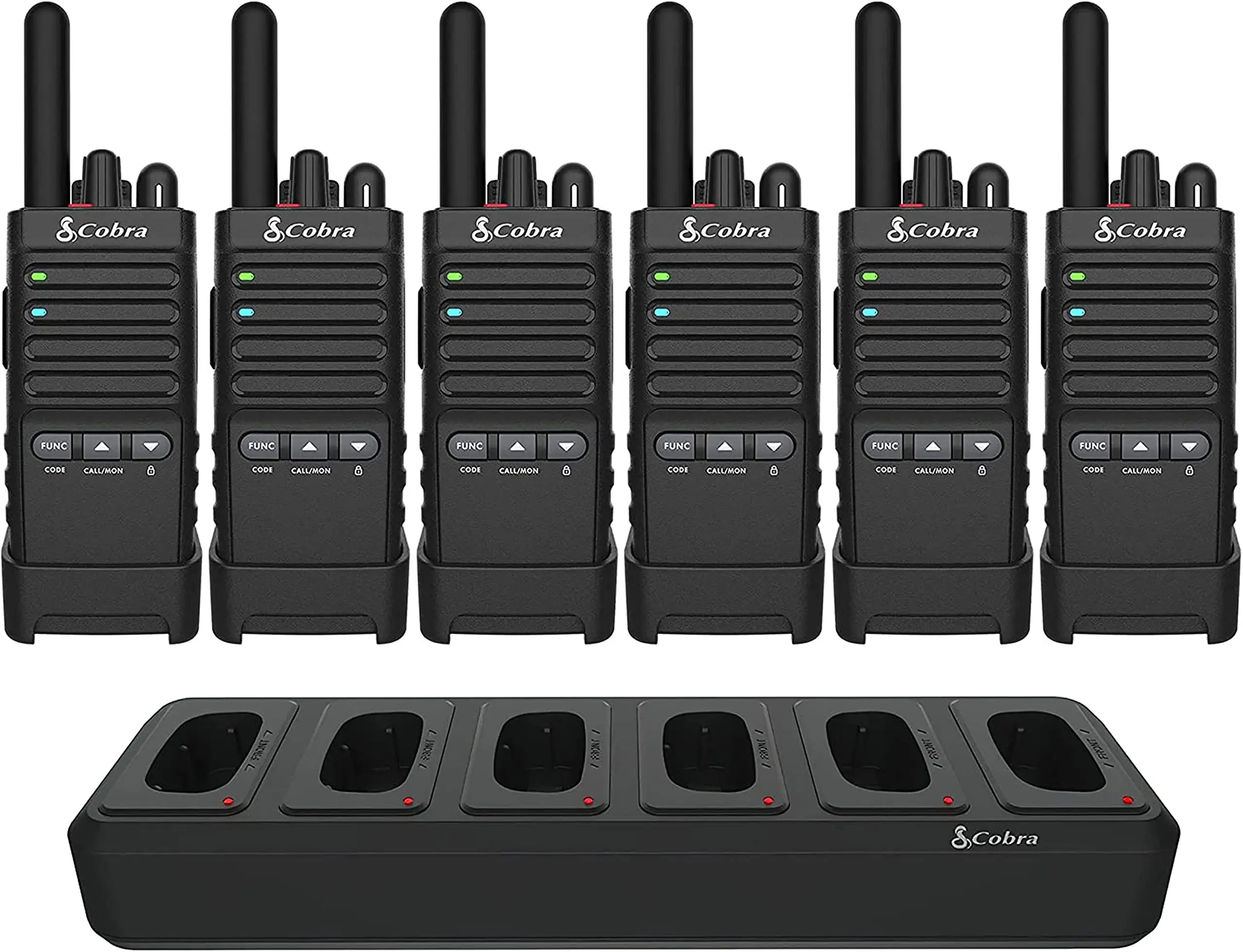
Cobra PX650 BCH6 Review: Conditional Buy (7.2/10)
A hotel buyer summed up the risk in one sentence: “within the 1st month 1 of them just stopped working completely.” That tension—strong day-to-day performance for some teams, sudden failures and range disappointment for others—defines the Cobra PX650 BCH6 experience. Verdict: Conditional buy, 7.2/10.
Quick Verdict
For organizations that need license-free FRS radios for routine coordination (retail, events, light-duty facilities), the Cobra PX650 BCH6 often lands as “simple and powerful.” But if you’re relying on “25 floors” coverage through dense structures—or you need true industrial durability—multiple reviewers say expectations can outpace reality.
| Decision | Evidence from user feedback |
|---|---|
| Buy if you need simple deployment | A verified buyer on Amazon noted: “simple and powerful walkie-talkies.” |
| Buy if you prioritize clear audio in-range | A verified buyer on Amazon noted: “speaker is very clear.” |
| Conditional if your site has steel/complex barriers | A verified buyer on Amazon wrote they had “reception through steel bulkheads,” while another said it was “very poor at transmitting from one warehouse to another adjacent warehouse.” |
| Avoid if you need guaranteed multi-building coverage | A verified buyer on Amazon said: “in the 3rd one it is very scratchy / hard to hear if at all.” |
| Avoid if you need rugged drop resistance | A verified buyer on Amazon warned: “not really rugged if you drop them.” |
| Watch out for durability variance | A verified buyer on Amazon reported: “within the 1st month 1 of them just stopped working completely.” |
Claims vs Reality
Cobra markets the Cobra PX650 BCH6 around a “300,000 sq. ft / 25 floors” business range and an IP54 splash-resistant build. Digging deeper into user reports, range and durability are where expectations collide with real workplaces.
Claim: “Up to 300,000 sq. ft / 25 floors” coverage.
While officially positioned for multi-floor buildings, at least one buyer couldn’t reconcile that headline with their jobsite reality. A verified buyer on Amazon wrote: “i think the range it stated by seller is not accurate… it cannot go more than 10 floors in my job site. i’m disappointed.” For facility managers who bought these expecting reliable vertical coverage, that kind of gap matters: it turns radios from a system into a “sometimes” tool.
At the same time, user experiences aren’t uniformly negative on distance. A verified buyer on Amazon describing ship repair work said the radios had “reception through steel bulkheads and can be heard miles away,” a story that implies strong performance in at least some harsh RF environments. The mismatch suggests environment-specific results: building materials, layout, and interference can swing the outcome dramatically.
Claim: “Professional/business” construction and durability.
Cobra frames the PX650 line as business-ready, but some buyers draw a hard line between “business” and “industrial.” One verified buyer on Amazon argued: “not commercial grade… this is just a normal walkie talkie put in an industrial looking shell,” adding it “wouldn’t be too bad for a dr office, hotel, car dealership” but “certainly not an industrial radio.” That’s a meaningful distinction for warehouses, shipyards, and construction crews where drops and daily abuse are routine.
Even less severe critiques echo the same point: performance may be strong, but survivability can lag. Another verified buyer on Amazon said: “not really rugged if you drop them,” framing ruggedness as the premium you’d need to pay for elsewhere.
Claim: Easy operation with privacy codes and programming.
Marketing emphasizes easy-to-use knobs and privacy codes. In practice, some users still hit a learning curve. A verified buyer on Amazon said: “a bit time spent figuring out how to get to the codes menu but not hard.” That’s not a deal-breaker, but for teams rolling out six radios quickly (security shifts, event staff), even minor setup friction can slow deployment.
Cross-Platform Consensus
A recurring pattern emerged: when the Cobra PX650 BCH6 is used within its practical range envelope, people talk about clarity and day-to-day dependability. When buyers stretch it across multiple buildings, heavy foliage, or warehouse-to-warehouse links, the praise turns into skepticism fast.
Universally Praised
The most consistent upside is straightforward: clear voice communication when conditions cooperate. For hospitality teams and small venue staff, clarity can matter more than theoretical miles. A verified buyer on Amazon put it simply: “speaker is very clear.” That kind of comment usually comes from people who are using radios for quick, frequent exchanges—housekeeping, front desk, floor runners—where garbled audio causes immediate operational pain.
Ease of basic use also shows up in the better reviews. One verified buyer on Amazon called them “simple and powerful walkie-talkies.” For managers who don’t want a licensing process or complex programming, that “simple” framing is the point: the radios become a tool you can hand to staff with minimal training.
Some users also describe unexpectedly strong reception in challenging structures, which is exactly what business buyers hope for. A verified buyer on Amazon working in ship repair said they had “reception through steel bulkheads,” and could be heard “miles away.” For a shipyard crew, that story signals real-world penetration through metal compartments—a scenario where many consumer radios fall apart.
Finally, even reviewers who criticize durability often still endorse the value proposition for the right environment. The same ship-repair reviewer—despite warning they’re “not really rugged if you drop them”—concluded they were “good value overall” and even said: “i keep buying them when my guys break them.” That’s not a glowing durability endorsement, but it is a telling operational vote: for some teams, replacing units is still cheaper than upgrading to heavier-duty systems.
Summary of praised themes (after the stories):
- Clear audio in typical working range
- “Simple” operation for teams
- Strong reception for some difficult sites
- Value per unit for multi-radio deployments
Common Complaints
Range realism is the biggest flashpoint. While the marketing spotlights multi-floor coverage, one verified buyer on Amazon reported a ceiling far below that: “it cannot go more than 10 floors in my job site.” For high-rise job sites or thick reinforced structures, that gap can translate into dead zones that break coordination.
Multi-building performance is another frequent friction point, especially for campuses and hotels with separate structures. A verified buyer on Amazon purchased them for a hotel and reported early failure plus poor coverage: “within the 1st month 1 of them just stopped working completely,” and added that in their third building it was “very scratchy / hard to hear if at all.” They estimated the spacing as “maybe… a football field,” which is exactly the sort of moderate-distance, obstacle-heavy scenario that reveals whether “business radios” can truly act like a system.
Durability complaints show up both directly and indirectly. One reviewer cautioned: “not really rugged if you drop them,” while another framed the whole product as industrial-looking rather than industrial-grade: “just a normal walkie talkie put in an industrial looking shell.” For warehouse and construction buyers, that’s a warning that the shell may not match the job.
There are also small but practical hardware annoyances. A verified buyer on Amazon noted: “the antena falls off very easily but can be glued back on.” For outdoor crews or security teams moving constantly, a loose antenna is more than cosmetic—it’s downtime, and it raises questions about long-term build consistency.
Summary of complaint themes (after the stories):
- “25 floors” claim feels optimistic for some sites
- Scratchy audio and dropouts across multiple buildings
- Durability concerns, especially drops
- Occasional unit failures and small hardware issues
Divisive Features
The Cobra PX650 BCH6 splits users most on one question: are these truly “professional/business” radios or consumer radios dressed for work?
On the positive side, the ship-repair reviewer’s experience—“reception through steel bulkheads”—suggests the radios can exceed expectations in some heavy environments. That kind of report will resonate with operations teams who just need workable comms without licensing or complex infrastructure.
On the other side, a different verified buyer drew a firm boundary: “not commercial grade,” arguing it’s “very poor at transmitting from one warehouse to another adjacent warehouse.” Put together, the picture isn’t that the radios are uniformly weak—it’s that performance can be highly situational, and the “business” label doesn’t guarantee industrial-grade consistency.
Trust & Reliability
Digging deeper into buyer narratives, reliability concerns aren’t framed as scams—more like variability in unit longevity and site-to-site performance. The sharpest reliability warning is the early failure report: a verified buyer on Amazon said: “within the 1st month 1 of them just stopped working completely.” For procurement teams, that kind of short-term failure story raises the stakes of buying a six-pack: even one dead unit can disrupt staffing plans and shift coverage.
Durability stories add a second layer to trust: even satisfied buyers sometimes treat breakage as expected. The shipyard reviewer said: “i keep buying them when my guys break them.” That’s a pragmatic endorsement of value, but it also implies these may be considered semi-consumable in rough workplaces—fine if you budget for replacements, risky if you expect a fleet to last untouched.
Alternatives
Only a few competitors are explicitly referenced in the provided data. The Autovated write-up mentions Motorola RM series and Midland business radios as comparison points, framing them as potential trade-offs rather than direct replacements.
Autovated suggests Motorola may offer “slightly better weather sealing and higher-end features,” while Cobra can be “more affordable” in that category. For buyers burned by “scratchy” building-to-building performance, that hints at a common upgrade path: paying more for consistency and sealing.
Midland is described as sometimes having “stronger clarity in very noisy environments,” while Cobra’s edge is “lightweight build and holster comfort.” That matters for event staff and security teams who wear radios all shift; comfort can be a real operational factor, not just a spec.
Price & Value
On Amazon, the Cobra PX650 BCH6 (6-pack) is listed at $299.95, positioning it as a mid-priced business bundle rather than a bargain consumer set. The value story in feedback often hinges on whether the radios meet your site’s range needs. One unhappy buyer called them “pretty much the same quality as the last ones we had but were more than half the price,” implying the premium didn’t translate into better performance for their hotel layout.
Resale and market pricing adds another angle: eBay listings show Cobra business-radio bundles appearing at a wide spread (including much lower prices for other Cobra models and used units). That suggests cost-conscious buyers sometimes look for deals outside primary retail—useful if you’re equipping seasonal event teams and can accept used/secondary-market risk.
Buying tips implied by user stories:
- If your operation is tough on gear, budget for spares (echoed by “i keep buying them when my guys break them”).
- If you need multi-building coverage, validate with a small set first (motivated by “very scratchy / hard to hear” across buildings).
FAQ
Q: Does the Cobra PX650 BCH6 really work across 25 floors?
A: Not consistently, based on buyer feedback. While the product is marketed for “25 floors,” a verified buyer on Amazon said: “it cannot go more than 10 floors in my job site.” Real-world range appears highly dependent on building materials and layout.
Q: Are these radios actually rugged enough for industrial jobs?
A: Some buyers say no. A verified buyer on Amazon wrote: “not commercial grade… just a normal walkie talkie put in an industrial looking shell,” and another added they’re “not really rugged if you drop them.” They may fit light-duty business use better than heavy industrial abuse.
Q: How clear is the audio during normal use?
A: Several reviewers praise clarity in-range. A verified buyer on Amazon noted: “speaker is very clear,” and another described them as “simple and powerful walkie-talkies.” Complaints tend to show up when users push range across buildings or difficult obstacles.
Q: Is setup complicated for privacy codes and channels?
A: It can take a bit of learning, but not everyone finds it hard. A verified buyer on Amazon said they spent “a bit time” figuring out the codes menu, “but not hard.” For rolling out to staff quickly, plan a short setup walkthrough.
Q: Any common hardware issues to watch for?
A: Yes, at least one buyer flagged a physical weakness: “the antena falls off very easily but can be glued back on.” Another reported an early failure: “within the 1st month 1 of them just stopped working completely,” suggesting some unit-to-unit variability.
Final Verdict
Buy the Cobra PX650 BCH6 if you’re a hotel, church security team, event crew, or retail operation that needs license-free radios that are “simple” and clear when used within realistic distances—especially if you can field-test your site first. Avoid it if your success depends on reliable building-to-building coverage or truly industrial durability, because multiple buyers describe “scratchy” reception and radios that are “not really rugged if you drop them.” Pro tip from the community mindset: treat them as good-value fleet radios—but budget for the possibility that “my guys break them.”