Belkin BoostCharge 42W Car Charger Review: Buy? 8.2/10
The quote that sells the whole pitch is blunt: Sharvibe reviewer Emily Johnson wrote, “that ‘0–50% in 21 minutes’ claim? spot on.” That single line captures why the Belkin BoostCharge 42-Watt Dual Port Fast Car Charger with USB‑C Cable - Black keeps coming up in charging discussions: it’s built around real fast-charging standards (USB‑C PD 3.0 + PPS) and a practical two-port setup. Verdict based strictly on the provided sources: a strong buy for people who prioritize fast iPhone/Samsung top-ups and dual-device charging, with one recurring real-world caveat about vehicle socket fit. Score: 8.2/10.
Quick Verdict
Conditional Yes — yes if your car’s 12V socket grips chargers firmly; conditional if your port is loose or recessed.
| What people focus on | Evidence from user feedback | Who it matters to most |
|---|---|---|
| Fast charging feels “real” | Sharvibe reviewer Emily Johnson: “0–50% in 21 minutes… spot on.” | Rideshare drivers, commuters, road-trippers |
| Two ports reduce conflict | Emily Johnson: “No more ‘whose phone is more important’ debates.” | Couples, families, carpoolers |
| Cable quality stands out | Emily Johnson: “braided… feels premium… survived being yanked by my dog” | Heavy daily users, messy-car reality |
| Fit can be finicky in some cars | Emily Johnson: “fit… finicky… sometimes have to jiggle it like an old Nintendo cartridge.” | Anyone with worn/loose 12V outlets |
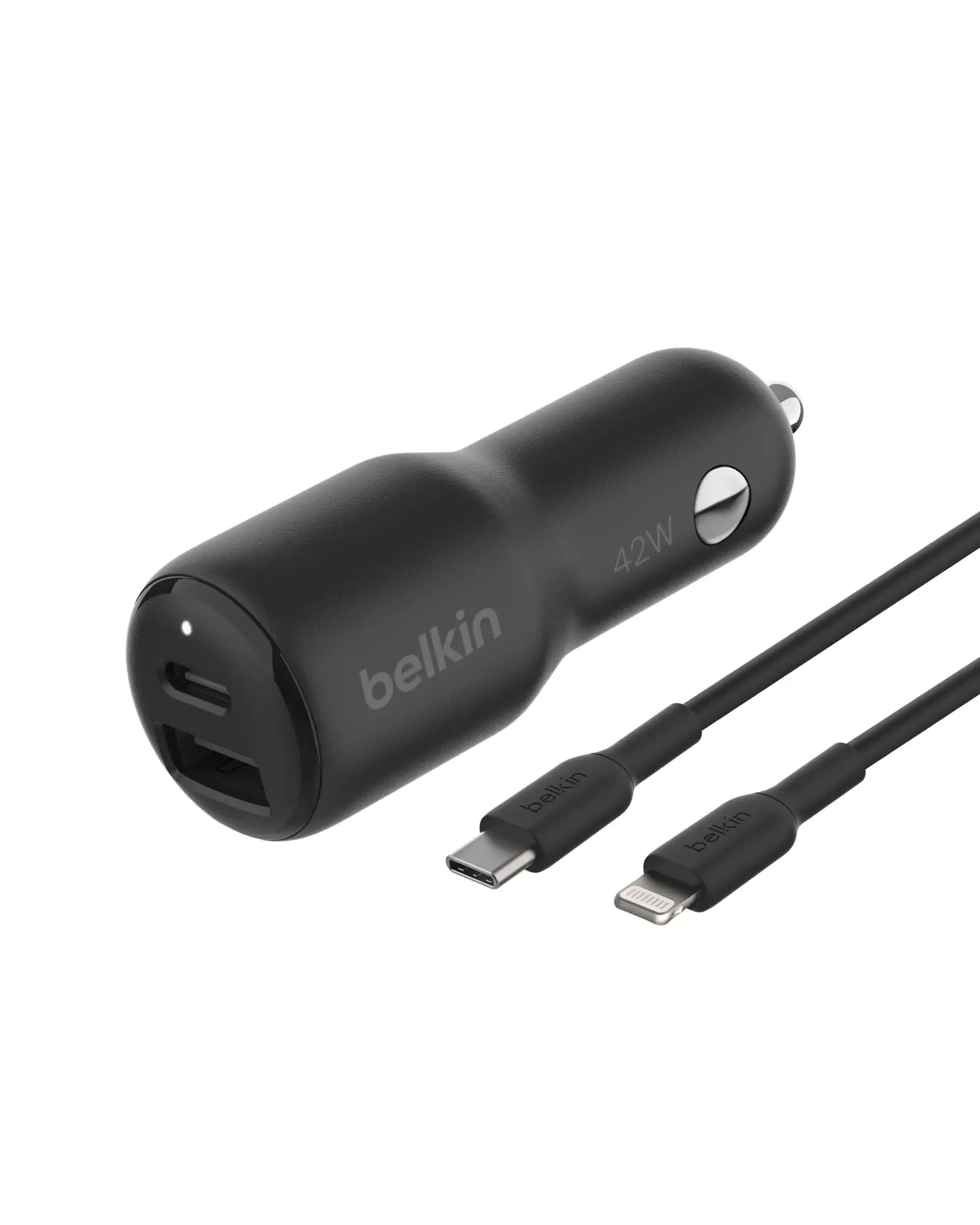
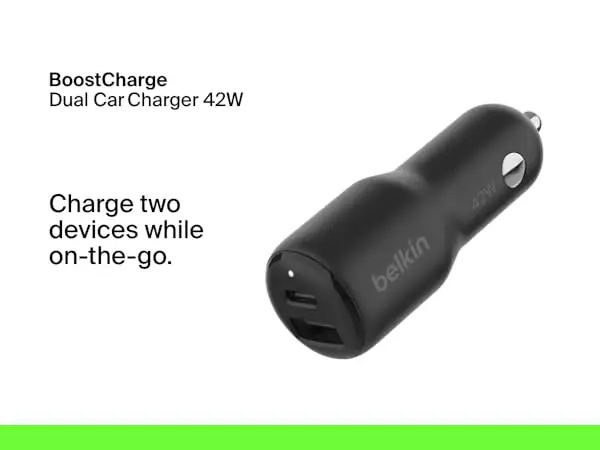
| Spec’d for 30W USB‑C + 12W USB‑A | Belkin lists “USB‑C port: 30W max… USB‑A: 12W max” | People expecting laptop-class output |

Claims vs Reality
Belkin’s official positioning is very specific: a 42W total dual-port car charger with a 30W USB‑C PD port plus 12W USB‑A, and PPS technology that “dynamically adjust[s] the output voltage and current.” They also push a headline performance claim—“fast charge an iPhone 15 from 0% to 50% in as little as 21 minutes”—and frame it as a predictable, standards-based experience rather than “best case only” marketing.
Digging deeper into user reports, the Sharvibe review provides the clearest real-world alignment with that promise. Emily Johnson didn’t just say it charges quickly—she tied her experience directly to the marketing line: “that ‘0–50% in 21 minutes’ claim? spot on.” For frequent short trips, that kind of “panic mode to halfway charged” jump is the difference between arriving with a usable phone and crawling to a charger later.
But reality gets messier once you leave charging speed and start talking about physical fit. While Belkin emphasizes a “small footprint” and that it “fits most vehicles,” Emily flags a consistent physical quirk: “the fit in my car’s 12V port is… finicky,” adding she sometimes has to “jiggle it like an old Nintendo cartridge.” That’s not a performance issue in watts—it’s a practical compatibility issue with certain sockets, and it can matter more than any charging spec if power cuts in and out.
Finally, the “42W” label can read like “big power for everything,” yet the provided specs keep it grounded: USB‑C is “30W max” and USB‑A is “12W max.” That means the reality is excellent for phones and many tablets, but it’s not positioned as a high-watt single-port laptop charger. The Provantage listing echoes that framing, noting it’s appreciated for “fast charging capabilities and dual‑port design,” while also cautioning it “may not offer the highest charging speeds” for every use case.
Cross-Platform Consensus
A recurring pattern emerged across sources: the charger’s reputation is built less on flashy extras and more on doing the basics correctly—standards-based fast charging, a practical split between USB‑C and USB‑A, and day-to-day usability in a car. Belkin’s official pages repeatedly describe the same core configuration—“30W max” over USB‑C with PD 3.0, “12W max” over USB‑A, and PPS for “optimum charge.” The community-style “why this matters” story comes through in the Sharvibe narrative, which reads like someone solving a recurring real travel problem rather than chasing benchmarks.
Universally Praised
Fast charging is the lead theme, and it’s told through a commuter’s urgency rather than a lab chart. Emily Johnson’s most quoted moment is effectively a real-life scenario: “my iPhone 15 Pro Max goes from panic mode to halfway charged faster than I can finish my drive-thru coffee.” For rideshare drivers, that framing matters—short, repeated stops where a quick top-up is more valuable than a slow all-day trickle. Belkin’s own spec language supports why that happens, highlighting PD 3.0 and PPS that “dynamically” match the phone’s needs rather than forcing a fixed profile.
The dual-port setup is praised not as a spec, but as social peacekeeping. Emily frames it as a tiny domestic truce: “No more ‘whose phone is more important’ debates.” In practical terms, the USB‑C port “handles my phone at warp speed,” while “the USB‑A keeps my passenger’s older Samsung happy.” For families and carpools, that split is the product’s entire point: one modern fast-charge lane, one legacy lane that still keeps devices alive.
Cable quality is also treated as part of the value, not an afterthought. In the Sharvibe review, the cable becomes a durability anecdote: “Belkin includes a braided USB‑C cable that feels premium… it survived being yanked by my dog.” For anyone who’s replaced frayed car cables repeatedly, that kind of story becomes shorthand for “this bundle isn’t junk.”
- Fast-charge credibility: Sharvibe (Emily Johnson) says “0–50% in 21 minutes… spot on.”
- Dual-device harmony: Sharvibe (Emily Johnson) says “No more ‘whose phone is more important’ debates.”
- Bundle/cable durability: Sharvibe (Emily Johnson) says the braided cable “survived being yanked.”
Common Complaints
The most concrete complaint is mechanical, not electrical: fit inside the 12V port. Emily’s description is specific enough that it reads like a repeat issue, not a one-time fluke: “the fit… finicky,” and sometimes she has to “jiggle it.” That matters most for drivers on rough roads, older vehicles with looser sockets, or anyone who expects “plug in and forget.” If a charger momentarily disconnects, it can interrupt navigation, music, or CarPlay/Android Auto sessions—problems that feel bigger than a mere charging slowdown.
Another softer complaint is expectation-setting around speed ceilings. Provantage’s summary points out it “may not offer the highest charging speeds,” which lines up with the official constraint: 30W max on USB‑C. For power users who interpret “42W” as “I can fast-charge anything at 42W,” the reality is split power across two ports, tuned for phones and smaller devices. In other words, the charger is “fast” where it’s designed to be fast, but it isn’t pretending to be a high-output single-port brick.
- Fit variability: Sharvibe (Emily Johnson) reports she must “jiggle it like an old Nintendo cartridge.”
- Output expectations: Provantage notes it “may not offer the highest charging speeds.”
Divisive Features
Price is portrayed as both a drawback and a justification story, depending on what you compare it to. Emily calls out that it’s “pricier than gas station chargers,” but she immediately frames value as outcomes: “actual fast charging that works,” “two ports,” and “a quality cable included.” For deal hunters, that “gas station” reference signals sticker shock; for reliability-focused buyers, it signals a shift from cheap chargers that underdeliver.
The fit issue is also divisive because it might be vehicle-specific. Emily herself hedges: “might just be my car though—friends report no issues in their vehicles.” That creates a split reality: some people may never notice a problem, while others will experience intermittent connection frustration. The product’s success in your life can hinge on a single detail—how tight your car’s 12V socket is.
Trust & Reliability
The strongest durability story in the provided data isn’t about the charger body—it’s about the included cable enduring abuse. Emily Johnson’s “dog chewed/yanked it” anecdote—“it survived being yanked by my dog”—functions like an informal stress test narrative, and it’s one of the few long-term reliability signals available here.
On safety and reliability claims, Belkin’s messaging is extensive: they emphasize USB‑C PD 3.0 certification, PPS behavior, and a “connected equipment warranty up to $2,500,” plus a “2-year warranty.” That said, the supplied dataset does not include verified consumer complaint threads about failures, overheating, or warranty experiences. The only reliability “quirk” raised in lived experience is the physical port fit and resulting need to reposition it.
Because the Trustpilot and Reddit sections here do not provide actual user posts or scam-flag patterns—only product-page style text and ratings—there isn’t enough real feedback in the dataset to responsibly claim broader fraud concerns or “6 months later” durability trends. The available trust signal is therefore mostly institutional (warranty language) plus the single detailed user narrative about everyday use.
Alternatives
The provided sources repeatedly mention Belkin’s 42W dual wall charger (WCB009 series) alongside the car charger, and that’s the only clearly comparable alternative actually present in the dataset. The difference isn’t subtle: one is for the vehicle’s 12V port, the other is for a wall outlet, but both emphasize the same fast-charging math—“30W max” USB‑C and “12W max” USB‑A, plus fast-charge claims (0–50% in “21 minutes” for iPhone, “26 minutes” for Samsung).
For someone who splits time between commuting and desk work, this becomes a “two locations, same philosophy” setup. If you’re mainly charging at home or the office, the wall charger’s stable outlet fit avoids the one real-world annoyance Emily describes in-car (“jiggle it…”). If your biggest pain is dead phone during road trips or rideshare shifts, the car charger remains the more relevant tool because it lives where the problem happens.
Price & Value
Pricing signals in the dataset are scattered, but they tell a clear story: new retail listings cluster around the mid-$20 to ~$30 range on Belkin’s own car charger page (listed at $24.99 in one snippet), while one review context frames it as high—Emily cites “at $45, it’s pricier than gas station chargers.” That gap suggests buyers see very different price points depending on bundle/cable inclusion or retailer.
Resale and market pricing from eBay indicates frequent lower-cost availability—open-box and pre-owned listings around $9.99 to the low teens appear for Belkin dual car chargers and bundles. For bargain-focused shoppers, that’s meaningful: it creates a pathway to get Belkin build quality without paying full retail, though condition and included cable may vary.
Community-style value logic comes through strongest in Emily’s justification: she argues the cost makes sense because you get “(1) actual fast charging that works… (2) two ports (3) a quality cable included,” then adds a practical buying tip: “just maybe check your car’s port fit first.” That advice is less about money and more about avoiding the one issue that can ruin the purchase.
- Retail framing: Belkin lists the dual car charger at $24.99 (Belkin product page snippet).
- Value justification: Sharvibe (Emily Johnson) says it “justifies the cost” for real fast charging + dual ports + cable.
- Used-market option: eBay shows open-box/pre-owned Belkin dual car charger listings often under $15.
FAQ
Q: Does it really fast charge an iPhone like Belkin claims?
A: Based on the provided user review, yes in at least one real scenario. Sharvibe reviewer Emily Johnson wrote the “0–50% in 21 minutes” claim was “spot on” for her iPhone 15 Pro Max use. Belkin also specifies USB‑C PD with PPS and a 30W max USB‑C port.
Q: Can it charge two devices at once without slowing down too much?
A: It’s designed for two-device use, with a 30W max USB‑C port and a 12W max USB‑A port (42W total). Emily Johnson described USB‑C charging her phone at “warp speed” while USB‑A kept a passenger’s older Samsung “happy,” implying both ports stayed useful simultaneously.
Q: What’s the biggest real-world downside people mention?
A: Fit in the car’s 12V socket. Emily Johnson called the fit “finicky” in her vehicle and said she sometimes had to “jiggle it like an old Nintendo cartridge.” She also noted friends had “no issues,” suggesting it can depend on the specific car’s port.
Q: Is the included cable actually good, or just a throw-in?
A: One detailed user account praises it strongly. Emily Johnson said the included braided USB‑C cable “feels premium” and “survived being yanked” by her dog. Belkin’s support info also shows some bundles include USB‑C to Lightning or USB‑C to USB‑C cables, depending on package.
Final Verdict
Buy if you’re a commuter, road-tripper, or rideshare driver who needs dependable USB‑C PD + PPS phone charging and wants a second port for a passenger—Sharvibe reviewer Emily Johnson summed up the payoff as “panic mode to halfway charged” speed and “no more ‘whose phone is more important’ debates.” Avoid if your car’s 12V socket is loose or recessed, because the only consistent negative story is the “finicky” fit and needing to “jiggle it.” Pro tip from the community: follow Emily’s advice—“just maybe check your car’s port fit first.”