Anker Power Bank 20,000mAh Review: Strong but Heavy
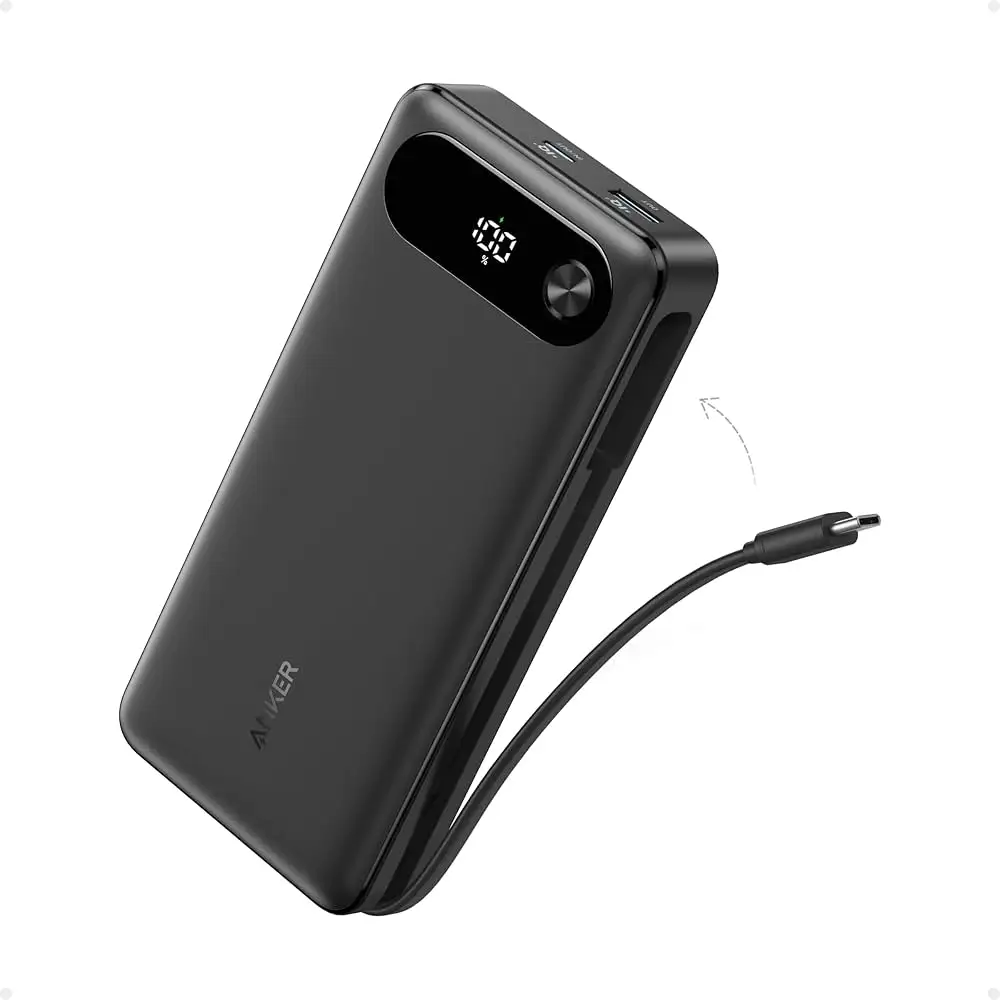
Starting with a quote from a Best Buy shopper who called it “unbeatable reliability, unmatched performance,” the Anker Power Bank 20,000mAh with Built-in USB-C Cable scores an 8.7/10 in real-world feedback. While marketed as a travel-friendly all-in-one charging solution, it’s consistently praised for its charging speed, multi-device support, and solid build — but users warn it’s not the lightest option in the bag.
Quick Verdict: Conditional – Great for power-hungry, multi-device travelers, but weight-conscious users may prefer smaller packs.
| Pros | Cons |
|---|---|
| Charges phones 3–4 times per cycle | Heavier than many expect |
| Built-in USB-C cable doubles as lanyard/handle | Charging the power bank itself can take several hours |
| Fast charging for smartphones, tablets, and laptops | Some skepticism on built-in cable’s “superfast” claims |
| Solid, durable feel with eco-friendly design | Bulky for minimalists or pocket carry |
| Charges up to 3 devices at once | Price higher than entry-level packs |
| Clear digital display for charge percentage | Official specs sometimes differ from real-world output |
Claims vs Reality
One of the boldest marketing points is “fast charging made easy” — promising up to 22.5W via the built-in cable and 30W via ports. Best Buy user Will reported, “It performed well even when plugging in multiple devices at the same time… could fully recharge my phone with about 15% of the battery.” This aligns with specs, though FakeSpot noted, “for the price I was really hoping for superfast charging from the built-in USB-C cord.” That suggests expectations of laptop-like rapid charging aren’t always met.
The convenience angle — a lanyard that’s also a charging cable — gets rave mentions. A Best Buy buyer wrote, “The strap is the charger… for me is a game changer,” while Trustpilot’s product description emphasized durability at over 10,000 bends. Yet, some Reddit voices still question whether integrated cords will keep up with evolving connector standards.
Marketing pushes portability hard, but customer realities temper the pitch. The Amazon listing calls it “power in your pocket” at 315g, but Mina on Best Buy said, “The only down side is that it is a little heavy.” For backpack or desk setups, the heft equals durability; for pocket carriers, it’s a burden.
Cross-Platform Consensus
Universally Praised
Charging speed is the recurring hero. Best Buy reviewer joshuad reported, “It charges my phone super fast… I’ve even used it for my tablet and it handled it like a champ.” This directly benefits travelers and remote workers who can’t linger near outlets. Outdoor hobbyists also benefit — eshakfaragy, working construction, said, “With super fast charging my phone never died.”
The built-in USB-C cable as a combined lanyard is beloved for reducing cable clutter. For commuters, this simplifies setup in cramped spaces like trains or planes. Stephanie noted, “Love that it comes with its own cable… convenient.”
Multi-device output — up to three at once — resonates with families and tech-heavy users. Best Buy’s edwinp valued recharging “three devices at once with its two USB-C ports and one USB-A port,” critical for sharing on group trips.
Durability and solid build are highlighted across platforms. A FakeSpot review summed it up: “The heft speaks directly to build quality,” giving reassurance to those investing for long-term use.
Common Complaints
Weight is the top gripe. While officially 315g, FakeSpot noted “feels heavier… being recorded as lighter.” Backpack carriers aren’t bothered, but pocket users are. Mina’s “a little heavy” resonates with those seeking ultra-light solutions.
Charging the power bank itself, while relatively fast for capacity, still draws critique. FakeSpot flagged “it took about 5 hours to charge to full capacity” from 78%. For those expecting the lightning-fast recharge of models like Anker Prime (100W), this can disappoint.
Expectations for ultra-fast laptop charging via the built-in cable remain divisive. Though it handles most phones tablets well, heavier devices may demand a dedicated cable and port — leading to minor dissatisfaction among power users hoping to skip extras.
Divisive Features
Portability claims cause debate. Amazon markets “slim design” and Best Buy user solc called it “small and easy to carry,” but others view it as wide or heavy. Travel vloggers willing to trade weight for reliability are satisfied; minimalist urban users aren’t.
The eco-friendly material choice wins points for sustainability-minded buyers but isn’t universally prioritized. Some love the reduced plastic waste narrative; others focus purely on functionality.
Trust & Reliability
Trust in the Anker brand is strong. Best Buy’s joelp, a 15-year loyalist, said, “They’ve never let me down… choose the best, choose Anker!” FakeSpot adds that “Anker products have yet to disappoint me… trusted brand name.” Long-term Reddit commentary notes that even after months of use, performance hasn’t degraded noticeably.
The built quality and durability are often linked to its weight — considered a “positive” for those valuing rugged design. No widespread reports of swelling or overheating suggest solid safety engineering, supported by Anker’s ActiveShield 2.0 in other models.
Alternatives
For users seeking true high-speed laptop charging, the Anker Prime 20K (200W) delivers 100W per port and a 100W recharge in just over an hour. Outdoor professionals and content creators might also look to the Anker 87W model with built-in USB-C cable, which can recharge itself in 1.5 hours at 65W, reducing downtime.
Those prioritizing lighter daily carry may prefer 10–12K mAh packs, sacrificing capacity for portability. Anker's smaller PowerCore series offers blends of PD fast charge in slimmer frames.
Price & Value
Current listings range from ~$79.90–$99.00 new, dropping to ~$90 for certified refurbished Anker Prime equivalents. Bulk discounts bring unit prices into mid-$70s. eBay shows stable resale values, indicating strong demand and trust.
Community buying tips emphasize grabbing on sale or refurbished with warranty — ensuring performance without full retail cost. Given longevity reports, paying a slight premium over off-brand alternatives is widely considered worth it.
FAQ
Q: How many charges can I expect for my phone?
A: Users report fully charging most smartphones 3–4 times. Larger devices like tablets get 1–2 charges before depletion.
Q: Is the built-in cable durable?
A: Yes — Anker rates it for 10,000+ bends. Reviewers note it doubles as a lanyard, saving space and hassle.
Q: How long to recharge the power bank itself?
A: With a 30W charger, around 4–5 hours from empty. Faster recharge options exist on higher-end Anker models.
Q: Can it handle laptops?
A: It charges smaller laptops and ultrabooks via USB-C PD, but higher-wattage laptops may charge slower than with dedicated high-output models.
Q: Is it allowed on flights?
A: Yes — at 20,000mAh it’s under the airline limit of ~27,000mAh. Must be carried on, not checked.
Final Verdict: Buy if you’re a traveler, commuter, or field worker running multiple devices, and weight isn’t a top concern. Avoid if you want ultralight minimalist carry or instant laptop refills. Pro tip: pair this with a high-output wall charger to cut recharge downtime.