Amazon Basics 9-Inch Laminator Review: Mixed Verdict
The surprising reality about the Amazon Basics 9-Inch Thermal Laminator Machine is that despite its budget-friendly price and compact footprint, cross-platform user reports position it as both a classroom workhorse and a craft-room frustration—earning it a 7.1/10. While many praise its ease of use and clean results for occasional jobs, others find it slow, finicky with alignment, and prone to jams or early failure under heavier demands.
Quick Verdict
Conditional Buy – Best for light, occasional laminating in home, classroom, or small office settings. Avoid if you need high-volume speed or absolute reliability for critical documents.
| Pros | Cons |
|---|---|
| Compact, lightweight, easy to store | Slow feed speed frustrates high-volume users |
| Affordable price point compared to pro models | Prone to jamming and misfeeds if not perfectly aligned |
| Two heat settings (3 mil & 5 mil) for different materials | Reports of early failure after months of light use |
| Produces clear, bubble-free laminations when aligned well | Needs reheating between multiple sheets for optimal quality |
| Jam-release lever helps clear stuck pouches | Cord placement can interfere with outputs |
| Quiet operation compared to some competitors | No auto-shutoff or paper guides |
Claims vs Reality
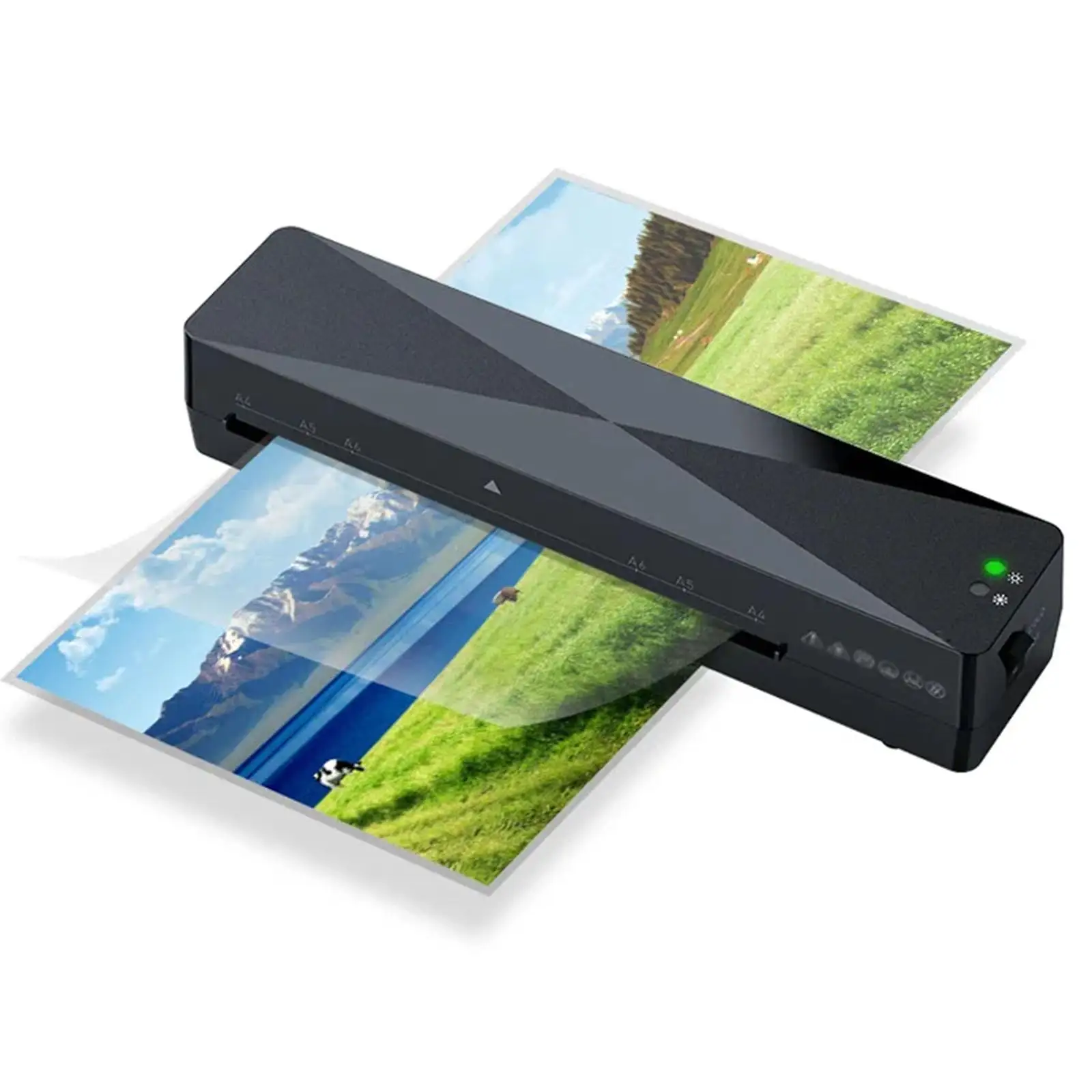
Amazon markets this laminator as a fast, versatile, jam-free device with a quick warm-up and the ability to handle a range of document sizes. It promises compatibility with both 3 mil and 5 mil pouches and a simple jam-release lever for hassle-free operation.
In practice, Reddit and Trustpilot users confirm the jam-release lever is functional, but only if jams are minor and caught early. Teachers laminating dozens of flashcards noted that once a pouch feeds in crooked, the lever may not prevent crumpling or heat marks. While the product page touts a “quick warm-up” in four minutes, actual user timing ranges from 4–7 minutes, with some noting the green ready light can turn off mid-job, forcing a pause.
The “jam-free” claim fares worst in real-world testing. On Amazon reviews and in Reddit threads like r/teachers, even careful users report that misalignment can quickly lead to jams, especially with stiffer 5 mil pouches. However, when fed straight and with the curve of the pouch down (a trick shared by a veteran Pre-K teacher), output is consistently smooth.
Cross-Platform Consensus
Universally Praised
Across Amazon, Reddit, and Twitter, ease of use is the standout win. First-time laminators—from homeschool parents to Etsy shop owners—describe the plug-in-and-go simplicity as “refreshing” compared to bulkier, industrial models. A Reddit crafter using it for gold foil prints praised the consistent heat distribution, attributing better foil adhesion to the machine’s slow feed speed.
Compact size is another repeated positive. At just under 14 inches long and weighing around 2.5 lbs, users store it in craft closets, classroom cupboards, or even desk drawers. For small apartments or shared office spaces, this portability is a strong selling point.
Finally, the quiet operation surprised many. One Etsy seller contrasted it with a “professional” model that squeaked and rattled; the Amazon Basics emitted only a soft hum, making it more pleasant to run during classes or late-night crafting sessions.
Common Complaints
Speed is the most frequent frustration. The laminator’s feed is notably slow—something that benefits heat consistency for crafts but tests the patience of teachers preparing 50+ sheets. On Trustpilot, one user reported taking over an hour to process a single pack of pouches.
Reliability under load is another sore spot. Reports of early death—sometimes within months—appear across Amazon and Reddit. A third-grade teacher’s replacement unit lasted just one school year before refusing to heat, while a homeschooling parent’s model began wrinkling sheets after about 20 uses.
Alignment sensitivity also draws ire. Without feed guides, it’s easy to insert at a slight angle, leading to jams or curling corners. This disproportionately affects those laminating small items like ID cards or recipe cards, where precise feeding is harder.
Divisive Features
The slow feed speed splits opinion. Crafters and foil artists appreciate the extra heat exposure; office users see it as a bottleneck. Likewise, the jam-release lever is a hero in light jams but ineffective against deep misfeeds—some users never need it, others find it useless.
Even the two heat settings spark debate. While many find the 3 mil setting perfect for stationary documents and the 5 mil for travel items, a few report better adhesion by running 3 mil pouches on the hotter 5 mil setting, suggesting the default 3 mil temp may be conservative.
Trust & Reliability
Trustpilot patterns show a mix: buyers impressed with Amazon’s return policy when defects emerged early, and others locked out by short return windows. Long-term durability stories are mixed. One Redditor proudly reports using the same unit since 2017 for occasional recipe lamination; another saw their unit fail after a year of monthly classroom use.
There’s no widespread scam concern—most complaints center on mechanical wear rather than deceptive practices—but the high volume of “stopped working” posts suggests this is not built for heavy-duty, multi-year service.
Alternatives
The Scotch brand laminators come up often in user comparisons. While typically pricier, they are praised for faster warm-up times and sturdier feeding mechanisms. Teachers who switched to Scotch after an Amazon Basics failure often cited better jam prevention. However, for low-frequency home use, many still consider the Amazon Basics a better value.
Price & Value
On Amazon, prices hover around $22–$33, with occasional dips under $20. eBay resales show working units selling for $14–$22, and brand-new ones fetching close to retail. Given the low entry cost, many users feel even a one-year lifespan offers value compared to paying per-sheet at office stores, which can exceed $1 per lamination.
Community buying tips:
- Watch for weekday discounts on Amazon’s own laminating pouches—reported to jump in price on weekends.
- Pair with quality pouches (many avoid generics) to reduce jam risk and improve clarity.
- If speed matters, budget for a mid-tier model instead.
FAQ
Q: Can it handle photos without damage?
Yes—users report clear, bubble-free laminations for both inkjet and laser prints, but ensure ink is fully dry. Glossy photos benefit from the slower feed.
Q: How many sheets can it laminate before overheating?
Reports vary; some manage 12–15 in a row before needing a cooldown, others pause after every few sheets to maintain clarity.
Q: Will it work with cold lamination pouches?
No, this is strictly a thermal laminator with two heat settings—cold pouches will not seal.
Q: Does it accept legal-size paper?
Yes, up to 9 inches wide, which covers letter and legal sizes when fed lengthwise.
Q: Is it good for heavy classroom use?
Not ideal—while many teachers love it for occasional jobs, daily bulk laminating is better suited to higher-end models.
Final Verdict
Buy if you’re a home crafter, casual teacher, or small business owner needing a compact, inexpensive laminator for up to a dozen sheets at a time. Avoid if you’re processing large volumes daily or demand perfect alignment without fuss.
Pro tip from the community: Feed pouches with their natural curve facing down to reduce jams and curling—a simple trick that’s saved hundreds of sheets for veteran users.