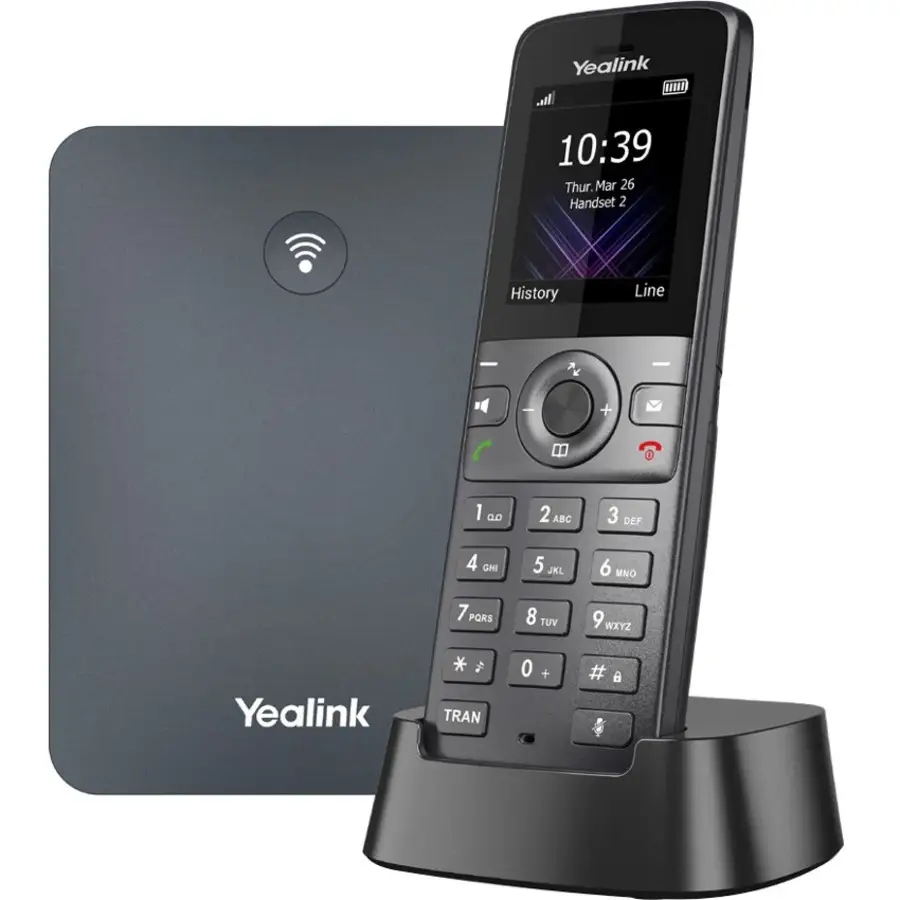
Yealink W73P Review: Conditional Buy Verdict (8.0/10)
“Limited range” is the phrase that keeps surfacing—even as official listings promise up to 300m outdoor coverage. That tension defines the story of the Yealink W73P IP Phone: a business-grade DECT SIP system that’s widely described as easy to deploy and clear-sounding, but not always as far-reaching or flexible as buyers expect. Verdict: Conditional buy — 8.0/10 (based on aggregated sentiment data from Provantage).
Quick Verdict
Conditional — Yes if you want a scalable SIP DECT base/handset setup with straightforward deployment; No if your priority is maximum range across large or complex buildings, or deep call-feature customization.
| What matters | Evidence from sources | Who it helps | Watch-outs |
|---|---|---|---|
| Mobility & flexibility | Provantage highlights “high mobility and flexibility” and being “generally well-received” | Small/medium offices, roaming staff | Coverage can be the limiter |
| Setup & deployment | Provantage calls out “easy set up and deployment”; NFON emphasizes “zero-touch provisioning via… RPS” | IT teams rolling out multiple units | Assumes stable base/network |
| Audio clarity | Provantage cites “robust audio quality”; Amazon specs mention “noise reduction… FNR” and OPUS support | Reception desks, sales teams | Depends on environment and network conditions |
| Scale (handsets/calls) | Amazon specs: “up to 10… handsets… 20 simultaneous calls”; NFON repeats 10/20 | Growing teams, multi-handset sites | Not the same as “unlimited expandability” |
| Range expectations | Amazon specs: “50m indoors and 300m outdoors (ideal conditions)” | Warehouses/light industrial | “Ideal conditions” vs real layouts |
| Customization depth | Provantage flags “limited customization options” | Advanced PBX users | May feel basic for power users |
Claims vs Reality
Digging into the marketing language, the Yealink W73P IP Phone is repeatedly framed as a high-performance cordless SIP DECT solution with strong coverage, strong audio, and business-ready scalability. Multiple product pages stress stability “even in poor network conditions” and “noise-free conversations,” while specs lean on headline numbers like “up to 20 simultaneous calls” and “up to 300m outdoors.”
The reality that emerges from the feedback-style sources is more conditional. Provantage’s summary captures the split cleanly: “The yealink w73p is generally well-received for its ease of use and cost-effectiveness. however, some users report limitations in range and customization.” That statement alone sets up two recurring gaps: coverage isn’t always enough in real spaces, and feature depth may not satisfy advanced setups.
Claim 1: Big range (50m indoor / 300m outdoor).
Official specs on Amazon state “dect radio coverage up to 50m indoors and 300m outdoors,” explicitly tied to “ideal conditions.” Meanwhile, the aggregated sentiment on Provantage warns of “limited range,” saying “dect signal range may not cover large areas.” While officially rated for wide coverage, multiple users summarized in that source report the opposite—suggesting real-world layouts, walls, and interference can shrink those numbers.
Claim 2: ‘Noise-free’ / HD audio in tough conditions.
Retail and manufacturer-style descriptions emphasize FNR and OPUS for clarity—Amazon notes “noise reduction system / fnr,” and Provantage highlights “robust audio quality - supports wideband codecs for clear communication.” The gap here is less about outright contradiction and more about context: claims frequently assume proper network conditions and base placement. Provantage’s caution—“dependence on base station - requires a stable base station connection”—puts a fine point on it: performance hinges on the base environment.
Claim 3: Productivity-ready call handling and flexibility.
Amazon specs promise “up to 10 sip accounts and 20 simultaneous calls,” echoed by NFON (“supports up to 20 simultaneous calls”). Provantage’s “limited customization options” suggests that while call capacity is strong on paper, some buyers expect more advanced call-feature control than the system provides. In other words, capacity isn’t the same thing as configurability.
Cross-Platform Consensus
A recurring pattern emerged across the sources: the Yealink W73P IP Phone is treated as a practical business cordless system that’s easier to roll out than many alternatives, but it’s also described as bounded by DECT realities—especially range—and by a more “basic” ceiling for advanced feature seekers.
Universally Praised
The first consistent theme is deployment simplicity. Provantage characterizes it as “easy set up and deployment,” positioning it as something that “simplifies installation and reduces downtime.” For small IT teams or offices without dedicated telecom staff, that kind of feedback matters: less time fighting provisioning and more time getting handsets into users’ hands. NFON reinforces this deployment narrative by focusing on management tooling, describing “zero-touch provisioning via the yealink redirection and provisioning service (rps).” For organizations scaling from a couple of cordless phones to a fuller SIP DECT setup, that “simple, fast, and centralized deployment” framing is the core appeal.
Mobility and roaming is the second consistent positive. Provantage’s summary explicitly lists “high mobility and flexibility - allows users to move freely while maintaining connectivity.” That’s a specific promise for user types like warehouse supervisors, front-desk staff who float between rooms, or small clinics where staff need to stay reachable while moving. Even the more marketing-forward retail descriptions tie this to eliminating wiring headaches; Amazon’s description says it “significantly eliminates additional wiring troubles and charges,” which aligns with why many buyers choose DECT in the first place.
Audio quality is the third broad positive, though it’s usually stated in codec/feature terms rather than personal anecdotes in the provided data. Provantage calls out “robust audio quality,” while Amazon lists “noise reduction system / fnr (flexible noise reduction)” and OPUS support. For teams that live on calls—sales desks, appointment booking, service dispatch—those are the features that reduce fatigue and miscommunication, especially in noisy environments.
After those narratives, the practical takeaways in the sources are straightforward:
- Strong rollout story: “easy set up and deployment” (Provantage) and “zero-touch provisioning” (NFON)
- Mobility-first design: “high mobility and flexibility” (Provantage)
- Audio feature set: OPUS + FNR called out across listings (Amazon, Provantage)
Common Complaints
Range is the most repeated pain point in the feedback-style summaries. Provantage’s “considerations” section states it plainly: “limited range - dect signal range may not cover large areas.” This matters most for buyers trying to blanket big footprints (multi-floor offices, deep warehouses, older buildings with thick walls). While Amazon and other listings quote “50m indoors and 300m outdoors,” Provantage’s user-complaint summary implies that many people don’t experience those headline numbers once real-world obstacles show up.
A second recurring concern is the system’s dependence on the base station environment. Provantage flags “dependence on base station - requires a stable base station connection.” That’s not a minor operational detail; it means performance can degrade if network conditions are poor, placement is suboptimal, or coverage needs exceed a single base’s practical reach. For remote sites or spaces where you can’t place the base centrally, that dependency becomes the day-to-day frustration.
Customization is the other repeated limitation. Provantage notes “limited customization options - may not support advanced call features.” For a small office that just needs reliable cordless SIP calling, that might be fine. But for more complex PBX users—those wanting deeper call routing nuance, specialized call center behaviors, or heavy per-user customization—this complaint suggests the W73P can feel constrained even if the basics are solid.
Key complaint themes summarized in the sources:
- “limited range” (Provantage)
- “dependence on base station” stability (Provantage)
- “limited customization options” (Provantage)
Divisive Features
Scalability reads as both a selling point and a boundary. Amazon specs emphasize that the system “can register 10… handsets,” supports “up to 10 sip accounts,” and “up to 20 simultaneous calls.” NFON similarly positions this as a differentiator: “allows registration of up to 10 handsets… supports up to 20 simultaneous calls.” For growing small businesses, that’s a meaningful ceiling—enough headroom to expand without replacing the platform immediately.
But the same “up to” framing becomes divisive for anyone who expects cordless systems to scale indefinitely across a campus without additional infrastructure. The sources themselves repeatedly attach conditions—“ideal conditions” for range, optional repeaters mentioned in product pages, and Provantage’s note that coverage may not meet larger-area needs. So the divisive point isn’t whether the W73P scales; it’s how far that scaling goes before you hit practical DECT limits.
Trust & Reliability
From a trust perspective, the dataset here doesn’t provide classic scam warnings or verified long-term “6 months later” narratives from Reddit; what it does include is a consistent positioning of the Yealink W73P IP Phone as a mainstream, business-targeted product sold through recognizable channels (Amazon listings, major resellers like Provantage, and telecom-focused retailers). That distribution pattern typically reduces buyer risk compared with obscure no-name listings.
Reliability signals in the provided sources lean more toward operational assumptions than durability stories. Provantage’s caution about “dependence on base station” is effectively a reliability warning: uptime and consistency depend on how stable your base placement and network connectivity are. NFON’s emphasis on centralized provisioning (“easy deployment and management”) also suggests the reliability story is partly administrative—devices that are easier to provision and update can be easier to keep consistent across a fleet.

Alternatives
Only a few “alternatives” are explicitly mentioned in the provided data, and they’re mostly compatibility references rather than head-to-head competitors. NFON notes the W73P is “compatible with yealink w73h, w78h, w56h, w59r and others,” and eBay seller copy mentions compatibility with “the w90 multi-cell system” for expansion. That frames the real alternative decision as staying in Yealink’s ecosystem but choosing a different architecture when scale demands it.
For buyers outgrowing single-base expectations, the multi-cell direction (referenced as W90 compatibility) becomes the implicit alternative path: rather than expecting one base to cover everything, the data suggests expansion via additional infrastructure is the way organizations handle bigger footprints. If your buying decision is primarily driven by “cover a larger area,” the sources hint that a multi-cell approach may match the need better than relying on ideal-condition range specs.
Price & Value
Price signals vary widely by channel in the provided data. Amazon’s bundle description focuses on what’s included (base + handsets) rather than a clear current price in the excerpt, while eBay listings show new units ranging from roughly $146 (single listing) up to $309.95 + shipping for bundles with multiple handsets. Other reseller pages quote region-specific pricing (CAD amounts, UK pricing ranges, AUD listings), reinforcing that cost depends heavily on market and bundle composition.
On value, Provantage’s sentiment summary frames the W73P as “cost-effective,” especially relative to wiring and deployment overhead: “eliminates the need for additional wiring.” For small businesses, the implied value proposition is not just purchase price but time saved in rollout and flexibility gained by cordless mobility.
Buying tips that follow from the community/reseller patterns in the data:
- Compare bundles carefully (base + how many W73H handsets) before judging price.
- Treat range specs as best-case; if coverage is mission-critical, budget for placement planning or expansion hardware rather than assuming “300m outdoors” will translate to your site.
- If you anticipate growth past a single-base comfort zone, pay attention to ecosystem compatibility references (e.g., multi-cell options mentioned in listings).
FAQ
Q: How many handsets and calls does the Yealink W73P support?
A: The listed specs say the Yealink W73P IP Phone can register up to 10 DECT handsets, support up to 10 SIP accounts, and handle up to 20 simultaneous calls per base (Amazon specs; also echoed by NFON).
Q: What range should buyers realistically expect?
A: Official specs cite up to 50m indoors and 300m outdoors “in ideal conditions” (Amazon). However, Provantage’s feedback summary flags “limited range,” warning that DECT coverage “may not cover large areas,” so real layouts and interference can reduce practical range.
Q: Is the W73P considered easy to deploy for businesses?
A: Yes—deployment is a recurring strength in the sources. Provantage describes “easy set up and deployment,” and NFON highlights “zero-touch provisioning” via Yealink’s RPS, aimed at faster centralized rollouts without extensive manual configuration.
Q: What are the most common complaints from buyer feedback summaries?
A: The most repeated issues are “limited range,” “dependence on base station,” and “limited customization options” (Provantage). These complaints matter most for large facilities, tricky building layouts, or teams needing advanced PBX-style call feature configuration.
Final Verdict
Buy the Yealink W73P IP Phone if you’re a small-to-medium business that values quick deployment and cordless mobility, and your environment can be covered reliably with realistic DECT expectations. Avoid it if your must-have is wide-area coverage through difficult buildings or you need extensive call-feature customization beyond the basics.
Pro tip drawn from the feedback summaries: treat the “50m indoor / 300m outdoor” range as an ideal-case spec—Provantage’s “limited range” theme suggests planning for your specific site matters as much as the handset itself.