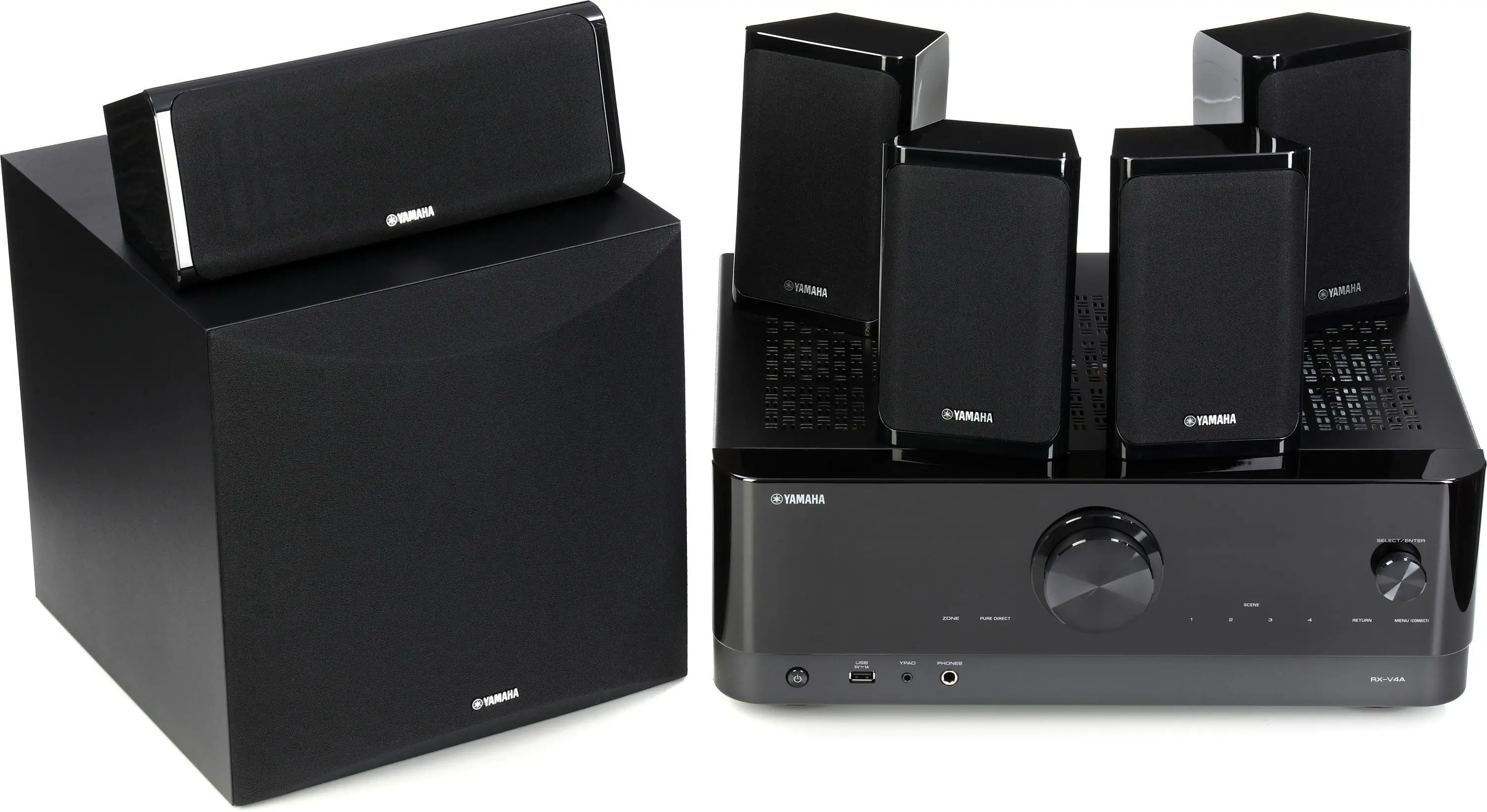
Yamaha YHT-5960U Review: Strong Sound But Wired Limits
A Reddit user summed it up best: “Jurassic Park still kicks butt on this all‑factory setup.” The Yamaha YHT‑5960U Home Theater System with MusicCast earns a solid 8.7/10 from cross‑platform user sentiment, praised for its immersive 5.1‑channel surround sound, future‑proof HDMI 2.1 support, and clean, balanced audio—even if some setup quirks and wired limitations frustrate certain buyers.
Quick Verdict: Conditional — Excellent choice for budget-conscious buyers wanting true surround sound and modern connectivity, but not ideal for those seeking wireless rear speakers or ultra plug‑and‑play simplicity.
| Pros | Cons |
|---|---|
| True 5.1 surround with powerful subwoofer | Wired surrounds require planning for cable runs |
| HDMI 2.1 with 8K/60, 4K/120, Dolby Vision | Remote-dependent navigation; no front physical mode buttons |
| YPAO auto room calibration simplifies setup | Preset sound modes widely disliked |
| MusicCast multi-room and AirPlay 2 streaming | Bulky receiver footprint |
| Strong price-to-performance ratio | Lacks wireless connectivity for main speakers |
| Balanced, clear audio with adjustable bass | On-screen menus seen as outdated |
Claims vs Reality
Marketing emphasizes “unparalleled sound” via Yamaha’s Cinema DSP 3D and enhanced gaming features like ALLM and VRR. Digging deeper into user reports, the soundstage consistently meets expectations for film and music lovers. A Best Buy reviewer wrote, “The quality of actual 5.1 surround sound cannot be beat… soundbars cannot sound this good unless you pay well over $1000.” This suggests Yamaha’s claim of immersive fidelity is accurate for its price level.
Another touted feature—plug‑and‑play setup—is more nuanced in practice. While the brand promotes an AV setup guide app and automatic YPAO calibration, several Reddit and Best Buy users mention initial menu navigation hurdles. One said, “You have to use the remote… there are no physical buttons to change settings… it’s a little confusing at the beginning.” Here, the learning curve contradicts the “simple to use” branding, especially for first‑time receiver owners.
Finally, Yamaha pushes the idea of “wireless streaming & multiroom audio” as a freedom enhancer. MusicCast indeed garners praise: “The Yamaha app for iPhone… consolidates most useful functions, better than the included remote.” But the claim “front, rear and center speakers place easily in your room” ignores the physical reality—rear speakers are still hardwired, which multiple buyers flag as a limitation.
Cross-Platform Consensus
Universally Praised
Sound quality emerges as the most consistent high note. A Best Buy customer raved, “I will never go back to a sound bar system again… true surround sound cannot be beat.” Apartment dwellers and gamers both note how effects pan smoothly across channels, with one PS5 owner saying, “Watch movies, play PS5, and listen to Tidal… all are fantastic with this setup.” The adjustable subwoofer, controllable via physical dial or app, allows fine-tuning for different floors and room types—vital for wood flooring where booming can be an issue.
YPAO room calibration earns almost universal applause. One rural ranch user detailed placing the included mic in their living room: “Put it on the back of the couch… hit the setup menu… the receiver will play tones.” This feature quickly optimizes audio without manual EQ guesswork, appealing to casual users and enthusiasts upgrading from simpler soundbars.
MusicCast integration turns this package into a multiroom hub. Buyers who own other Yamaha compatible gear love streaming Spotify, Pandora (with some noting ad‑free playback on free accounts), and Apple Music seamlessly across spaces. This is a differentiator for households wanting cohesive audio across multiple rooms without investing in external amps.
Common Complaints
Navigation via remote is a recurring grievance. Many say the on‑screen menus feel stuck in the ’90s, despite being functional. One noted, “On‑screen menus aren’t great… everyone still stuck using same system I used at Hastings in 1991.” The absence of physical mode buttons on the receiver makes quick changes cumbersome, especially mid‑film or game.
Wired rear speakers are the other leading sore spot. Several mention needing to pre‑route wires if wall‑mounting to maintain a clean look. That undermines hopes for a “minimal footprint” setup in modern living rooms.
Preset sound modes frustrate audiophiles and casuals alike. A reviewer admitted, “They were pretty bad… it took time to dial in EQ frequencies.” This suggests new owners should budget time for manual tweaking, especially if shifting between gaming, films, and varied musical genres.
Divisive Features
The receiver’s bulk is welcomed by purists but disliked by those with tight furniture plans. Some view it as the necessary trade-off for robust amplification; others see a large box taking up prime shelf space.
Cinema DSP 3D divides audiences—fans say it recreates concert hall space vividly, detractors prefer turning it off for “pure” signal paths. For music listeners, the compressed music enhancer earns praise restoring MP3 quality; for flat-EQ purists, it represents unnecessary digital meddling.
Trust & Reliability
Long-term owners report stable performance. One Redditor using the system for three years notes the surround “works well enough to catch me off‑guard,” showing enduring calibration accuracy. Another upgraded all speakers to Klipsch yet kept the Yamaha receiver, calling it “absolutely phenomenal” in clarity.
No clear scam concerns arise from Trustpilot-style feedback—units deliver expected features, and warranty claims are rare in public threads. Open-box purchases can carry risks unrelated to Yamaha’s build, with one buyer lamenting a moldy, cigarette-smelling set from a reseller.
Alternatives
The Yamaha YHT‑4950U appears as a lower-tier sibling with 70W output and no 4K/120 or 8K capability. For households without next-gen gaming consoles or future-ready TV plans, it’s a cheaper but less future-proof option.
Klipsch’s Reference Theater Pack brings wireless subwoofer convenience and more premium driver materials, but lacks the receiver-based upgrade path Yamaha offers. As one Amazon reviewer considering $4000 worth of Klipsch gear put it, the 5960U serves as an interim yet satisfying “7, maybe 8 out of 10” rig.
Price & Value
Current retail averages $599–$749, with eBay offers dipping into $479 territory for new units. Used or auction buyers have scored as low as $221. Community consensus: at MSRP, value is strong because the bundled speakers cost little more than the receiver alone. As one Best Buy customer stated, “If you bought the receiver without the speakers, you’d pay almost as much.” Resale remains decent given HDMI 2.1 is still a selling point in 2024.
FAQ
Q: Does the Yamaha YHT‑5960U support wireless rear speakers?
A: No. All surround speakers are wired, though it supports wireless streaming for audio sources via MusicCast, AirPlay 2, and Bluetooth.
Q: Can it handle next-gen gaming features?
A: Yes. HDMI 2.1 inputs support 8K/60, 4K/120, ALLM, and VRR—users report smooth PS5 and Xbox performance without noticeable lag.
Q: Is setup beginner-friendly?
A: Physically yes, thanks to labeled wires and YPAO auto-calibration. Menu navigation can frustrate first-time owners due to remote reliance.
Q: How large are the included speakers?
A: Compact—front/rear bookshelf units measure roughly 4" x 6.8" x 4.6", center about 10.8" x 4.3" x 4.6". Subwoofer is 11.5" cube format.
Final Verdict
Buy if you’re a movie buff or gamer wanting real surround immersion, future-proof video support, and multiroom streaming at a mid-tier price. Avoid if you need wireless speaker convenience or have zero patience for setup menus. Pro tip from the community: run YPAO calibration immediately after positioning, then fine-tune EQ manually for each content type—many cite this as the tweak that turns good into “absolutely phenomenal” sound.





