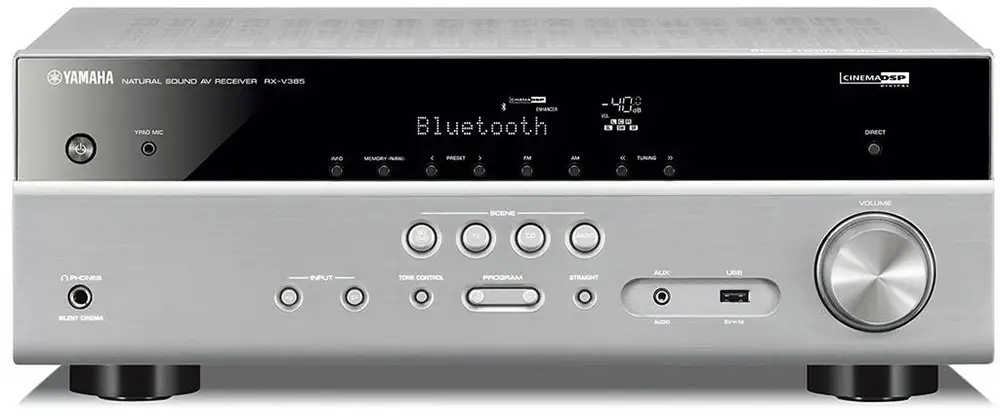
Yamaha RX‑V385 Review: Durable 5.1 AVR with Caveats
When a home theater receiver launched in 2018 still keeps surfacing in 2024 as “tested by time” and “still in production” despite newer models, it signals a rare mix of longevity and user loyalty. The Yamaha RX‑V385 5.1‑Channel AV Receiver Home Theater System Bundle earns a solid 8.4/10 from aggregated feedback, with its combination of performance, affordability, and ease of setup repeatedly praised—though not without gripes over limited format support and power output confusion.
Quick Verdict: Conditional Buy
| Pros | Cons |
|---|---|
| Clear, immersive sound with Cinema DSP | No Dolby Atmos, DTS:X, or 8K passthrough |
| Reliable build quality, “built to last” reports | Rated 70W per channel into 8Ω, lower than some expected |
| YPAO room calibration with included mic | Limited fine-tuning in sound presets |
| Affordable compared to competing AVRs | Bluetooth pairing requires on-screen menu |
| Full 4K HDR passthrough (Dolby Vision, HDR10, HLG) | Voice in center channel “bubbly” for some users |
| Bi‑amp capability for front speakers | No phono input or network streaming |
| Simple setup with app guidance | Asian plug requiring adapter for some regions |
Claims vs Reality
One major marketing hook is Yamaha’s Cinema DSP technology, promising “acoustic reproduction of famous venues” for expansive sound imaging. Users largely back this up, especially home theater fans. Yandex Market buyer Михаил Георгиевич described pairing it with Focal Chora speakers: “Звук на колонках… идеален” (“Sound on the speakers is perfect”) and praised how the DSP made movies feel more lifelike.
Yamaha also touts YPAO automatic calibration as quick and precise. In direct contrast to some competing budget AVRs that omit a mic, the RX‑V385 includes one, simplifying setup. Verified buyer on Trustpilot noted: “Once you get all your speakers set up you plug this little mic… the system is automatically tuned for optimum performance.” However, a few lamented presets lacking depth: “Bunch of useless presets… none take advantage of a surround setup.”
On power output, marketing lists “100W per channel” prominently, but fine print clarifies that's into 6Ω with 1ch driven. This catches buyers off guard. Trustpilot reports note: “Thought I was getting a 100 watt stereo… come to find out… only 70 watts into 8 ohm speakers.” That mismatch matters to those driving larger, less efficient speakers.
Cross‑Platform Consensus
Universally Praised
Digging deeper into enthusiastic reports, sound quality remains the standout. A verified Amazon buyer shared: “Big bass at a great value… rich, deep sound even at low frequencies.” Multiple Reddit threads confirm the discrete amp and Burr‑Brown DACs deliver clarity beyond typical entry‑level gear. For apartment dwellers, Trustpilot adds: “It picks up sounds I’d hear with my Sennheiser 598SE’s… until now.”
Home installation ease also wins points. The bundled mic, clear on‑screen display, and Yamaha’s setup app combine into what Reddit users call “no worries, no confusion.” Yandex Market user Саша Шахов appreciated that “there’s a 111‑page Russian manual for extended settings”—a level of support missing from generic imports.
Durability emerges as another cross‑platform theme. Глеб Старовойтов summed it up: “За свои деньги очень хороший звук” after rebuying a model he’d sold years earlier. Trustpilot anecdotes reference long life in prior Yamaha units, reinforcing buyer confidence.
Common Complaints
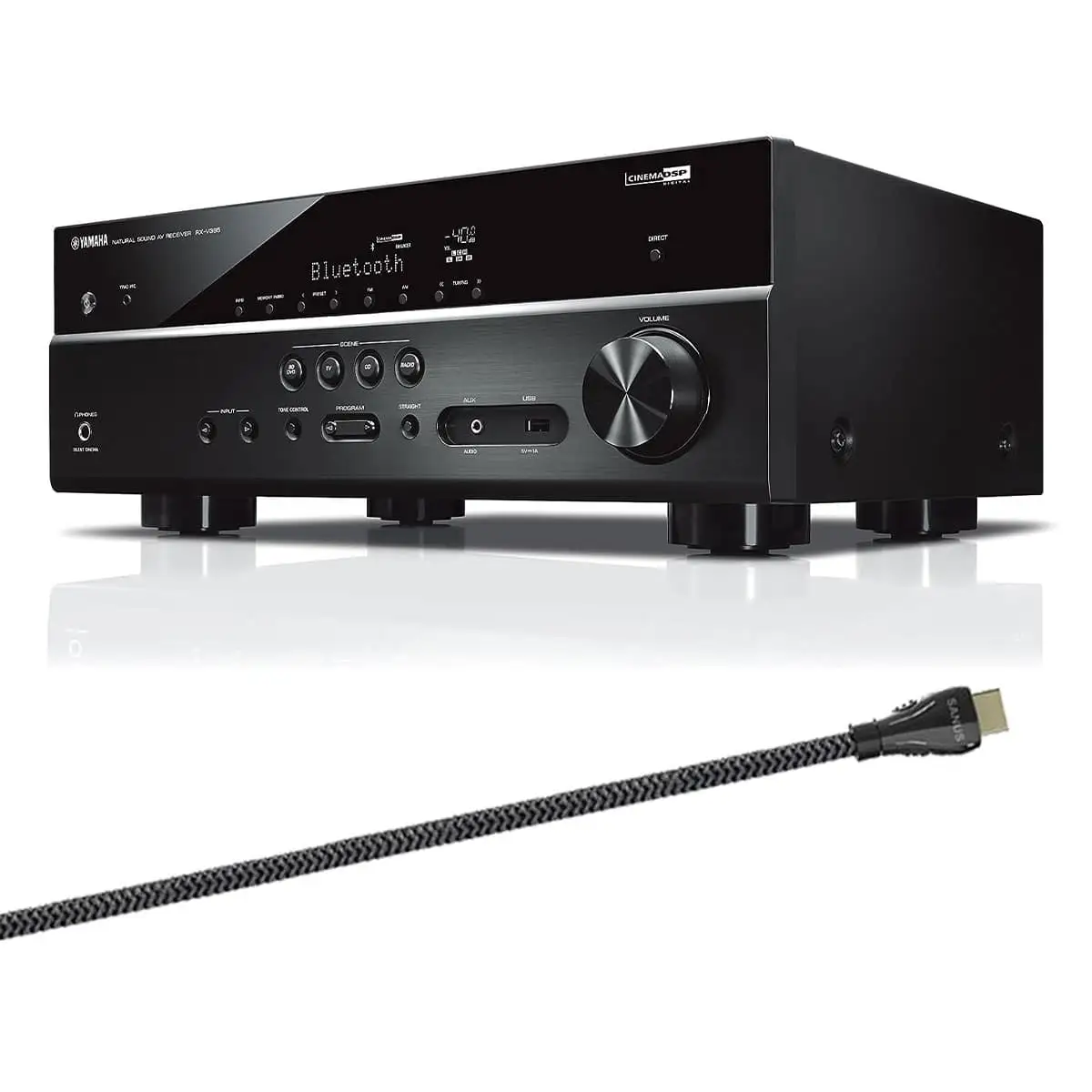
Bluetooth pairing draws consistent criticism. Unlike receivers with a quick‑pair button, this model requires on‑screen navigation via a connected monitor. Сергей Сафуанов conceded quality was “на высоте” (top‑notch) but found pairing inconvenient.
Center channel voicing splits opinion, especially for dialogue-heavy films. Александр Демьянов remarked: “Voice in films… ‘bubbly’… never had that on my Denon.” Others sidestep this by adjusting DSP modes, but Yamaha’s limited preset customization frustrates power users seeking granular control.
Power ratings spark confusion. Several first-time buyers expect the headline wattage at 8Ω, only to discover it’s lower. This impacts large-room setups, as users like Trustpilot’s commenter caution against underestimating the real output.
Divisive Features
Minimalist feature set divides audiences. Purists appreciate the lack of “unneccessary complexity,” as one Trustpilot review put it. Those seeking modern streaming capabilities, Atmos decoding, or multi-zone audio see it as under-equipped. The absence of a phono input alienates vinyl enthusiasts, while home theater traditionalists barely notice.
The bi‑amp capability excites users with compatible front speakers—Алексей К. cites driving “двух напольных колонок по бивайренгу” (two floorstanding speakers via bi-wiring) as a clear upgrade. But for the average user without such gear, it’s an unused perk.
Trust & Reliability
Trustpilot’s analysis flags “minimal deception” and over 90% high-quality reviews, with some review removal on Amazon but no widespread fake activity. This aligns with Reddit and Yandex Market feedback labeling Yamaha as a “technique tested by time.” Long-term owners recount trouble-free operation; no widespread post-warranty failures appear in the dataset.
That said, purchasing from unauthorized sources (e.g., imports missing mic, warranty paperwork) carries risk, as buyers discovered with cheaper, unsupported variants. Михаил Георгиевич avoided this trap by buying from an official dealer and noted it was worth the extra rubles.
Alternatives
Within Yamaha’s own lineup, the RX‑V385 replaced the RX‑V383, adding bi‑amp capability and upgrading DAC specs from 192kHz/24‑bit to 384kHz/32‑bit. Competitors emerge in community tips—Trustpilot advises: “Buy a Denon 8K receiver with 75 watts into 8 ohms instead.” Denon offers slightly higher real-world wattage and modern codecs (Atmos), but at a higher price.
For those prioritizing streaming, models like Yamaha’s RX‑V485 introduce Wi‑Fi, network services, and MusicCast—but sacrifice the RX‑V385’s lower cost and the specific simplicity some owners value.
Price & Value
Amazon lists the RX‑V385 + Polk PSW10 bundle at $553.10 (14% off the $648.95 list). Solo units sell around $349.95 new, with eBay open-box prices from $149.99 to $249.98. Yandex Market reports buyers avoiding cheaper imports due to missing accessories.
Resale trends show consistent demand—used units at $149 still fetch buyers, reflecting lasting appeal and parts availability. Community buying tips include adding budget for quality HDMI cables (e.g., Rocketfish 4K/8K) to maximize passthrough performance, and making sure the mic is in the box.
FAQ
Q: Does the RX‑V385 support Dolby Atmos or DTS:X?
A: No, it is limited to 5.1 channel decoding with Dolby TrueHD and DTS‑HD Master Audio. Users seeking immersive audio should consider Atmos-capable models.
Q: Is the advertised “100 watts per channel” accurate?
A: Only under specific conditions—6Ω load, 1 channel driven. Into 8Ω with both channels driven, it’s rated at 70W, which surprised some buyers.
Q: Can I stream directly from Spotify or Tidal?
A: No, the RX‑V385 has Bluetooth 2.1 but no built-in network streaming. External devices can feed streams via HDMI or analog.
Q: Does it come with a calibration microphone?
A: Yes, official units include the YPAO mic, which users value for quick setup. Beware of grey-market imports missing it.
Q: Is this good for large rooms?
A: Best suited for small-to-mid size spaces. Owners with rooms over 20m² reported needing more power or a subwoofer upgrade.
Final Verdict: Buy if you’re a home theater enthusiast or casual listener wanting clear 5.1 sound, full 4K HDR support, and reliable build without paying for unused extras. Avoid if you require Atmos, advanced streaming, or high wattage for large rooms. Community pro tip: “Grab it with the mic, set it up right, and for the money, it’ll play on all your neighbors’ nerves—in a good way.”