Xiaomi Mi Smart Band 10 Review: Great Value, Key Caveats
A reviewer’s lab meter measured the Xiaomi Mi Smart Band 10 Global Version (Midnight Black) hitting “980 nits” max brightness—well short of the “1500 nits” headline claim. That gap captures the broader story: this band lands a lot of “refined” wins, but its limitations show up quickly depending on how you train. Xiaomi Mi Smart Band 10 Global Version (Midnight Black) verdict: strong value fitness tracker with notable caveats — 8.1/10.
Quick Verdict
For anyone who wants a lightweight tracker for steps, notifications, and lots of sport modes, Xiaomi Mi Smart Band 10 Global Version (Midnight Black) gets a “Conditional Yes.” The “condition” is simple: if you require built-in GPS or NFC payments outside China, multiple sources stress you’ll be disappointed. On the other hand, if you mostly want a comfortable band with a bright AMOLED and reliable heart-rate readings, reviewers consistently describe it as a safe pick for the price.
Digging deeper into reported day-to-day experiences, the band’s biggest strengths show up in “comfort” and “smoothness,” while weaknesses cluster around sleep tracking accuracy and the missing smartwatch-style extras (calls, replying, music storage). NotebookCheck frames it as “a refinement,” praising “accurate measurements” and “very comfortable to wear,” while flagging sleep and connectivity limitations.
| Decision Factor | What the data says | Who it helps / hurts | Source |
|---|---|---|---|
| Display brightness | Claimed 1500 nits; measured “980 nits” | Helps outdoor users, but less “sunlight-proof” than advertised | NotebookCheck.net |
| Heart-rate accuracy | Avg difference “0.51%” vs Polar H10 | Helps cyclists/runners wanting trustworthy HR | NotebookCheck.net |
| Battery life | Brand claim “up to 21 days”; reviewer saw ~6 days with AOD, ~9 without (heavy settings) | Helps travelers; hurts AOD-heavy users expecting 21 days | Xiaomi Global + NotebookCheck.net |
| Built-in GPS | “No satellite connectivity” | Hurts phone-free runners/cyclists | NotebookCheck.net |
| NFC payments | “No NFC support”; other sources say NFC limited to China | Hurts contactless-payment seekers outside China | NotebookCheck.net + Xiaomi for All |
| Sleep tracking | “Sometimes inaccurate”; “not reliable” in sleep efficiency | Hurts users buying mainly for sleep insights | NotebookCheck.net |
Claims vs Reality
Claim 1: “1500 nits” display brightness for “glanceable in any light.”
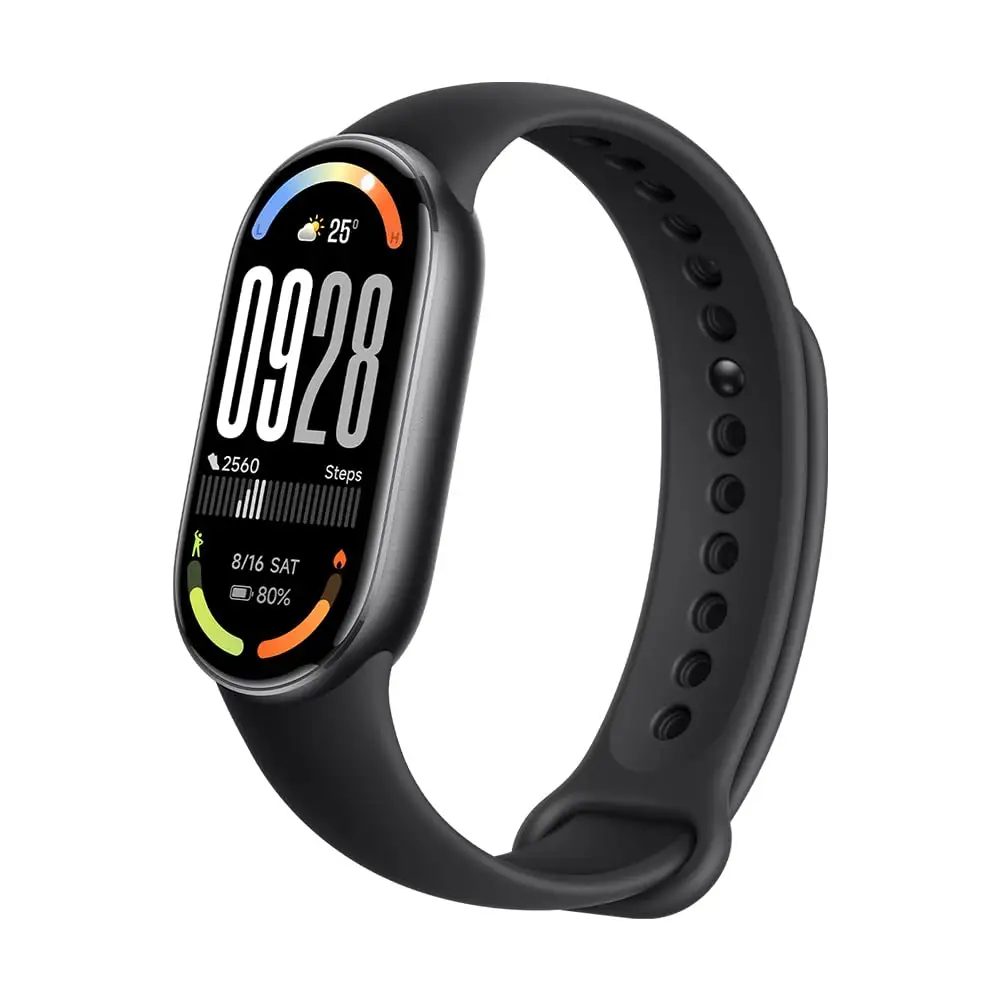
Xiaomi marketing leans hard into the display story—“1500 nits HBM brightness” and ultra-thin bezels. The reality from hands-on measurement is more complicated. NotebookCheck reports: “Xiaomi advertises a display brightness of up to 1500 cd/m², a value we did not achieve in our test,” adding: “we measured a maximum brightness of 980 nits.” That’s still bright, and they stress it remains “brighter than its predecessor and competitors,” but it’s not the headline number.
For outdoor walkers and commuters, that difference matters less than consistency and readability. NotebookCheck still calls it a “very bright AMOLED panel,” and notes reliable wrist-raise wake. The investigative takeaway is that the screen is a strength, but Xiaomi’s peak brightness claim appears optimistic versus at least one reviewer’s instrumented test.
Claim 2: “Up to 21-day long-lasting battery life.”
Official materials position the band as a “set it and forget it” device, with “up to 21-day long-lasting battery life” in typical use. But heavy settings shift the story quickly. NotebookCheck describes its own scenario: “we use all the functions… had the health values measured every minute…” and then reports “around 6 days” with Always-On Display and “around 9 days” without AOD. That’s not a contradiction so much as a reminder that Xiaomi’s 21-day claim is based on a narrow “typical usage mode” recipe.
For power users—people who keep AOD on and crank sensor frequency—expectations should be set by the reviewer’s observed week-ish range. For casual users who accept Xiaomi’s “typical” toggles, the brand claim may be more reachable, but the provided data includes no verified buyer quote confirming 21 days in real life.
Claim 3: Improved sleep intelligence and guidance.
Xiaomi’s product page highlights “enhanced sleep management with personalized guidance.” Yet multiple sources describe sleep tracking as the area where refinement is still needed. NotebookCheck lists as a con: “sleep tracking is sometimes inaccurate,” and goes into specifics: “the results was not reliable… the tracker sometimes failed to recognize long periods of lying in bed before falling asleep, mistakenly recording them as actual sleep.”
For users buying the band primarily as a sleep device, the gap is meaningful: the feature set may be extensive, but the accuracy story is uneven based on this review. That’s especially important because the marketing frames sleep insights as “advanced,” while the reviewer experience flags misclassification in a common scenario (awake-in-bed time).
Cross-Platform Consensus
Universally Praised
A recurring pattern emerged around comfort and wearability. NotebookCheck repeatedly emphasizes how unobtrusive it feels: “very comfortable to wear,” and notes the weight: “with the strap attached… 27 grams; without it, 16 grams.” For office workers or students who want a tracker that doesn’t feel like a mini smartwatch, that matters more than raw specs; it’s the difference between wearing it 24/7 and leaving it on a dresser. Even Xiaomi for All’s positioning reinforces the “lightweight, discreet” appeal, describing it as ideal for those who “prefer a lightweight, discreet device over bulkier smartwatches.”
Accuracy of core health sensors—especially heart rate—also reads as a dependable strength in the available data. NotebookCheck describes a comparison test against a Polar H10 chest strap: “the average difference… was just 0.51%,” with the “largest deviation… one beat per minute.” For cyclists who train by heart-rate zones, that kind of statement is the gold standard of reassurance: the band is being benchmarked against a respected reference device, and the variance is tiny.
The display quality gets praised even when measured brightness falls short of the claim. NotebookCheck still calls it “very bright,” and highlights smoothness: “apps open quickly and transitions in the UI are smooth,” with “no crashes” during their period. For people who mainly want to check notifications and workout stats, “smooth performance” is a practical win—less friction during workouts, fewer missed notifications, less daily annoyance.
After those narratives, the consensus positives can be summarized cleanly:
- Strong comfort/weight story: “very comfortable to wear” (NotebookCheck.net)
- Credible heart-rate accuracy vs Polar H10: “average difference… 0.51%” (NotebookCheck.net)
- Smooth UI operation: “apps open quickly… transitions… smooth” (NotebookCheck.net)
Common Complaints
The loudest complaint theme is what’s missing: location and payments. NotebookCheck lists “no satellite connectivity” and “no NFC support,” and Xiaomi for All echoes the practical frustration: “not having built-in gps means you’re often tethered to your phone,” while also pointing out “global nfc limitation” in their review narrative. For phone-free runners, that tether can ruin the entire point of a minimal band—if you must bring the phone anyway, a larger watch becomes easier to justify.
Sleep tracking is the second major complaint cluster, but it’s more about accuracy than features. NotebookCheck calls it “sometimes inaccurate,” and explains a concrete failure mode: lying in bed awake gets counted as sleep. For users trying to fix insomnia or measure true sleep onset, that’s not a small error; it changes the entire interpretation of sleep efficiency.
There are also smaller usability and “smartwatch limitations” that show up repeatedly in the provided sources. Xiaomi for All notes “no speaker or microphone,” meaning you “can’t make or answer calls,” and flags “no music storage.” NotebookCheck similarly states, “you can’t reply to messages,” describing truncated texts and limited emoji support. For busy professionals hoping for quick replies from the wrist, this band is positioned as a notifier, not a communicator.
After those narratives, the complaint summary:
- No built-in GPS / “no satellite connectivity” (NotebookCheck.net; Xiaomi for All)
- NFC not supported or limited by region (NotebookCheck.net; Xiaomi for All)
- Sleep tracking “sometimes inaccurate” (NotebookCheck.net)
- Notifications limited: can’t reply; long texts shortened (NotebookCheck.net)
Divisive Features
Battery life is divisive because it depends heavily on how you configure the band. Xiaomi’s official framing stresses “21 days,” while NotebookCheck demonstrates how AOD plus frequent sensors compress runtime to “around 6 days,” rising to “around 9 days” without AOD in heavy settings. For minimalist users who disable advanced monitoring, the marketing narrative may feel true; for power users, it won’t.
The interface also splits by user experience level. Xiaomi for All mentions a “slightly confusing interface” where swipe navigation “can be a bit bewildering for first-time users,” even while acknowledging the OS is fluid. NotebookCheck describes the gesture model in detail (swipe directions and edge-swipe back), and generally praises usability and customization. The same gesture-only design can feel “clean and simple” to one user and “where did that setting go?” to another.
Trust & Reliability
Trust concerns in the provided dataset center more on ecosystem and limitations than on fraud or counterfeit reports. NotebookCheck notes Xiaomi “does not provide any details regarding repairability,” and offers no sustainability or long-term service clarity. That isn’t a scam signal by itself, but it does matter for buyers who keep wearables for multiple years and want an easy repair path.
On longer-term durability, the most concrete reliability “story” available is about the strap closure. NotebookCheck reports: “the strap uses a pin closure, which in testing occasionally came undone, for instance when the watch caught on something.” For active users—gym-goers, warehouse workers, parents carrying kids—this is a practical durability risk: a momentary snag could mean the band pops open. The dataset doesn’t include “6 months later” Reddit threads or verified buyer durability diaries, so the only durability evidence here is that closure behavior observed during testing.
Alternatives
The data itself repeatedly frames Xiaomi Mi Smart Band 10 Global Version (Midnight Black) against two in-family alternatives: Smart Band 9 and Redmi Watch 5. The story is not “which is best,” but “which fits your constraints.”
If you already own a Smart Band 9, Xiaomi for All argues the upgrade is evolutionary: “a clear evolution” with a larger display and new metrics, but “the basic experience remains very similar.” NotebookCheck echoes that theme with its verdict line: “not a major new product, but rather a refinement.” For budget-focused users, the 9 may remain the better value if you don’t care about the 1.72-inch screen.
If you’re choosing between this band and a Redmi Watch 5, the decisive factor is GPS and smartwatch features. Xiaomi for All explicitly says Smart Band 10 has “no built-in gps,” plus no calling or voice assistant features, and positions Redmi Watch 5 as the option with integrated GPS and richer “full smartwatch” behavior. For runners who want route tracking without a phone, the Watch-style alternative is treated as the practical solution in the provided sources.
Price & Value
Pricing in the supplied Amazon snippet places the Smart Band 10 around $69.99 for “Mi Smart Band 10 (2025) Global Version,” while NotebookCheck cites an “RRP starting at €50” (with ceramic costing more). Meanwhile, market listings compiled by Globerada show notably lower offers for “midnight black global version,” including “38,38€” on AliExpress with a coupon, and various EU-market offers clustering in the 40–50€ range.
The value narrative depends on what you compare it to. Xiaomi for All frames it as “affordable,” while NotebookCheck notes it “has also become more expensive” compared to prior generations. In practical terms, if you can purchase it closer to the 40–50€ band shown in marketplace listings, the “refinement” upgrades (bigger display, smooth OS, solid HR accuracy) are easier to justify.
Buying tips implied by the data:
- If you need NFC for payments, Xiaomi for All warns “global nfc limitation,” so price-shopping a “global version” won’t fix that.
- If you plan to use AOD heavily, set value expectations around NotebookCheck’s “around 6 days” rather than Xiaomi’s “21 days.”
FAQ
Q: Does the Xiaomi Mi Smart Band 10 Global Version (Midnight Black) have built-in GPS?
A: No. NotebookCheck lists “no satellite connectivity,” and Xiaomi for All explains it “relies on your smartphone’s GPS” for routes. For runners or cyclists who want to leave their phone at home, this is a core limitation.
Q: Is NFC available on the global version for contactless payments?
A: Not reliably. NotebookCheck lists “no NFC support,” and Xiaomi for All states NFC is restricted to the Chinese version, calling it a “global nfc limitation.” If payments are a priority, the provided sources suggest looking elsewhere.
Q: How accurate is heart-rate tracking compared to a chest strap?
A: NotebookCheck reports very close results in its comparison, stating the “average difference… was just 0.51%” versus a Polar H10, with the “largest deviation… one beat per minute.” That implies strong HR accuracy for training zones.
Q: Will it really last 21 days on a charge?
A: It depends on settings. Xiaomi marketing claims “up to 21 days” in typical mode, but NotebookCheck saw “around 6 days” with Always-On Display and heavy monitoring, and “around 9 days” without AOD under the same heavy settings.
Q: Is sleep tracking reliable enough to buy it mainly for sleep?
A: Caution is warranted. NotebookCheck says sleep tracking is “sometimes inaccurate” and describes the band “mistakenly recording” awake-in-bed time as sleep. If sleep accuracy is your top priority, the provided data suggests this is a weak spot.
Final Verdict
Buy Xiaomi Mi Smart Band 10 Global Version (Midnight Black) if you’re a casual-to-intermediate fitness user who values a bright AMOLED, reliable heart-rate tracking, and an ultra-light band for everyday wear. NotebookCheck’s “accurate measurements” and “very comfortable to wear” framing fits that profile well.
Avoid it if your routine requires phone-free GPS workouts or contactless payments in global markets—both are repeatedly called out as missing (“no satellite connectivity,” “no NFC support,” and “global nfc limitation”).
Pro tip from the community-style coverage: if you’re tempted by the “21 days” claim, match your expectations to your settings—AOD and high-frequency health monitoring are where NotebookCheck’s “around 6 days” reality shows up fast.