VTech DS6151-2 Review: Conditional Buy Verdict (7.8/10)
That extra “press Line 1/Line 2” step is the first thing many owners talk about—and it neatly captures the bigger story of the VTech DS6151-2 Cordless Phone System with Answering System, Silver: a capable, business-friendly two-line setup that feels straightforward to some people and oddly finicky to others. Verdict: Conditional buy — 7.8/10.
Quick Verdict
Digging through buyer feedback across Amazon, Best Buy, and aggregated community summaries, a clear pattern emerged: when the system is set up cleanly (and each handset/base volume is configured), many people describe it as a reliable, clear-sounding two-line workhorse for home offices and small businesses. But complaints cluster around call/speakerphone quality variability, readability/lighting, and occasional line/handset quirks that frustrate less technical users.
A Best Buy reviewer summed up the learning curve in one detail: “you have to set the volume for the base unit and each handset individually… it took me some time to figure out.” Another user on Amazon echoed the “extra step” annoyance of two-line operation: “This one requires you select & press either line 1 or line 2… annoys my husband to have that extra step.”
| Verdict | Evidence from users | Who it fits |
|---|---|---|
| Conditional Yes | “cakewalk to setup / use” (Best Buy) | Small offices, home business |
| Strong Pro | “call quality is nice and clear” (Best Buy) | People prioritizing basic clarity |
| Pro | “range is impressive” (Amazon verified purchase) | Larger homes/shops |
| Con | “speakerphone has terrible quality” (ReviewIndex) | Heavy speakerphone users |
| Con | “difficult to read… not lit up enough” (Best Buy) | Low-vision users/night use |
| Risk | “randomly disconnects calls” (ReviewIndex) | Conference-call heavy workflows |
Claims vs Reality
Marketing materials lean hard on two-line flexibility, DECT 6.0 clarity/range, and “hearing aid compatible.” In user feedback, those claims often hold up—but with important caveats that show up repeatedly.
Claim: “Easy to set up and use.”
A recurring pattern emerged in both Best Buy reviews and the ReviewIndex summary: many owners really do find it simple. One Best Buy reviewer called it a “cakewalk to setup / use,” and another said, “This phone has clear sound and is easy to use. The answering portion is easy to set up as well.” ReviewIndex quotes reinforce that tone: “easy to set up and use,” and “the set up & answering machine are good.”
But “easy” isn’t universal. A dissatisfied Best Buy reviewer described it as “difficult to use,” adding: “the phone says i have only line 1 online… line 2 says no line… i am unable to call out.” That gap suggests setup and line configuration can be smooth for some, confusing for others—especially if the environment (VoIP adapters, DSL filters, or wiring) is less straightforward.
Claim: “Clear sound quality.”
Plenty of users praise audio clarity. On Best Buy, one reviewer wrote, “voice quality… has been good,” while another said, “call quality is nice and clear.” An eBay buyer review highlighted “audio quality is very good,” and ReviewIndex includes positive snippets like “working very well,” and “great phone system.”
Yet the same sources also document sharp complaints. ReviewIndex includes: “the speakerphone has terrible quality,” and another user story: “now… it buzzes so loud, you can’t hear anyone on the phone.” A Best Buy reviewer who liked the system overall still warned about “a lot of background noise.” So while marketing promises “crystal clear conversations,” user reality is more conditional—good in many cases, but not consistently “crystal clear,” especially on speakerphone or in noisier environments.
Claim: “Hearing aid compatible.”
Official listings highlight hearing aid compatibility, and at least one Best Buy customer had a positive experience: “i bought this for my dad who wears hearing aids and it is easy for him to use and understand the person on the other end.” But ReviewIndex captures the opposite experience from a specific hearing-aid setup: “this handset claims to be hearing aid compliant but is not detected by my unitron hearing aid.” While officially positioned as compatible, multiple user reports suggest compatibility can depend heavily on the hearing aid model and how it pairs with handset behavior.
Cross-Platform Consensus
Universally Praised
For many buyers, the VTech DS6151-2 earns its keep by being a practical two-line cordless system that feels “built for work.” Best Buy feedback repeatedly frames it as a sensible replacement for aging office phones. One reviewer said, “i needed to buy a replacement phone for our small business and this works well for the price,” while another called it “awesome… for use in a small office.”
Ease-of-use praise tends to come with a “once you learn it” undertone. A Best Buy reviewer described the phone as “well-built” and liked that ringer volume can be set “for the base unit and each handset individually,” even if it “took me some time to figure out.” That same theme appears in Amazon verified feedback about menu navigation: one buyer said the “menu… is easy to navigate,” and another pointed out that programming “the directory and answering machine was straight-forward and easy.”
Range and mobility show up as a concrete win for multi-floor or larger-space users. An Amazon verified purchaser described a three-floor office where “being able to carry a phone… is really handy,” adding “set up… was easy,” and that they “haven’t noticed any issues” with interference. Another Amazon verified buyer using a large shop wrote: “works well in our large building, with good clarity in every room,” calling basic setup strong and the system “highly recommended!”
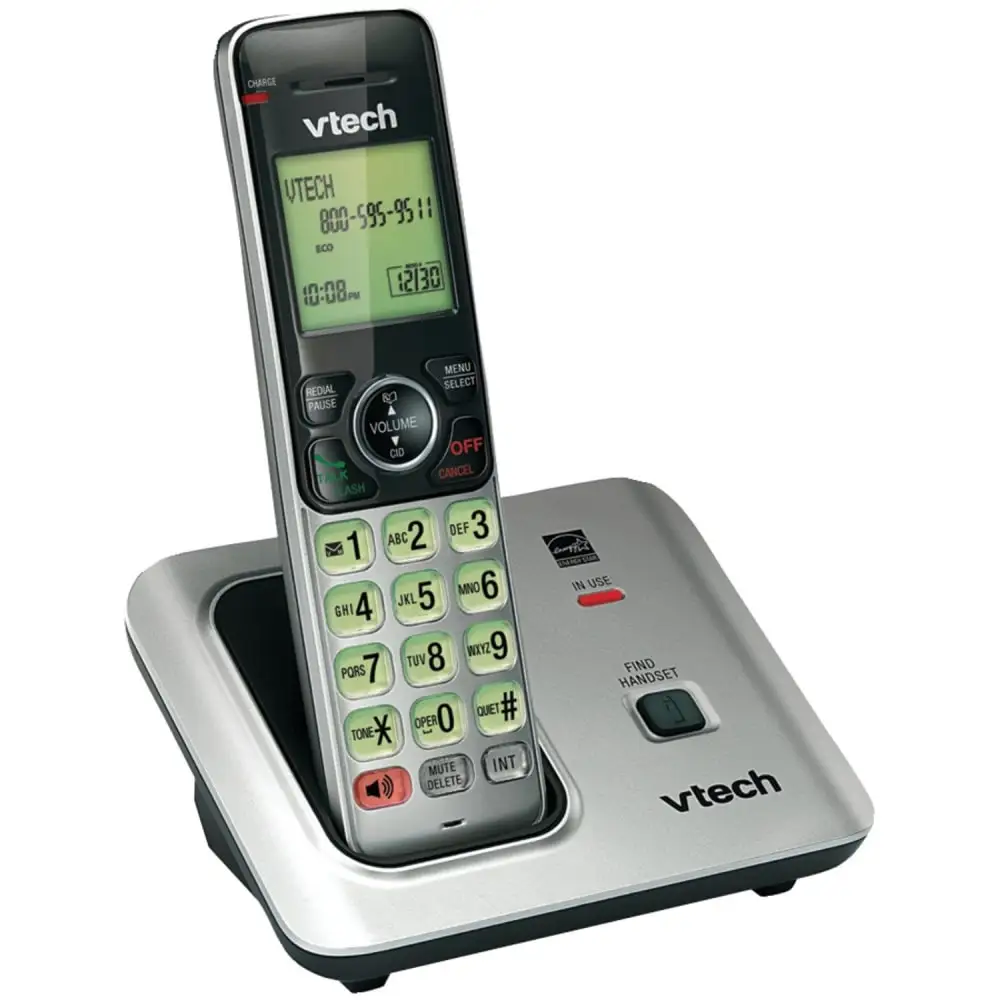
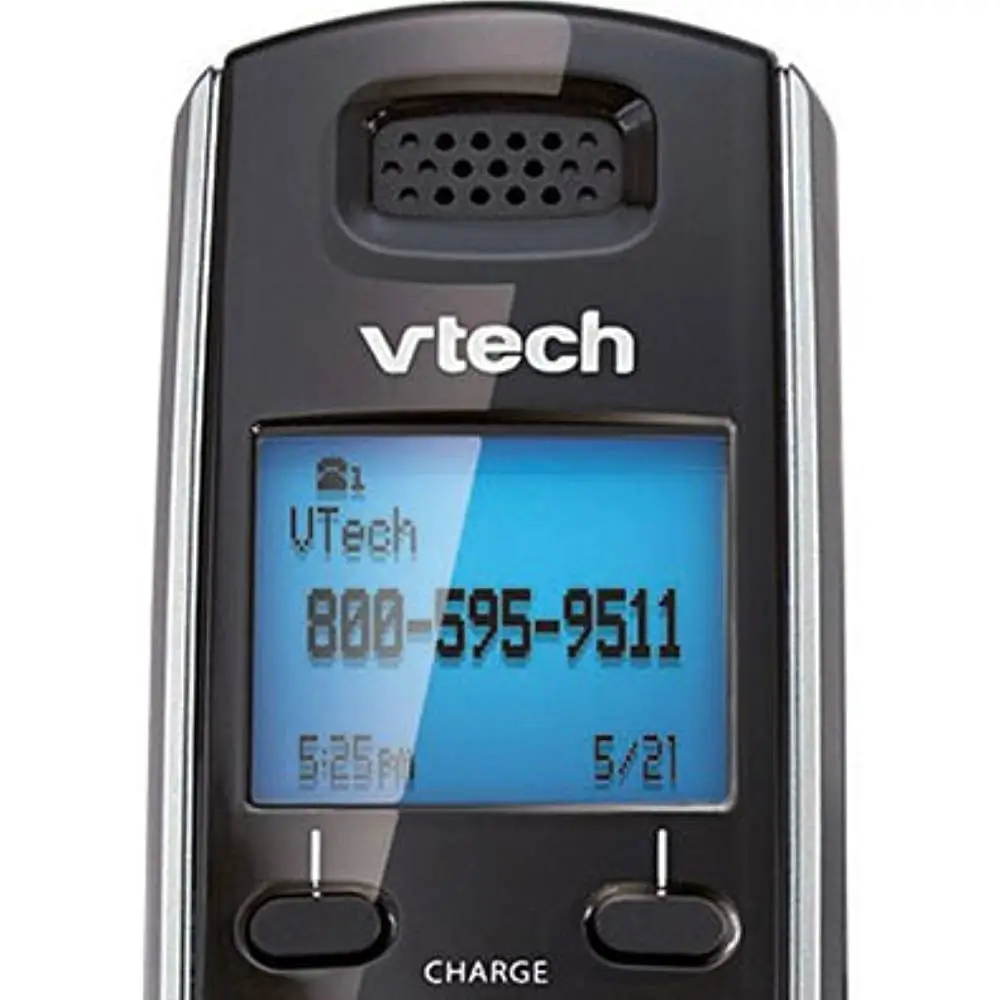
The physical interface gets praise too, especially from older users. A Best Buy reviewer highlighted: “good sound volume, big buttons on face, easy to hold,” and another said it’s “great for older people we can see who’s calling.” ReviewIndex also spotlights controls: “the buttons are nice and big and the backlight… is nice and bright.”
- Most repeated wins: easy setup, solid range, practical two-line basics
- Best-fit users: small businesses, multi-room homes, older users who want big buttons
- Common “pleasant surprise”: clarity and range when installed cleanly
Common Complaints
The most serious negative thread is call quality inconsistency—especially around speakerphone, buzzing, and disconnections. ReviewIndex includes blunt reports like: “the speakerphone has terrible quality,” and “it randomly disconnects calls.” Another user story there describes a progression from okay to unusable: “after 38 days… it buzzes so loud, you can’t hear anyone.” For offices that live on speakerphone or conference calls, those kinds of reports are hard to ignore.
A second frustration is interface/visibility in low light. While some praise the display, others say the opposite. A Best Buy reviewer complained: “the phone is difficult to read (small print and not lit up enough).” ReviewIndex echoes a similar complaint in controls: “only thing i wish was the buttons lit up… i spend a good amount of time using it in the dark.” Even an Amazon verified buyer who liked the system noted: “the screens are not so easy to see, especially in certain lighting.”
Two-line behavior itself can create friction, particularly for households expecting “lift to answer.” An Amazon verified buyer contrasted the DS6151 with an older system: “my old phones would pick up whichever line was ringing… this one requires you select & press either line 1 or line 2.” That extra step is small, but in busy environments it becomes a repeated annoyance—especially if multiple people share the system.
Finally, a subset of complaints involve reliability quirks and accessories. One Amazon verified reviewer described a handset that stopped playing incoming audio: “one of the phones no longer allowed you to hear the customer… the handset… was stuck in ‘headset’ mode,” and they fixed it by disconnecting and reconnecting the battery. Another Amazon verified purchaser reported receiving components that were “open box rather than new,” though “everything seems to work just fine.”
- Biggest operational risk: speakerphone/call stability complaints
- Most affected users: conference-call heavy offices, night/low-light users
- Notable “paper cut”: selecting Line 1/Line 2 to answer
Divisive Features
Ringer behavior is a classic split: some appreciate per-device control, others find it obnoxious or confusing. A Best Buy reviewer was “annoyed by the extremely loud volume of the ringer” until discovering separate volume settings per base and handset. On Amazon, one buyer in a shop environment warned that ringing can bleed into calls: “the ringing will be heard by the person on the other end and it is quite loud,” and their workaround was to “take the handset off the base-station when using the speakerphone.”
The answering system experience also varies. Some users see it as a clean bonus—ReviewIndex includes: “the built in answering machine is a bonus.” Another Amazon verified buyer praised voicemail touches: “you can delete a message without listening to the whole thing.” But ReviewIndex also captures a failure scenario: “we can hear the messages being left but they don’t get saved to the machine.” That division suggests setup and use patterns (and possibly line/provider behavior) strongly influence satisfaction.
Trust & Reliability
Across sources, reliability reads as “good when it works, but not flawless.” ReviewIndex quantifies the split vibe by mixing “working very well” with failure reports like “stopped working” and call-quality deterioration. That matches individual stories: one Amazon verified buyer described a handset issue after a month that was resolved by a battery reset, while another user praised longevity by comparison—“this replaced my office 2-line phone system i had for 10 years” (ReviewIndex excerpt), implying the DS6151 is often purchased as a pragmatic replacement rather than a premium upgrade.
On scam concerns, the most concrete red flags in the dataset aren’t about fraudulent charges—they’re about fulfillment quality and support responsiveness. An Amazon reviewer reported receiving units that appeared “open box rather than new,” and another complained, “i sent you email… but i got no help either,” regarding a “hardware defected” handset. Those aren’t definitive proof of scams, but they do show that when buying through third-party sellers, condition and post-sale support can become part of the risk profile.
For long-term durability, some buyers sound optimistic based on prior VTech ownership. An Amazon reviewer described decade-long use: “to this day, those phones continue to work,” and saw the DS6151 as a familiar, upgraded continuation. Still, other reports—like buzzing after 38 days or handsets that “eventually” need replacement—suggest durability can vary significantly by unit and usage intensity.
Alternatives
Only a few competitors are explicitly named in user feedback: Panasonic, Siemens, AT&T, Uniden. The most consistent comparison theme is cost versus longevity. An Amazon verified buyer described cycling through more expensive sets: “the first one was a siemans… the second was a panasonic… in each case the handsets died once it was out of warranty,” and concluded that this VTech set was “cost effective for our home office.” Another Amazon reviewer called the DS6151 “way better than the panasonic i used to,” framing VTech as a value-first pick that can still satisfy demanding users.
But some users also imply that higher-end business phones may be worth it if call quality sensitivity is high. A Best Buy reviewer advised: “if you need to use a phone more frequently for other business you might want something a little better,” citing background noise. Meanwhile, ReviewIndex includes complaints about conference call dialing and random disconnects—areas where a more business-focused AT&T or Panasonic system might outperform, depending on model.
Price & Value
Pricing in the provided data jumps around depending on seller and bundle. Amazon shows roughly $80.52 for the single-handset DS6151 listing, while Best Buy lists $94.99 (clearance) for the DS6151-2 variant. VTech’s official store pages cited in the data show higher pricing (e.g., $128.95) for DS6151-2 listings, and eBay listings range widely—new around $90.41 in one listing, and used/pre-owned options far lower.
User buying logic often comes down to “features per dollar” for a true two-line cordless system. One Amazon verified buyer in a large shop called it “highly recommended,” emphasizing expandability and range. Another Best Buy reviewer picked it because “the price was right for the product,” and said they’d “definitely buy these again.” At the same time, complaints about condition (“open box”) and defective parts suggest that paying slightly more for a reputable seller can reduce headaches.
- Value sweet spot: small business needing two lines + multiple handsets
- Watch-outs: third-party seller condition; speakerphone expectations
- Practical tip from users: per-handset volume/ringer settings take time to learn
FAQ
Q: Do you have to press Line 1 or Line 2 to answer calls?
A: Yes, many owners say you often must select the line. An Amazon verified buyer noted: “This one requires you select & press either line 1 or line 2.” For households used to “pick up to answer,” that extra step can feel annoying, especially with multiple people sharing the phone.
Q: Is the sound quality actually clear for business calls?
A: Often yes, but not consistently for everyone. A Best Buy reviewer said “voice quality… has been good,” and another reported “call quality is nice and clear.” However, ReviewIndex also includes harsh reports like “the speakerphone has terrible quality” and accounts of buzzing or disconnects.
Q: Does it work well in a large home or multi-floor office?
A: Many users say range is a strong point. An Amazon verified buyer in a three-floor office said carrying a phone between floors was “really handy,” and another reported: “range is impressive.” A shop user wrote it had “good clarity in every room,” suggesting it can handle larger spaces when set up well.
Q: Is it truly hearing aid compatible?
A: Results vary by hearing aid model. One Best Buy reviewer said it worked well for their dad “who wears hearing aids,” but ReviewIndex includes a user report: “this handset claims to be hearing aid compliant but is not detected by my unitron hearing aid.” Compatibility appears real for some, unreliable for others.
Q: Is the display and keypad good for night use?
A: It depends on expectations. Some users praise “big buttons” and a bright backlight, but others complain about low-light usability. A Best Buy reviewer said it was “difficult to read… not lit up enough,” and ReviewIndex includes: “i wish was the buttons lit up… using it in the dark.”
Final Verdict
Buy the VTech DS6151-2 if you run a home office or small business that needs a budget-friendly two-line cordless phone system, values range and basic clarity, and doesn’t mind learning per-handset settings—like the Best Buy reviewer who found it “a good choice” once they figured out volume per handset.
Avoid it if your workflow depends on speakerphone-heavy conference calls or you need guaranteed low-light readability; ReviewIndex complaints like “randomly disconnects calls” and “speakerphone has terrible quality,” plus Best Buy’s “not lit up enough,” point to real risk for those scenarios.
Pro tip from the community: set ringer/volume on every handset and the base individually—one Best Buy user said it’s “a good thing,” but “took me some time to figure out.”