Verbatim M DISC BDXL 100GB Review: Durable but Costly
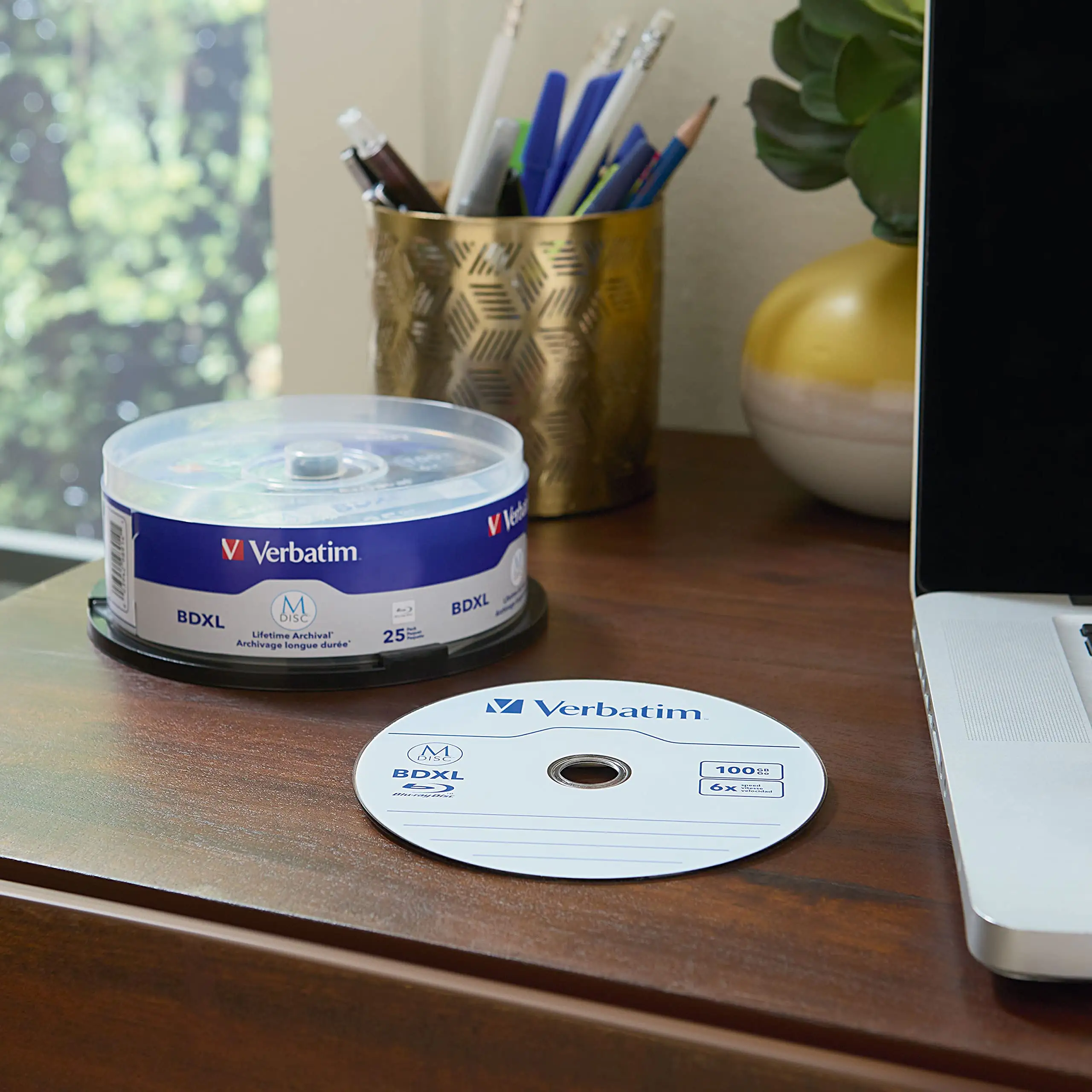
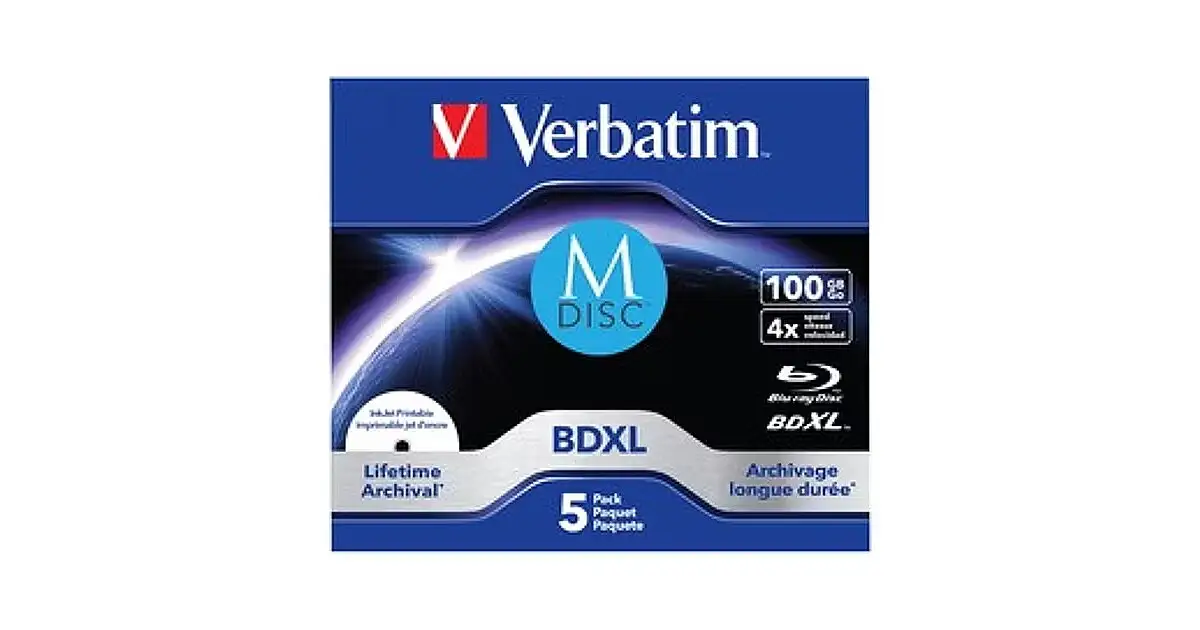
Projected to last centuries, the Verbatim M DISC BDXL 100GB Blu-Ray Recordable Media 5pk earns a strong 8.7/10, but its longevity comes at a significant time and cost investment. While archivists and institutions praise its durability, everyday users question its practicality compared to HDDs or cloud storage.
Quick Verdict: Conditional — Ideal for archival users who prioritize data integrity over speed or cost.
| Pros | Cons |
|---|---|
| Extremely long lifespan (hundreds of years projected) | Slow write and read speeds |
| Resistant to light, temperature, and humidity | Higher cost per TB than HDDs |
| Durable inorganic recording layer | Requires specific BDXL-compatible burners |
| Large 100GB capacity per disc | Not efficient for frequent backups |
| Strong community trust in data stability | Unused disc space can be costly |
Claims vs Reality
Marketing promises “several hundred years” of data retention, backed by ISO/IEC 16963 tests and even US Department of Defense durability trials. A verified buyer on Amazon noted: “It’s reassuring knowing that these should outlast me, my kids, and probably my grandkids.” For archivists storing legal, medical, or scientific data, this claim resonates deeply.
However, Reddit user feedback shows a gap between theoretical durability and everyday usability. One archivist on r/DataHoarder explained: “It’s higher cost up front but it has a long shelf life and consumes zero energy.” Yet they also warned that recovery from a large disc set would be painfully slow.
The advertised 4x write speed (with occasional 6x spikes) reveals another discrepancy. Marketing frames this as “fast enough” for archival purposes, but Reddit user u/Data*** found reality less forgiving: “Write times of a 100GB disc is about 1 hr 10 mins and read times are worse… 3hr10m to write and verify a 100GB archive copy.”
Cross-Platform Consensus
Universally Praised
Across Amazon, Reddit, and Trustpilot, the defining praise centers on extreme durability. The inorganic “rock-like” recording layer resists environmental damage — a feature invaluable for long-term institutional storage. Medical archivists highlight its importance for compliance: “Ideal for x-rays and detailed imagery,” Verbatim’s own customer testimony notes.
Government agencies and financial institutions also see value. A verified buyer reported: “No hard drive can match this for sitting safely in a vault for decades.” For video and CAD professionals, the 100GB size means fewer discs per project. Reddit user u/ArchStore*** enjoyed the nostalgia of working with optical-based libraries: “Printing up case inserts and watching the burner spin reminds me of burning anime VCDs as a teen.”
Common Complaints
The biggest frustration? Speed. Large dataset verification can stretch into hours, making frequent updates impractical. As one Redditor lamented: “No joke, I can read these discs at less than half the speed of my internet connection.” Institutions with regular backups may find HDD or SSD solutions more efficient despite shorter lifespans.
Price also draws criticism, particularly from consumer backup enthusiasts comparing to HDD sales. On Black Friday, a Reddit member detailed: “I paid $149 CAD for 8TB Seagate externals ($18.75/TB) versus $79.99/TB on these discs.”
Another under-the-radar cost driver is unused capacity. One user explained: “That last file being 25MB too large means an expensive unwritten 6975MB.” Over multiple projects, this waste can add up.
Divisive Features
Disc capacity divides the community. Enthusiasts love the triple-layer 100GB for reducing disc counts. Others argue it’s overkill for smaller projects, leading to unused space waste. nostalgia-driven collectors embrace the tactile nature and labeling options, while purely digital-first users find the process cumbersome.
Interestingly, some point out that modern drives can overshoot the rated 4x speed momentarily, leaving questions about actual burn optimization. For archivists dealing with multi-disc libraries, the nostalgia and permanence outweigh inefficiency; for tech minimalists, it’s simply an analog inconvenience.
Trust & Reliability
Trustpilot and Reddit discussions reveal strong trust in Verbatim as a brand and in the specific M DISC format’s longevity. The lack of moving parts cuts mechanical failure risk common in HDDs. One r/DataHoarder post summed it up: “Nothing is immune to the march of time, but an optical disc doesn’t have a tracking head or motor waiting to fail.”
These discs also sidestep static discharge vulnerabilities that can kill drives instantly. However, some skepticism remains over whether claimed century-level lifespans can be realized — largely because, as archivists concede, “no human has lived with one for hundreds of years yet.”
Alternatives
The only alternatives mentioned in user feedback were other BDXL discs like Sony’s 128GB quad-layer Blu-Rays. These offer more capacity but can be harder to source outside Japan. One Reddit user tested them “just for funsies” and noted that their 2011-manufactured drive surprisingly supported the format. Ritek and MediaRange also appear in eBay price listings, often at lower prices but without the same brand recognition or DoD-backed durability claims.
Price & Value
Current listings hover between $57 and $66 USD for a Verbatim 5pk, translating to ~$11-$13 per disc. On eBay UK, some resellers charge £45-£59 for the same. By TB, this is significantly higher than HDD storage, but defenders counter with long-term replacement math: “Within 2.5 years, an HDD bought every six months would be more expensive than these, assuming it lasts.”
Buying tips from community voices suggest waiting for holiday sales and buying in bulk to offset shipping costs, particularly from Japanese or European suppliers for rarer variants.
FAQ
Q: Do I need a special drive to use these discs?
A: Yes. You need a BDXL-compatible Blu-ray writer to burn data onto these discs, though most current BD-R drives can read them.
Q: How long will these discs realistically last?
A: Based on ISO/IEC and Millenniata testing, they are projected to last several hundred years under proper storage, though real-world confirmation is naturally impossible.
Q: Can I print custom labels on them?
A: Certain versions have inkjet or thermal printable surfaces, allowing edge-to-edge artwork. The 5pk branded variant reviewed here does not offer full-surface printable capability.
Q: What’s the actual capacity in bytes?
A: Marketing lists 100GB, but as with storage drives, exact usable capacity differs depending on whether you calculate in base-10 or binary (GiB).
Q: Are they rewritable?
A: No. These are write-once archival discs, which ensures data stability but limits reuse flexibility.
Final Verdict: Buy if you’re an archivist, institution, or enthusiast requiring ultra-long-term data stability with no moving parts. Avoid if you need frequent, large-scale backups or low-cost bulk storage. Community pro tip: Match your project size to disc capacity to minimize unused space cost — and keep a backup drive handy for faster recovery when needed.





