Ubiquiti UniFi Dream Router 7 Review: Worth the Upgrade?
A Reddit user summed up a hard truth about the Ubiquiti UniFi Dream Router 7 (UDR7): "For your speed and with no Wi-Fi 7 devices, not really worth it… but this is Ubiquiti, just go ahead and buy one." That blend of caution and brand loyalty captures the 8.8/10 overall sentiment—stellar for the right setup, but unnecessary overkill for others.
Quick Verdict: Conditional — Excellent for multi‑gigabit or Ubiquiti ecosystem users, but wasted on slow connections or non‑Wi‑Fi‑7 devices.
| Pros | Cons |
|---|---|
| Full Wi‑Fi 7, tri‑band, 2.5GbE & 10Gbps SFP+ ports | No second 10Gbps ethernet port |
| Integrates full UniFi application suite | Single low‑power PoE port limits AP expansion |
| Solid security at 2.3Gbps IDS/IPS | 2.4GHz band speed lags behind peers |
| Compact “egg” design with front LCM display | Internal fan, microSD slot placement awkward |
| Seamless use with UniFi Protect cameras | Needs extra APs for multi‑floor coverage |
Claims vs Reality
Ubiquiti markets the UDR7 as a "modern network management center" that can replace several devices with integrated routing, switching, PoE, camera storage, and advanced firewalling. On paper, it sounds universally appealing—tri‑band Wi‑Fi 7 up to 5.7Gbps, 300+ client support, plus multi‑gig ports including a 10Gbps SFP+ uplink.
However, digging deeper into user reports, the benefits hinge heavily on having the right complementary hardware and internet speed. A Reddit user cautioned that with only 300/300 fiber and no Wi‑Fi 7 clients, "not worth the price… for the Ubiquiti experience, yes." This shows a gap between the high‑end spec sheet and the everyday gains for legacy device owners.
Another claim is wide coverage up to 160m² (~1,750 ft²). While RTINGS and Dong Knows Tech found coverage solid—actually closer to 2000 ft² in optimal placement—the 6GHz band underperformed at range, with ~25% reduction compared to lower bands. In smaller open spaces, it excelled, but in a Reddit bungalow case, "poor signal, tried everything, disconnections all the time" highlighted real‑world limitations in tricky layouts.
Ubiquiti also touts NVR functionality with included 64GB microSD and UniFi Protect integration. This does work as advertised—even Coolblue points out you can “connect an IP camera directly and store footage." Yet reviewers noted practical frustrations like Dong Knows Tech's "impossible to remove the card without unplugging either the SFP+ or power cable."
Cross‑Platform Consensus
Universally Praised
For users with multi‑gigabit setups, the wired performance is outstanding. Dong Knows Tech found it “among the fastest hardware with the 2.5Gbps port grade,” and RTINGS recorded 1,050Mbps average at short range over 6GHz. Gamers and streamers appreciated this headroom: Coolblue’s expert lists “fast enough to stream, game and work at the same time” as a key selling point.
The integration with UniFi's full application suite was a standout. UDR7 can run Network, Protect, Talk, Access, and Connect—making it a hub for APs, cameras, VOIP systems, and even EV chargers. For small business IT admins, this consolidation is a cost‑saver. Dong Knows Tech explained you could “add APs, cameras, phones all managed from the same web UI, without a login requirement if preferred” which appeals to privacy‑conscious enterprise setups.
Security at speed is another plus. While some routers slow down drastically with IDS/IPS enabled, the UDR7 maintains ~2.3Gbps throughput under full protection—matching its port speed. This eliminates the trade‑off between network safety and performance, something advanced home users and SMBs value highly.
Common Complaints
The most consistent criticism is the port configuration. There's only one 10Gbps port (SFP+), so running 10Gbps both WAN and LAN isn’t possible without external gear. High‑end enthusiasts expecting full 10GbE inside their network were disappointed. Even Dong Knows Tech lamented, "dashing the dream of those wanting… on both the WAN and LAN sides."
The single PoE port is limited to 802.3af, not powerful enough for current Wi‑Fi 7 APs like U7 Pro Max. This means buyers planning large expansions must budget for extra PoE switches. For multi‑floor coverage, multiple sources (Coolblue and Reddit) note it won't replace mesh nodes: “For a stable network on multiple floors, you have to add Ubiquiti access points.”
Performance on the 2.4GHz band is weak compared to competitors—Dong Knows Tech found it “the slowest among similarly specced hardware.” For IoT or older laptops that still rely heavily on 2.4GHz, this could translate into sluggishness.
Divisive Features
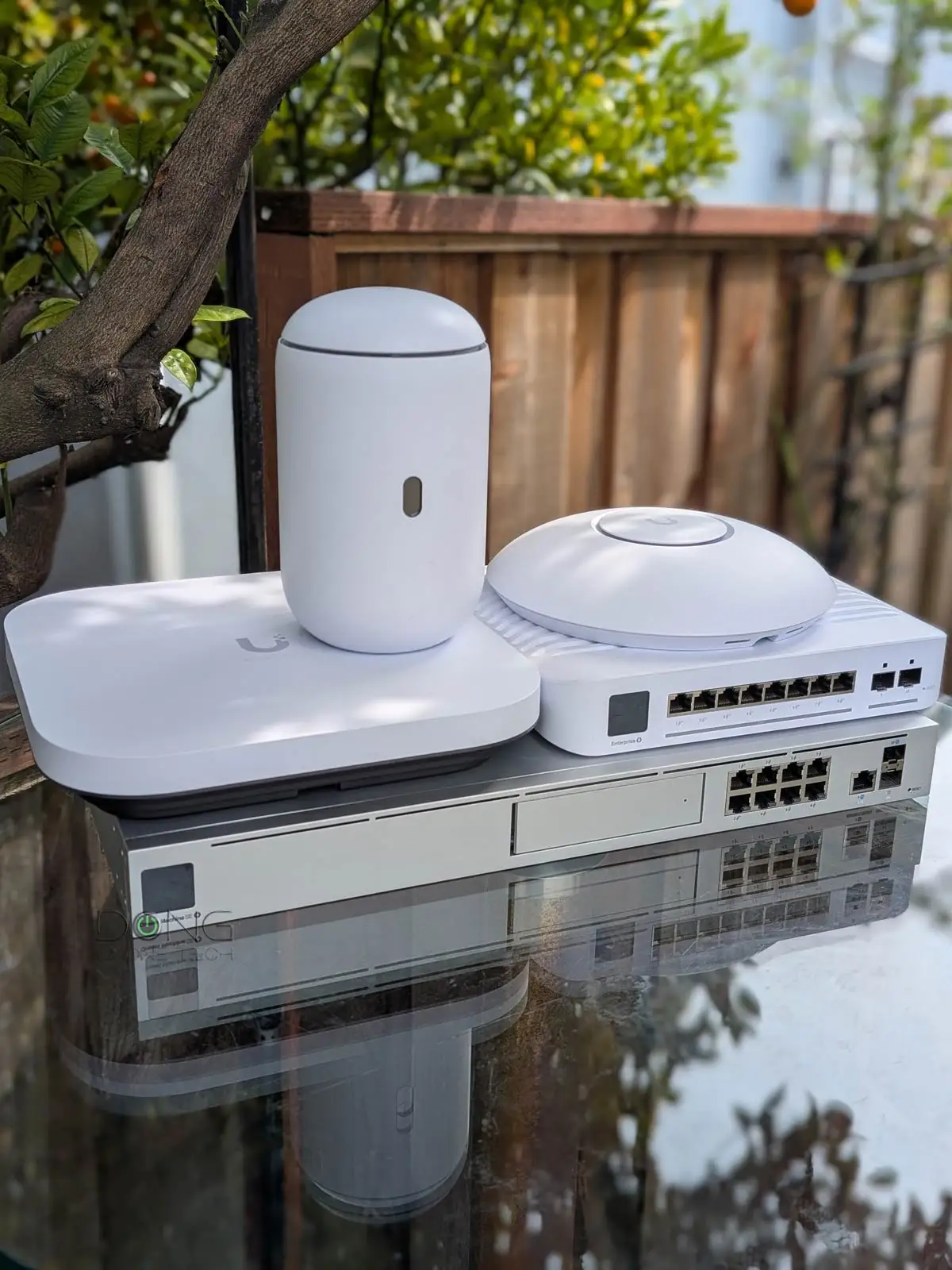
Form factor and design polarize users. Some love the compact, egg shape with status LED ring and LCM front display—Dong Knows Tech called it “compact and beautiful.” Others in Reddit threads value wall‑mount options, which this lacks, making desktop placement more awkward.
Privacy handling splits opinion. While you can locally manage the router without a cloud account, enabling full remote features requires signing into a UI account—a step some see as “convenience” and others as “privacy risk.”
Trust & Reliability
No widespread scam concerns emerge, and long‑term reliability has precedent in the Dream series. Dong Knows Tech pointed out his UDM from 2019 “working trouble‑free” still, reassuring buyers about longevity of the chassis design. The UDR7’s active cooling fan has been quiet in tests, and temperatures stay modest—RTINGS didn’t flag overheating.
On the flip side, the microSD slot’s placement between the SFP+ and power port is an ergonomic nuisance over time, though likely irrelevant for users who rarely swap cards.
Alternatives
Ubiquiti’s own UniFi Express 7 offers similar Wi‑Fi 7 tri‑band performance but omits the full application suite and scales down ports—only one PoE‑less 2.5GbE LAN port—at lower cost ($199). RTINGS found UDR7’s 5GHz band range slightly better than UX7.
Eero Max 7 delivers faster speeds and better range in mesh setups, but lacks Ubiquiti’s enterprise‑grade management, PoE, and app ecosystem. Amplifi Alien trades top‑end wired port speeds and enterprise features for broader range in its consumer‑focus design.
For Wi‑Fi 6 owners, the older UDR remains relevant—two PoE ports and decent gigabit throughput make it fine for sub‑gigabit plans.
Price & Value
Prices range from $257 to $279 in US markets, though Australian resellers list above $500 AUD. Given the multi‑gig port suite, integrated apps, and Wi‑Fi 7, the UDR7 undercuts many enterprise competitors in cost while outperforming similarly priced consumer routers in configurability.
Community buying tips stress avoiding this model if your ISP speed is under 1Gbps or your devices lack Wi‑Fi 7—money would be better spent on better AP coverage or a PoE switch. For SMBs or tech enthusiasts already invested in UniFi infrastructure, it’s seen as excellent value, replacing multiple standalone devices.
FAQ
Q: Can the UDR7 work as an access point only?
A: No, it functions as a cloud gateway and cannot be repurposed into a mesh point. You’ll need dedicated UniFi APs like the Express 7 for AP‑only roles.
Q: What PoE standard does its LAN port support?
A: It supports 802.3af PoE only—sufficient for cameras or phones but underpowered for modern Wi‑Fi 7 access points.
Q: How many UniFi devices can it manage?
A: Officially 30+, including APs, cameras, and phones. Compared to the UDR, it adds capacity for 10 more devices.
Q: Does it require a Ubiquiti account to use?
A: No, local management is possible via web UI or mobile app in “local mode,” though some remote features require a UI account.
Q: What’s the real coverage area?
A: Optimal placement in open layouts yields ~2000ft², though the 6GHz band drops about 25% at range.
Final Verdict: Buy if you’re a UniFi ecosystem user with 2.5Gbps or better internet, need integrated camera/VOIP management, and value granular network control. Avoid if your home has heavy 2.4GHz reliance, you need dual 10GbE, or you expect full coverage without satellites. Pro tip from the community: pair it with strategically placed UniFi APs and a PoE+ switch to unlock its full potential.





