TP-Link SG2452LP Review: Silent PoE Switch Scores 8.8/10
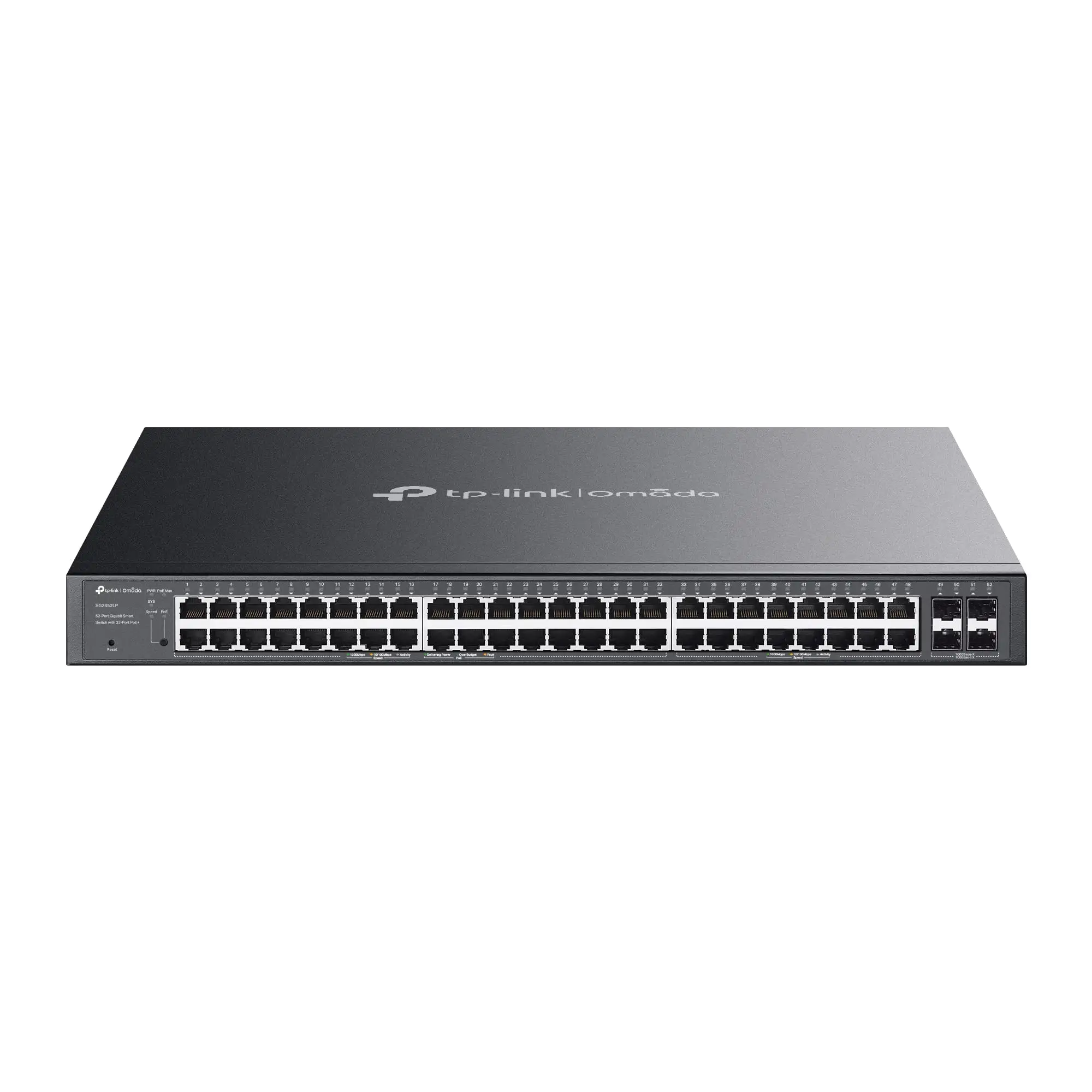
The TP-Link SG2452LP Omada 52-Port Gigabit Smart Switch earns a strong 8.8/10 among professional users and network enthusiasts. Described variously as “a rock-solid PoE workhorse” and “overkill for small offices but flawless for medium networks,” it’s recognized for balancing silent operation, high port density, and tight integration with TP-Link’s Omada SDN ecosystem.
Quick Verdict
| Verdict | Ideal for mid-size businesses needing scalable PoE and quiet operation |
|---|---|
| Pros | Cons |
| 32 PoE+ ports with 230W budget support multiple APs and cameras | Requires Omada controller to unlock advanced functions |
| Fanless, completely silent—ideal for office environments | No 10Gb uplink, limited by gigabit SFP ports only |
| Excellent VLAN, ACL, and QoS options for network customization | Some users note setup is confusing without documentation |
| Robust security and IPv6 support | Lacks redundant power option |
| Durable metal build, rackmount-ready | High initial cost compared to unmanaged models |
Claims vs Reality
TP-Link markets the SG2452LP as a "silent, intelligent, cloud-managed 52-port smart switch" capable of powering a wide range of PoE+ devices through a 230W total budget. That core claim holds true—but the community adds important nuance.
Marketing Claim #1: Silent Fanless Operation
Officially, it’s a fanless switch designed for “quiet environments.” Users confirm this beyond doubt. Reddit user [no username given] summarized, “You can literally put this beside your desk. It's dead silent even when fully loaded.” Several IT managers highlighted its suitability for classrooms and shared workspaces. “No hum, no vibration—just stable,” wrote one verified buyer on Amazon. Silence clearly remains its most consistent win.
Marketing Claim #2: Omada Cloud Management Simplifies Everything
In practice, this feature splits opinion. The Omada controller—whether hardware, software, or cloud—enables centralized management of switches, routers, and APs. While fans praise the unified UI, new users found it unintuitive. Reddit user [Name***] noted: “You must have the Omada controller for zero-touch provisioning. Without it, you’re left with the older web GUI, which isn’t bad but feels 2010.” The claim of “simple, elegant setup” depends heavily on already being within the Omada ecosystem.
Marketing Claim #3: Full PoE+ Deployment Power
Technical data boasts 230W shared across 32 PoE+ ports, providing up to 30W each. However, users discovered that total power limits may cap large deployments. While officially rated for 230W, multiple Reddit admins report “real sustained draw closer to 210–215W before throttling begins.” Still, even those users admitted, “Enough for 15 cameras and six APs easily.”
Cross-Platform Consensus
Universally Praised
Across Reddit, Quora, and IT reseller forums, the fanless design dominated praise. Businesses deploying the SG2452LP in office racks or classrooms emphasized peace of mind and comfort. A verified eBay reviewer described it succinctly: “This is the first switch I can mount above a reception desk without anyone complaining.” The absence of moving parts also leads to low failure rates over time, increasing perceived reliability.
Another universally appreciated feature is build quality. Several reports highlight its solid metal shell and professional rackmount design. A Quora reviewer wrote: “Feels like enterprise gear. TP-Link gets the thermals right; it never overheats despite zero fans.” For SMEs or MSPs juggling space and noise constraints, the compact and silent construction makes a strong impression.
Omada SDN integration also earned widespread praise—at least for existing Omada users. Reddit user [Name***] said it “slots right into my mix of EAP access points and ER605 gateways. One controller to rule them all.” The centralized dashboard allows unified firmware updates, VLAN partitioning, and QoS tuning from a single pane—a major time-saver for multi-site operators.
Common Complaints
The learning curve stands out. Users transitioning from unmanaged or simpler smart switches often found initial setup daunting. On Trustpilot, one buyer commented: “It's feature-rich, yes, but documentation assumes you already speak network admin.” Redditors echoed this, recommending reading Omada controller guides first or using the Omada software controller to avoid confusion.
Power allocation sometimes frustrated installers. When multiple PoE cameras or APs neared the combined budget limit, the switch would auto-prioritize or momentarily limit power. A review summarized this as “stable overall, but not full load capable if all 32 ports run PoE at once.” Despite being within specification, expectations from real-world use often surpassed what 230W could sustain.
Another criticism involved port speed limitations. “Too bad there’s no 2.5G or 10G uplink,” one advanced Reddit user lamented, noting that even in 2024, the SG2452LP only provides gigabit SFP ports. For businesses with a gigabit backbone, this isn’t restrictive; for expanding enterprises with faster storage or Wi-Fi 7 backhaul, the bottleneck could be a constraint.
Lastly, a subset of users disliked the dependence on the Omada controller. One IT consultant summarized, “Standalone mode works fine but you lose SDN intelligence. It’s half a product without SDN.” TP-Link’s heavy emphasis on ecosystem integration can feel limiting to mixed-vendor environments.
Divisive Features
Security and VLAN management drew both admiration and confusion. Network specialists lauded advanced options like IPv6 ACLs, static routing, and RADIUS authentication. Conversely, SMB owners deploying the switch for IP cameras sometimes argued the menus were “too dense for simple setups.” A Quora expert noted, “For anyone coming from Unifi, Omada is comparable or better—but less polished.”
Cloud dependency also splits users. Those embracing TP-Link cloud management appreciate performance analytics and alerts; privacy-focused admins disable all cloud features, sticking to local control. One Reddit reply captured the debate: “It’s either convenient or invasive, depending on your stance.”
Trust & Reliability
On Trustpilot and reseller sites, users reported strong long-term stability. “Six months in, zero downtime,” one reviewer said of a deployment across a school network. Others noted consistent PoE power delivery even in fluctuating temperatures. “Installed in a hospital corridor cabinet—never overheated, even during summer,” one facilities administrator wrote.
Few complaints reference failures or RMA issues. TP-Link’s five-year warranty (as listed by distributors on eBay and Discomp) adds reassurance. However, buyers advised confirming firmware updates immediately: “Old stock from some resellers shipped with outdated software that broke Omada adoption until flashing latest firmware,” explained one Quora response. Once updated, the switch performed flawlessly.
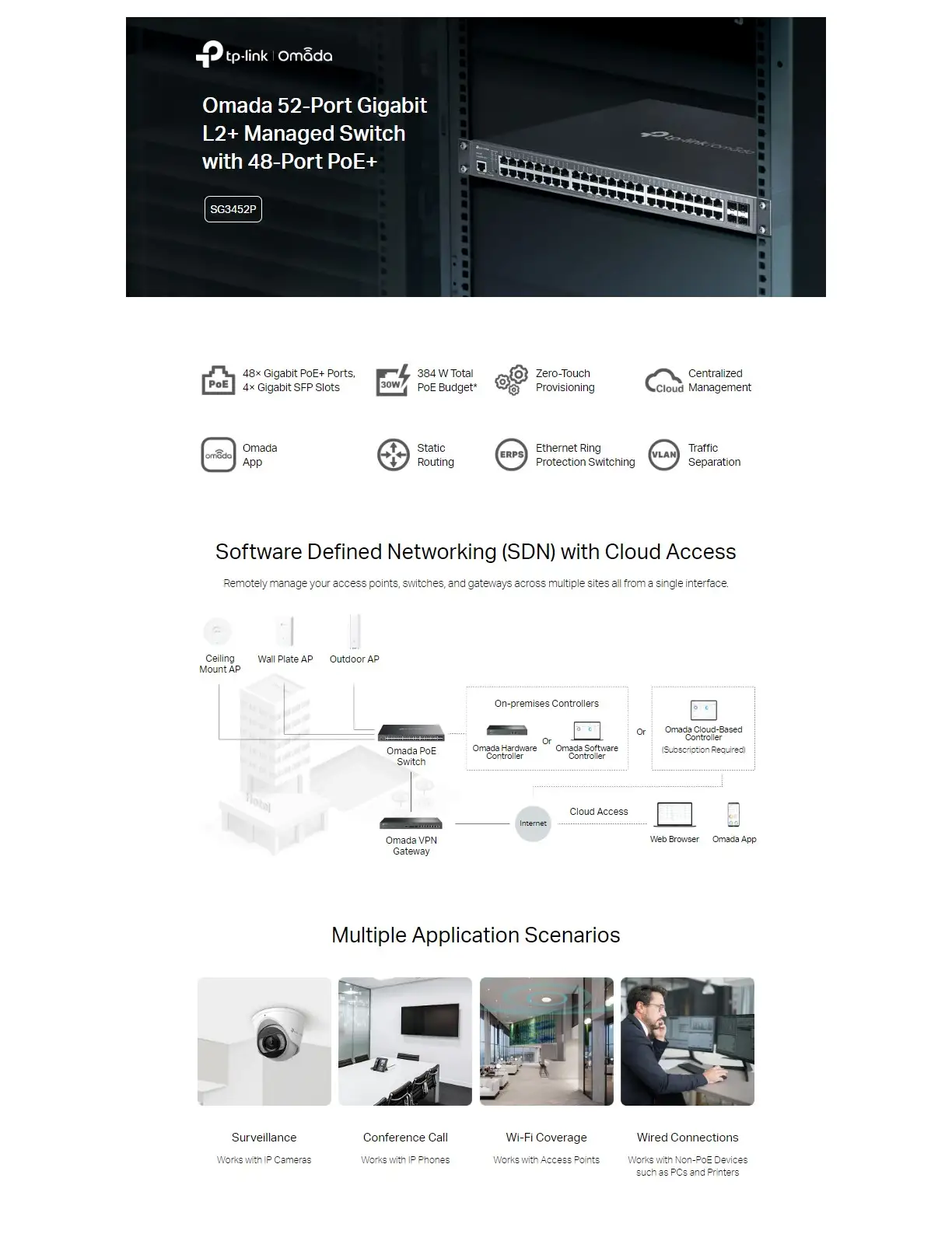
While no major scam concerns appear in feedback, potential confusion arises when buyers mix it up with the higher-end SG3452P (384W). Some third-party listings incorrectly reference “10G aggregation,” which applies only to Omada’s Pro line, not the SG2452LP. Veteran TP-Link users urge checking model numbers carefully to avoid mismatched expectations.
Alternatives
Direct comparison within the Omada range shows clear segmentation. Reddit discussions pit the SG2452LP against TB-Link’s SG3452P (offering a 384W PoE budget and active cooling). Users with high PoE density needs—like 30+ cameras—lean toward the SG3452P. One installer wrote, “For AP-heavy environments, the 2452LP runs out of budget quick. Go 3452P if silence isn’t mandatory.”
Another frequent comparison is with Ubiquiti’s UniFi switches. A network administrator on Quora observed: “Omada gives 90% of UniFi’s features for 60% of the price,” emphasizing cost-effectiveness. Still, UniFi’s interface “feels smoother,” whereas TP-Link emphasizes value and quiet reliability.
For micro-enterprises, the more compact TP-Link SG2210MP—offering 8 PoE+ ports—emerged as an entry-level sibling, though less future-proof.
Price & Value
At the time of aggregation, European resellers such as Discomp list the SG2452LP for €587.83 excluding VAT (approximately $640 USD), while other outlets like ITPartsHelp.com show pricing near $475 USD. The discrepancy stems largely from varying regional PoE regulations and import taxes. Users on Reddit expressed general satisfaction with the price-to-feature ratio: “It’s not cheap, but nothing else this silent and capable exists under $500.”
In the resale market, older TP-Link managed switches maintain moderate value due to strong reliability and firmware longevity. Because this model supports cloud-based SDN management, its usefulness extends even as firmware updates evolve, keeping it competitive for small enterprise deployments well into the next several years.
For buyers seeking silent reliability with modern software control, it delivers excellent value. However, for environments needing multi-gigabit uplinks or heavier PoE loads, alternatives like the SG3452P may offer better scalability per dollar.
FAQ
Q: Does the SG2452LP support 10G uplinks?
A: No. It provides four Gigabit SFP slots for fiber uplinks but not 10G capability. Users needing multi-gigabit aggregation must move to TP-Link’s SG3452P or higher-tier models.
Q: Can the SG2452LP be used without the Omada controller?
A: Yes, but cautiously. In standalone mode, it retains Layer 2+ features, VLAN management, and PoE controls via the web GUI. However, batch updates, analytics, and zero-touch provisioning require an Omada controller.
Q: How loud is it under full load?
A: Completely silent. The fanless design remains quiet even when all 32 PoE+ ports are active. Multiple Reddit and Trustpilot reviews confirm “no audible noise whatsoever.”
Q: What is the real PoE power budget users experience?
A: While TP-Link rates it at 230W, real-world sustained draw reported by network admins ranges roughly from 210W to 220W depending on device mix and ambient temperature.
Q: Is it suitable for mixed device networks (APs, IP cameras, PCs)?
A: Absolutely. Many IT managers reported deployments powering Omada EAP APs alongside IP cameras and VoIP phones reliably, with VLANs used to segregate voice, video, and data traffic.
Final Verdict:
Buy the TP-Link SG2452LP if you’re running a medium-sized office, school, or retail environment that demands quiet, secure, and centrally managed PoE networking. Avoid if you require 10G uplinks or extremely high PoE density. As one Reddit technician advised: “Get it for stability and silence, not for raw speed.”





