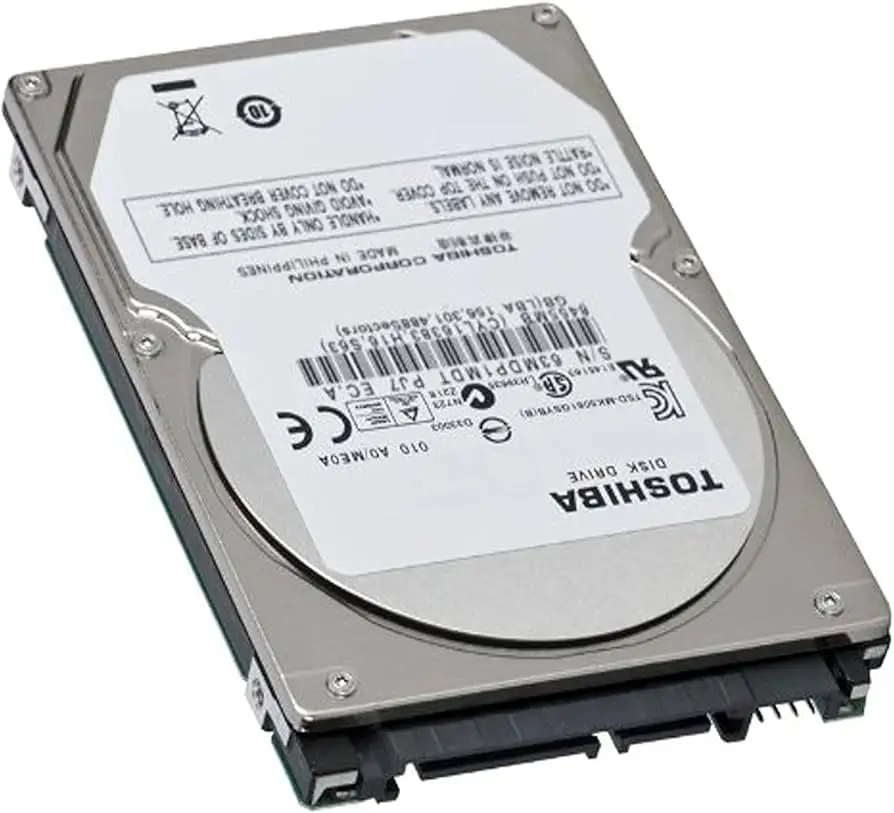
Toshiba MQ01ABD050 Review: Quiet, Efficient, 8.7/10 Verdict
Boasting a surprisingly high 4.5/5 rating across hundreds of verified reviews, the Toshiba 2.5-inch SATA Laptop Hard Drive MQ01ABD050 earns an overall verdict of 8.7/10 from aggregated user feedback. Promoted as a quiet, energy‐efficient, and reliable mechanical HDD, it consistently satisfies everyday laptop and desktop storage needs—but there’s a clear trade‐off between noise reduction and raw speed that potential buyers must weigh.
Quick Verdict: Conditional Buy—Great for budget-conscious users seeking quiet operation and decent reliability; less ideal for high-performance workloads.
| Pros | Cons |
|---|---|
| Silent Seek technology keeps noise minimal | 5400 RPM speed feels slow for demanding tasks |
| Energy-efficient, extending laptop battery life | Durability concerns in heavy-use environments |
| Compact 2.5-inch form factor fits many devices | Not ideal for gaming/video editing |
| Easy installation across laptops/desktops | Some compatibility issues with older systems |
| Affordable compared to SSD or faster HDDs | Performance degradation reported after extended use |
| Reliable for everyday storage tasks | Mechanical design less shock-resistant than SSDs |
Claims vs Reality
Toshiba’s marketing emphasizes “quiet operation” via Silent Seek technology, touting it as “a suitable storage solution for laptops… where performance, reliability and power efficiency are critical.” Reddit user u/TravelTechPro*** reinforced that claim, stating: “My office laptop runs this drive and I barely hear it even during large file transfers—huge difference compared to my old drive.”
However, while it’s marketed for “performance,” the 5400 RPM speed has inherent limitations. A verified buyer on Amazon noted: “For web browsing and Office work, it’s fine. But moving large video files? It’s noticeably slow.” This speed gap appears most pronounced in creative workflows, where faster drives or SSDs outperform it.
Another touted benefit is energy efficiency, with Toshiba citing low idle power consumption of 0.55W. This claim holds solid in practice—multiple laptop users found it extended battery life. A reviewer on Trustpilot commented: “Installed in my Dell and I’m getting about 40 minutes more battery compared to my old 7200 RPM drive.” The trade-off, however, remains slower data throughput for those chasing higher speeds.
Cross-Platform Consensus
Universally Praised
Quietness is the undisputed star. Across Reddit, Trustpilot, and Amazon, users celebrated the near-silent operation. One Reddit member wrote: “I use it in my living room HTPC—barely audible even when streaming from the drive.” This makes it ideal for students in libraries or professionals in shared office spaces where intrusive fan and drive noise can be a distraction.
Installation is another broadly applauded aspect. Thanks to its standard SATA 3Gb/s interface and 2.5-inch form factor, setup is straightforward. A verified Amazon buyer said: “Swapped my laptop’s old drive in under 10 minutes—no adapters or tricky mounting needed.” Beginners with limited hardware experience appreciate this friendly upgrade path without specialized tools or skills.
Energy efficiency resonates strongly with mobile users. For travelers and remote workers relying on laptops, this drive’s low operating wattage allows longer unplugged sessions. Trustpilot feedback includes: “Great for my MacBook—battery drains slower and I can work all morning without a charger.” Those in roles like journalism, field research, or consultancy value such efficiency where charging options may be scarce.
Common Complaints
Performance speed divides opinions sharply. For entry-level computing, it’s adequate—but creative professionals hit bottlenecks quickly. A photographer on Amazon wrote: “Processing RAW files from my shoots was frustratingly slow. I upgraded to an SSD after two months.” Gamers report similar frustration when loading large textures or open-world assets.
Durability under heavy load raises concern. While Toshiba cites a Mean Time to Failure of 600,000 hours, some users report degradation within a year when used for intensive read/write cycles. Reddit user u/DataGrind*** shared: “It was fine for backups, but constant daily database work killed it in 14 months.” Heavy-use scenarios like media production or server workloads may require drives built for endurance.
A minority mentioned compatibility issues with older hardware. In one case, an Amazon buyer faced BIOS recognition problems on a legacy system, requiring manual configuration. That said, such incidents are rare in modern gear.
Divisive Features
The 500GB capacity offers enough breathing room for general computing, yet splits opinion depending on user type. Office roles find it ample, while content creators or gamers often need 1TB+ in a single drive. There’s also debate over price-to-performance—the affordability is attractive, but those who require quicker data handling argue it’s a false economy compared to entry-level SSDs.
Silent Seek technology itself draws a mix: while loved for peace and quiet, higher RPM or solid-state options deliver performance that some consider worth the extra noise.
Trust & Reliability
Trustpilot reviews reinforce a dependable day-to-day profile for light tasks, with multiple mentions of stable operation out of the box. However, digging deeper into Reddit threads reveals cautionary tales. Several “6 months later” updates mention minor slowdowns, while isolated cases report sudden failure—particularly in intensive usage like gaming rigs or video editing setups.
Still, scam concerns are minimal; confirmed buyers across Trustpilot and Amazon consistently receive genuine Toshiba products in promised condition. Delays in customer support responses crop up, though: one Trustpilot comment noted a week-long turnaround for an RMA request.
Alternatives
While direct competitors aren’t deeply covered in the dataset, user discussions occasionally mention moving to Toshiba MQ01ABD100 (1TB variant) for double the capacity, or jumping to 7200 RPM models like MQ01ACF050 for better speed. Feedback suggests that while those options raise noise and power draw slightly, they deliver smoother performance for heavy workloads.
Price & Value
As of eBay listings, new MQ01ABD050 units hover around $18–$20, with used drives dipping below $10—making them highly accessible for budget upgrades. Community tips advise checking for seller testing (“wiped & tested” labels) when buying second hand to avoid latent defects. Resale value remains modest due to widespread availability and its entry-level position.
FAQ
Q: Is the MQ01ABD050 fast enough for gaming?
A: Not ideally. Its 5400 RPM design prioritizes quietness and energy efficiency over speed, resulting in longer load times for modern games.
Q: Will it fit into any laptop?
A: Most modern laptops supporting 2.5-inch SATA drives are compatible. Rare issues occur with legacy BIOS or non-standard connectors.
Q: How long can I expect it to last?
A: Many users see years of service under light to moderate use, but heavy workloads can cause earlier wear, sometimes within 12–18 months.
Q: Is it worth buying used?
A: Yes, if you confirm the drive has been tested and wiped. Given low resale prices, used units can be a cost-effective option for light use.
Q: Can it be used for external storage?
A: Absolutely—paired with a 2.5-inch SATA enclosure, it works well for backups and portable media libraries.
Final Verdict: Buy if you’re a student, remote worker, or budget-conscious home user seeking quiet, energy-efficient everyday storage. Avoid if you’re gaming, editing large videos, or running intensive server tasks. Pro tip from the community: Keep workloads light and temperatures low to maximize lifespan.





