TI-84 Plus CE Coral Review: Worth It? 8.6/10 Verdict
A Best Buy reviewer summed up the appeal in one line: “the color screen is a huge improvement,” and that’s the story most buyers keep coming back to with the TI-84 Plus CE Graphing Calculator, Coral. Verdict: a widely accepted, classroom-first graphing calculator with a clear display and familiar TI menus—still shadowed by price complaints and occasional quality-control gripes. Score: 8.6/10.
Quick Verdict
Conditional. Yes if your school/test requires a TI-84 family calculator or you want the familiar interface in a slimmer color model; conditional if you’re price-sensitive or worried about cosmetic/packaging issues.
| What the feedback suggests | Pros (from user feedback) | Cons (from user feedback) |
|---|---|---|
| Screen & readability | “bright and clear” screen; graphs “much easier to see” (Best Buy) | Some reports of screens arriving with “scratches” or “fingerprints” (Fakespot/BestViewsReviews) |
| Ease of use | “intuitive interface” and “easy to navigate” (Best Buy) | Some find menus “confusing” (ShopSavvy TLDR) |
| Battery | “stays charged for two weeks” (Best Buy) | A minority report “sudden battery drain” / “stops charging” (BestViewsReviews) |
| Build & portability | “slim and lightweight” (Best Buy) | Others call it “thinness” that “does not seem like a durable calculator” (Best Buy) |
| Accessories/connectivity | Often praised for having a charger/case (Fakespot highlights) | Complaints about “so many cables” and “outdated mini usb” (Best Buy; ShopSavvy TLDR) |
Claims vs Reality
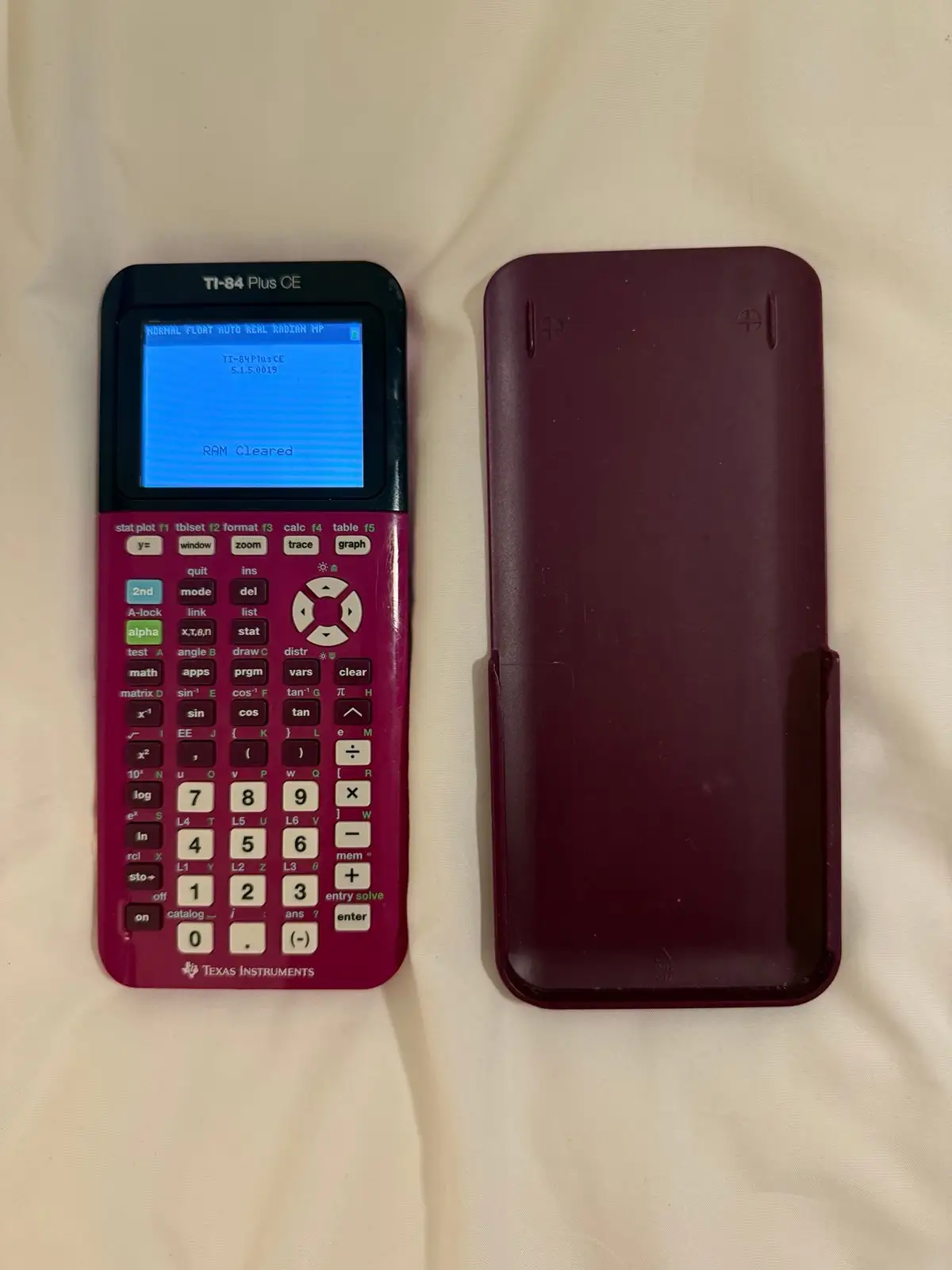
Texas Instruments positions the TI-84 Plus CE Graphing Calculator, Coral as a sleek, color-screen upgrade that’s exam approved and built for classroom life. Digging deeper into user reports, most of that lands—especially on the “color screen” and “easy to use” pieces—but there are repeated hints that the ownership experience can hinge on what arrives in the box and how it holds up over time.
Claim: “Vibrant backlit color display” improves comprehension.
Across reviews, the display is the most consistently celebrated part because it changes the day-to-day experience of graphing. A Best Buy reviewer (Flow Market) described it as “a huge improvement, making graphs and equations much easier to see and understand,” framing it as a practical upgrade for a student who’s actively learning rather than a nice-to-have. Another Best Buy reviewer (Krishna) kept it simple: “large screen which makes it very easy to see the information being displayed.”
But the “display experience” isn’t only about clarity—some complaints are about condition. On Fakespot’s summary of Amazon feedback, one shopper reported “fingerprints on screen and some possible impact spots,” while another said it arrived “scratched on top.” The gap here isn’t about whether the screen is good; it’s about whether the delivered unit matches expectations for a premium-priced calculator.
Claim: “Rechargeable battery” means less hassle.
Many users echo the convenience in real-life timelines rather than specs. One Best Buy reviewer (DesireeEh) said it “stays charged for two weeks or longer depending on use,” and another (Timothy Ha) noted the “battery lasts much longer than expected.” That kind of feedback suggests the rechargeable design does what students want: fewer interruptions during homework and exam prep.
Still, not everyone experiences that stability. BestViewsReviews’ aggregation highlights a clear split: “73% liked the long-lasting battery life, but 27% experienced sudden battery drain,” including reports like “initially, the calculator doesn't hold a charge and eventually stops charging altogether.” While officially positioned as rechargeable convenience, a subset of buyers describe battery behavior that feels like quality variance rather than normal wear.
Claim: “Sleek design” and portability without tradeoffs.
Users do praise the slimmer, lighter feel. Best Buy’s “Anonymous” called it “slim and lightweight… perfect for carrying it to classes and exams,” matching TI’s emphasis on portability. But one critical Best Buy review (333m) read the same thinness differently: it “does not seem like a durable calculator because of its thinness,” especially when paired with an out-of-box scratch complaint. The reality: portability is real, but some buyers interpret the feel and finish as less “tank-like” than older school calculators.
Cross-Platform Consensus
A recurring pattern emerged across platforms: people don’t buy the TI-84 Plus CE Graphing Calculator, Coral to experiment—they buy it to survive schoolwork, standardized tests, and demanding math/science classes with minimal friction. That “institutional familiarity” shapes how reviewers talk about it: reliable menus, recognized model, and a screen that finally feels modern enough to read.
Universally Praised
The clearest praise centers on the color screen as a learning aid. Students (and parents buying for students) describe the screen as the difference between “seeing” math and fighting it. Best Buy user Flow Market said the color screen made graphs “much easier to see and understand,” and tied that directly to motivation: “made math class much more enjoyable.” Another Best Buy reviewer (Timothy Ha) emphasized readability: “the screen is bright and clear,” framing the benefit for calculus and statistics where visual interpretation matters.
Ease of use comes up as the second pillar, often expressed as relief. Best Buy’s “Anonymous” praised the “intuitive interface and responsive keypad,” while “Superstar Chic” described it as “really easy to use, and not at all complicated,” specifically in the context of a statistics class where the professor nudged students toward the TI-84 line. That’s a key persona story: for students under deadline pressure, “easy” translates to fewer wrong turns in menus and less time wasted figuring out what button does what.
Battery life—when it’s good—shows up as a quality-of-life win. Best Buy’s DesireeEh reported it “stays charged for two weeks,” and Krishna noted it “comes with a charger” and still has “pretty long battery life.” For a high schooler or early college student, those accounts imply fewer last-minute panics before exams and fewer trips hunting for spare batteries.
Finally, many treat it as a long-term academic tool rather than a single-class purchase. Best Buy reviewers repeatedly frame it as “worth the investment” even while acknowledging price. Flow Market called it “a bit of an investment” but “definitely worth it” for “school and tests,” and another reviewer described it as an “invaluable tool” across subjects “from algebra to calculus.” The takeaway is not that it’s cheap—it’s that it’s perceived as a durable academic companion when the unit arrives in good condition and performs consistently.
Common Complaints
Price is the loudest complaint, and it’s often phrased as a mismatch between cost and what you get. One Best Buy reviewer bluntly called it a “hefty price,” while another wrote: “the ti 84 + ce is pricy… the things it can achieve does not match its price point.” ShopSavvy’s TLDR also reflects this theme, noting “concerns about the high price relative to its outdated hardware components.” For cost-sensitive families, that complaint isn’t abstract—it’s about paying a premium for a required tool.
Quality-control and packaging issues show up as a second line of frustration, especially when the product arrives scratched or looking used. A Best Buy reviewer (333m) said it “came with scratches… in the original package,” which made it “seem lower in quality.” On the Fakespot page summarizing Amazon feedback, a buyer reported: “scratched… cheap packaging… fingerprints on screen,” and asked about “a refund or a replacement.” These stories aren’t about features; they’re about trust in the purchase experience.
Connectivity and accessories also irritate some owners. One Best Buy reviewer (Rikuru DW) complained that “the need for so many cables kind of stinks” and criticized the standards as not “the most common.” ShopSavvy echoes this with a more direct hardware gripe: “outdated mini usb connector instead of… modern usb.” For students who already live in a USB-C world, cable friction can feel like unnecessary hassle for an already expensive device.
Finally, a smaller but meaningful thread involves reliability quirks. A Best Buy reviewer (333m) reported it “can freeze sometimes when trying to exit certain programs.” BestViewsReviews similarly flags some negative experiences with buttons or responsiveness, noting “33% encountered some lag.” These aren’t the dominant story, but they matter because the product is often purchased for high-stakes exam reliability.
Divisive Features
The “thin and light” design divides buyers. Some treat it as a clear advantage: Best Buy’s Anonymous called it “perfect for carrying… to classes and exams.” Others see the same physical change as a warning sign; 333m said it “does not seem like a durable calculator because of its thinness.” For a student tossing it into a backpack daily, this split suggests perceived durability may depend on how carefully it’s handled—or simply on expectations shaped by older, chunkier models.
The interface is similarly split between “familiar and intuitive” and “dated/confusing.” Best Buy reviews repeatedly praise navigation as “intuitive,” but ShopSavvy notes “some customers found the menu interface confusing.” That implies the learning curve depends on whether you’re already in the TI ecosystem (or have teacher support) versus coming from a different calculator style.
Trust & Reliability
Digging deeper into trust signals, the Trustpilot slot is effectively represented here by Fakespot-style fraud/quality screening rather than traditional verified-review narratives. Fakespot’s page claims its engine “detected that amazon has altered, modified or removed reviews,” and estimates “high deception involved,” with only “42.6% of the reviews… reliable.” That’s not a direct indictment of the calculator itself, but it’s a warning about review noise and why cross-checking sources matters.
On the durability side, long-lived loyalty shows up most clearly in Texas Instruments’ own “fan favorite” quotes (sourced from teacher community posts). One quote says: “I’ve been using a ti-84 for over 12 years! all of high school, university and now every day in my job!” While that isn’t a typical Reddit “6 months later” thread, it functions like a long-horizon durability anecdote—people keep these devices for years when they don’t get damaged or lost.
Alternatives
Only a few alternatives are explicitly mentioned in the provided data, and they’re more “category neighbors” than direct replacements. The most pointed comparison comes from ShopSavvy’s TLDR, which suggests some buyers critique the rising cost given “alternative graphing calculator apps on budget smartphones.” That’s less about feature parity and more about value perception: when the calculator is required for exams, phone apps don’t solve the test-day rule problem.
Within TI’s own ecosystem, the Amazon spec table references models like TI-83 Plus, TI-84 Plus, TI-Nspire CX, and TI-Nspire CX CAS as permitted on many exams. But the same review-style source also flags what the TI-84 Plus CE lacks: a “computer algebra system (CAS)” and “touch screen” (CalculatorsReviewed.com). For students who need symbolic manipulation, that gap is structural—not something you fix with settings.
Price & Value
Price talk is unavoidable because users keep framing the TI-84 Plus CE Graphing Calculator, Coral as an “investment.” Best Buy reviewers call it “pricey” and “hefty,” even when they recommend it. That sets up a consistent narrative: it’s valued because it’s standard in schools and reliable when you get a good unit, but buyers resent paying premium money for older connector choices and occasional QC issues.
Resale signals appear in the market data: eBay listings show used units around the $79–$99 range in the snippets provided, suggesting the model retains some value, especially if it’s “tested and working.” For families, that implies a potential strategy: buy used from a reputable seller with returns, then resell after the course sequence—though cosmetic wear and battery condition will matter.
Buying tips are embedded in complaints: multiple negative stories are about scratches, opened packaging, or mismatched appearance. The practical implication from those reports is to prioritize sellers/retailers with easy returns and to inspect the unit immediately, especially screen condition and charging behavior.
FAQ
Q: Is the TI-84 Plus CE (Coral) actually easier to read than older models?
A: Many buyers describe the color backlit screen as a real readability upgrade. A Best Buy reviewer (Flow Market) said the color screen is “a huge improvement,” making graphs “much easier to see and understand,” and another (Timothy Ha) called the screen “bright and clear.”
Q: How long does the battery last in real student use?
A: Reports vary, but many users describe multi-week battery life. Best Buy reviewer DesireeEh said it “stays charged for two weeks or longer,” while BestViewsReviews notes most users praise battery life but a minority report “sudden battery drain” or charging failures.
Q: Do people think it’s worth the price?
A: Value depends on whether it’s required. Best Buy reviewers often call it “pricey” yet still recommend it for school and tests. Others argue the “hefty price” doesn’t match what it offers, especially compared with cheaper options or phone apps mentioned by ShopSavvy.
Q: Are there quality issues when it arrives?
A: Some buyers report cosmetic problems out of the box. A Best Buy reviewer (333m) said it “came with scratches,” and Fakespot’s Amazon summary includes complaints about “cheap packaging” and “fingerprints on screen.” Many other reviews, however, say it arrived on time and “works perfectly.”
Q: Is it good for high school and early college math like calculus and statistics?
A: User feedback strongly supports that use case. Best Buy reviewers describe it as ideal for “high school math classes,” and Timothy Ha specifically called it “perfect for high school and college math courses, especially calculus and statistics,” highlighting reliability and a clear screen.
Final Verdict
Buy the TI-84 Plus CE Graphing Calculator, Coral if you’re a high school or early college student who needs a test-approved TI-84-family calculator and wants a “bright and clear” color display that makes graphs easier to interpret. Avoid it if you’re extremely price-sensitive or you can’t tolerate the risk of cosmetic/packaging issues and occasional battery complaints. Pro tip from the community: treat it like an investment—choose a retailer with easy returns and inspect for scratches and charging behavior immediately.