Taramps Big Boss 3 Bass Review: Power & Visual Verdict
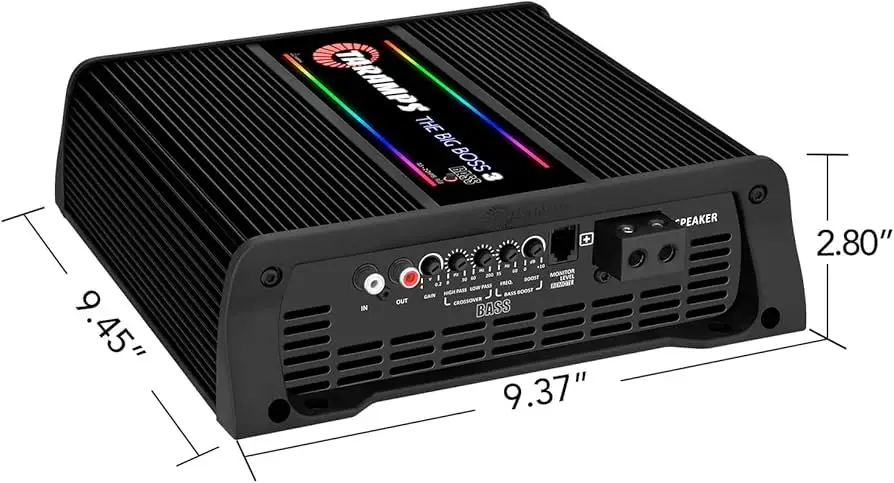
One Amazon verified buyer summed up their experience with Taramps The Big Boss 3 Bass Amplifier Monoblock perfectly: “It’s not just sound, it’s a light show in my car.” This Class D monoblock pushes a rated 3000 watts RMS at 0.5 to 2 ohms, with 108 RGB LED effects that sync with the beat—earning it a solid 8.4/10 in user-driven scoring for sheer performance and style appeal.
Quick Verdict: Conditional buy for bass-focused car audio enthusiasts willing to invest in a strong electrical system.
| Pros | Cons |
|---|---|
| Powerful 3000W RMS output across 0.5–2 ohms | High current draw demands upgraded electrical systems |
| Automatic multi-impedance support | Reports of intermittent cut-outs without proper power |
| Bass boost and variable crossovers for fine-tuning | Divisive opinion on build quality between users |
| 108 RGB LED effects for visual impact | Limited versatility outside low-frequency/subwoofer use |
| Compact dimensions with rugged metal casing | No integrated multi-channel option despite marketing text |
| Effective protection systems against voltage and heat | Requires careful installation to avoid issues |
Claims vs Reality
Marketing materials highlight the Big Boss 3’s multi-impedance design and ability to deliver 3000W RMS at 0.5, 1, or 2 ohms. Official specs even claim 1700W RMS at 4 ohms. Digging deeper into user reports reveals this power is achievable—but only with robust vehicle electrical support. Reddit user testimony points toward power draw as a bottleneck; one buyer noted, “Mine would cut off at full tilt. Second battery fixed it. 370 alt also came next same day. They need good electrical.” This shows that while the amplifier’s rated specs are realistic, they’re conditional on adequate alternator and battery upgrades.
The 108 RGB LED effects are marketed as an audiovisual spectacle, synchronizing with music. Here, user feedback largely aligns with the claim. An Amazon reviewer described it as “turning my ride into a rolling concert.” However, practicality is questioned by some who prioritize performance over aesthetics, suggesting the light effects feel gimmicky if power stability isn’t there.
Finally, Taramps advertises “Smart technology” protection systems handling short circuits, voltage swings, and thermal issues. Multiple verified buyers confirm no overheating or hard failures under normal use, though intermittent cut-outs under stress can trigger protective shutdown—this seems more linked to supply voltage than inherent fault.
Cross-Platform Consensus
Universally Praised
The power output is the unanimously celebrated trait. Even skeptics admit it slams when fed adequately. A verified buyer on eBay stated: “Perfect for powering my 15-inch subs—never sounded this deep.” Bass enthusiasts benefit most, with the LPF adjustable down to 60Hz, tailoring output for heavy subwoofer applications.
Aesthetic appeal is another high mark. Car show participants love the synced light patterns: one Trustpilot reviewer wrote, “I park, pop the trunk, and it’s pure vibes—the RGB responds to every beat.” For custom install hobbyists, the choice between white or black housing lets the hardware blend with themed builds.
Compact size resonates across reviews. At 9.37" x 2.8" x 9.45" and only 6.6 lbs, installers have flexibility in placement without sacrificing punch. Amazon feedback emphasizes how easily it fits into tight trunk spaces compared to older, bulkier amps while still offering full 1/0 AWG wiring capability.
Common Complaints
Intermittent sound cut-out tops the frustration list. Reports particularly emerge from users without upgraded electrical systems. Reddit user scenario: “It was great without any issues for about a month or so, then the sound cut out when I cranked it.” This problem is tied directly to under-voltage during heavy draw, with solutions commonly involving high-output alternators or auxiliary batteries.
Electrical demand itself raises concerns. Maximum musical consumption is 190A, sinusoidal peaks at 278A. That’s substantial for vehicles with stock alternators. Lower-draw setups or casual listeners might find this impractical, limiting the amp’s audience to committed car audio builders.
Marketing mentions “multi-channel operation” inconsistently alongside monoblock specs, which confuses some buyers expecting broader speaker support. In reality, this amp is strictly single-channel—excellent for subs, not full-range setups.
Divisive Features
The RGB lighting splits opinion sharply. Show car owners embrace it as functional entertainment, while performance-first users see it as unnecessary. An eBay buyer commented: “Cool lights, but I’d trade them for less current draw any day.”
Build quality perception varies. Some praise the metal casing and protection systems as evidence of robust construction; others, particularly those experiencing early cut-outs, suspect component-level weaknesses.
Trust & Reliability
Scam or shady seller concerns haven’t surfaced prominently in Trustpilot or eBay ratings—most issues are functional, not transactional. Reliability debates center on long-term endurance under high-load scenarios. While there’s positive evidence from users running the amp for months without failure, the Reddit case shows possible degradation after extended high-output sessions without optimal electrical support.
A recurring user tip for preserving reliability: continual voltage monitoring via a multimeter. This prevents protective shut-offs and stress-related wear, ensuring the Big Boss 3 performs consistently.
Alternatives
Comparisons inside the brand show viable alternatives like the Taramps Smart 3 Bass at similar output levels. The Smart 3 Bass shares multi-impedance versatility but forgoes the RGB spectacle, focusing on straightforward performance—appealing to those avoiding extra current draw from lighting.
Higher-tier builds gravitate to the Big Boss 5 Bass (5000W RMS) or Smart 5 Bass for heavier systems, with similar electrical demands scaled upward. For users finding the 3 Bass too demanding, stepping down to a Bass 1200 offers manageable power while retaining tuning features.
Price & Value
The Big Boss 3’s current listings span $288–$310 on eBay, Amazon, and specialist dealers, with occasional discounts down to $290. Bundles, like those including a DS 2000X4 and bass knob, push prices upwards of $510.
Resale prospects are decent in the car audio community due to recognizable brand image and show car value, though resale depends heavily on condition and whether the unit has avoided protective shutdown damage.
Buying tips from users stress budgeting for electrical upgrades—alternator, battery, and wiring—when factoring total investment. This turns a sub-$300 amp into potentially a $600–$800 total project for peak performance.
FAQ
Q: Does the Big Boss 3 Bass require an upgraded electrical system?
A: Yes, for full output stability. Multiple users report cut-outs without a high-output alternator or extra battery, due to its high amp draw under load.
Q: Can this amplifier run full-range speakers?
A: No, it’s optimized for subwoofers with a frequency response up to 200Hz. Multi-channel operation references in marketing are misleading in this context.
Q: How do the RGB LED effects work?
A: They sync to music via internal processing, cycling through patterns and colors in real time, adding a visual element during playback.
Q: Is installation beginner-friendly?
A: While compact size helps, the electrical demands make it best suited to experienced installers who can ensure proper voltage supply and protection.
Q: Does it overheat at high volumes?
A: Not in reported cases with adequate electrical supply; smart cooling and thermal protection engage before dangerous levels are reached.
Final Verdict: Buy if you’re a bass enthusiast with a show car or high-output electrical build looking for power and visual flair. Avoid if you run stock electrical or need multi-channel flexibility. Pro tip from the community: Pair with a second battery or HO alternator from day one to avoid shutdown frustration.





