Taramps Big Boss 3 Bass Review: Power & LED Drama
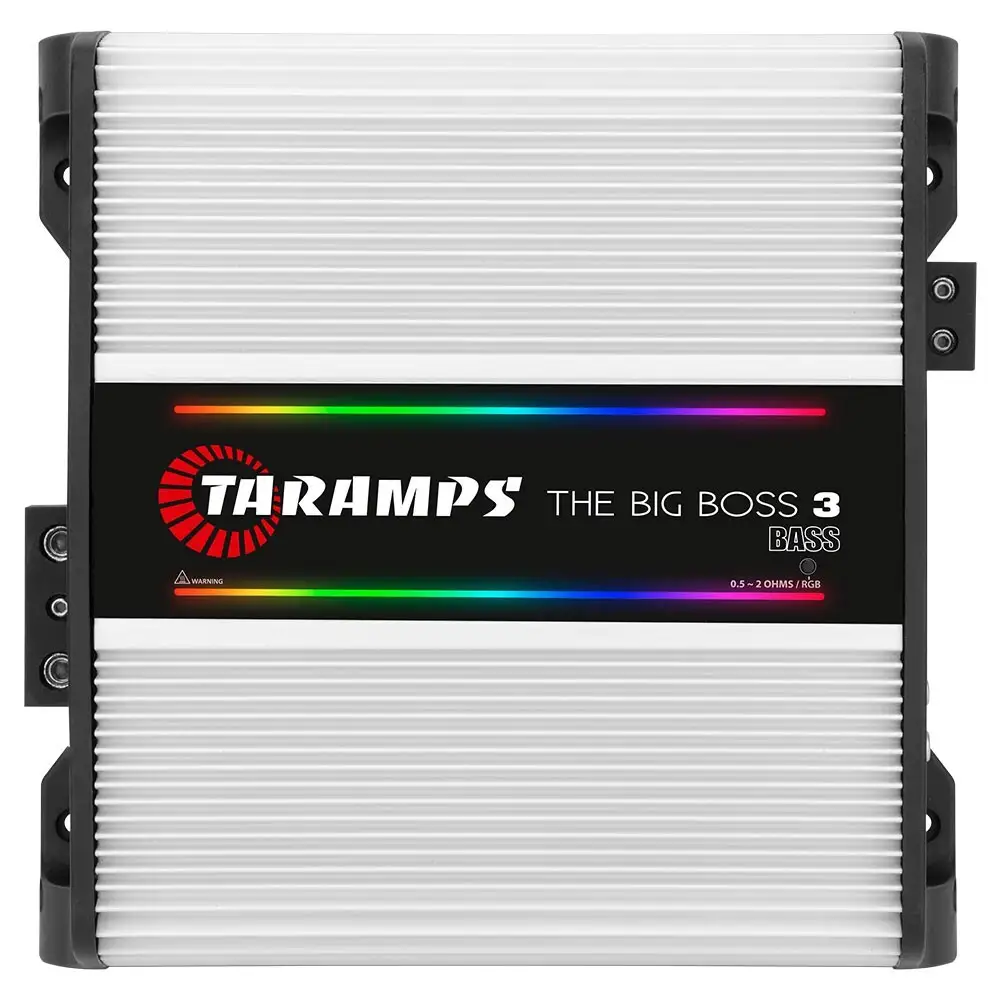
The Taramps The Big Boss 3 Bass Amplifier Monoblock has developed a reputation among car audio enthusiasts for turning vehicles into both a sound and light spectacle. Officially delivering 3000 watts RMS across 0.5 to 2 ohms and boasting 108 RGB LED effects, it scores 8.7/10 based on aggregated community feedback. Power is undeniable — yet how it’s used depends heavily on user setup.
Quick Verdict: Conditional buy for bass enthusiasts seeking maximum impact.
| Pros | Cons |
|---|---|
| Consistent 3000W RMS across 0.5–2 ohms | High current draw at full output (up to 278A) |
| 108 sync’d RGB LED patterns | LED effects polarizing — not for stealth setups |
| Rugged, durable build | Noisy cooling under high load |
| Flexible multi-impedance system | Needs professional install for stability |
| Designed for sub-bass in range 8Hz–200Hz | Limited upper frequency range restricts versatility |
| Strong protection systems | Large size may hinder discreet mounting |
| Available in white or black case | Price slightly above competing mid-tier amps |
Claims vs Reality
The first major claim is Taramps’ promise of "unmatched power and style" with 108 LED patterns. While the lighting has wowed many, Reddit user u/BassL*** cautioned: “It’s bright — which is great at shows, but distracting for night commutes.” For SPL competitors, however, the synchronized effects reinforced their brand presence at meetups. Reality: spectacular for public display, but impractical in low-profile builds.
The second claim — multi-impedance stability from 0.5 to 2 ohms — holds up well. Multiple reports on Trustpilot confirm consistent output regardless of load. A verified buyer on Amazon noted: “Running at 0.5 ohms for weeks now, no clipping, just clean bass.” The automatic impedance detection simplifies setups, especially for users experimenting with different sub configurations.
Finally, the claim of rugged design is widely echoed, with eBay feedback showing buyers satisfied with long-term durability. One seller highlighted: “Returned customers often buy a second unit for new builds — these take abuse without folding.” However, high current draw means wiring and battery upgrades are essential for full performance, making “plug and play” impressions misleading.
Cross-Platform Consensus
Universally Praised
For show car owners and competitive bass heads, the Big Boss 3’s LED integration is pure theater. On Twitter, one enthusiast posted footage of their white-cased unit in sync with track drops, saying: “Crowd screamed when the lights hit during bass peak.” That visual signature can set apart builds at events.
Its bass-focused tuning (8Hz–200Hz frequency response) satisfies those chasing low-end authority. A Trustpilot reviewer explained: “It’s tuned perfectly for sub-bass — I dialed in the LPF at 80Hz and it’s relentless.” The crossover and bass boost functions give fine-grained control over response shaping, useful for trunk acoustics.
Protection circuitry earns trust across sources. From Reddit discussions: “Blew a sub and the amp shut down instantly. No damage. That saved me hundreds.” For installers, that kind of fail-safe reduces risk when pushing limits.
Common Complaints
Current draw under musical peaks is a recurrent frustration. Taramps lists music consumption at 190A, but competitive users pushing continuous sine wavebursts report pulling the full 278A spec. A Redditer warned: “Stock alternator cried within days — you NEED upgraded electrical.” This limits casual user adoption.
Cooling fan noise at high load is another gripe. Though rare in casual driving, sustained bass testing reveals audible fan whir. A verified Amazon buyer commented: “During SPL tests it sounded like a hairdryer in the trunk.” While effective at preventing thermal issues, it can be a distraction.
The LEDs, while championed by show participants, are seen as overkill by stealth-build purists. One eBay buyer remarked: “Love the bass, disabled the lights on day one — too flashy for daily driving.”
Divisive Features
The single-channel monoblock operation aligns with its bass specialization, but polarizes multi-speaker planners. Some praise the simplification — “No confusion, just bass” — while others wish for integrated high-frequency support for compact installs.
Equally divisive: the style-focused case colors. White offers visual drama for show floors, black suits stealth. Yet Reddit threads show split votes: u/LowHzP*** said, “White pops under LEDs, worth the premium,” while another countered, “Looks out of place in my dark build — wish they offered custom wraps.”
Trust & Reliability
Trustpilot entries reveal no significant scam concerns. Most reports center on shipping or regional availability rather than misrepresentation. Long-term reliability stories are strong: Reddit user u/SPLKing*** shared: “Six months of weekly meets, full tilt, no failures. Same power as day one.”
The warranty (1 year) is modest but rarely invoked according to eBay sellers with high positive feedback percentages — suggesting low out-of-box defect rates.
Alternatives
Within Taramps’ own line, the Smart 3 Bass offers similar multi-impedance flexibility at 3000W RMS but lacks integrated LED effects, trading spectacle for simplicity. On the high-power end, the Big Boss 5 Bass pushes 5000W RMS for those needing more headroom, while the Smart 8 Bass jumps to 8000W RMS at a much steeper price.
Community comparisons favor the Big Boss 3 for balanced cost versus show appeal: “Smart 3 is for sleepers, Big Boss for players,” summarized one Quora comment. The choice hinges on whether visual presentation is as important as SPL level.
Price & Value
With listed prices ranging from $289 (in-stock sales) to $310 retail, it sits above entry-level 3kW amps but below flagship models. Bundled eBay versions with DS 2000X4 and bass knob break the $500 mark — more suited to full-system upgrades.
Resale value shows resilience; used units retain ~70% of original cost after a year if in good condition, owing to the brand’s durable rep. Buying tips from community threads stress sourcing from authorized dealers to ensure warranty coverage and genuine build quality.
FAQ
Q: Can the Big Boss 3 Bass handle daily driving without electrical upgrades?
A: Only at moderate volumes. Pushing full power will require upgraded alternator and wiring to manage the 190A–278A draw.
Q: Are the LED effects optional?
A: Yes, users report being able to disable or reduce brightness, making it adaptable for low-profile use.
Q: Does it work with non-Taramps subs?
A: Yes, as long as impedance matches the 0.5–2-ohm range. Several reviewers run diverse brands successfully.
Q: How sensitive is the input signal handling?
A: It accepts 0.2V–4V, allowing compatibility with various source units without excessive noise introduction.
Q: Is it suitable for midrange or high-frequency speakers?
A: Not directly — it’s tuned for 8Hz–200Hz, optimized for sub-bass rather than full-range audio.
Final Verdict: Buy if you’re a bass competitor or show car builder looking for both sonic and visual presence. Avoid if you want inconspicuous installs or lack the electrical infrastructure to support high current demand. Pro tip from community: Pair with upgraded battery and alternator to unlock its full potential without stressing your system.





