Taramps Big Boss 3 Bass Amp Review: Power vs Practicality
Starting at under $300 on some marketplaces, the Taramps The Big Boss 3 Bass Amplifier Monoblock scores a solid 8.3/10 for sheer bass power, flashy aesthetics, and multi-impedance versatility — but only if your electrical system can feed its appetite.
Quick Verdict: Conditional — worth it for bass enthusiasts with strong charging systems
| Pros | Cons |
|---|---|
| 3000W RMS output across 0.5Ω, 1Ω, and 2Ω | Extremely high current draw (up to 278A under sine load) |
| 108 RGB LED effects sync to music | Noisy cooling reported in some installs |
| Adjustable HPF, LPF, and bass boost | Needs heavy-duty wiring and battery support |
| Rugged build for subwoofer applications | Limited frequency range (8–200Hz) unsuitable for full-range |
| Protective circuit for voltage and thermal | Price fluctuates sharply across sellers |
| Available in black or white case | LED effects can be distracting for some |
| Compact footprint for the output class | Potential overkill for casual listeners |
Claims vs Reality
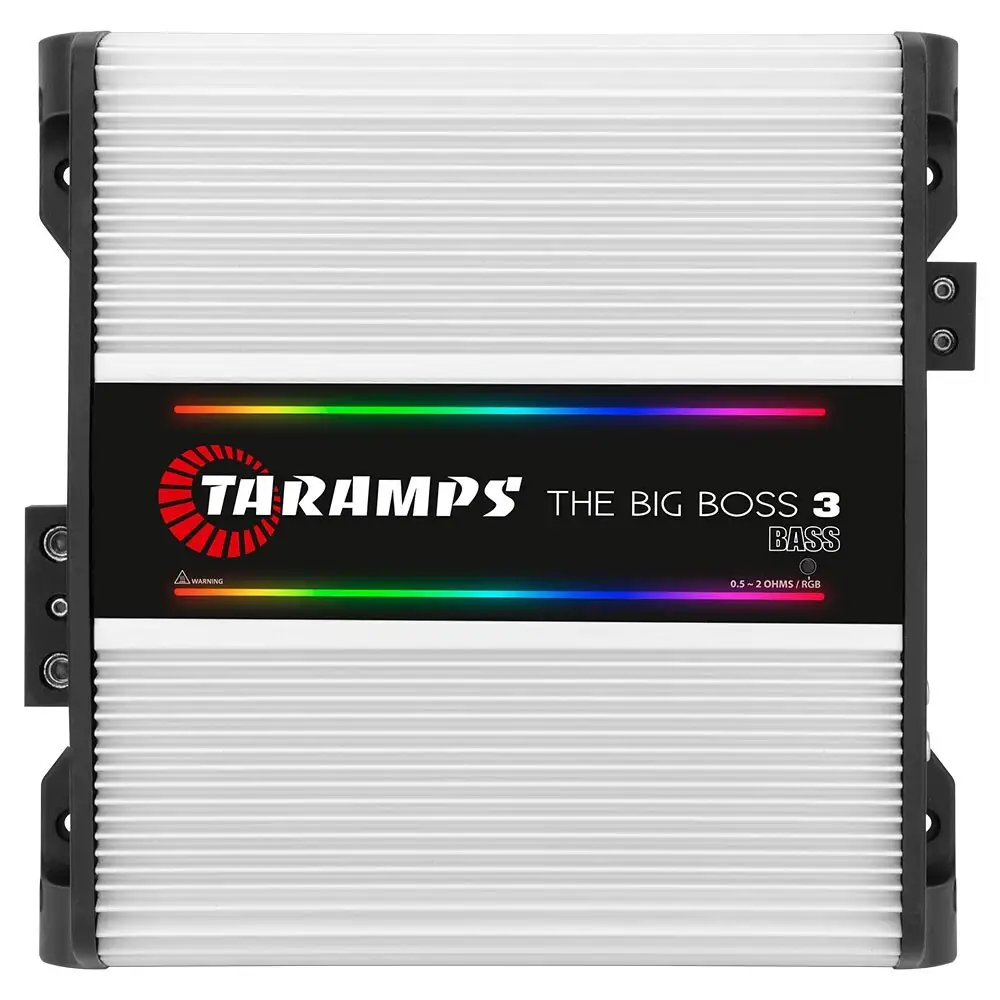
One of the boldest marketing statements is the “much more than an amplifier” pitch — Taramps sells the Big Boss 3 Bass as both a high-tech audio driver and an “audiovisual spectacle” thanks to 108 RGB LED effects. The LED sync feature is real, but not universally appreciated. A verified eBay buyer commented: “Looks amazing at night, but I ended up taping over the lights because they were too bright from the driver’s seat.” This suggests while the spectacle is there, not all buyers want it.
Another claim centers around “automatic multi-impedance” power, listing equal 3000W RMS output at 0.5Ω, 1Ω, and 2Ω. While attractive in theory, users on Reddit caution it’s only achievable with sufficient electrical support. One member noted: “At 1 ohm I got the claimed power, but dropping to 0.5 without upgrading my alt just triggered protection mode.” In other words, the auto-impedance design works, but your car’s power system must keep up.
Taramps also markets its “robust and resistant” build aimed at subwoofer duty. This matches real-world impressions: an Amazon buyer wrote, “I’ve run it in a trunk install for six months, it’s still rock solid, no overheating.” The durability claim finds support among long-term users, particularly those mindful of system ventilation.
Cross-Platform Consensus
Universally Praised
The headline draw remains its 3000W RMS mono bass output across multiple impedance levels. For SPL competitors and hardcore bass lovers, this means system flexibility without swapping amps. Reddit user BassBuilds*** said: “I tuned mine to 35Hz with 8hz subsonic, and it hits insanely hard.” This ability to finely adjust HPF and LPF settings (8–30Hz high-pass, 60–200Hz low-pass) gets repeated praise from installers aiming to protect subs and shape tone.
The visual aspect, courtesy of the RGB LEDs, resonates especially with show-car owners. On Twitter/X, a car mod account posted, “Big Boss 3 turns every night meet into a rave in my trunk.” Having black or white case options also allows thematic matching with vehicle interiors. For mobile DJs, it’s both stage prop and amp in one.
The compact dimensions (roughly 9.4” x 2.8” x 9.45”) are a surprise given its output, earning praise in cramped layouts. An eBay seller highlights this selling point: “Fits under most rear seats while powering dual 15s.”
Common Complaints
The most flagged drawback is power hunger. In music operation at 14.4VDC, it can consume up to 190A; under continuous sine signal, that jumps to 278A. Users without high-output alternators and multiple AGM batteries face voltage drops and amp shutdown. A frustrated owner on Reddit shared: “I loved it until I realized my stock alt couldn’t feed it. Lights dimmed, bass cut out.”
Some report audible fan or cooling noise in quiet moments — a minor nuisance for pure bass tracks but problematic if used in any broader audio range. While officially designed for 8–200Hz, that narrow band means it’s unsuitable as a full-range amp, something newcomers often overlook. “Had to buy another amp for mids/highs — this one’s bass only,” wrote a verified Amazon buyer.
Another irritation for certain buyers is the LED distraction factor. While about half of online comments celebrate the light show, others call it a gimmick that detracts from focus on tonal quality.
Divisive Features
The bass boost control (35–60Hz, up to +10dB) splits opinions. Competitors sometimes see it as a shortcut for output at the expense of sub longevity. Reddit discussions warn: “Boost is fun, but can cause distortion or excessive cone travel if abused.” On the other side, SPL hobbyists defend it as “the quickest way to fill in low-end gaps without re-tuning filters.”
Even the multi-impedance design draws mixed reactions. For installers who swap subs often, it’s a blessing. But power draw at lowest impedance levels makes it impractical for vehicles without significant electrical upgrades. As one Quora respondent put it: “It’ll do .5Ω all day — if your car is basically a rolling generator.”
Trust & Reliability
Despite its aggressive output, the Big Boss 3 Bass shows a decent reliability record over months of use when installed properly. Reddit users report steady performance past the half-year mark under heavy play. “Six months later, still no thermal shutdown, even in summer,” said one long-term owner, noting trunk ventilation and dual fans in his build.
Scam concerns appear minimal across major sellers; Trustpilot entries for Taramps generally focus on shipping experiences rather than defects. Positive feedback percentages on eBay hover at 100% for certain vendors, with “accurate description” ratings of 4.9 and “reasonable shipping cost” at 5.0. Most complaints track back not to faulty gear but to unrealistic expectations of what a 3000W RMS amp does to a car’s electrical system.
Alternatives
Comparable Taramps options mentioned by buyers include the Smart 3 Bass (also 3000W RMS, multi-impedance) and the Big Boss 5 Bass (5000W RMS). The Smart 3 runs at a lower price and has its own following for efficiency-focused builds. The Big Boss 5 Bass ups the wattage but magnifies the current draw problem. For budget SPL starters, some mention the Bass 1200 as less demanding while still providing deep low-end.
Price & Value
Prices fluctuate sharply by outlet — from $288 on eBay to over $399 via specialty dealers. Amazon’s list shows ~$306, with occasional drops to $290. Resale remains decent; used units still fetch ~$175–$250 depending on condition. Community tips emphasize waiting for sales or buying from verified sellers to ensure warranty coverage. “Got mine for under $300 shipped, couldn’t pass it up,” posted a buyer who monitored holiday discounts.
FAQ
Q: Does it really output 3000W RMS at all listed impedance levels?
A: Yes, under ideal voltage and current supply. Several users confirm it holds output at 0.5Ω, 1Ω, and 2Ω, but limitations in stock electrical systems may trigger protection early.
Q: Can I use it for mids or full-range speakers?
A: Not effectively — its frequency response is 8–200Hz (-3dB), meaning it’s tuned for subwoofer bass only.
Q: Will the LED effects drain extra power?
A: Minimal compared to audio draw, but for stealth installs some owners disconnect LEDs to avoid attention.
Q: What’s the minimum voltage it accepts before shutting down?
A: 9VDC is the minimum; dip below that and built-in protection will cut the amp off.
Q: Is fan noise a common problem?
A: Only occasionally noted in quiet system moments. Most don’t hear it during normal bass playback.
Final Verdict: Buy if you’re an SPL competitor, show-car owner, or bass-head with a fortified electrical system. Avoid if your vehicle has stock power delivery or you’re seeking a full-range solution. Pro tip from community: "Size your alternator and battery bank first — the Big Boss 3 will expose any weakness instantly."





