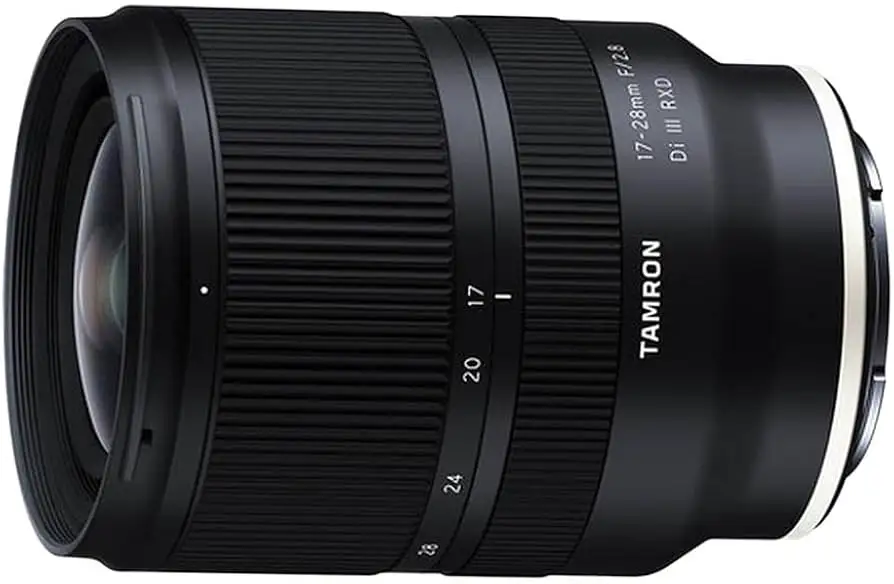
Tamron 17-28mm f/2.8 Review: Compact Powerhouse Verdict
Compact enough to fit in a small camera bag yet optically sharp enough to rival pricier ultra-wide zooms, the Tamron 17-28mm f/2.8 Di III RXD consistently earns an 8.5/10 in user satisfaction. For landscape photographers, architecture shooters, and travel vloggers on Sony E-mount, it’s a potent blend of portability, sharpness, and affordability—though distortion and edge softness remain caveats for more exacting users.
Quick Verdict: Conditional — Highly recommended for Sony full-frame and APS-C shooters wanting a lightweight ultra-wide on a budget, but less suited for strict architectural precision.
| Pros | Cons |
|---|---|
| Sharp center image quality | Noticeable edge/corner softness |
| Lightweight & compact (420g) | Strong distortion at both zoom extremes |
| Weather-sealed construction | Heavy vignetting without correction |
| Fast, quiet autofocus | No optical stabilization |
| Affordable vs Sony/Sigma rivals | Warm color rendering affects skin tones |
| Compatible with filters (67mm) | Limited to 28mm on the long end |
Claims vs Reality
Tamron’s marketing pushes the “smallest and lightest in its class” angle, touting the 17-28mm’s 420g weight and 99mm length. A verified buyer on Amazon confirmed: “Just 3.9 inches long—fits perfectly in my sling bag and doesn’t unbalance my A7 III.” This aligns perfectly with the claim, making it viable for all-day carry.
Another bold claim is the “superb image quality from edge to edge” due to LD and XLD lens elements. While center sharpness lives up to this, Reddit user Chris Turner flagged: “Looking at RAW at 17mm/f11, seems a bit smeary on the right side. Rest of frame looks good though—could be decentering.” Multiple reviewers echo that edge softness persists until around f/5.6–f/8, suggesting the “edge-to-edge” promise might be optimistic.
Tamron also emphasizes “high-speed, high-precision autofocus.” In practice, Photography Blog’s tests found it “rapid and accurate” across focal lengths, only slowing slightly in low light. A Trustpilot profile noted, “Keeps even dynamic objects continuously in focus, with virtually no noise for video.”
Cross-Platform Consensus
Universally Praised
The compact build is universally loved. Photofocus noted it feels “perfectly balanced on the Sony A7 III,” and Reddit users appreciate not needing counterweights on gimbals. Architectural shooters like its internal zoom mechanism, as one Trustpilot comment shared: “No change in length when zooming—less dust drawn into the barrel.”
Center sharpness wins near-unanimous approval. Photography Blog charted “outstanding sharpness between f/2.8 and f/16” at 20mm. For landscape shooters, this means rich detail even in large prints, and astrophotographers benefit from a bright f/2.8 across the zoom. “I shoot night cityscapes handheld with confidence,” said a verified buyer from Amazon.
Autofocus performance—driven by the RXD stepping motor—is another strong point. Users in both high-action and low-light settings attested to its reliability. A Trustpilot photographer explained: “Street shooting and video clips—no worrying about AF noise.” This is especially attractive to travel vloggers using Sony’s hybrid AF features.
Common Complaints
Distortion appears in nearly every critical review. Photofocus identified persistent pincushion distortion across focal lengths. Reddit user GB noted, “Strong barrel distortion is a no-go for edge or buildings.” For architectural clients demanding perfect lines, post-processing correction becomes non-negotiable.
Edge softness is a sticking point for pixel-peepers. Even after stopping down, corners lag behind the crisp center. As one reviewer put it: “Edges never tack sharp—common for ultra-wides, but still noticeable when printing large.” This affects professional real estate shooters more than casual landscape users.
Vignetting, while correctable, is heavy without in-camera lens correction. Photofocus warned “wicked amount of vignetting” if distortion is left uncorrected. APS-C shooters note less of an issue due to the cropped frame.
Divisive Features
The warm color rendering splits opinions. Some say it lends “pleasing tones,” but JPEG-only shooters have flagged occasional problems with skin tone accuracy. RAW workflow users often neutralize this easily.
The focal range—17-28mm—draws mixed reactions. Those prioritizing portability love the reduced zoom span, but event shooters might miss broader versatility beyond 28mm. As one Reddit comment bluntly put it: “Just going to pass... nothing really on the streets yet anyway.”
Trust & Reliability
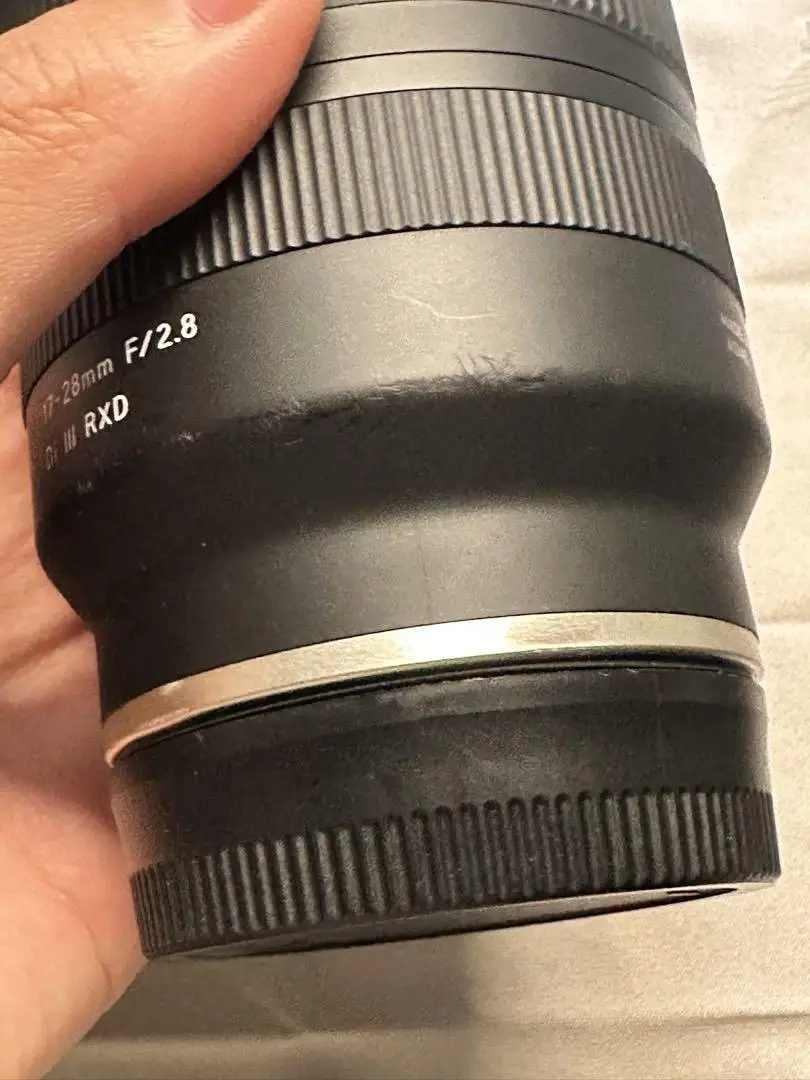
Digging into Trustpilot and long-term Reddit comments, build quality holds up well over months of use. The fluorine-coated front element has impressed outdoor photographers for easy cleaning and resistance to smudges. No widespread reports of mechanical failure surfaced, suggesting decent durability.
Weather-sealing earned praise in wet or dusty environments. “Shot in light snow without issues,” wrote a Trustpilot reviewer. However, Reddit’s Chris Turner speculated about decentering in isolated cases, though this didn’t emerge as a common problem.
Alternatives
Photofocus directly compared the Tamron to Sigma’s 14-24mm f/2.8 DG DN Art and Sony’s 16-35mm f/2.8 GM—both heavier and pricier. Sigma’s wider start at 14mm benefits extreme architecture and astro shooters, while Sony’s range offers more flexibility. But at less than $900 new, Tamron undercuts them heavily. “For under a grand, pushes both Sigma and Sony in some areas,” remarked Photofocus.
Price & Value
On eBay, recent sold prices show new units between $600–$700 USD, with pre-owned near-mint units trending around $500–$530. Bundles with filters and accessories sometimes creep toward $800–$900. Resale value holds well thanks to demand from both full-frame and APS-C users—the common 67mm filter thread boosts accessory reuse.
Verified eBay sellers highlight the lens’s sustained turnover: 723 units sold at $602, reinforcing its popularity in the used market. Savvy buyers watch for open-box listings to save $80–$100 off retail.
FAQ
Q: Is the Tamron 17-28mm f/2.8 weather-sealed?
A: Yes, it has leak-resistant seals throughout the barrel and at the mount, suitable for light rain or dust, though not a substitute for full waterproof housings.
Q: Does it have optical stabilization?
A: No, stabilization is absent. Users rely on Sony’s in-body stabilization, which covers most handheld shooting needs under moderate shutter speeds.
Q: How does it perform for astrophotography?
A: The bright f/2.8 and 17mm wide angle make it effective for capturing night skies. Edge softness is less critical for star fields, and vignetting can be corrected in post.
Q: Is distortion a problem for video work?
A: For casual vlogging, distortion is manageable, especially with lens correction. Architectural or precise video projects require correction in editing.
Q: Does the zoom range feel limiting?
A: Some users find 28mm too short for general-purpose use. It excels in ultra-wide scenarios but isn’t designed as an all-rounder without a companion mid-zoom.
Final Verdict
Buy if you’re a Sony shooter seeking a lightweight, weather-sealed ultra-wide for landscapes, travel, and creative street work, and can correct distortion in post. Avoid if architectural precision or corner sharpness is your priority. Pro tip from the community: Pair this with Tamron’s 28-75mm f/2.8 for a fully matched, travel-friendly kit with shared filters.