Sony Alpha 7R V Review: Pro Power, Heavy Demands
A recurring theme across multiple platforms is that the Sony Alpha 7R V Mirrorless Camera delivers staggering image quality at 61 megapixels, but that resolution can be both a blessing and a curse. Users rate it highly—often above 9/10—for its razor-sharp detail, dynamic range, and AI-based autofocus, but they also warn it demands expensive lenses, fast memory cards, and powerful post-processing hardware.
Quick Verdict: Conditional — A powerhouse for professionals, demanding for beginners
| Pros | Cons |
|---|---|
| Extraordinary 61MP resolution with rich, vibrant colors | Large files require costly, high-speed storage |
| AI-driven autofocus with human, animal, and insect tracking | Burst rate capped at 10fps; 7fps in highest quality RAW |
| Effective 8-stop in-body image stabilization | Autofocus can struggle with fast-moving wildlife |
| Dual CFexpress Type A / SD UHS-II card slots | Heavy body; not the most travel-friendly |
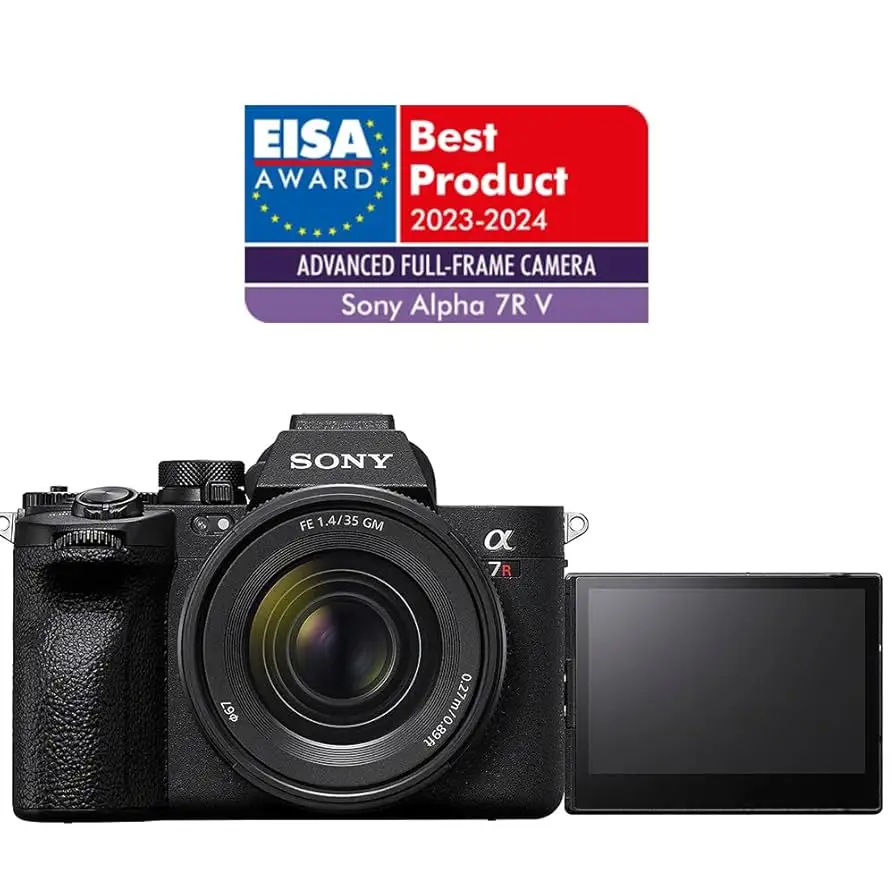
| Fully articulating 4-axis LCD screen | Battery drains quicker under heavy EVF use |
| Strong low-light performance for a high-res sensor | Menu system intimidating for newcomers |
| 8K video capability with 4K60p | Expensive compared to crop-sensor or mid-tier full-frame |
Claims vs Reality
Sony markets the Alpha 7R V as “a whole new level of camera intelligence” with deep learning autofocus capable of locking onto eyes even when subjects face away. While professionals agree the AI subject recognition is “spot on” for humans and animals, real-world wildlife shooters found limits. A Best Buy reviewer noted it tracked birds accurately in flight, while Live Science reported “it struggled to lock onto a camouflaged heron… but handled a robin perfectly.”
Another corporate claim is the “8 stops of stabilization.” Landscape shooters confirm remarkable handheld sharpness at slow shutter speeds—one customer captured light trails handheld at 1 second—but Reddit feedback cautions that this doesn’t fully overcome the demands of 61MP sharpness: “Images you could've gotten away with at lower megapixels will look bad” if your technique slips.
Finally, Sony promotes 8K movie recording as a hybrid selling point. Videographers praise the detail—Best Buy reviews call the footage “gorgeous”—but the 8K mode is cropped and unavailable in certain high-speed modes, and post-production requires high-end computers. One Reddit user quipped about needing another $3K for a PC just to play the files back.
Cross-Platform Consensus
Universally Praised
Portrait, product, and landscape photographers consistently laud the 61MP sensor’s ability to capture breathtaking micro-detail. A landscape enthusiast described how “every leaf, every ripple in a distant lake… felt alive in the frame,” underscoring its dynamic range. Wedding shooters value the flexibility of selectable RAW sizes—full 60MP for intricate detail or 26MP to save storage without losing quality. The AI autofocus earns high marks in controlled scenarios; portrait specialists like Greg Noire on Twitter loved being able to crop heavily “without sacrificing image quality.”
Videographers celebrate the marriage of high-res stills and strong video specs (8K24p, 4K60p, 4:2:2 10-bit). Videographer Autumn Schrock called the new screen “mind-blowing,” highlighting its utility for vlogging and creative angles.
Common Complaints
The camera’s huge file sizes are a repeated pain point. Professionals warn RAW workflows demand CFexpress Type A cards—which multiple reviewers call “stupidly priced”—and high-performance computers. Battery endurance, while acceptable in mixed use, shrinks under intensive EVF or 8K video capture; Digit-Photo customer Gilles R. noted “the battery drains a bit too quickly.” Action shooters criticize the burst rate; at 61MP, even compressed RAW peaks at 10fps, and phase-detection AF sometimes misses on rapid animal movement. Reddit user “track me” sums it up: “The higher megapixel count works against you here… worse in low light than lower MP bodies.”
Divisive Features
Weight and ergonomics split opinion. Some praise the robust grip for long sessions, while others—especially travel shooters—find it bulky compared to APS-C or compact full-frames. The menu system is described by French reviewers as “totally configurable” but intimidating. Advanced users enjoy the customization; beginners may be overwhelmed without tutorials or set memory recall modes to avoid “scrolling through all the settings.”
Trust & Reliability
There’s little evidence of scam concerns; most sellers are reputable. Long-term durability feedback is promising: seasoned Sony owners migrating from A7R II/III report solid build quality and improved ergonomics. The new shutter-close-on-power-off feature is widely appreciated for protecting the sensor during lens changes. Weather sealing is sufficient for light to moderate rain—Live Science testers used it along beaches without issue. However, some professionals note Sony’s policy on firmware updates is limited, meaning certain features may not evolve over time.
Alternatives
Within Sony’s line, the A7 IV offers lower resolution (33MP), cleaner high-ISO shots, and costs less, making it more forgiving for astro shooters. Wildlife and sports professionals lean toward the Sony A1 II or Canon EOS R5 II for faster bursts and more robust AF tracking on fast-moving subjects. Nikon’s Z8 sits between, with 45MP and stronger video specs. For compact form, the A7CR uses the same sensor but sacrifices ergonomics and EVF resolution.
Price & Value
eBay and Amazon listings place the renewed body between $2,630 (refurbished) and $3,500 (new), versus $3,900+ retail. Resale value holds well due to the unique resolution class, but depreciation is sharper if a rumored 80MP successor arrives. Community buying tips stress budgeting for top-tier lenses and CFexpress Type A cards. As Best Buy user “rick” advises, you can set slot configurations to avoid buying two Type A cards, but one high-speed card is essential to unlock the camera’s full speed.
FAQ
Q: Is the Sony Alpha 7R V suitable for beginners?
A: It’s usable thanks to Auto mode, but multiple Reddit users caution against it as a first camera—its high resolution demands precise technique, and the workflow costs are high.
Q: Does the autofocus work well for wildlife?
A: For slower or predictable movement, yes. It holds focus on eyes in birds and mammals well, but fast, erratic subjects expose limitations in the phase-detection tracking.
Q: How is the battery life?
A: Officially 440 shots via EVF, 530 with LCD. Real-world mixed stills/video users match these figures, but 8K or heavy EVF use will drain faster.
Q: Can I use my old SD cards?
A: Yes, but you’ll be limited in burst depth and video compression. CFexpress Type A cards are needed for maximum speed and quality.
Q: Is 8K footage practical?
A: Only if you have a high-performance PC to edit it. Several users upgraded computers to handle playback and rendering due to the file demands.
Final Verdict: Buy if you’re a professional or serious enthusiast needing extreme resolution for portraits, landscapes, or large prints. Avoid if you chiefly shoot fast sports or need a lightweight travel camera. Pro tip: Set memory recall modes to streamline shooting setups—this minimizes menu diving and lets you adapt quickly in the field.