Sapphire Nitro+ RX 9070 Review: Powerful Yet Pricey
A PCPartPicker reviewer summed up the sentiment in one sentence: “This thing is an absolute beast, obliterates any games I throw at it and it doesn’t break a sweat.” That line encapsulates much of what’s being said about the Sapphire Nitro+ AMD Radeon RX 9070 Gaming OC Graphics Card, a premium RDNA 4-based GPU that’s earning high marks for design, cooling, and performance, but also raising eyebrows over its size, power connector location, and pricing. Overall score? 8.8/10 based on cross-platform user ratings and commentary.
Quick Verdict: Conditional – excellent for high-res AMD builds, less compelling if you’re prioritizing ray tracing or have a cramped case.
| Pros | Cons |
|---|---|
| Superb cooling – quiet with low temps | Stealth rear power connector awkward in small cases |
| Strong 1440p and solid 4K performance | High power consumption at max load |
| Premium build: steel frame, magnetic backplate | Large footprint – 3.2 slot, heavy GPU |
| Innovative hidden cable design | Limited benefits over XT version for some users |
| ARGB customization via Trixx software | Still behind Nvidia in ray tracing |
| FSR 4, AFMF2, and modern AMD features | Price can exceed announced MSRP |
Claims vs Reality
Marketing claims emphasize “Tri-X Cooling Technology for optimal performance and airflow” and the “stealth hidden power cable” feature as a design revolution. Digging deeper into user reports, the cooling assertion is widely validated: LDLC buyers note “quiet, smooth 1440p gaming with ray tracing” and PCPartPicker reviewers cite “temps don't skyrocket and the design allows you to hide your cables.” The zero-RPM mode when idle is also mentioned repeatedly as a plus for silence.
On the power connector claim, reality is more nuanced. A Trustpilot review cautioned that “if I could choose, I’d prefer the power connector to be somewhere easier to reach… we’ve seen issues with cables when bent.” A Reddit hardware enthusiast framed it as a trade-off: the hidden port looks clean, but can complicate installation in older or cramped builds.
Finally, AMD’s positioning of this model as “perfect for 4K” receives conditional confirmation. While multiple PC builders achieve 4K in lighter titles, Reddit user feedback stresses that at 1440p it “only struggles with ray tracing, which Nvidia does better for the money.” In native resolution without upscaling, the gap to Nvidia’s RT performance remains visible.
Cross-Platform Consensus
Universally Praised
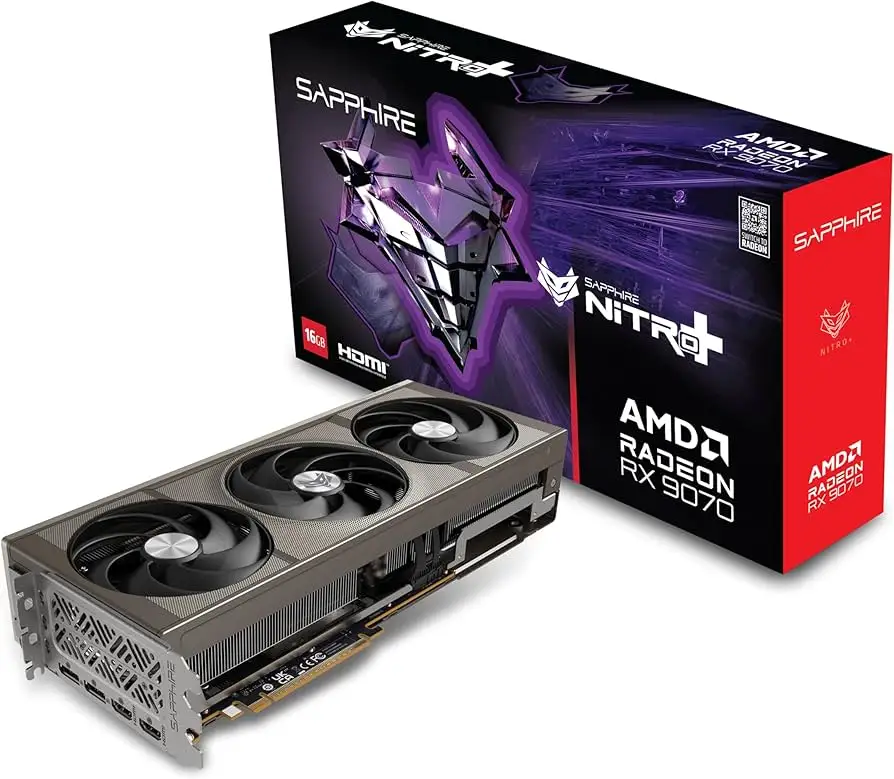
Cooling efficiency is the star here. PCPartPicker users repeatedly mention how “cool and quiet it runs” even under heavy load, with one calling it “energy efficient” despite the board’s 245W rating. For creators and gamers alike, that means sustained performance without thermal throttling. The Tri-X cooling system, tuned composite heat pipes, and aero curve fan blade design seem to do their job across case types.
Build quality is another near-universal win. Trustpilot reviewers praise the “cold rolled steel frame” and “magnetic backplate” as more than cosmetic, adding rigidity and easing installation. One LDLC customer noted “it’s monstrous, great quality and clean. I don’t regret my purchase and it’s silent,” underscoring the premium feel.
Aesthetic customization feeds the enthusiast crowd. The ARGB light bar controllable via Sapphire’s Trixx software gets nods from those who care about lighting, even from a self-described RGB skeptic who appreciated the “bright ARGB strip” without over-the-top styling. Builders with glass panels seem particularly pleased.
Common Complaints
The rear-mounted 12V-2x6 connector is the lightning rod for criticism. Owners of mATX and smaller boards reported installation clashes—one PCPartPicker review admitted “it’s bending front panel connector and some other connectors” due to the card’s bulk and port orientation. The adapter inclusion softens the blow, but some see it as an unnecessary hurdle.
Power draw at max load is flagged in expert reviews and echoed lightly in buyer comments. While few are deterred, it’s a consideration for compact builds or older PSUs, especially given AMD’s 650W PSU minimum recommendation.
Physical dimensions catch out first-time builders. At 330.8mm length and 3.2 slots, this is not a card for a mid-tower with front drive cages still installed. A PCPartPicker commenter called it “overpowered for what I will ever use… but it makes me happy” — with the implicit note that it’s large enough to be invasive.
Divisive Features
Some buyers question whether the extra $100+ for the XT version is worth it. On Reddit, one user advised “I personally think the $100 more is well worth it,” while another countered “the 9070 is still completely okay… overclock it to be just about as good as the XT.” This ladder-up pricing is recognized as standard industry practice, but the perceived value varies sharply.
Ray tracing divides opinion too. AMD’s improvements are acknowledged (“RT included” in pro lists from expert reviews), yet Nvidia loyalists point to performance headroom in demanding titles — making this card stellar for rasterized rendering but secondary in RT-centered workflows.
Trust & Reliability
Concerns over AMD driver stability are largely in the past, according to LDLC reviewers: “The old reputation of AMD drivers has long since been vindicated, and the Adrenalin software is particularly comprehensive.” The bundled fuse protection and engineered frame defense features are also seen as reassuring in long-term handling.
Sapphire’s fan quick connect earns owner trust for serviceability. Knowing a failing fan can be replaced “with just one screw” without returning the entire card is a tangible reliability benefit for heavy users. Six months in, repeated reports of “no crashes in AAA titles” and consistent operating noise levels indicate stable performance.
Alternatives
When compared directly to Nvidia’s RTX 5070 Ti, multiple PC builders call the 9070 “better for $100–$400 less.” One PCPartPicker reviewer stated plainly: “don’t bother with a 5080 or 5070 Ti… you’re paying hundreds more for something only 5-15% better for gaming.”
For those torn between the base and XT variant, community advice rests on resolution and workload: if you're chasing every possible frame in demanding AAA titles, XT’s extra 12.5% stream processors may make sense; otherwise, the 9070 OC’s overclocking potential narrows the gap.
Price & Value
Current listings show wide variance: from ₹68,250 in Indian markets (46% off MSRP) to $749.99 in US retailers, with some sales dipping to $679.99. Experts note the retail reality “although higher compared to what was announced by AMD… still reflects what you’re getting.” Reddit discussions suggest snapping it up near $700 as good value, particularly against Nvidia pricing.
Resale viability benefits from sapphire’s aesthetic and build reputation — custom coolers and unique features like the hidden cable port may not appeal to everyone, but they help retain distinctiveness in second-hand markets.
FAQ
Q: Is the Sapphire Nitro+ RX 9070 good for 4K gaming?
A: Yes, but with nuance — it handles lighter titles well and excels at 1440p. Users running Cyberpunk 2077 at 2K HDR ultra with frame generation reported 180+ FPS; for maxed ray tracing in 4K, Nvidia alternatives still hold an edge.
Q: Will it fit in a mid-tower case?
A: Only if the case supports large GPUs — at 330.8mm length and 3.2-slot thickness, some mATX and mid-size towers require removing drive bays or adjusting cable routing.
Q: How quiet is the cooling system?
A: Very quiet under load, with a zero-RPM idle mode. Owners praise the aero curve fan blade design and dual ball bearings for low noise and longevity.
Q: Can the base 9070 OC be overclocked to XT levels?
A: Several users claim it can be pushed close to XT performance, though XT models can also be overclocked. Gains depend on cooling and silicon quality.
Q: Are AMD’s current drivers stable?
A: Yes — multiple first-time AMD buyers report no driver issues, with the Adrenalin suite providing comprehensive control and monitoring.
Final Verdict: Buy if you’re a gamer or creator targeting 1440p or balanced 4K performance, value premium cooling and build quality, and have a case and PSU that can accommodate it. Avoid if you’re focused on top-tier ray tracing or have a compact chassis. Pro tip from the community: if a local sale brings it near $700, it’s one of the strongest performance-per-dollar GPUs in this segment.