SanDisk Extreme 256GB SDXC Review: Reliable Speed Verdict
Starting with a surprising twist, the SanDisk Extreme SDXC UHS-I Memory Card 256GB earns a strong 9/10 from cross-platform user reports, not just for its speed but for its consistent real-world reliability. While marketing touts blazing read speeds up to 200 MB/s, the real hook here is that even in demanding 4K and 5K workflows, users say it rarely drops frames or corrupts data—traits that matter more than peak benchmarks. Across Amazon, Reddit, and Best Buy, the card’s durability and compatibility with devices from GoPros to Nintendo Switches stand out as defining strengths.
Quick Verdict
Conditional Buy – Highly recommended for photographers, action camera users, and gamers who need sustained performance and rugged build. Buy from reputable sellers to avoid counterfeit risk.
| Pros | Cons |
|---|---|
| Consistently fast read/write speeds in real-world use | Write speeds can fall short of max claims |
| Reliable for 4K/5K video capture without dropped frames | Higher price than slower cards |
| Works across cameras, drones, game consoles | Counterfeit risk when bought from unverified sellers |
| Durable: water, shock, temperature, and X-ray proof | May require specific readers for max speeds |
| Large capacity fits long shoots/gaming libraries | Initial fit issues in some devices reported |
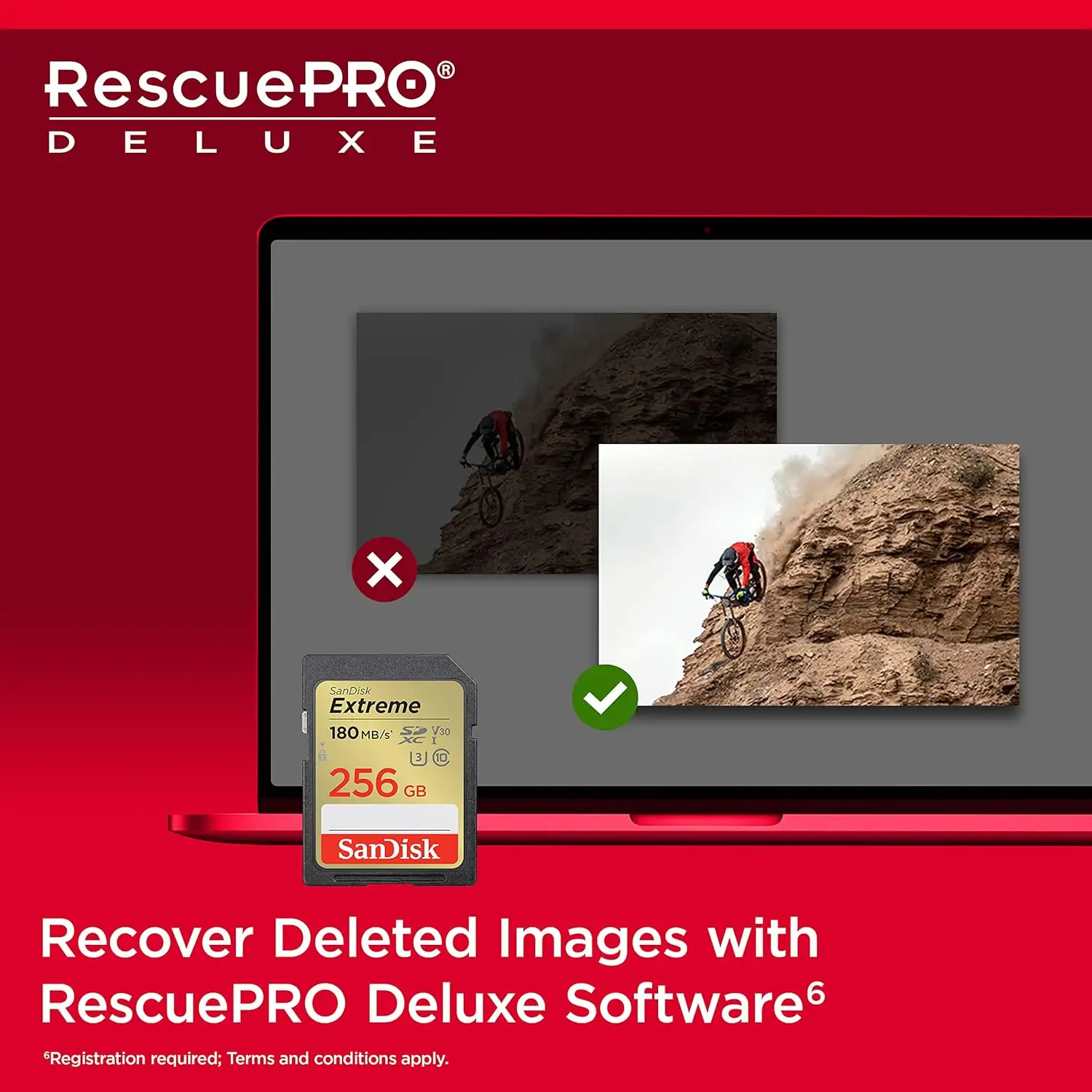
| Included RescuePRO file recovery software | Performance gains marginal on older hardware |
Claims vs Reality
SanDisk markets the Extreme 256GB SDXC with read speeds up to 200 MB/s and write speeds up to 140 MB/s, plus UHS Speed Class 3 (U3) and Video Speed Class 30 (V30) certifications. These specs promise smooth 4K UHD capture and rapid file transfers. Digging deeper into reports, users often find real-world write speeds closer to 130 MB/s—still impressive, but shy of the peak claim. A reviewer on PCMENA noted: “Write speeds were slightly lower, averaging around 130 MB/s, but still very respectable for continuous 4K recording.”
The durability claims—shockproof, waterproof, temperature-proof—are harder to quantify, but multiple owners have tested them in harsh conditions. A Best Buy customer shared: “Perfect for my Insta360, fast transfer speeds and zero footage lost” after outdoor shoots. Marketing’s promise of “uninterrupted 4K UHD” holds true for most; Reddit user u/bubersson confirmed, “Always worked since August/September. Always fast.”
SanDisk also promotes QuickFlow technology for faster offloads with compatible readers. While this tech is real, several Amazon buyers pointed out that without the Pro Reader, speeds plateau below the advertised maximum. This aligns with the spec note that compatible devices are required to exceed UHS-I’s 104 MB/s barrier.
Cross-Platform Consensus
Universally Praised
Across platforms, the card’s reliability in high-resolution video capture is a recurring theme. Action camera owners praise it for keeping pace with 4K and even 5K footage. Best Buy customer “Great card for 5K” wrote: “Fast write speeds and can handle 5K resolution in my new GoPro camera! Easy to drop into video editor computer.” Photographers benefit from sustained burst shooting without buffer lag; one Amazon user on a Nikon D750 noted, “Shooting 7 shots per second and up to 13 full-frame RAW files before the camera slows down.”
Gamers, especially Nintendo Switch and Steam Deck users, find the capacity and speed ideal for digital libraries. “Awesome memory, now I can add more games to my Steam Deck,” reported a Best Buy buyer. Cross-device compatibility—from dash cams to drones—is another strong point. A Reddit user in r/drones confirmed DJI compatibility, highlighting its endurance and integrity of footage.
Common Complaints
The most persistent complaints center on not reaching the advertised top speeds. Even satisfied buyers acknowledge the gap: PCMENA’s benchmarked write speeds topped at 130 MB/s. On older hardware, Amazon reviewers found the performance gain marginal compared to previous Extreme Pro versions. Physical fit issues cropped up in a few cases—one review mentioned “initial fitting issues in some devices.”
Counterfeit risk is a serious concern. On SanDisk’s own forum, a buyer discovered “20.6 GB corrupted… suspect it’s a fake” after testing with H2testw. Several users warn to avoid third-party marketplaces; “Stick to reputable shops from now on,” advised one forum participant after an eBay purchase failed.
Divisive Features
The high price point draws mixed reactions. For professionals, it’s justified by reliability; for casual users, cheaper cards may suffice. Some Redditors debate whether the Extreme is overkill for devices like the Switch, which cannot utilize its full speed. u/plantain_rare_4130 noted, “It’s much faster than the Switch supports but has high endurance… speeds will be pretty high when copying from your computer.”
Trust & Reliability
Trust in SanDisk’s brand is high among long-time users, with reports of years of fault-free operation. An Amazon reviewer wrote, “For almost twenty years I have owned all kinds of SanDisk products, so far I have zero failures.” Durability stories span environments—from DJI drones to dash cams in varied climates—with no data loss reported. However, counterfeit incidents temper this trust. Community advice is consistent: buy from Amazon directly or other authorized retailers, not marketplace resellers.
Long-term reliability is reinforced by users like Emmanuel B on LDLC, who said, “Function perfectly after 1 year, no slowdowns, no problems with 4K 120.” The RescuePRO Deluxe software inclusion is viewed as a safety net, though few report needing it.
Alternatives
Mentioned alternatives include Samsung Pro and Evo Select cards. Some Redditors prefer these for price, but acknowledge endurance issues with certain Samsung models. For strictly gaming or lighter use, SanDisk Ultra models are cheaper but slower. Professionals shooting high bitrate video may consider UHS-II cards for higher sustained writes, though at a steep price premium—eBay listings show these at $300+ compared to ~$40 for the Extreme Pro.
Price & Value
Current market prices hover around $29–$42 new on eBay and Amazon, with resale value holding well due to brand trust. Open-box units can drop to $17, but the counterfeit risk increases with bargain hunting. Buyers advise watching for sales at Best Buy or authorized online stores—several Redditors scored sub-$25 deals. Given its durability and cross-device utility, many see it as a long-term investment that avoids the headaches of cheaper, failure-prone cards.
FAQ
Q: Does this card actually reach 200 MB/s read speeds?
A: Only with compatible readers and devices using QuickFlow technology. Most users report ~185–200 MB/s reads, but writes average 130 MB/s.
Q: Is it overkill for a Nintendo Switch?
A: Likely, as the Switch cannot fully utilize the speed. However, its endurance and reliability make it a safe choice for large libraries.
Q: How does it handle 4K video recording?
A: User feedback confirms smooth, uninterrupted 4K UHD capture, even in long sessions, thanks to U3 and V30 ratings.
Q: Is counterfeit risk high?
A: Yes, when buying from unauthorized sellers. Stick to official retailers to avoid fake cards that fail integrity tests.
Q: Will it work in older cameras?
A: Yes, but speed gains over previous Extreme models may be marginal on older hardware without UHS-I optimization.
Final Verdict: Buy if you’re a photographer, videographer, or gamer needing dependable high-speed storage across devices. Avoid if you’re on a tight budget and don’t need sustained high writes—cheaper options may suffice. Pro tip from community: pair with SanDisk’s Pro Reader to unlock full QuickFlow speeds and always verify authenticity before use.