Retevis RT68 (10 Pack) Review: Yes, With Conditions
A school dismissal line moving “much faster” isn’t the kind of performance metric you expect from a budget FRS radio pack—but that’s exactly how one Amazon reviewer framed the impact of the Retevis RT68 Two Way Radio Walkie Talkies with USB Charging Base (10 Pack). The pattern across platforms is less about flashy specs and more about operational relief: fewer dead zones in buildings, clearer audio under pressure, and radios that survive being handled by busy staff.
The verdict from the available feedback is strong, with caveats. Across Amazon reviews (4.5/5 overall) and a detailed camp write-up attributed to Jennifer Moore, the RT68 is repeatedly described as “super durable,” “easy to use,” and clearer than older sets—especially in environments where cell service can’t be trusted. The biggest consistent “gotcha” is technique: several users say you have to speak directly into the mic for best results.
Score: 8.6/10
Quick Verdict
The Retevis RT68 Two Way Radio Walkie Talkies with USB Charging Base (10 Pack) is a Yes (Conditional): a reliable, cost-effective choice for schools, churches, camps, and retail teams that need simple, license-free communication—provided your team can adapt to mic placement and you’re okay with the included charging setup.
| Decision | Evidence from users | Who it fits best |
|---|---|---|
| Buy (Conditional) | Amazon average rating shown as 4.5/5 with 598 global ratings | Schools, churches, retail, camps |
| Pro: Building penetration | “No issues using it in a sky rise, perfect for long range.” (Amazon, US reviewer) | Facilities, maintenance, security |
| Pro: Clear audio | “Audio was very clear.” (Amazon reviewer) | Busy teams needing fast handoffs |
| Pro: Durability | “Super durable.” (Amazon reviewer) | High-handling environments |
| Con: Mic technique matters | “You have to speak directly into the microphone though.” (Amazon reviewer) | Large teams with mixed training |
| Con: Charger overload | “didn't like all the chargers” (Amazon reviewer) | Buyers wanting tidy charging |
| Reality check: Battery claims vary | Amazon listing says “up to 24 hours”; Retevis product page mentions “8–12 hours” | Anyone needing all-day shifts |
Claims vs Reality
The Retevis RT68 Two Way Radio Walkie Talkies with USB Charging Base (10 Pack) is marketed heavily around range, durability, and battery life. Digging deeper into user reports, the “truth” seems to depend on where and how it’s deployed—schools and churches report practical wins, while others point out behavior-dependent limitations.
Claim 1: “Wide range and strong penetrating power”
Amazon’s specs emphasize that the RT68 “can work in buildings and between concrete walls” and highlights “good range and clear communication.” A recurring pattern emerged in real-world work settings: users specifically call out multi-floor performance rather than vague “long range” promises.
A verified buyer on Amazon wrote: “we have no issues using it in a sky rise, perfect for long range. … you can clearly hear the other walkie talkies.” That’s a concrete scenario—vertical structures, interference, and team coordination—where many consumer radios fall apart.
At the same time, the only explicit numeric range claim in the data comes from Retevis’ own product FAQ: “generally speaking, it will reach to 0.5–2 miles,” with the usual terrain caveat. No user quote confirms a mile figure, but multiple stories describe the “felt” range as strong enough to change operations.
Claim 2: “Rugged, fall resistant (1 meter)”
The official language is confident: “one meter free fall … no damage and can continue to work normally.” User feedback doesn’t measure meters, but it repeatedly anchors durability in everyday accidents.
A verified buyer on Amazon summed it up bluntly: “super durable.” Another wrote that after a year of school use, “they are all still working great.” And in a long-form post attributed to Jennifer Moore (Sharvibe), she described repeated drops: “I’ve already dropped mine like three times … onto gravel, and not a scratch.”
That said, these are anecdotal durability stories, not lab tests. Still, across platforms the durability narrative is consistent and unusually specific for radios in this price tier.
Claim 3: “Up to 24 hours of battery life”
This is where contradictions show up. The Amazon bundle specs claim “up to 24 hours of battery life,” but the official Retevis listing for a 20-pack bundle says “12 hours once fully charged,” and its FAQ also frames it as “approximately 8–12 hours under normal use.”
User feedback tends to land closer to “full shift coverage” rather than 24 hours. Jennifer Moore’s post says: “we get through full 10-hour days with juice to spare.” An Amazon camp user reported: “they charged in an hour,” and that they lasted through active use with “audio…very clear,” but didn’t claim multi-day runtime.
While officially described as “up to 24 hours,” multiple sources in the provided data suggest “8–12 hours” is the more realistic planning number—especially for workplaces relying on continuous traffic.
Cross-Platform Consensus
The Retevis RT68 Two Way Radio Walkie Talkies with USB Charging Base (10 Pack) draws its strongest praise from institutional users—schools, churches, camps, and retail teams—who measure value in reduced friction, faster coordination, and fewer “can you repeat that?” moments. Digging deeper into user reports, the recurring pattern isn’t “best-in-class specs,” but dependable performance where older radios struggled.
Universally Praised
Clarity comes up repeatedly as the emotional center of the positive feedback. A verified buyer on Amazon framed it as the difference between working and not working: “you can clearly hear the other walkie talkies.” Another reviewer, comparing against prior gear, said the RT68’s “sound quality far exceeds the ones we've had before (where we struggled to understand anything anyone said).” For retail crews spread across outdoor/indoor zones, that isn’t a luxury—it’s what prevents mis-picks, missed customers, and wasted walking.
Range and building performance are also treated as practical reality, not marketing fluff. A verified buyer on Amazon highlighted high-rise usage: “no issues using it in a sky rise, perfect for long range.” In the same vein, the school dismissal reviewer described a workflow change: “now dismissal goes much faster.” The benefit isn’t the number of feet—it’s that staff can redirect traffic and solve problems without physically running across campus.
Durability is another consensus point, especially in environments where radios get dropped, clipped, and handled by rotating staff. A verified buyer on Amazon said simply: “super durable.” Jennifer Moore’s longer post turns that into a story of repeated drops onto gravel with “not a scratch,” and praised the “rubberized exterior” for grip “when you’re wearing gloves.”
Finally, ease of use shows up as a quiet but decisive advantage. One Amazon reviewer said they were “easy to use,” and another emphasized that their team loved them at a youth camp: “the camp counselors and administrators loved them… and they were easy to use.” For schools or churches with volunteers, low training overhead is part of the product.
After those narratives, the praise clusters into a few repeatable themes:
- Clearer audio than older/cheaper sets (Amazon reviews; Sharvibe post)
- Works well in large properties and buildings (Amazon reviews)
- Sturdy enough for daily workplace drops (Amazon reviews; Sharvibe post)
Common Complaints
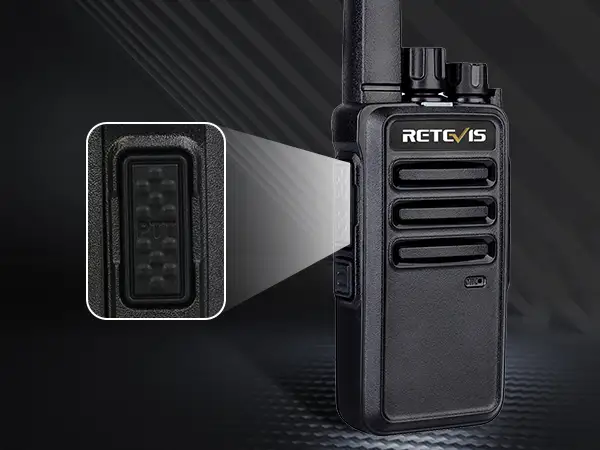
The most consistent complaint is surprisingly specific: microphone positioning. A verified buyer on Amazon warned: “you have to speak directly into the microphone though.” Jennifer Moore echoed the same issue: “you do need to speak directly into the mic for best results.” The implication is clear—teams with high turnover or casual users may initially think the radio is “quiet” or “finicky” until they adjust habits.
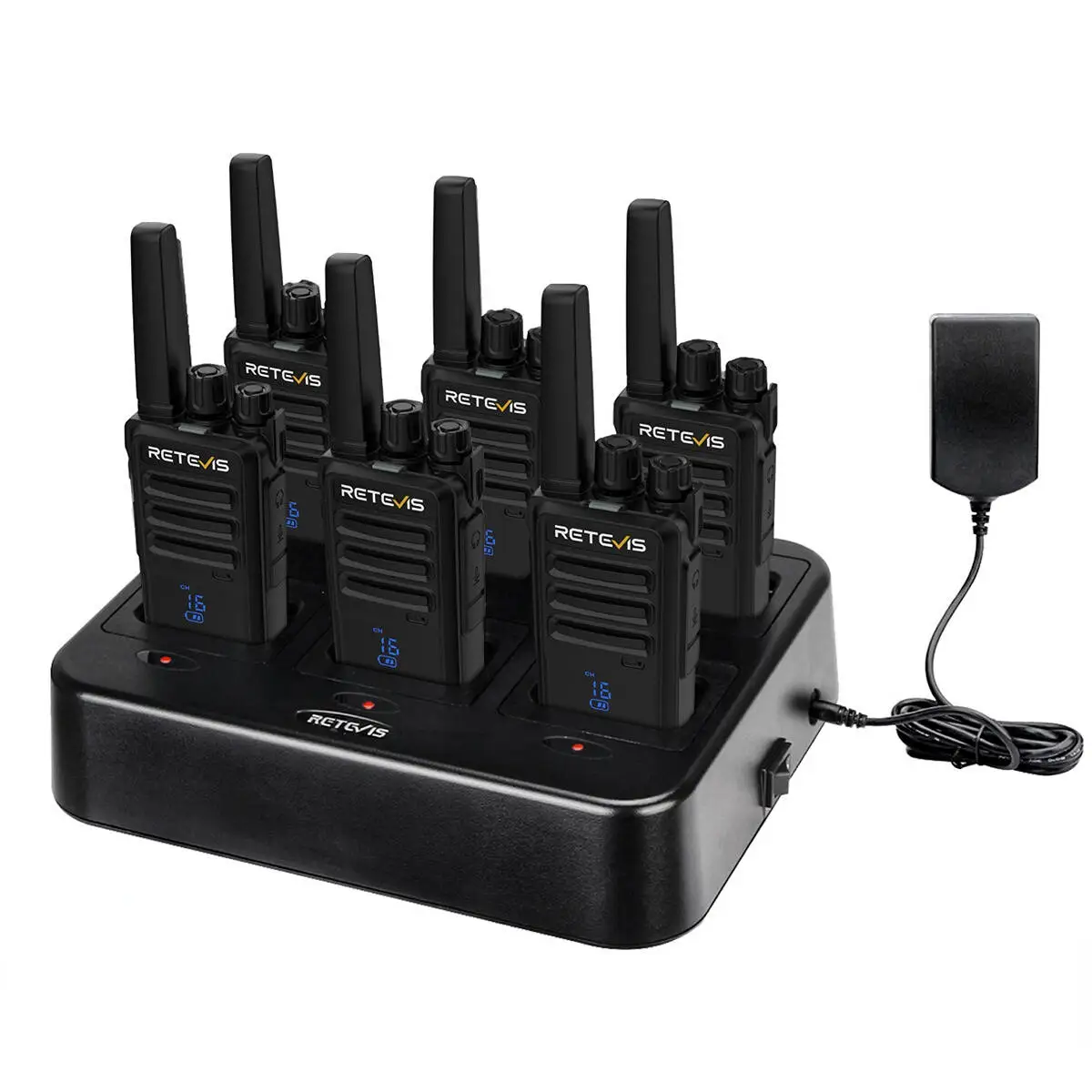
Charging logistics also frustrate some buyers. One Amazon reviewer said: “didn't like all the chargers.” The 10-pack format can create a desk full of bases and cables, which matters for schools and churches trying to keep equipment tidy, labeled, and accountable. Even if performance is strong, the charging footprint becomes part of the day-to-day maintenance burden.
There’s also confusion around programmability. One Amazon reviewer cautioned: “some retevis can be programmed and some can't so check first.” In the provided specs, Retevis describes programming via cable/software, but user confusion suggests that purchasing bundles without the right cable or expecting certain features “out of the box” can lead to disappointment.
Summarizing the complaint patterns:
- Mic technique required for best clarity (Amazon; Sharvibe)
- Charging setup can feel cluttered at 10-pack scale (Amazon)
- Programmability expectations vary (Amazon vs product-page guidance)
Divisive Features
Battery life is divisive mostly because the official claims conflict across sources and user stories describe “shift success,” not the headline “24 hours.” While Amazon specs say “up to 24 hours,” the Retevis documentation for similar RT68 bundles describes “8–12 hours” or “12 hours,” and one user story lands at “full 10-hour days.” For a school using radios only during arrival/dismissal bursts, this likely feels like “forever.” For all-day retail or security traffic, it’s still solid—but not necessarily the two-day endurance some buyers might infer.
VOX (hands-free) is advertised across listings, but there are no direct user quotes in the provided data praising or criticizing VOX specifically. That absence matters: it suggests VOX may not be the reason people like this radio, even if it’s present on the spec sheet.
Trust & Reliability
The Retevis RT68 Two Way Radio Walkie Talkies with USB Charging Base (10 Pack) doesn’t show classic scam-warning signals in the provided material, largely because the “Trustpilot” content here appears to be product-page style text rather than independent reviewer testimony. Digging deeper into the dataset, the most trustworthy reliability indicators come from long-term usage stories on Amazon rather than third-party rating platforms.
One of the strongest durability signals is time-in-service. A verified buyer on Amazon wrote: “we have had these radios for over a year now, and they are all still working great.” That kind of institutional uptime—where devices are shared, dropped, and recharged constantly—carries more weight than early “just arrived” impressions.
Another reliability proxy is comparative replacement behavior. A school user described them as “very cost-effective,” and a camp user emphasized they “charged in an hour” and were “easy to use.” The throughline is that teams adopt them into routine operations rather than treating them as occasional hobby radios.
Alternatives
The Retevis RT68 Two Way Radio Walkie Talkies with USB Charging Base (10 Pack) is repeatedly positioned (in official materials) as compatible with other FRS radios, explicitly naming models like Retevis RT22, RT21, and H-777. That’s the only competitor set mentioned in the provided data, so alternatives here are limited to those references.
Retevis’ own FAQ frames RT68 vs RT22 as a tradeoff: “rt68 can sit for charging without the belt clip removed… battery is 1200 mah, while rt22 is 1100 mah,” and suggests RT22 if you want “a thinner and shorter antenna.” For teams that value a simpler charging routine and slightly higher stated capacity, the RT68 is positioned as the operationally easier tool. For users prioritizing compactness, RT22 is implied as the sleeker option.
There’s also a compatibility angle: if you already own RT21/RT22/H-777 units, official materials claim the RT68 can “work with other frs radios with 16 channels on the same channel and ctcss.” For organizations mixing old and new inventory, that may matter more than raw performance claims.
Price & Value
The Retevis RT68 Two Way Radio Walkie Talkies with USB Charging Base (10 Pack) is presented as a budget-friendly bulk communication tool, and user feedback repeatedly frames it as a value play rather than a luxury purchase. A verified buyer on Amazon said: “Great value!” Another called them “very cost-effective,” and connected the purchase directly to a measurable outcome: “now dismissal goes much faster.”
Pricing in the dataset varies by retailer and bundle configuration. A Newegg listing shows a 10-pack with earpieces priced at $239.00, while a separate post attributed to Jennifer Moore references $139.99 (source: Sharvibe). These are not directly comparable without confirming identical bundles, but the spread reinforces a practical buying tip: pricing depends heavily on pack size and included accessories (earpieces, multi-chargers, etc.).
Resale/market signals are indirect. The eBay listing referenced is for a single RT68 unit type (“2W 1200mAh…”) with high sales volume (“265 sold”), suggesting ongoing demand for the model family. For buyers managing a fleet, that implies replacement units may be easy to source even if a full 10-pack bundle goes out of stock on Amazon.
Buying-oriented takeaways based on the provided data:
- Value is strongest when replacing older, unclear radios (Amazon comparisons)
- Bundle contents drive price swings (Newegg vs Sharvibe)
- Single-unit market activity suggests replacements are available (eBay listing)
FAQ
Q: How far can the Retevis RT68 cover?
A: Official Retevis materials say “generally…0.5–2 miles,” but real-world stories focus on buildings and properties rather than miles. A verified buyer on Amazon noted: “no issues using it in a sky rise,” and another described strong coverage across a large work area.
Q: Do these radios really work well inside buildings?
A: Many users say yes, especially for workplaces. A verified buyer on Amazon wrote: “we have no issues using it in a sky rise,” and another said the audio is clear enough that “you can clearly hear the other walkie talkies.” Official specs also emphasize penetration through concrete.
Q: Is battery life actually 24 hours?
A: Treat “24 hours” as best-case marketing. Amazon specs mention “up to 24 hours,” but Retevis documentation in the provided data describes “8–12 hours” or “12 hours.” A user story from Sharvibe said they got “full 10-hour days with juice to spare.”
Q: Are they easy for a large team to learn quickly?
A: Many accounts describe them as simple. A verified buyer on Amazon said they are “easy to use,” and a camp reviewer noted “the camp counselors and administrators loved them… and they were easy to use.” The main learning curve is speaking directly into the mic.
Q: What’s the most common issue teams run into?
A: Mic technique and setup logistics. A verified buyer on Amazon warned: “you have to speak directly into the microphone though,” and another disliked the charging situation: “didn't like all the chargers.” For big teams, a short training and a charging station plan helps.
Final Verdict
Buy the Retevis RT68 Two Way Radio Walkie Talkies with USB Charging Base (10 Pack) if you run a school, church, camp, or retail operation that needs reliable, license-free communication and cares most about “clear enough to work” audio and day-to-day durability. Avoid it if you need guaranteed “24-hour” endurance in continuous-use scenarios or if your team won’t adapt to speaking directly into the mic.
Pro tip from the community: plan a quick mic-use briefing—because as one verified buyer on Amazon put it, “you have to speak directly into the microphone though,” and that single habit seems to separate “crystal clear” from “say again?” in real use.