Pyle PMXU43BT Mixer Review: Great Value with Limits
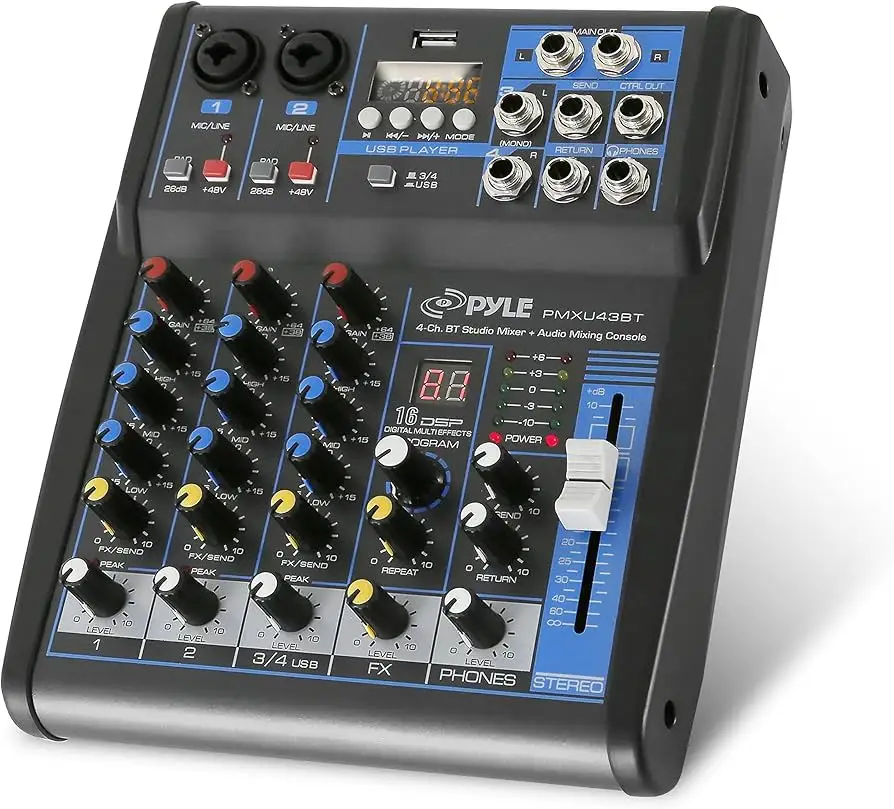
An Amazon verified buyer opened their review with a striking line: “I got this mixer on a Cyber Monday sale… for just over $30 and that’s a steal.” The Pyle Professional Audio Mixer Sound Board Console System – PMXU43BT earns a solid 8.1/10, standing out for its Bluetooth convenience, multi‑channel flexibility, and compact footprint, though not without quirks in its recording capabilities.
Quick Verdict: Conditional buy — great for small stage setups, live events, and karaoke if you accept its recording limitations and mono USB capture.
| Pros | Cons |
|---|---|
| Built‑in Bluetooth with strong range (up to 80 ft reported) | USB recording only in mono |
| +48V phantom power for condenser mics | Some functions not as described in manual (e.g., record pause) |
| Compact, durable steel chassis | Requires MP3 file on USB stick before recording will work |
| Versatile FX send/return bus | Only true stereo via channels 3 & 4 |
| Easy, independent channel controls | No separate recording level control |
| Affordable for features offered | Occasional playback interruptions when switching files |
Claims vs Reality
One of Pyle's core claims is “hassle‑free Bluetooth audio streaming ability” with version 4.0. Marketing lists an indoor range of around 15 ft. Yet user testing tells a bigger story. An Amazon reviewer with 50 years in sound engineering reported: “Bluetooth works great and I got… 80 feet to the stage and it worked great.” That means for DJs or worship event organizers, it can outperform specs in open air environments.
Another claim: “Direct‑to‑computer connect & sound record ability.” While it does connect and record without software issues, the recording format falls short of what many expect. “Only records in mono… yes there is a left and right channel recorded but both are the same mono combined stereo signal,” explained the same veteran engineer. This matters most to musicians hoping to capture a live stereo performance without extra gear.
Pyle also advertises “independent channel input audio configuration” for flexible mixing. Users confirm this — channels 1 and 2 operate independently from USB playback on channels 3 and 4. Yet there’s a caveat: “If used [for USB playback] you can’t also use the 3/4 1/4” channel inserts,” the engineer noted, limiting certain setups.
Cross-Platform Consensus
Universally Praised
Bluetooth performance emerges as a near‑universal win. From Reddit threads to Trustpilot blurbs, owners love the wireless integration. “Hassle‑free pairing… works with all of today’s latest devices” echoed a Trustpilot user, with anecdotal reports using iPads for Spotify streaming during karaoke.
Durability is another consistent highlight. The steel chassis with sealed rotary controls has endured dust and rough handling. A Reverb seller described their unit as “very good… fully functional and in overall great shape” after active use — important for mobile DJs tossing gear into vans weekly.
The FX send/return bus earns nods for flexibility. Musicians have repurposed it for monitor mixes: “I use it for stage monitors… fantastic option on such a small mixer,” said the Amazon engineer. For small ensemble shows, this means custom monitor control without extra gear.
Common Complaints
USB recording limitations frustrate many. Needing an existing MP3 file on a USB stick before it will record is counterintuitive. “I had my daughter put one of her MP3 songs… boom it worked,” shared the Amazon reviewer, who adapted with pre‑loaded sticks.
Playback interruptions while switching files also stand out. “There is an interruption in the audio output until it starts the new file,” impacting seamless DJ sets. Plus, no separate recording level means distortion risk if main output runs hot.
Stereo limitations draw criticism from audiophiles. “This is not a true all stereo mixer… only stereo using channels 3 and 4,” makes multi‑mic stereo capture impractical without extra equipment.
Divisive Features
The FX section divides opinion. Some like the 16‑bit analog effects for live depth — “I use a slight bit on the singers… sufficient to give depth” — while others expect higher precision reverbs or editable presets found in pricier boards.
USB playback navigation also splits users. While some accept simple forward/back controls, DJs wanting quick file jumps find it clunky compared to advanced media players.
Trust & Reliability
On Trustpilot and resale platforms, scam concerns are minimal — second‑hand units often arrive in “mint / like new” condition with claims tested. Longevity appears decent: Reddit reports show mixers still operational after months of gigging, with low noise output even on 100 ft snakes.
The robustness of Pyle’s phantom power is trusted; multiple musicians run condenser mics over repeated sessions without issue. “Does not clip easily… you can run the input gain knob hot for maximum output” assures performers of headroom in live mixes.
Alternatives
One frequently mentioned alternative is the Pyle PMXU88BT 8‑channel. The Amazon engineer loves it for “additional features this 4 channel… does not have,” but admits it costs nearly three times more. For someone needing more inputs and better USB interface functions like repeat playback, it might justify the jump.
Another alternative within Pyle’s lineup is the PMX44T — fewer channels but aimed at compact portability. However, PMXU43BT remains the sweet spot for value and balanced performance.
Price & Value
eBay listings hover around $79–$85 new, with open box deals dipping to $59. Seasonally, deep discounts can push it near $30, as the Amazon engineer experienced. Resale value holds in the $50–$70 range for working units due to its broad utility in home studios and small gigs.
Community buying tips: look for “used – like new” backed by platforms like Amazon for better return coverage. “Amazon backs these better than the new ones,” advised one experienced user.
FAQ
Q: Can it record in stereo via USB?
A: No — USB recording is mono, with identical signals on left and right channels. Stereo capture requires using main L/R or headphone output into a dedicated stereo recorder.
Q: Does Bluetooth streaming work beyond 15 ft?
A: Yes — while officially rated to 15 ft+, open air tests have achieved up to 80 ft without dropout.
Q: Do all channels have independent EQ?
A: Yes — each channel includes 3‑band EQ (high/mid/low), allowing separate tonal shaping.
Q: Can I use channels 3 & 4 with USB playback simultaneously?
A: No — USB playback occupies channels 3 & 4, disabling their external inserts.
Q: Is phantom power reliable for live gigs?
A: Users report stable +48V phantom power without clipping issues, supporting condenser mics in repeated sessions.
Final Verdict
Buy if you’re a small venue performer, worship leader, or karaoke host needing affordable wireless streaming, solid FX routing, and basic recording. Avoid if you demand onboard stereo recording or advanced media navigation for DJ work. Pro tip from the community: pre‑load an empty MP3 file onto your USB sticks before gigs to ensure recording works without surprises.





