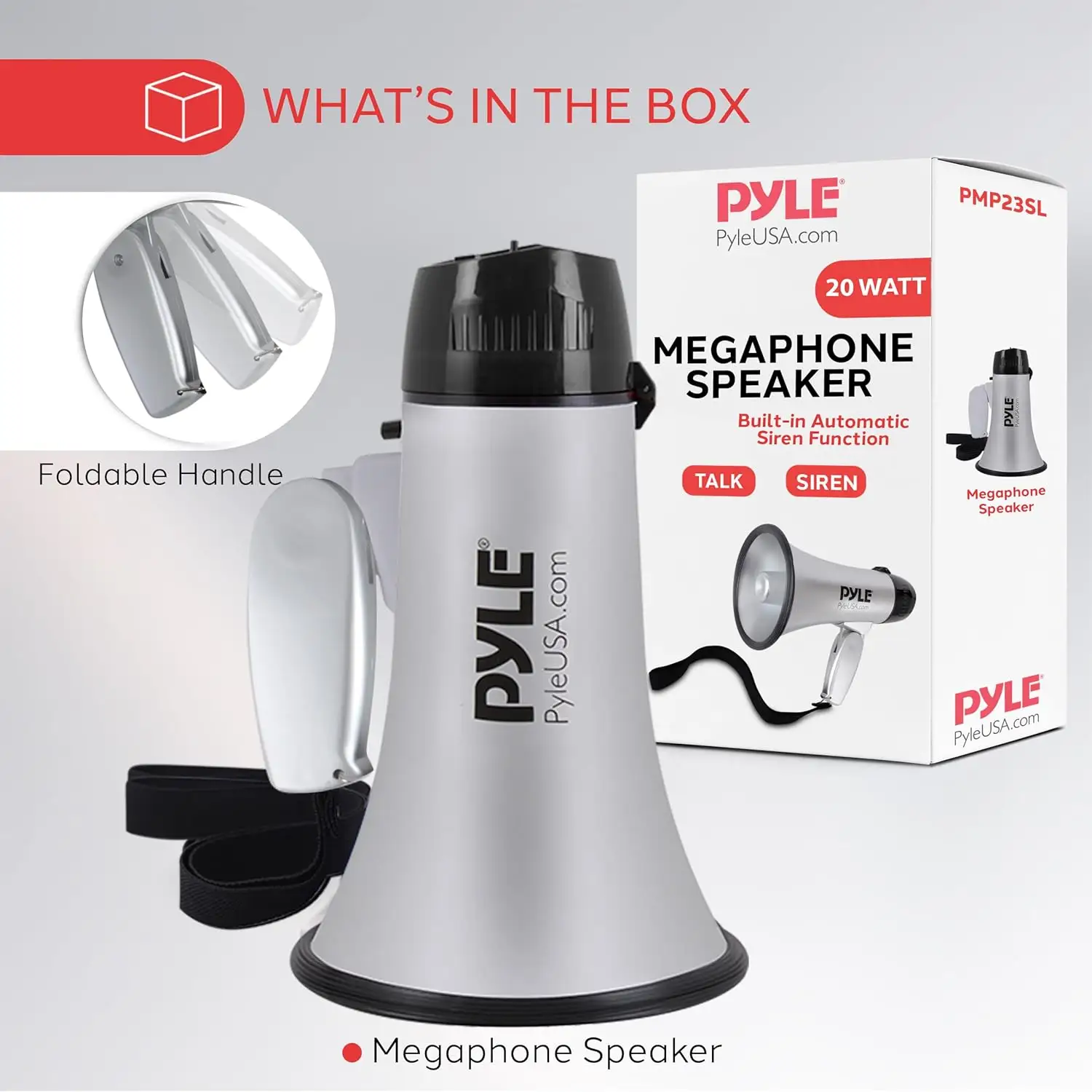
Pyle Megaphone Speaker PA Bullhorn Review: 7.6/10 (Conditional)
A 50-watt bullhorn that’s “very, very loud” — and, for some buyers, so finicky it becomes “pretty useless” once the battery door acts up: Pyle Megaphone Speaker PA Bullhorn lands as a conditional recommendation at 7.6/10 based on the provided cross-platform feedback.
Quick Verdict
Yes — conditionally. If your priority is maximum volume and voice projection for coaching, rallies, or crowd control, the praise is consistent. If you need dependable long-term durability (especially around the detachable mic cable and battery compartment), multiple reports raise red flags.
| What people agree on | Evidence from users | Who it’s best for |
|---|---|---|
| Loud, attention-grabbing output | “very, very loud at maximum volume” (Amazon review) | Coaches, marshals, organizers |
| Helpful detachable mic + strap | “love the detachable mic… comes with a shoulder strap” (Amazon review) | Users needing hands-free-ish use |
| Siren is extremely loud | “the siren is extremely… loud” (Amazon review) | Safety drills, emergency signaling |
| Battery system is confusing | “battery insertion instructions… confusing” (Amazon review) | Anyone willing to troubleshoot |
| Durability complaints recur | “on my third one… in as many months” (Amazon review) | Heavy-use workers should be cautious |
Claims vs Reality
Pyle’s marketing and spec language leans hard on distance, power, and “clear sound & long range.” Officially, the product is described as a 50 watt megaphone with an audio projection range claims spanning “be heard up to 1200 feet away” and even “over 1,700’+ yards” in the provided Amazon spec block. Digging deeper into user experiences, the “loud” part is repeatedly reinforced, but the “hassle-free” part is where reality starts to wobble.
The loudness claim is the easiest one to match with firsthand accounts. A verified buyer on Amazon wrote: “it’s nice and loud,” and another went further: “very, very loud at maximum volume, nice and clear speaker.” Even when reviewers aren’t raving, they still frame the output as a practical solution to being heard: one Amazon reviewer said they bought it for coaching and “now i don’t have to lose my voice or scream… and just talk in my normal voice but all the kids can now hear.”
Where the marketing language stretches is around usability and consistency. The device is battery-powered and requires 8 C batteries (per Amazon specs). Multiple user narratives revolve around battery compartment confusion and contact problems. A verified buyer on Amazon warned: “the battery insertion instructions on the device is confusing… pull out the plastic sleeve… follow the instructions on the sleeve,” and another described mechanical quirks like the gasket: “be careful it doesn’t fall off.” On the Pyle product Q&A text included under Twitter/X, users asked bluntly: “how to put in batteries… it doesn’t work” and “does not work with batteries. i just bought new c batteries,” with responses pointing to orientation—suggesting this is a recurring friction point for real buyers.
Finally, the durability claim is the biggest gap. While some long-form community-style writeups praise reliability, Amazon’s negative experiences describe frequent replacement and component failure. One Amazon reviewer summed it up: “works great but doesn’t last… i am on my third one… in as many months,” citing the detachable mic cable working loose and the speaker becoming “prone to distortions.”
Cross-Platform Consensus
Universally Praised
“Loud” isn’t a vague compliment in this dataset—it’s the central story. A recurring pattern emerged across Amazon reviews and community writeups: buyers are reaching for this bullhorn when they need to cut through distance or ambient noise. On Amazon, one reviewer described replacing an older unit and said the new one “works great… it’s nice and loud,” and another emphasized practical projection: “now i don’t have to lose my voice… all the kids can now hear.” For coaches and organizers, that’s the real value proposition: saving your voice while still controlling a group.
Voice projection in noisy environments also shows up in the community-style “motorsports event” narrative. A Reddit/community source writeup about the Pyle PMP50 Pro claimed it was used as a safety marshal tool and highlighted that “the built in siren is very handy (and loud!)… but the real power comes from the voice projection,” adding: “You are able to easily make announcements over engine and background noise.” Even though that writeup focuses on a closely related model, it reinforces the same theme buyers echo on Amazon: when the unit is functioning properly, it can dominate messy real-world sound.
Hands-free convenience features—especially the detachable microphone and shoulder strap—come up as quality-of-life wins for people who need to talk while moving. A verified buyer on Amazon wrote: “i love the detachable mic… it also comes with a shoulder strap so you can carry it at your side and still use the mic.” Another reviewer described workflow options: “option of trigger on handle… or detach microphone and push to talk… or use locking mechanism to keep microphone on. includes a shoulder strap.” For rally leaders, field coaches, or event staff, those small controls are what separates a “loud horn” from a tool you can actually run all day.
After those stories, the feature praise tends to crystallize into a few repeatable takeaways:
- Loud output that cuts through crowds (“very, very loud”).
- Practical projection for coaching without yelling (“talk in my normal voice”).
- Detachable mic + strap makes extended use easier (“carry it… still use the mic”).
Common Complaints
Digging deeper into user reports, the biggest reliability anxiety clusters around two areas: the detachable microphone connection and the battery compartment/contact system. These aren’t abstract gripes—buyers describe work interruptions and repeated replacements. A verified buyer on Amazon said: “works great but doesn’t last… the cable connecting the detachable microphone to the unit works its way loose, causing intermittent interruptions.” For workers using it “4 days a week,” that translates into a tool that can’t be trusted mid-shift.
Battery friction shows up both as “it won’t turn on” moments and as “the design is confusing” moments. One Amazon reviewer gave a step-by-step workaround—“pull out the plastic sleeve inside the battery chamber”—because “the battery insertion instructions on the device is confusing.” On the Pyle Q&A text embedded under Twitter/X, multiple users ask variations of “doesn’t work with batteries,” with replies repeatedly emphasizing orientation and contact. That repetition suggests the battery system may be error-prone in practice, especially for first-time users or anyone inserting batteries in a hurry before an event.
Then there’s the sound quality inconsistency. Some users describe “nice and clear speaker,” while others report interference. A verified buyer on Amazon wrote: “in talk mode there is a constant static noise… when you actually talk into the mic it sounds staticky,” adding that the unit at their workplace “there is no static noise,” which hints at unit-to-unit variation or QC issues. Another Amazon reviewer mentioned operational quirks: the mic staying “running hot for a couple of seconds” after releasing the trigger, and the feedback risk if the detachable mic is held too close to the horn: “otherwise a loud feedback sound will happen.”
After these narratives, the complaint themes consolidate into:
- Detachable mic cable/connection issues (“works its way loose”).
- Battery door/contact frustrations (“does not work with batteries”).
- Static/feedback and small control quirks (“constant static noise”).
Divisive Features
The siren is a perfect example of a feature that users either love or fear. For emergency drills, crowd clearing, or grabbing attention fast, it’s celebrated. A verified Amazon reviewer wrote: “i love the siren. it works great.” But others describe it as overkill or hard to control. Another verified buyer said: “the siren is extremely, and in my opinion unnecessarily, loud,” and complained that “the volume control does not mute it” and it “automatically goes off” when switching into siren mode—prompting them to physically block the switch to prevent accidents.
Weight and “portability” also split depending on expectations. Some reviewers are pleasantly surprised: “the megaphone itself is not as heavy as i imagined… grip is comfortable.” Yet power comes with battery bulk: one reviewer noted it’s “light in weight, even with eight c batteries,” but still called out cost and practicality: “eight c batteries can get costly.” For casual users, that ongoing battery demand can feel like a hidden tax; for professionals, it may be an acceptable trade for output.
Trust & Reliability
A Trustpilot-linked TLDR summary (ShopSavvy) frames the model as popular for “impressive loudness” but flags “notable issues regarding durability and reliability, with many customers reporting malfunctions shortly after use.” That lines up with the Amazon reviewer who described rapid failure cycles: “on my third one… in as many months,” blaming fragile connections and speaker distortion over time.
At the same time, the broader web writeups in the dataset sometimes paint Pyle’s higher-powered bullhorns as “reliable” and “sturdy,” even claiming use by military or service personnel. The contradiction is worth stating plainly: while community-style sources describe “build quality” and “reliability,” multiple Amazon buyers describe failures that appear under normal, frequent use—especially where the detachable mic cable meets the unit and where battery hardware takes stress.
Because the provided Reddit/community content doesn’t include true “6 months later” posts with timestamps or follow-ups, the most concrete durability stories here come from Amazon’s heavy-use reviewer narratives and the Trustpilot-linked analysis summary.
Alternatives
Only a few direct alternatives are named in the provided data, so the comparison stays inside that fence. One Amazon reviewer explicitly compared their experience to an “inexpensive off-brand version” and said they tried Pyle for “increased volume and lighter weight,” but after repeated failures concluded: “i’m thinking now i’ll go back to the cheaper but more durable unit from harbor freight.” That’s the clearest competitor mention: an off-brand/Harbor Freight-style bullhorn that may sacrifice refinement for toughness.
Within Pyle’s own ecosystem, the data references closely related models (PMP50, PMP53IN, PMP58U, PMP42BT). Users praising detachable mic workflows and loud projection often speak in the same breath about modes (talk/siren) and add-ons like aux input. If your alternative is “stay with Pyle but change models,” the dataset suggests feature trade-offs (Bluetooth, USB/record functions, rechargeable variants), but the durability concerns don’t clearly disappear—Amazon feedback on the PMP58U includes both glowing praise (“loud, good, worth it!”) and serious longevity complaints (“works great but doesn’t last”).
Price & Value
Pricing in the dataset spans multiple channels and can look deceptively attractive at first glance. On eBay, one listing shows around $43.95 (plus shipping), and the Pyle store text under Twitter/X shows a “reg $55.19” style price presentation. A recurring pattern in Amazon reviews is value framing: one reviewer called it “excellent… at a decent price,” citing roughly “about $40” as their purchase point and praising clarity and features for the money.
But the value equation swings hard based on whether you land a solid unit. The heavy-use Amazon reviewer’s experience turns “cheap and loud” into “expensive over time” quickly: buying “third one… in as many months” erases any upfront savings. Battery cost is another value lever. Even satisfied users acknowledge the power draw: “eight c batteries can get costly,” and that’s before any spares for events, drills, or prolonged outdoor use.
Buying tips embedded in user stories lean practical rather than promotional:
- Expect to troubleshoot battery insertion (“pull out the plastic sleeve… follow the instructions on the sleeve”).
- Consider removing batteries during storage to avoid leakage (“remove them when not in use”).
- If durability is mission-critical, factor replacement risk into the “deal.”
FAQ
Q: Is the Pyle bullhorn actually loud enough for outdoor crowds or coaching?
A: Yes, loudness is the most consistent theme in user feedback. A verified buyer on Amazon said it’s “very, very loud at maximum volume,” and another described coaching relief: “now i don’t have to lose my voice… all the kids can now hear.” Community writeups also describe announcements cutting through engine noise.
Q: Do people have problems getting it to work with batteries?
A: Some do. An Amazon reviewer warned the “battery insertion instructions… confusing” and advised using the internal sleeve’s diagram. In the Pyle site Q&A text, multiple users asked why it “doesn’t work with batteries,” with replies repeatedly pointing to correct orientation—suggesting setup errors or finicky contact.
Q: Is the siren practical, or is it too much?
A: It depends on your use case. One Amazon reviewer said, “i love the siren. it works great.” Another called it “unnecessarily loud” and complained it “automatically goes off” when switched into siren mode and that the volume control “does not mute it,” leading them to block the switch to prevent accidents.
Q: How reliable is the detachable microphone setup?
A: Mixed. Several positive reviews praise the detachable mic for convenience—“love the detachable mic… shoulder strap… still use the mic.” But one heavy-use reviewer reported the “cable connecting the detachable microphone… works its way loose,” causing “intermittent interruptions,” and said they were on their “third one” after frequent use.
Q: Does it produce static or feedback?
A: Some units appear to. A verified buyer on Amazon reported “a constant static noise” in talk mode and said speech sounded “staticky.” Another reviewer warned that placing the detachable mic too close to the front can trigger “a loud feedback sound,” framing it as a handling issue rather than a constant defect.
Final Verdict
Buy if you’re a coach, organizer, or safety lead who needs maximum voice projection and can tolerate some setup quirks—especially around the battery sleeve and feedback management. Avoid if your job depends on daily, heavy use where a loose detachable mic cable or battery-compartment issues would be a dealbreaker.
Pro tip from the community: a verified Amazon reviewer advised ignoring the printed battery instructions on the device and instead “pull out the plastic sleeve inside the battery chamber” and follow the sleeve diagram to avoid installation mistakes.