Pyle Marine Radio Bluetooth Kit Review: Conditional 7/10
A $75 “marine” head unit that “doesn’t like to be rained on” is the kind of contradiction that shows up fast in real-world installs. Pyle Marine Radio Bluetooth Waterproof Boat Console System with Mic, Speakers, Remote lands as a budget-friendly audio refresh for small boats and oddball installs—but only if you treat “waterproof” as “needs protection.” Verdict: Conditional buy, 7/10.
Quick Verdict
The community read is conditional: it’s a decent-value starter kit if you accept compromises in loudness, remote range, and water exposure expectations.
Several Amazon reviewers sound genuinely satisfied with the basics. A verified buyer on Amazon noted: “the stereo system works great,” and another wrote: “everything worked right out of the box.” But the same review stream includes sharper warnings about durability and warranty friction—especially if you install after the return window.
| Decision | Evidence From User Feedback |
|---|---|
| Buy if you want a budget starter kit | “great marine radio for the money” (Amazon review) |
| Don’t expect true open-boat waterproofing | “this unit will need a cover… it doesn't like to be rained on” (Amazon review) |
| Bluetooth is often “good enough” | “sounds good and was easy to connect to via bt” (Amazon review) |
| Remote can be frustrating | “i have to be really close… before it will work” (Amazon review) |
| Loudness may fall short at speed without an amp | “difficult to hear at cruising speed… buy the amp” (Amazon review) |
| Watch for failures and warranty wait times | “did not work out of the box… 4-6 weeks” (Amazon review) |
Claims vs Reality
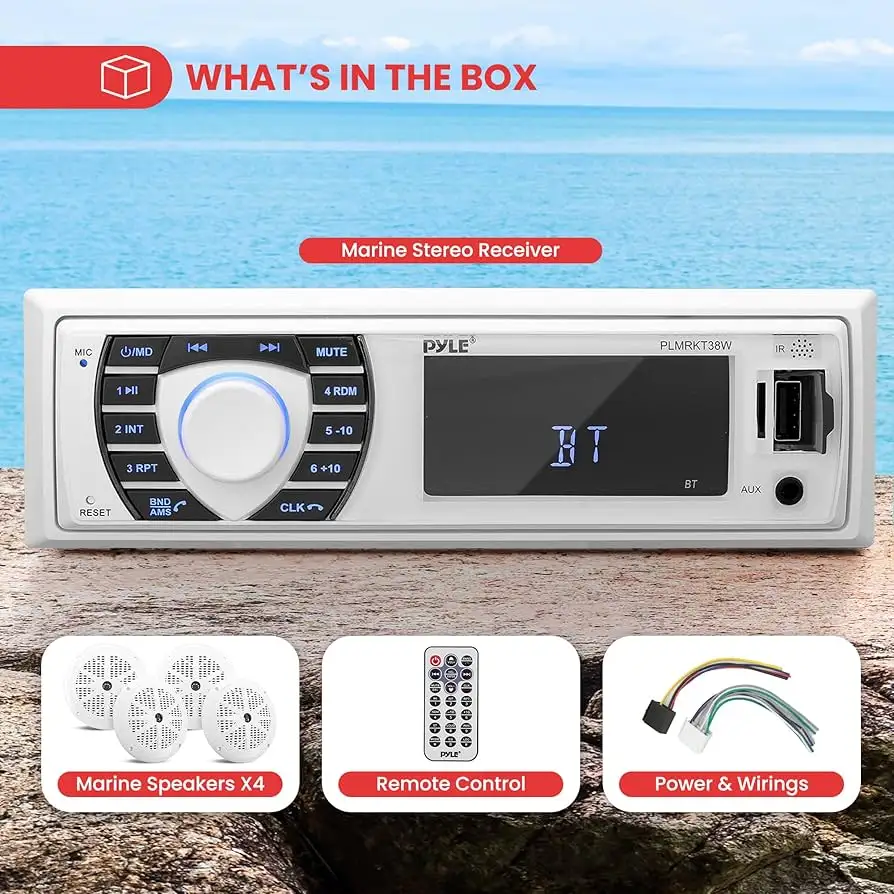
Marketing language for this family of Pyle marine kits leans hard into “waterproof / weatherproof” and “marine grade.” Digging deeper into user reports, the lived reality sounds closer to “works fine with a cover” than “shrug off rain in an open console.” A verified buyer on Amazon put it bluntly: “just a heads-up, this unit will need a cover if you're installing in an open boat… it doesn't like to be rained on.” For owners of open boats or exposed helm setups, that quote changes the decision from a simple budget upgrade to a budget upgrade plus protective housing.
Another recurring claim is convenience—remote control, easy adjustability, and hands-free features. Yet multiple users describe the remote as borderline line-of-sight. A verified buyer on Amazon wrote: “the only issue i have with it is the remote control. i have to be really close… it doesn't pick up from my drivers seat which is only an arms length away.” For boaters who mount the unit overhead or farther from the helm, that turns “remote included” into “remote included, but you may still use your phone.”
Power and volume is the third area where marketing numbers and boat reality diverge. One Amazon reviewer liked the value but admitted: “would have been 5 stars if it was just a touch louder… difficult to hear at cruising speed.” Their workaround is telling: “i installed the 400w pyle… amplifier… and it sounds great.” For anyone imagining “75W x 4” is enough to cut through wind and engine noise, the feedback suggests budgeting for an amp if you care about cruising-speed intelligibility.
Cross-Platform Consensus
Universally Praised
The strongest consensus is value-per-box. Even when expectations are modest, buyers appreciate getting a head unit plus multiple speakers and wiring without piecing together a system. A verified buyer on Amazon framed it as almost unbeatable for the cost: “how can you complain about 75$ head unit with bluetooth 4 speakers and wire.” For budget-focused DIYers—like people outfitting an older fishing boat, a golf cart, or a garage “bar” setup—this bundle approach reduces decision fatigue and gets sound playing quickly.
Ease of installation comes through as a repeatable win for hands-on owners. A verified buyer on Amazon wrote: “easy install,” and another said their setup “worked right out of the box.” This matters most to owners replacing an outdated stereo who want a straightforward single-DIN swap, rather than rewiring an entire helm. When your goal is a weekend project that ends with music on the water, “works right out of the box” is the success metric that shows up again and again.
Bluetooth functionality is praised more for convenience than audiophile performance. A verified buyer on Amazon noted: “sounds good and was easy to connect to via bt,” and another reviewer dealing with remote limitations said: “the bluetooth range is good to around 20 feet or so, so i usually just change songs or volume on my phone.” For casual listeners who keep a phone at the helm, that “change songs on my phone” pattern becomes the real control method, especially when the remote disappoints.
After those stories, the consistent “wins” look like this:
- Good price-to-features appeal for entry-level marine audio (Amazon customer reviews)
- Many report straightforward setup and immediate functionality (Amazon customer reviews)
- Bluetooth pairing/streaming is commonly “easy” and practical for helm use (Amazon customer reviews)
Common Complaints
The loudest complaint theme is reliability variance—units that fail early, speakers that quit, or radios that power-cycle unexpectedly. A verified buyer on Amazon reported: “one speak stopped working and the radio turns off on its own at times.” Another went further, describing a dead-on-arrival experience that only surfaced after installation timing: “i installed my about 50 days after purchase and it did not work out of the box.” For boaters who buy parts ahead of a refit and install later, that “install quickly” warning can be more important than any spec.
Remote control range is a second repeated pain point, and it shows up in practical, annoying ways. One Amazon reviewer said they had to be “really close” or “directly in front” of the unit. Another described a similar short-range reality: “the remote works from a short distance but functions well.” For helm layouts where the radio sits slightly off-angle, or for overhead mounting, a short-range remote turns into a near-useless accessory.
Finally, “marine” labeling doesn’t always match water exposure expectations. The most pointed Amazon quote—“‘marine’ doesn't necessarily mean water proof”—reads like a cautionary headline. For open boats, dock parties, and surprise squalls, the user workaround wasn’t “it survived,” but “added the cover for it so it'd be protected from rain.” In other words: protection is part of ownership.
Common complaint takeaways:
- Early failures and intermittent shutdowns show up in Amazon reviews
- Remote often requires close, direct aiming (Amazon reviews)
- “Waterproof” expectations frequently turn into “use a cover” behavior (Amazon reviews)
Divisive Features
Volume and clarity at speed is where owners split into two camps: “good enough for the money” versus “needs amplification.” One Amazon reviewer described it as an entry-level win but admitted it’s “slightly difficult to hear at cruising speed.” Another buyer, using it in a non-marine setting, had the opposite experience: “it sounds amazing, everyone loves it… more then enough volume and base.” That contrast suggests environment matters more than marketing wattage—quiet cockpit or indoor installs can feel impressive, while open water and engine noise can expose limits.
Controls and display usability also divide based on mounting position and sunlight. A verified buyer on Amazon noted their display was hard to see due to how they mounted it: “mounted overhead it’s hard to see the display from the seat.” They also described accidentally hitting the wrong function while trying to adjust volume because they couldn’t see the screen. For owners with flexible dash placement, this may never surface; for cramped helms, it can become a daily annoyance.
Trust & Reliability
The trust question here isn’t “is it a scam,” but “what happens if you get a bad unit.” Digging deeper into Amazon narratives, the most trust-damaging stories involve warranty turnaround and return windows. A verified buyer on Amazon wrote: “it was past the return window for amazon and pyles warranty is send it back and they will repair or replace it in 4-6 weeks.” For seasonal boaters, that timeline can effectively wipe out a month or more of prime boating time.
Long-term durability also comes through indirectly via failure language and “install quickly” advice. A verified buyer on Amazon warned others to “install if quickly and make sure it works.” Meanwhile, another buyer reported speaker failure and random shutdowns. Put together, the pattern suggests some owners have smooth sailing, while a smaller but meaningful group hits defects that turn a bargain into a hassle.
Alternatives
Only one clear alternative is explicitly mentioned by a buyer: Pioneer. In the sentiment analysis feed for the PLMRB29W, one negative snippet includes: “doesn ' t , i 'll pick up the pioneer.” That’s not a spec comparison—it’s a frustration-driven brand pivot. For buyers who prioritize long-term reliability and are willing to spend more, that quote signals where disappointed owners say they’d go next.
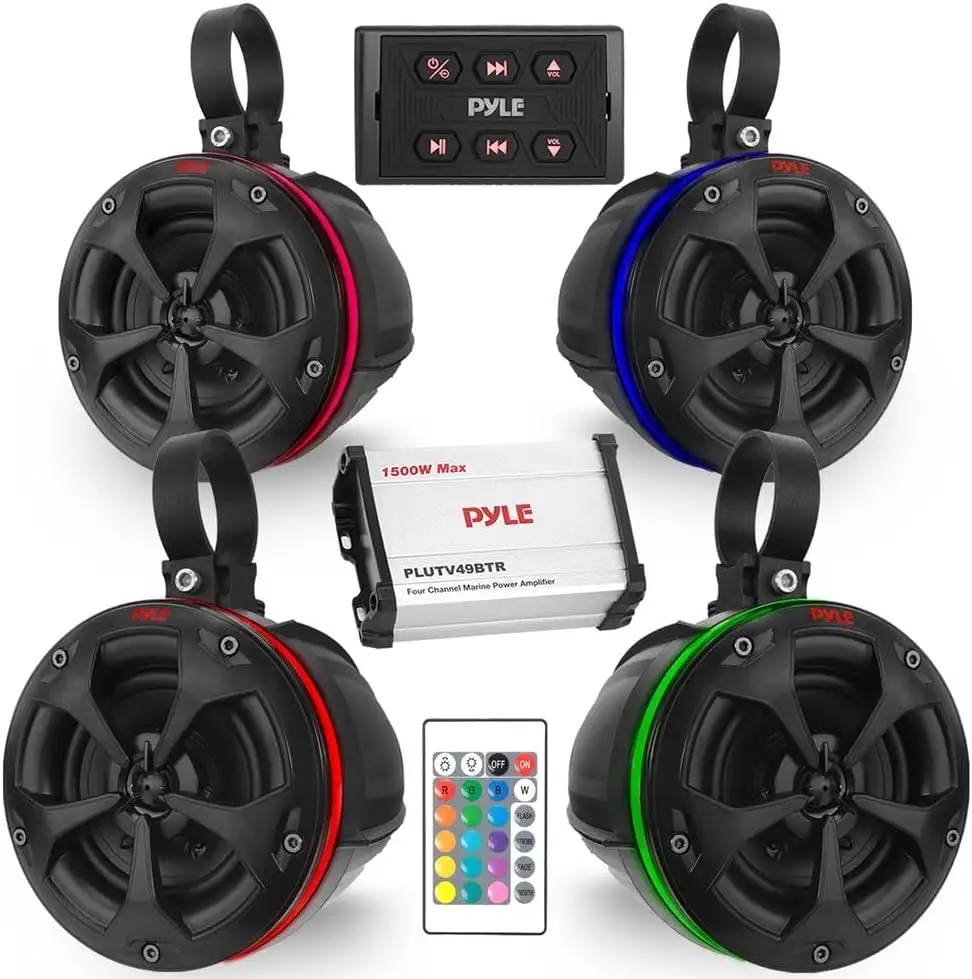
At the same time, some owners choose a different path: keep the Pyle head unit but add amplification. A verified buyer on Amazon updated their experience after adding a Pyle amp: “it sounds great… loud enough that i have to turn it down sometimes at cruising speed.” For those who like the value proposition but need more headroom, that “add an amp” route is the alternative strategy that emerges from user stories.
Price & Value
The dominant value narrative is that this kit delivers a lot of hardware for very little money—often framed as “entry level” and “for the money.” A verified buyer on Amazon called it “great marine radio for the money,” while another defended expectations at the price point: “great for low end set… if you want really good quality spend more.” For first-time boat owners or anyone restoring an older craft, that value framing sets expectations: you’re buying coverage (features + speakers) more than premium refinement.
Resale and market pricing signals appear through eBay listings rather than user reviews, but they reinforce the budget category: marine Pyle bundles show up as “open box” or low-cost new listings. That matters for bargain hunters who are comfortable with the trade-off: low price, variable reliability, and potentially needing protective housing.
Buying tips implied by community experiences:
- Install promptly to catch defects inside return windows (Amazon review experience)
- Budget for a cover in exposed installs (“need a cover”) (Amazon review)
- If you cruise at speed often, consider adding an amplifier (Amazon update)
FAQ
Q: Is the Pyle marine head unit actually waterproof?
A: Not everyone treats it as waterproof in real use. A verified buyer on Amazon warned: “this unit will need a cover… it doesn't like to be rained on.” If your boat has an open console, user feedback suggests planning a protective cover or housing.
Q: How good is the Bluetooth connection and range?
A: Several owners describe Bluetooth as easy and practical. A verified buyer on Amazon said it was “easy to connect to via bt,” and another noted “bluetooth range is good to around 20 feet.” Some users rely on their phone for control when the remote is finicky.
Q: Does the included remote control work well?
A: Feedback points to short range and line-of-sight behavior. A verified buyer on Amazon wrote: “i have to be really close… or directly in front of it before it will work.” Another buyer said it “works from a short distance but functions well,” which still implies limited range.
Q: Is it loud enough for cruising speed on a boat?
A: Some owners say it’s not quite loud enough without extra help. A verified buyer on Amazon reported it becomes “difficult to hear at cruising speed,” then updated that adding a “400w… amplifier” made it “sound great.” In quieter installs, others report “more then enough volume.”
Q: Any reliability red flags from buyers?
A: A few reviews describe early failures or defects. A verified buyer on Amazon said: “one speak stopped working and the radio turns off on its own,” and another reported it “did not work out of the box” after installing around 50 days later. Some frustration centers on warranty turnaround time.
Final Verdict
Buy if you’re a budget-focused boater restoring an older setup, a small-boat owner who can mount it in a protected console, or a DIYer who’s fine using phone control for Bluetooth. A verified buyer on Amazon captured that “for the money” satisfaction: “great marine radio for the money.”
Avoid if your head unit will be exposed to rain or spray without a cover, or if you need dependable, high-volume audio at cruising speed without adding an amplifier. Pro tip from the community: “install if quickly and make sure it works” (Amazon review), and treat “marine” as “needs a cover” in open-boat installs.