Nintendo Switch OLED Zelda TOTK Edition Review: Conditional
The loudest “wow” isn’t about performance—it’s about the screen and the collectible look. Nintendo Switch OLED Model - The Legend of Zelda: Tears of the Kingdom Edition earns a conditional verdict because fans call it “beautiful” and “mind-blowing” in handheld, while others keep circling the same two gripes: “no game included” and paying extra for aesthetics. Score: 8.8/10.
Quick Verdict
Yes/Conditional — Yes if you play handheld or want the Zelda collectible; conditional if you mostly dock, already own an OLED, or are waiting on next-gen rumors.
| What Buyers Liked/Disliked | What the feedback says | Best for | Source |
|---|---|---|---|
| OLED screen upgrade | “the oled screen sure makes a crazy difference in handheld play” | Handheld-first players | Best Buy (console reviews) |
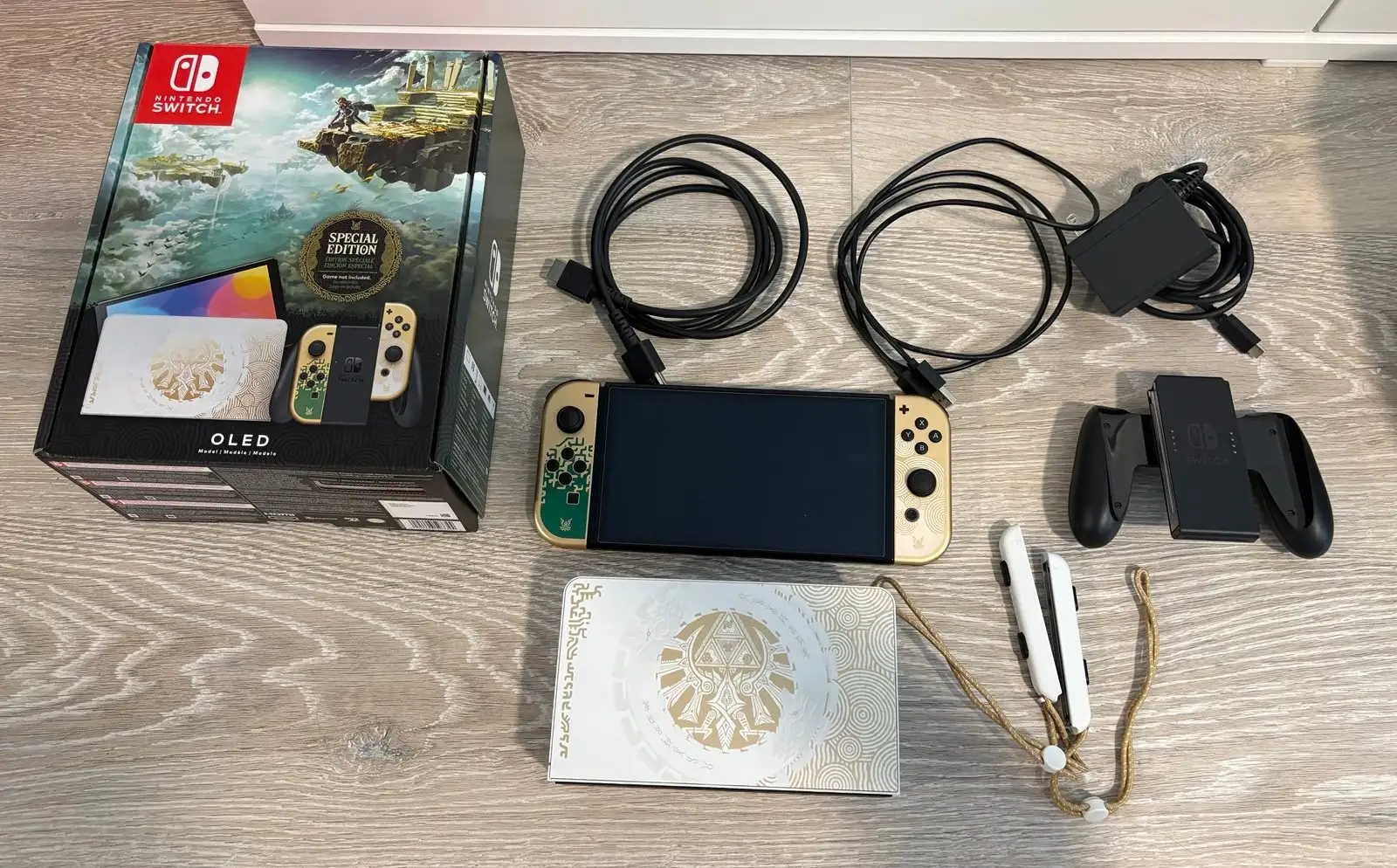
| Special edition design | “the design on the dock itself is probably the best and cleanest I’ve ever seen” | Collectors, Zelda fans | Best Buy (console reviews) |
| Kickstand improvements | “the new kickstand is much more sturdy” | Tabletop play, travel | Best Buy (console reviews) |
| Game not included | “only con was not having the game come included” | Anyone expecting a bundle | Best Buy + Nintendo/Amazon specs |
| Price premium | “price is higher… compared to the standard” | Value-focused buyers | Best Buy (console reviews) |
| Docked mode changes little | “nothing really changes when docked” | TV-only players | Best Buy (console reviews) |
Claims vs Reality
Nintendo and retail listings frame the edition as a hardware-and-style upgrade: a “7-inch OLED screen,” “wired LAN port,” “enhanced audio,” “64 GB internal storage,” plus Tears of the Kingdom-inspired dock and Joy‑Cons (Nintendo official site; Amazon specs). Digging deeper into user reports, the most consistent reality check is that the biggest “upgrade” is experiential—especially in handheld—rather than a performance leap.
Claim: “7-inch OLED screen… vivid colors and crisp contrast.” Users repeatedly validate this—but in a very specific context: handheld play. A Best Buy reviewer who upgraded from an original Switch said: “the oled screen sure makes a crazy difference in handheld play… this is a nice screen.” Another wrote: “the difference between the oled screen and the original switch screen is a massive improvement… the colors are really vivid whereas the old screen looks washed out in comparison.” For people who mostly play on the couch with the console in their hands, the OLED is described as the moment the purchase “makes sense.”
The gap appears when shoppers expect that screen upgrade to translate into TV output changes. One Best Buy buyer put it plainly: “this will not upgrade your video output on the tv but wow the screen is a great upgrade for handheld mode.” In other words: the marketing claim about the screen holds up—but only when you’re actually looking at the Switch itself.
Claim: “Wired LAN port… stable internet connection.” Users do mention the dock’s Ethernet port as a quality-of-life win, especially compared to older models that required an adapter. A Best Buy reviewer praised it as “an integrated ethernet port, erasing the need to buy a seperate adapter.” Another highlighted the same point when describing why the dock feels like it’s meant to be displayed: “with bonus ethernet port built-in.” The reality, though, is that this isn’t “new power”—it’s convenience and stability for online play and downloads.
Claim: “Game not included.” Here, the “reality” is less about surprise and more about missed expectations. Official listings clearly state “game not included” (Nintendo official site; Amazon specs), yet it still shows up as a recurring complaint. A Best Buy reviewer summarized the letdown: “only con was not having the game come included with the special edition switch.” Another warned other shoppers directly: “be aware that this zelda edition does not come with the game. that’s easy to miss at first glance.” The claim is accurate; the friction comes from how easily buyers mentally treat “special edition” as “bundle.”
Cross-Platform Consensus
A recurring pattern emerged across retail reviews and community-style commentary: the Zelda OLED edition is praised most by people upgrading from a launch-era Switch and by handheld-focused players, while the most skeptical voices come from value shoppers and those thinking about what’s next for Nintendo’s hardware.
Universally Praised
The first and most consistent praise is visual: the OLED screen. Best Buy owners repeatedly frame it as the difference-maker for handheld gaming. One said: “for handheld gamers an oled is a must.” Another described the experience as “night and day difference… playing handhled is so mich more enjoyable becase the screen is bigger and just looks amazing compared with the regular one.” For commuters, travelers, and anyone who plays in bed or on the couch without the TV, the practical implication is simple: this is the upgrade you actually see every minute you play.
The second theme is that the edition “feels” collectible. Even people who admit the console is functionally similar to other Switch models keep dwelling on the design execution. A Best Buy buyer called it “a beautiful centerpiece for the living room,” praising that “it functions just like its older sibling but with an excellent art design that will please any zelda fan.” Another went further into collector mentality: “this is one of the best switch designs by far… i honestly want to buy another one just to have on display.” The user type here isn’t just “gamer”—it’s the Zelda fan who wants the dock and Joy‑Cons to look intentional in their space.
Third: the small-but-real usability upgrades—especially the kickstand and handheld ergonomics. Multiple reviewers who came from older hardware describe the kickstand as the unsung hero. One wrote: “the best part about it might be the kick stand is 1000% better than the original,” while another said the OLED model was “a breath of fresh air… the improved screen, kickstand, and battery life have been very welcome.” For tabletop play (hotels, dorm rooms, kitchens), that sturdier stand becomes a day-to-day quality upgrade rather than a spec-sheet bullet.
After those stories, a short summary of what “praise” tends to cluster around:
- OLED handheld visual upgrade (Best Buy console reviews)
- Zelda-themed dock/Joy‑Con design and “display” appeal (Best Buy console reviews)
- Kickstand and comfort improvements for tabletop/handheld (Best Buy console reviews)
- Ethernet port convenience in the dock (Best Buy console reviews; Nintendo official site)
Common Complaints
The most repeated complaint is surprisingly basic: the game not being included. This comes up even from people who love the hardware. A Best Buy reviewer who otherwise called the console “by far the best custom switch available” still wrote: “only con was not having the game come included.” Another echoed the same frustration as their “one gripe”: “they don’t come with the game.” The user type most affected is the buyer gifting the console or assuming “Tears of the Kingdom Edition” equals a bundle.
Next is price-to-upgrade skepticism. Several users essentially say: if you’re buying it for performance, you’re buying the wrong thing. A verified review (Best Buy-syndicated in the provided data) framed it as: “the upgrades, aside from the oled screen, are not significantly different from previous switch models.” ShopSavvy’s TLDR review makes the same point from a summary angle, calling out that the higher price is “mainly for its aesthetic appeal rather than hardware advancements.” For deal-hunters, the implication is that the premium is easiest to justify if you value the look and handheld screen.
Finally, controller durability anxiety lingers. Even when people aren’t experiencing issues immediately, they keep referencing Joy‑Con drift as a known risk. A Best Buy reviewer noted: “there’s a chance of experiencing joy-con drift, a common issue with switch controllers.” Another said their “only complaint” was that the Joy‑Cons “run just like any other… that includes all the problems of drifting that may occur.” In other words: the edition doesn’t “fix” old controller worries; it just dresses them in Zelda colors.
Common complaint recap:
- “No game included” expectation trap (Best Buy console reviews; Nintendo/Amazon specs)
- Paying extra for design, not power (Best Buy console reviews; ShopSavvy TLDR)
- Joy‑Con drift concern persists (Best Buy console reviews)
Divisive Features
The “worth it” question splits along play style. For docked-first players, the upgrade can feel indulgent. One Best Buy reviewer said: “speaking as someone who mostly plays with their switch docked… the upgrade was totally worth the money,” but also admitted they expected it to be “a frivolous purchase.” Another was more blunt in practical terms: “nothing really changes when docked.” The divide isn’t about whether the console is good—it’s whether your primary use case ever sees the OLED screen.
Storage is another split. Officially it’s 64 GB (Nintendo official site; Amazon specs), and some users treat that as “greater storage” and a reason to upgrade. Others immediately route around it with microSD cards, or still want more. One reviewer noted: “needs more storage,” while another downplayed it: “the storage could be more but i already have a micro sd card… so it doesn’t really matter to me.” The “right” answer depends on whether you’re mostly digital, how many big games you keep installed, and whether you already own a large card.
Trust & Reliability
Digging deeper into the long-form verified reviews (Best Buy-syndicated in the provided data), reliability discussions show up less as catastrophic failures and more as long-running Switch themes: Joy‑Con drift risk and wear-and-tear on older units prompting upgrades. One owner described upgrading from a “day 1 switch… that was getting controller drift,” framing the Zelda OLED as a clean reset with better feel and grip. Another replaced a “gen 1 switch with a noisy fan,” emphasizing that the new unit’s screen and contrast were better, but also warning that a new model could arrive within “8–12 months.”
On scam concerns specifically, the provided Trustpilot-labeled content is effectively a republished set of Best Buy review excerpts rather than independent dispute narratives, so the most actionable “trust” signal in this dataset is buyer emphasis on official retailers being “sold out” and the edition’s popularity. That scarcity pressure shows up indirectly in the community-style caution: one GameRant-style writeup argues buyers “might want to hold off” if a “Switch 2” is near, because it could “decrease the value” of the special edition (Reddit/community source in provided data). The reliability risk here is less “will it work?” and more “will I regret timing the purchase?”
Alternatives
Only a few alternatives are explicitly named in the provided data, and they change the decision depending on what you’re actually buying.
If the goal is simply to play The Legend of Zelda: Tears of the Kingdom, Best Buy digital game reviewers rave about the game itself—often in sweeping terms. One wrote: “i’m obsessed! the map is much bigger… so much more to explore in hyrule.” Another called it “mind blowing… the gameplay is spot on, and it’s just so much fun,” while still acknowledging some concerns like “weapon durability and occasional performance issues” in the aggregate summary. For a buyer who already owns any Switch, the “alternative” is buying the game (digital or physical) instead of a new console.
If the goal is “a Switch, but Zelda-themed,” the main alternative inside the Switch family is a standard Switch OLED without the special edition premium. Several reviewers imply the Zelda model is roughly a small upcharge over standard OLED—one called it “for an extra $10… a no-brainer if you’re a zelda fan”—so the choice becomes aesthetic value rather than spec value.
And hovering over everything is the rumored next console. The community-style writeup emphasizes waiting: “the switch 2 will likely be released in the near future… waiting… may be a better option” (Reddit/community source in provided data). That’s not a competing product in hand, but it is the alternative many hesitant buyers are weighing.
Price & Value
Retail pricing in the provided data shows the console at $359.99 when available at Best Buy, with frequent “sold out” status in listings and “no longer available” on Nintendo’s official store page. That scarcity narrative shows up in buyer tone—some treat it like a collectible and even talk about buying a second unit “just to have on display.”
Resale signals from eBay listings in the dataset suggest prices above typical retail in some cases, such as $405 “free shipping” from one seller and $438.90 from another listing, while another shows $375 plus shipping. This spread implies that the “value” depends heavily on timing, availability, and total delivered cost—not just the sticker price.
Buying tips embedded in user feedback skew practical:
- If you play mostly handheld, the OLED screen is where people feel the money went: “difficult to go back to a normal switch.”
- If you’re expecting a bundle, double-check because “this zelda edition does not come with the game.”
- If you’re on the fence, some recommend seeing it in person: “check it out in store for yourself.”
FAQ
Q: Does the Nintendo Switch OLED Zelda edition include Tears of the Kingdom?
A: No. Official listings state “game not included” (Nintendo official site; Amazon specs). Buyers still mention it as a common surprise—one Best Buy reviewer wrote: “only con was not having the game come included,” and another warned it’s “easy to miss at first glance.”
Q: Is the OLED upgrade worth it if I mostly play docked on TV?
A: Conditional. Several owners stress the screen is the main upgrade and “nothing really changes when docked,” while a docked-first buyer still said the OLED difference made them play handheld more because the old screen looked “washed out” compared to the new one (Best Buy console reviews).
Q: What’s the biggest real-world upgrade over the original Switch?
A: The handheld experience. Owners highlight the OLED panel (“crazy difference in handheld play”), a sturdier kickstand (“1000% better”), and better battery life compared to launch models (Best Buy console reviews). People upgrading from day-one units describe it as a “breath of fresh air.”
Q: Are Joy‑Con drift issues fixed on this special edition?
A: Not according to buyer expectations. Multiple reviewers caution that Joy‑Cons “run just like any other,” including the “chance of experiencing joy-con drift” (Best Buy console reviews). Some report no drift “so far,” but the concern remains part of the purchase calculus.
Q: Is it mainly a collectible, or a functional upgrade too?
A: Both, depending on play style. Collectors praise the “best and cleanest” dock design and premium look, while handheld players call the OLED “night and day.” Value-focused buyers note the upgrades beyond the screen “are not significantly different” and the price premium is driven by the theme (Best Buy console reviews; ShopSavvy TLDR).
Final Verdict
Buy if you’re a handheld-first player, upgrading from a launch-era Switch, or a Zelda collector who wants a console that looks “like owning a piece of gaming art.” Avoid if you only care about TV play or are paying extra solely hoping for a performance jump—multiple owners say it “functions just like its older sibling” and “nothing really changes when docked.” Pro tip from the community: treat “Tears of the Kingdom Edition” as a design edition, not a game bundle—because “be aware that this zelda edition does not come with the game.”