Kodak EKTAR H35N Review: Creative Yet Quirky Verdict
The promise of twice the photos per roll is real — and it’s what makes the KODAK EKTAR H35N Half Frame Film Camera stand out in today’s resurging analog market. With a score of 8.4/10 based on cross-platform feedback, users consistently celebrate its portability, vintage aesthetic, and creative possibilities, but caution that certain functional quirks, especially in low-light and winding mechanics, demand patience.
Quick Verdict: Conditional — best for casual and creative shooters, less ideal for demanding low-light work
| Pros | Cons |
|---|---|
| Doubles shot count per roll | Low-light performance inconsistent |
| Upgraded glass element lens for sharper images | Film winder prone to sticking |
| Built-in star filter adds artistic flare | No close-focus or macro capability |
| Bulb mode + tripod mount for long exposures | Flash can be unreliable for some users |
| Lightweight and highly portable | Grain more noticeable than full-frame film |
| Affordable entry into film photography | Plastic build feels “toy-like” to some |
Claims vs Reality
Kodak promotes the EKTAR H35N’s built-in star filter as a unique way to create “four-beam flares” on light points, adding drama to night photos. While users like those on Trustpilot confirm the effect works as described — “a difference maker for bright points of light” — they note it’s most appealing for artistic compositions, not everyday shooting. The filter is also optional, and switching it off keeps shots clean.
Another headline claim is the coated glass lens upgrade over the previous acrylic-only version. PCMag’s review found it “nets crisper photos with improved flare resistance,” a sentiment echoed by Reddit user feedback: “glass lens on the H35N is dope… some alleged shutter changes to avoid shake.” However, the gain in sharpness doesn’t erase the inherent half-frame trade-off: more visible grain when negatives are enlarged, especially beyond casual print sizes.
Finally, Kodak’s marketing emphasizes bulb mode and tripod support as rare features among point-and-shoots. Users who experiment with long exposures agree this opens creative doors — “perfect for capturing trails at night” — but the fixed f/8 aperture still limits flexibility. For night scenes, faster film or flash remains essential.
Cross-Platform Consensus
Universally Praised
The core appeal is the half-frame format, which doubles exposures per roll and cuts film costs. Reddit enthusiasts describe it as “twice as many shots is a huge bonus” and highlight its storytelling potential via diptychs — pairing two sequential frames for narrative impact. Tom’s Guide calls this “fantastic value for money… lowering film costs, of course.” For travel photographers, this means carrying less film without missing moments.
Portability is another win. Across Amazon and Reddit, users praise its “lightweight” build at just 110g. PCMag noted it “fits into most pockets” and is ideal for spontaneous shooting. The vintage-inspired design earns consistent compliments: faux-leather panels on the H35, striped or glazed finishes on the H35N, all described as “a perfect chic accessory” by Kodak’s own site.
Ease of use is a recurring standout. The one-button shutter and simple film advance make it beginner-friendly. “It’s foolproof,” reports Tom’s Guide — a sentiment echoed by Fakespot buyers who “find it simple to set up, intuitive to operate.” Even seasoned film shooters enjoy its disposable-camera-style workflow, freeing them to focus on moments rather than settings.

Common Complaints
The winder mechanism draws repeated criticism. Tom’s Guide notes “a few instances where I felt the winder get stuck… not perfect.” Reddit reports similar, with one commenter advising to “apply a little force” if it jams. For frequent shooters, this is a minor but persistent irritation.
Low-light performance is polarizing. Fixed apertures (f/8 with flash, f/11 without) plus 1/100s shutter mean available-light shots indoors or at dusk often underwhelm. “Low-light performance is hit-or-miss,” confirms Tom’s Guide, while Trustpilot warns “use the flash for handheld snaps in anything shy of bright light.” Reports of flash reliability vary: some users say it works consistently, others complain about intermittent failures or long recycling times.
Build quality perceptions differ. While PCMag accepts the “lightweight plastic” as appropriate for the price, Fakespot collates buyer comments calling it “toy-like” compared to vintage metal-bodied point-and-shoots. Drops can break the flash, as one buyer admitted: “dropped it… the flash broke.”
Divisive Features
The half-frame format itself splits opinion. Many praise its cost efficiency and unique aspect ratio (vertical by default), but purists dislike the heavier grain and smaller negative size. “Photo quality gets diminished a little bit… not a big deal to me,” says one Amazon-quoted user, while others prefer full-frame for enlargements.
Similarly, the star filter’s appeal hinges on taste. Creative shooters love the added sparkle, while documentary photographers often leave it disengaged.
Trust & Reliability
Concerns over authenticity or seller scams are minimal; Fakespot detects “over 90% high quality reviews.” The bigger reliability questions are mechanical and electrical: flash longevity after drops, and winder stiffness emerging over time.
Durability stories suggest normal wear if handled carefully. Reddit user reports from long-term H35 use — “three dozen rolls” — indicate the body holds up, though "camera shake is an issue" at night. No systemic light-leak or body-failure patterns appear in multi-platform reports.
Alternatives
Within Kodak’s own lineup, the original H35 is cheaper but lacks the H35N’s glass lens, bulb mode, and tripod socket. PCMag finds the H35 looks “classier” but calls the N’s upgrades worth the extra cost for creative flexibility.
Competitors in this budget segment include the Kodak Ultra F9 (full-frame, all-plastic lens) and AgfaPhoto Analogue 35mm. Lomography’s LomoApparat offers more advanced creative options (wide-angle, multiple exposures) but at a higher price. For serious hobbyists, the Pentax 17 delivers a brighter 3-element lens and manual controls, but at $499 it’s in another category.
Price & Value
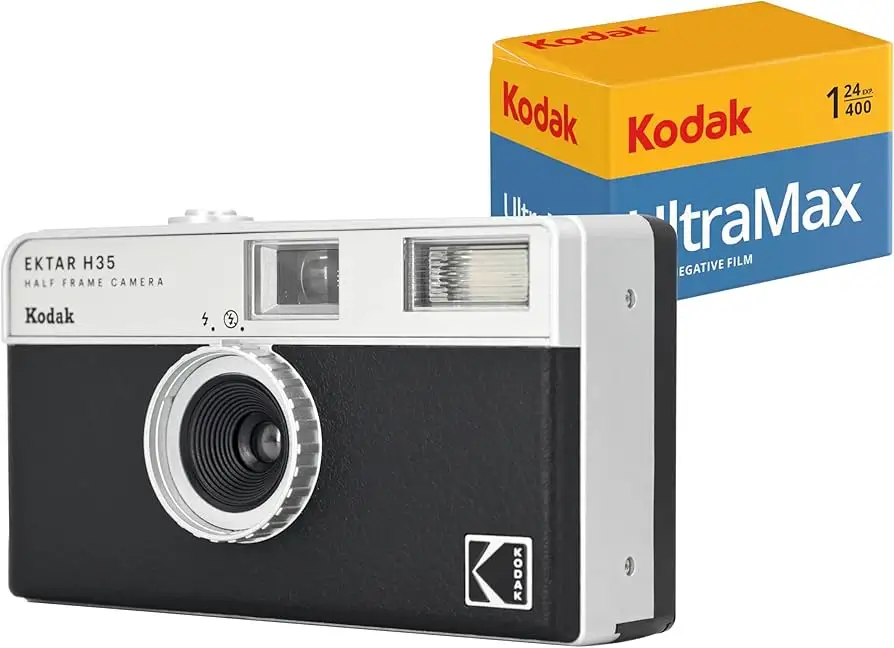
The H35N typically retails $57–$64, with bundle options including Kodak Ultramax 400 film pushing prices toward $90+. Community consensus is it’s “so worth it” for the doubled exposures and reusable design versus disposable film costs. Film and development still outweigh initial camera price over time — “you’ll spend more on film costs than the camera itself,” warns PCMag.
Bundle deals can be excellent starter kits, covering the first roll and pushing buyers to experiment immediately.
FAQ
Q: Does the half-frame format affect picture quality?
A: Yes — the smaller negative means grain is more visible when enlarged, but many users find it acceptable, especially for casual prints or social media. Labs scan half-frame at similar resolution to full-frame.
Q: Can it shoot landscape photos?
A: By default, half-frame cameras shoot vertical. Rotate the body 90 degrees to get landscape orientation; this is standard practice among experienced H35N owners.
Q: How reliable is the flash?
A: Mixed reports. Some users report consistent function, others note intermittent firing or long recycle times. Keeping fresh AAA batteries and using the flash primarily indoors improves reliability.
Q: What’s the benefit of the star filter?
A: It adds four-point flares to bright light sources, ideal for night cityscapes or creative portraits. Engagement is optional via a front switch.
Q: Can I use it for close-ups?
A: No — fixed focus is set for distance shots, suitable for arm’s-length selfies but not macro work.
Final Verdict: Buy if you’re a casual or travel shooter who values extra exposures per roll, lightweight design, and occasional creative flourishes. Avoid if you demand pristine low-light quality or a flawless winding mechanism. Pro tip from the community: use faster film and always bring a tripod when exploring bulb mode for night shots.





