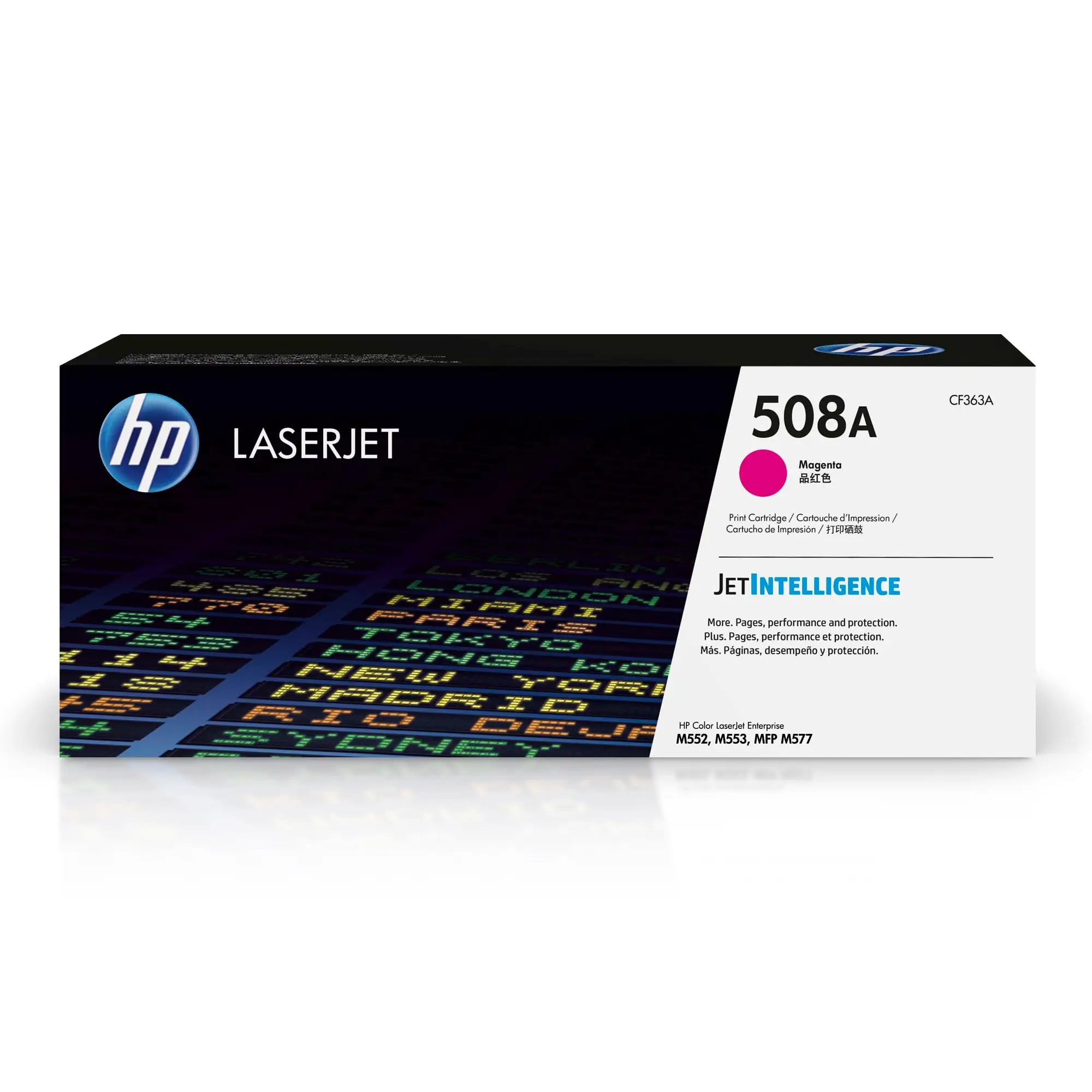
HP 508A Magenta Toner (CF363A) Review: Worth It?
A Staples reviewer summed up the strongest argument for paying OEM prices in one line: “the original is worth the cost.” For the HP 508A Magenta Toner Cartridge (CF363A), that theme—less hassle, consistent output—shows up again and again, even as a smaller set of users describe messy failures that feel wildly out of place for a premium cartridge. Verdict: a reliable pick for busy offices that prioritize consistency, with real risk if you’re unlucky enough to get a defective unit. Score: 8/10.
Quick Verdict
The HP 508A Magenta Toner Cartridge is a Conditional Yes: it earns praise for “always works” reliability and easy swaps, but a handful of reports describe streaking and toner leaks that can turn “quick replacement” into a service call.
| Decision factor | What users said | Who it matters to | Source |
|---|---|---|---|
| Print quality | “the colors remain true” | Marketing teams, client-facing prints | Staples reviews |
| Reliability vs remanufactured | “less frustrating and last much longer” | Small offices tired of downtime | Staples reviews |
| Ease of install | “very easy to do. works perfectly.” | Anyone swapping cartridges under pressure | Staples reviews |
| Shipping/availability | “next day service is the best” | Offices that can’t wait days | Staples reviews |
| Price | “Expensive toner… easy to load and prints fine.” | Cost-conscious buyers | Staples reviews |
| Defect risk | “spill the toner all over the inside of my printer” | High-volume environments | Staples reviews |
Claims vs Reality
HP’s official positioning for the HP 508A Magenta Toner Cartridge leans hard on reliability and predictable output—“high-quality at fast speeds,” “designed for reliability and consistency,” and a stated yield of “~ 5,000 pages.” Digging deeper into user feedback, the spirit of that claim often lands, but the experience varies depending on whether you get a normal cartridge or a bad one.
One recurring pattern emerged: users who have compared OEM to reconditioned supplies frame OEM as an anti-headache purchase rather than a luxury. A Staples reviewer who had previously tried reconditioned cartridges said: “the reconditioned ones i purchased may have lasted a year and often caused me numerous problems,” while the OEM “lasted me for two years.” That story doesn’t read like someone chasing perfect magenta—it reads like an office manager buying back time.
But marketing language about trust and consistency collides with a small set of alarming reports. Staples user dmireles described cartridges that “started with streaks across my prints, then they would spill the toner all over the inside of my printer,” adding that a tech ultimately said “the cartridges are defective” even though they were “still more than half full.” Another Staples reviewer, team_king, reported an even earlier failure: “broke before 10% used… spitting out toner inside of the printer and streaking my pages red,” and said HP support suggested calling “a service tech.” For buyers paying premium prices precisely to avoid downtime, those stories are the sharpest contradiction.
Finally, the yield narrative is complicated by user expectations and cartridge variants. The 508A is marketed as “~ 5,000 pages,” while one Staples post titled “does not perform as promised” complains about a “high yield cartridge” only reaching “6,000 pgs (+/- 200).” That appears to reference a high-yield unit (likely 508X), not the 508A standard yield—so it’s not a clean apples-to-apples mismatch. Still, it shows how page-yield promises can become a frustration trigger when buyers are counting pages.
Cross-Platform Consensus
Universally Praised
The most consistent praise around the HP 508A Magenta Toner Cartridge isn’t flashy—it’s operational. People repeatedly describe ordering, installing, and moving on with their day, which is exactly what a consumable is supposed to do. Staples user metwo put it plainly: “The replacement was very easy to do. works perfectly.” For a small business where the “printer person” is also the receptionist or office manager, that ease-of-replacement story is the difference between a five-minute fix and an afternoon lost.
A second theme is the confidence that OEM lasts and prints clean compared with alternatives. A Staples reviewer in the “most helpful positive review” wrote: “excellent quality and long lasting,” explaining the OEM cartridge “lasted me for two years,” while reconditioned options “often caused me numerous problems.” That’s a specific user type—someone who already experimented with cheaper paths and came back after dealing with consequences. For offices that print customer proofs, presentations, or client-facing collateral, “long lasting” isn’t about squeezing every penny; it’s about reducing interruptions.
Color fidelity also shows up as a practical benefit, not a vague compliment. Staples user haney lumber 48 said: “the colors remain true.” For a business printing signage, product sheets, or branded documents, “true” color means fewer reprints and fewer “why does this look different than last time?” moments—especially when printers are shared across teams and no one wants to troubleshoot color shifts.
Finally, delivery experience becomes part of the product’s perceived reliability. Staples user anna maria f. praised predictable fulfillment: “as always they delivered, next day service is the best.” Another review goes beyond shipping speed into service consistency: elsawagner wrote, “every time we order supplies we get our stuff the following day or in two days,” even calling out the driver: “jerry the delivery guy is awesome.” For workplaces running close to empty, fast replacement is functionally a reliability feature.
- Most-cited wins: easy installation, consistent print quality, dependable delivery.
- Best-fit buyers: offices that value uptime and predictable color output.
Common Complaints
The most common “complaint” isn’t about print quality—it’s cost. Multiple Staples reviewers acknowledge performance while flagging price. One reviewer simply titled their comment “expensive toner,” adding: “easy to load and prints fine.” Another called it “Amazing… albeit expensive it does the job.” This matters most for small organizations that don’t print enough to amortize OEM pricing across high volume; the cartridge may feel like a sharp recurring bill rather than a smooth operating expense.
Then there’s the complaint category that carries far more emotional weight: messy failures. When toner streaks or leaks, it stops being a consumable and starts becoming a maintenance incident. Staples user team_king described a cartridge that “kept spitting out toner inside of the printer and streaking my pages red,” and speculated it might relate to a new “agitator” design. Staples user dmireles reported a similar path: “streaks across my prints” followed by toner spilling “all over the inside of my printer.” For IT teams or office managers, that’s not just a defective product—it’s a downtime event that can include cleanup, service calls, and wasted paper.
A recurring pattern emerged in these negative stories: the frustration is amplified because the cartridges were not near empty. dmireles emphasized they were “still more than half full,” while team_king said the original cartridge “broke before 10% used.” That’s exactly where buyers feel most cheated—when the failure happens early enough that “cost per page” looks like a bad joke.
- Most painful downside: defect-related streaking and leaks.
- Who feels it most: high-volume offices where one failure disrupts multiple people.
Divisive Features
OEM reliability itself is divisive—not because many call it unreliable, but because expectations are extreme at this price point. On one side, you have Staples user bosco 2 saying: “always works,” and kathleen reporting: “works well with no issues. lasts long for regular use.” These users treat OEM as the stable baseline: buy, install, print.
On the other side are the defect stories that make the same “OEM premium” feel unjustified. team_king describes spending “$200+” and still facing issues, with support suggesting a service tech. In that framing, the cartridge is no longer a confidence purchase—it’s another risk item. The divisive point isn’t whether it can be great; it’s whether buyers trust that they won’t be the unlucky outlier.
- If you value predictable operation, reviewers repeatedly frame OEM as “worth the cost.”
- If you’re defect-averse, the leak/streak reports loom large because consequences are messy.
Trust & Reliability
“Scam” language appears in the provided Trustpilot data, but it’s tied to an HP printer ink scenario rather than this specific toner cartridge. A Trustpilot reviewer raged: “BEWARE- INK IS A SCAM,” arguing it felt “designed… to get you to replace partially full cartridges” and complaining: “you cannot print any color, even black, when one single cartridge is empty.” While that story speaks to broader brand distrust around consumables, it doesn’t directly verify a CF363A failure mode—so it functions more as context for why some buyers approach cartridges suspiciously.
Where durability does show up for this product family, it’s in long-haul office use. The Staples “most helpful positive review” is effectively a long-term report: “i purchased one of these in 2016, and it lasted me for two years.” Another Staples reviewer reinforced the “steady baseline” narrative: diane g. said the cartridge “has always served us well.” These aren’t laboratory tests—these are workplace stories where the cartridge either quietly does its job or becomes memorable for the wrong reasons.
Alternatives
The dataset mentions “reconditioned ones” and “refill toner” as the main alternatives, but doesn’t provide specific competing brand names in user quotes. Still, the contrast is sharp in the real-world stories. A Staples reviewer who moved away from reconditioned cartridges said they “often caused me numerous problems,” while the OEM “lasted… two years” and was “less frustrating.”
For buyers tempted by lower-cost refill or remanufactured options, that user story frames the trade-off: you may save upfront, but you might pay in troubleshooting time and inconsistent results. Meanwhile, the defect stories within OEM itself remind cost-focused users that “OEM” doesn’t mean “immune.”
Price & Value
Pricing in the provided data ranges widely depending on seller and region (e.g., Staples lists $285.89, one reseller lists $215, and HP regional stores show different currencies). Users don’t argue about the number so much as the feeling: it’s expensive, but it reduces friction when it works.
A recurring value argument is “downtime avoidance.” Staples user kathleen calls it “worth the cost” because it “works well with no issues.” And for operations where a stalled printer stops billing, shipping, or customer communication, shipping speed becomes part of value—anna maria f. praising “next day service,” or the office that “was out!!” and was grateful for fast shipment.
Buying tips implied by the stories:
- If you’re switching from remanufactured due to issues, reviewers explicitly describe OEM as “less frustrating.”
- If you’re buying for a shared printer, prioritize sellers with consistently fast delivery so outages stay short.
FAQ
Q: How many pages does the HP 508A Magenta Toner Cartridge print?
A: The official spec for the HP 508A (CF363A) lists a yield of ~5,000 pages. Real-world output varies by coverage and job type. Some complaints about page counts mention “high yield” cartridges hitting “6,000 pgs (+/- 200),” which appears to refer to a different cartridge type.
Q: Is OEM HP toner really worth the extra cost over reconditioned/remanufactured?
A: Many Staples reviewers think so, mainly for reliability. One wrote the OEM “lasted me for two years,” while “the reconditioned ones… often caused me numerous problems.” Another said “the original is worth the cost” because it “works well with no issues” and “lasts long for regular use.”
Q: Is the cartridge easy to install for non-technical users?
A: Multiple reviews describe installation as straightforward. Staples user metwo said: “The replacement was very easy to do. works perfectly.” Another reviewer called it “easy to load and prints fine,” suggesting it’s a manageable swap for small offices without dedicated IT support.
Q: What are the most serious problems users report?
A: The biggest red flags are streaking and toner leaks. Staples user dmireles reported “streaks across my prints” and toner spilling “all over the inside of my printer.” Staples user team_king described a cartridge that “kept spitting out toner… and streaking my pages red,” with support advising a service tech.
Final Verdict
Buy the HP 508A Magenta Toner Cartridge if you run an office where uptime matters and you want the “install it and forget it” experience—like the reviewers who said it “always works” and praised “excellent quality and long lasting.” Avoid it if a single defective cartridge would be catastrophic and you can’t tolerate the possibility of streaking/leaks, as described by users who saw toner spill inside the printer.
Pro tip from the community: if you’ve been burned by reconditioned cartridges, one Staples reviewer’s takeaway was blunt—OEM costs more, but it’s “less frustrating and last much longer.”