HP 35A Black Toner Cartridge Review: Worth It? 8.6/10
A toner cartridge that people describe as “easy to install” and “never have problems”—yet also routinely gets called out for price pain. That tension defines the HP 35A Black Toner Cartridge, earning it a 8.6/10 based on the feedback here: strong reliability and print quality sentiment, with the loudest frustration aimed at OEM pricing.
Quick Verdict
For the HP 35A Black Toner Cartridge, the answer is Conditional: buy it if you prioritize dependable OEM output and fuss-free installation; look elsewhere if cost-per-page is your top metric.
| What matters | What people said | Who it’s best for |
|---|---|---|
| Print quality | “Quality product, no smears” (Best Buy) | Forms, invoices, crisp text needs |
| Ease of install | “Lightly shake, pull the tab out and slide the cartridge into the printer” (Best Buy) | Non-technical home/office users |
| Reliability vs generics | “Much better than the off brands or recycled” (Best Buy) | Anyone burned by remanufactured carts |
| Price | “HP prices are pathetically high” (Staples) | Budget shoppers may hesitate |
| Longevity | “Lasts a long time” (Best Buy) | Light-to-moderate print volume |
| Availability | “Nice to have this cartridge in stock” (Staples) | Owners of older LaserJet models |
Claims vs Reality
HP’s official messaging frames the HP 35A Black Toner Cartridge around dependable, “bold, crisp text and sharper images,” plus “trouble-free printing,” and it’s consistently rated at roughly ~1,500 pages. Digging deeper into user remarks, the “trouble-free” part is where feedback most strongly aligns with the marketing: installation is treated as near-automatic and day-to-day printing is described as predictable.
A verified Best Buy reviewer captured the simplicity angle with a step-by-step ritual: “Lightly shake, pull the tab out and slide the cartridge into the printer. Close the door, and it’s ready to use.” Another Best Buy customer reduced the experience to pure functionality: “Good laser jet cartridge… it works as expected.”
Where the story diverges is cost and perceived yield consistency. While the cartridge is officially rated around 1,500 pages, some long-time users feel it doesn’t stretch as far as it used to. A Staples reviewer who relies on an older LaserJet described a change over time: “My only complaint is that they don't seem to last as long (are not good for as many pages) as they used to do,” adding that increased work-from-home printing could be part of the explanation.
The other reality check is financial. Marketing language stresses value, but buyers routinely reframe the decision as paying extra to avoid headaches. One Shopper+ reviewer explained the tradeoff bluntly: “Years ago the office I worked in tried re manufactured laser cartridges which resulted in quality issues. Ever since that lesson I've been satisfied with paying the extra for oem cartridges.”
Cross-Platform Consensus
Universally Praised
The strongest cross-platform praise for the HP 35A Black Toner Cartridge centers on clean output and a frictionless experience, especially for people using older HP LaserJet models who just want their printer to keep functioning.
For users printing text-heavy documents—shipping labels, schoolwork, invoices—the “no smear” theme shows up repeatedly. A verified Best Buy customer contrasted it with off-brand frustration: “Often the ‘generic’ cartridges ‘produce smears along the edges of paper.’ Not so with the HP brand product.” That kind of comment frames OEM toner as risk reduction: for small offices, one smudged batch can mean reprints and wasted time.
Ease of use is also treated as a core benefit for non-technical buyers. A verified Best Buy reviewer wrote, “There is not much to say other than it works as expected,” while another emphasized the set-it-and-forget-it pattern: “What can I say, it’s ink! Never any issues. Run till empty.” For home users who print infrequently, that reliability matters because the cartridge might sit for long stretches and still be expected to perform.
Long-term ownership stories show up as a quiet but persistent endorsement. Reddit-like community language appears in Best Buy feedback, such as the customer “Gare Bear,” who wrote: “I’ve had the printer that uses this hp-35a cartridge since… 2009… operation has been flawless.” Similarly, a Staples reviewer tied the cartridge’s continued availability to keeping an aging printer alive: “My little HP printer just keeps going… I’m sure glad I can still purchase toner for it.”
After those narratives, the repeatable praise themes are:
- Clean, sharp output: “Quality product, no smears” (Best Buy)
- Low-friction setup: “Easy to install” (Best Buy)
- Predictable OEM performance: “HP product and dependable HP quality” (Best Buy)
Common Complaints
The dominant complaint isn’t that the HP 35A Black Toner Cartridge fails—it’s that buyers feel cornered into paying OEM prices to avoid generic problems. That frustration can be sharp. A Staples customer didn’t mince words: “Your price is pathetic at $85.00.” The same reviewer immediately compared it to compatibles: “Compatibles… are $27.00.”
This price pressure hits hardest for frequent printers and work-from-home users who burn through toner faster. Even when people praise quality, the cost-per-page anxiety shows through, especially because the cartridge is positioned as standard yield. Buyers who print a lot don’t just see a cartridge; they see a recurring bill.
Another recurring complaint is the fear that yields don’t always feel like the rating suggests. While officially rated around 1,500 pages, some users perceive shorter life. A Staples reviewer summarized that disappointment: “They don't seem to last as long… as they used to do.” That kind of comment doesn’t claim a defect, but it does suggest that real-world coverage, content type, or increased usage patterns can make the rated yield feel optimistic.
Availability is the third pain point, more of a market reality than a product flaw. HP store listings in the data repeatedly show “out of stock” or “sold out,” and buyers express relief when they can still find it. A Staples reviewer wrote: “Nice to have this cartridge in stock,” framing availability as a win rather than an expectation.
After those narratives, the most common complaint themes are:
- OEM pricing frustration: “HP prices are pathetically high” (Staples)
- Perceived yield decline: “Don't seem to last as long” (Staples)
- Stock issues: “In stock!” (Staples)
Divisive Features
The biggest split is whether OEM is “worth it.” Some buyers see the HP 35A Black Toner Cartridge as the safe choice because generics can be messy or inconsistent. A verified Best Buy customer said: “Works best with our hp printer, much better than the off brands or recycled.” On the other side, Staples feedback shows shoppers scrutinizing how similar compatibles look and cost, implying the OEM premium feels hard to justify: “Compatibles… look identical, including the packaging, to HP.”
There’s also a philosophical divide about how much performance commentary even matters for toner. Several Best Buy reviews basically shrug: “There is not much to say other than it works as expected.” Yet others are highly specific about output cleanliness and longevity, treating toner choice as essential to avoiding smears and reprints. The same product becomes either a boring commodity or a reliability safeguard depending on the user’s past experiences with off-brand cartridges.
Trust & Reliability
Digging deeper into reliability signals, the most consistent trust pattern is buyers explicitly contrasting OEM against remanufactured or generic alternatives. A Shopper+ reviewer offered a long-memory warning: “The office… tried re manufactured laser cartridges which resulted in quality issues.” That story frames OEM as a decision made after something went wrong—important for small businesses that can’t afford printer downtime.
Long-term durability stories appear less as “six months later” posts and more as multi-year ownership arcs tied to LaserJet longevity. One Best Buy reviewer described years of consistent use: “My b & w printer is used daily, but it still lasts a long time with continued great quality.” Another highlighted ongoing compatibility with older printers: “Love this HP P1006 LaserJet printer… and it never skips a beat… happy I could still find the toner” (Best Buy user Big Ruckus).
Alternatives
The only clearly referenced alternative category in the data is compatible/non-OEM cartridges (often described as “generic,” “off brands,” “remanufactured,” or “HP compatible”). The alternative pitch is price: Staples feedback points to much cheaper compatibles, and marketplace listings show lower-cost compatible packs.
But user stories repeatedly warn that savings can come with risks. A verified Best Buy reviewer described a specific failure mode: “Generic cartridges… produce smears along the edges of paper.” A Shopper+ reviewer described a broader quality failure from “re manufactured laser cartridges,” concluding that paying more for OEM was worth it for predictable results.
For budget-focused buyers printing drafts or low-stakes pages, the compatible path is tempting. For anyone printing client-facing documents, the feedback here frames OEM toner—specifically the HP 35A Black Toner Cartridge—as the safer bet when the downside of a bad cartridge is wasted time and messy output.
Price & Value
The value debate around the HP 35A Black Toner Cartridge is constant: many buyers like the performance, but they feel the OEM price is hard to swallow. Staples feedback captures the raw sentiment: “HP prices are pathetically high,” while other reviews soften it into a pragmatic compromise—pay more, avoid problems.
Resale and market pricing signals in the data show wide variation depending on “genuine/original” vs “compatible,” and whether the listing is a single cartridge or multi-pack. That variability reinforces why some shoppers hunt for sales and price matching. A verified Best Buy reviewer described the tactic directly: “The salesman matched the price on the internet… so I save $18.00.”
Community buying tips embedded in reviews lean toward:
- Look for promotions/clearance and price matching (Best Buy users mention sales and matched pricing).
- Consider multi-packs if you’re committed to OEM (Staples reviewers call the two-pack “better value”).
- If you’ve had issues with generics, OEM is treated as the “buy once, cry once” approach (Shopper+ and Best Buy anti-generic comments).
FAQ
Q: How many pages does the HP 35A Black Toner Cartridge print?
A: It’s commonly rated around 1,500 pages. HP listings cite ~1,500 pages (ISO/IEC 19752, varies by content), and compatible listings also echo 1,500. One Staples reviewer felt it “doesn't seem to last as long… as they used to,” suggesting real-world yield can feel lower.
Q: Is the HP 35A easy to install for non-technical users?
A: Yes—ease of installation is a repeated theme. A verified Best Buy reviewer described the process as: “Lightly shake, pull the tab out and slide the cartridge into the printer… ready to use.” Multiple Best Buy reviews summarize it as working “as expected” with minimal fuss.
Q: Do generic/compatible cartridges work as well as OEM for this model?
A: Feedback is split. Some shoppers highlight that compatibles are far cheaper (Staples: “Compatibles… are $27.00”), but others warn about quality issues. A verified Best Buy buyer said generics can cause “smears along the edges,” and another said OEM works “much better than the off brands or recycled.”
Q: What printers is the HP 35A associated with in user feedback?
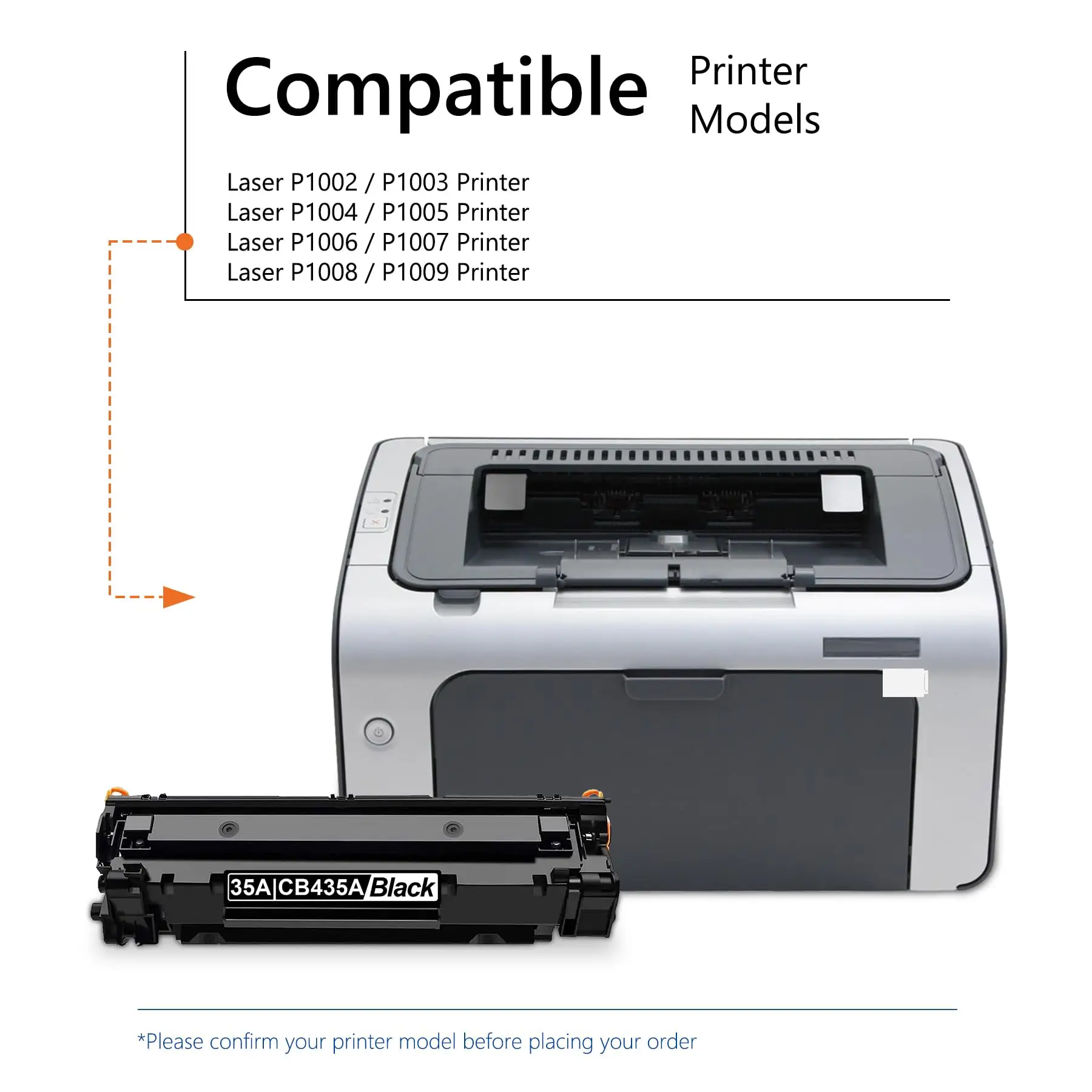
A: Users frequently mention HP LaserJet P1006 and related P1000-series models. A verified Best Buy user wrote about loving the “HP P1006 LaserJet printer,” while product listings in the data repeatedly reference compatibility with models like P1002–P1006 and P1009.
Q: Is the HP 35A worth the money?
A: It depends on your risk tolerance. Buyers who prioritize predictable output call it dependable—“HP product and dependable HP quality” (Best Buy). Price-sensitive shoppers strongly object to OEM pricing: “HP prices are pathetically high” (Staples). Many justify the premium after bad experiences with remanufactured cartridges (Shopper+).
Final Verdict
Buy the HP 35A Black Toner Cartridge if you’re running an older HP LaserJet (especially P1000-series) and need dependable, sharp black text without “smears,” and you’d rather pay extra than troubleshoot. Avoid it if you print high volume and the OEM premium will sting every month. Pro tip from the community: watch for sales or price matching—one Best Buy reviewer said the store “matched the price on the internet,” turning OEM into a less painful buy.