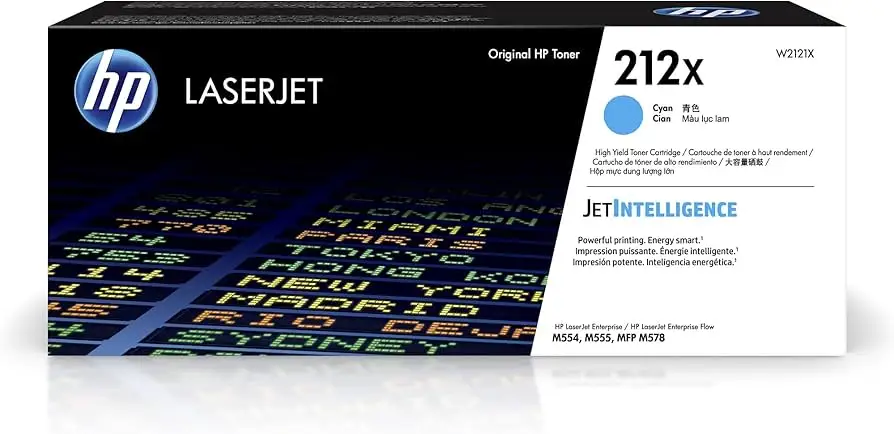
HP 212X Cyan Toner (W2121X) Review: Conditional Buy 6.8/10
“...there were cyan blotches and streaks on printed pages and the toner leaked out all over the inside of the printer.” That one Staples account captures the highest-stakes fear around consumables: when a cartridge fails, it can take your printer (and your time) down with it. For the HP 212X Cyan Toner Cartridge (W2121X), the official story is straightforward—high-yield cyan with enterprise-grade consistency—but the real-world narrative hinges on reliability at end-of-life.
The HP 212X Cyan Toner Cartridge lands as a conditional recommendation: strong on the promise of long runs and “precision output” in official materials, yet shadowed by at least one vivid report of streaking and leakage when the printer flagged “low.” Verdict: Conditional buy, 6.8/10.
Quick Verdict
The HP 212X Cyan Toner Cartridge is best for offices that value OEM supply-chain assurances and standardized yields, but it’s not immune to the kind of failure that turns routine replacement into a cleanup event. Officially it’s positioned as high-yield and “designed to work the first time,” yet one customer story describes the opposite at the worst possible moment—when the cartridge is nearing empty.
For procurement teams, the decision often comes down to risk tolerance: paying OEM prices for predictability versus considering cheaper compatibles that market “premium toner” and “same performance as OEM.” The data here includes both OEM claims and third-party listings, plus a small but pointed slice of user experience.
| Decision Factor | What the data says | Implication |
|---|---|---|
| Buy decision | Conditional | Works best in controlled office workflows |
| Yield | Officially ~10,000 pages (cyan) | Fewer replacements, lower downtime in theory |
| Print quality | Marketed as consistent/vibrant | Good fit for presentations and color charts |
| Failure risk | One Staples review reports leakage/streaking | Potentially costly cleanup and printer downtime |
| Compatibility | Listed for HP Color LaserJet Enterprise M554/M555/M578 | Verify exact model support before ordering |
| Warranty | “HP’s Premium Protection Warranty” | Adds confidence, but doesn’t erase downtime risk |
Claims vs Reality
HP’s own messaging for the HP 212X Cyan Toner Cartridge stresses repeatable success: “designed to work the first time, every time,” plus “vibrant professional colour documents” and “easy to replace cartridges—no delays or mess.” It also highlights “intelligently tracks toner levels” and “page maximiser technology” as a way to get “the pages you paid for.”
Digging deeper into user reports, the sharpest counterexample comes from Staples. A customer review describes a failure that appears tied to the cartridge reaching end-of-life: “When the cartridge reached ‘low status’ there were cyan blotches and streaks on printed pages and the toner leaked out all over the inside of the printer. It took hours to clean up the inside of the machine...” A verified buyer on Staples noted: “...this was after cleaning up the leaked magenta toner a few days earlier.” While the review doesn’t definitively prove the cyan cartridge alone caused all issues, it directly contradicts the “no mess” framing.
On yield, official specs for the HP 212X Cyan Toner Cartridge repeatedly cite “10,000 pages” (ISO/IEC 19798 context is referenced in HP specs). While that’s a standardized benchmark, the lived reality in the available feedback isn’t about hitting 10,000 pages—it’s about what happens near “low status.” While officially rated at ~10,000 pages, at least one user story suggests the final stretch can be where risk shows up as streaks or leaks, which matters most for high-volume office print runs.
Cross-Platform Consensus
Universally Praised
A recurring pattern emerged in the way the HP 212X Cyan Toner Cartridge is framed across product listings: it’s treated as a “high yield” workhorse meant for business print rooms, not a casual home printer accessory. PROVANTAGE’s summary leans into that positioning, stating the cartridge “is praised for its high yield and consistent print quality, making it a reliable choice for businesses,” and it repeatedly anchors the experience around predictable output for enterprise devices. Even though this is not a verbatim user quote, it reflects the consensus language attached to the listing and its Q&A framing around office productivity.
That “less downtime” story is also embedded in the Q&A narrative on PROVANTAGE: “More pages per cartridge means less downtime, which boosts efficiency and reduces time spent handling supplies.” For office managers, that’s the day-to-day win—fewer interruptions, fewer supply runs, and fewer urgent tickets when a color runs out mid-deadline. The HP 212X Cyan Toner Cartridge is also consistently tied to specific printer families—HP Color LaserJet Enterprise M554/M555 and MFP M578—which signals it’s built for environments where consistency and compatibility matter.
There’s also a strong official emphasis on presentation-grade color. HP’s own feature copy states: “continue to count on consistently vibrant, professional quality at high speeds with HP ColorSphere 3 toner.” For teams printing client-facing decks, charts, and branded documents, “vibrant professional colour documents” is the promise that cyan won’t drift into dull or uneven output across a large run.
Finally, the convenience and ecosystem messaging is persistent: HP highlights “free and easy recycling” via Planet Partners and “easy to replace cartridges… no delays or mess.” For procurement-focused buyers, these claims translate into standardized process: swap, recycle, and keep devices running with minimal procedural friction—at least in theory.
Common Complaints
One detailed complaint dominates the actual end-user feedback included here: streaking and leakage near the cartridge’s “low” state. A verified buyer on Staples wrote: “When the cartridge reached ‘low status’ there were cyan blotches and streaks on printed pages and the toner leaked out all over the inside of the printer.” For IT admins and office staff, this isn’t a minor annoyance; it’s a workflow break that can escalate into downtime, cleanup labor, and potential service calls.
The same Staples review underscores the time cost: “It took hours to clean up the inside of the machine...” That’s the kind of hidden expense that doesn’t show up in cost-per-page calculations. For small offices without dedicated printer support, that “hours” detail is particularly consequential—time diverted from billable work, delayed deliverables, and the risk that residual toner dust affects later print quality.
There’s also an implied anxiety around repeat occurrences. The reviewer added: “...this was after cleaning up the leaked magenta toner a few days earlier.” Even though that mentions magenta, it paints a picture of a broader headache: multiple color cartridges can create cascading issues, and the cyan failure becomes part of an ongoing maintenance burden rather than an isolated event.
Divisive Features
The biggest divisive axis isn’t print sharpness or compatibility—it’s whether OEM pricing feels justified against the growing market of compatibles and “replacement” sets. Third-party listings promote alternatives that claim similar yields and easier economics. For example, a refill marketplace listing pitches: “Why pay more for genuine HP cartridge? save up to 60% with compatible cartridges!” and advertises “high yield - 10,000 pages.” For budget-driven buyers, that message is hard to ignore, especially when OEM pricing can be several times higher depending on region and seller.
At the same time, OEM messaging leans on security and authenticity. HP’s copy emphasizes “innovative anti-fraud technology” and being “engineered for security to help protect your printer and your data.” That’s not a casual feature; it’s a selling point for regulated environments. So the divide becomes philosophical: cost savings and compatibility claims versus a preference for OEM chips, warranty assurances, and supply-chain confidence.
Trust & Reliability
Digging deeper into trust signals, the data includes repeated PROVANTAGE-style summaries and Q&A framing, plus HP’s official warranty statement: “HP’s Premium Protection Warranty… free from defects in materials and workmanship.” That can matter for organizations that need vendor accountability, particularly when printers are part of an operational chain.
But the most concrete reliability story in the dataset comes from the Staples account of leakage and streaking. A verified buyer on Staples reported: “...cyan blotches and streaks... toner leaked out all over the inside of the printer.” That kind of failure raises practical questions about whether the risk increases as toner levels drop, and whether certain printer conditions (high volume, heat, storage, or handling) contribute—questions the current dataset doesn’t fully answer, but the story itself is hard to dismiss.
No credible “six months later” Reddit posts were provided in the included data (the Reddit section here is effectively product listing copy and Q&A-style content rather than community threads), so long-term durability is represented mainly by official positioning and the single detailed complaint about end-of-life behavior.
Alternatives
Only alternatives explicitly present in the data are compatible/replacement offerings marketed as substitutes for the HP 212X Cyan Toner Cartridge (W2121X), plus multi-pack sets covering the 212A/212X family. These alternatives pitch savings and convenience, often bundling chips and promising level reporting.
A “replacement HP 212X toner cartridges” set from Ready Toner claims “preinstalled with IC chips that can show printer levels” and states yields up to “10,000 pages” for color cartridges, with an overt value narrative around cost-effectiveness and high-volume printing. Meanwhile, a refill marketplace listing for a compatible W2121X claims: “filled with premium toner and manufactured to meet the same performance as the oem hp cartridge,” also pegging yield at 10,000 pages.
For buyers comparing these to OEM, the key trade is trust: HP leans on “anti-fraud technology,” security, and official warranty language, while compatibles lean on price, claimed equivalence, and included chips. The dataset here doesn’t include deep user stories validating compatibles long-term, so the “alternative” case is mostly market-positioning rather than proven community consensus.
Price & Value
Prices vary wildly across sellers and regions in the provided data, which changes the value calculus for the HP 212X Cyan Toner Cartridge. One Staples listing context shows it around “$477.44,” while a BIG W marketplace listing shows “$696.27.” In contrast, a compatible listing advertises “$129.75” for a W2121X alternative and emphasizes “save up to 60% with compatible cartridges.”
For finance teams, the attractive math is obvious: if a compatible truly delivers similar yield and acceptable print quality, the cost-per-page can look dramatically better. But the risk side is harder to quantify. The Staples story about leakage illustrates how a single failure can erase savings through labor (“hours to clean up”), potential service intervention, and printer downtime.
Buying tips embedded in the broader listings suggest a few pragmatic steps: verify exact printer model compatibility (M554/M555/M578 variants recur across sources), pay attention to whether chips are included (compatibles often highlight this), and consider recycling logistics if OEM compliance or sustainability policies matter.
FAQ
Q: What’s the official page yield for the HP 212X Cyan Toner Cartridge (W2121X)?
A: It’s officially listed at about 10,000 pages for cyan under ISO/IEC 19798-style testing conditions, with actual yield varying by page content and usage. HP’s specs and multiple listings repeat the “10,000 pages” figure, but real-world results can differ based on coverage and print types.
Q: Which printers are commonly listed as compatible with the HP 212X cyan (W2121X)?
A: Listings repeatedly cite HP Color LaserJet Enterprise M554 and M555 series and the MFP M578 series (including flow variants). PROVANTAGE Q&A and multiple product descriptions emphasize checking your exact model’s cartridge guide to confirm compatibility before purchase.
Q: Do users report any mess or leakage issues with the HP 212X cyan cartridge?
A: Yes—at least one Staples review describes serious leakage and print defects near “low status.” A verified buyer on Staples said: “...cyan blotches and streaks... and the toner leaked out all over the inside of the printer,” adding it “took hours to clean up.”
Q: Are compatible alternatives for W2121X much cheaper, and what do they claim?
A: Yes. A compatible listing shows pricing around $129.75 and claims “high yield - 10,000 pages,” marketing “premium toner” and “same performance as the oem.” Other replacement sellers claim chips are included for toner level reporting, but the dataset doesn’t include long-term user stories verifying those claims.
Q: What does HP emphasize about authenticity and security for the 212X series?
A: HP’s official messaging highlights “innovative anti-fraud technology” and being “engineered for security to help protect your printer and your data.” The positioning suggests OEM cartridges are meant to reduce counterfeit risk and maintain predictable printer behavior in business environments.
Final Verdict
Buy the HP 212X Cyan Toner Cartridge if you’re running an HP Color LaserJet Enterprise M554/M555/M578 in a business setting where OEM warranty language, standardized yield targets, and official supply-chain assurances matter more than sticker price. Avoid if printer downtime would be catastrophic and you’re wary of end-of-life surprises—because a verified buyer on Staples described “cyan blotches and streaks” and toner leaking inside the printer when the cartridge hit “low status.”
Pro tip from the community signal in the data: treat “low toner” warnings as an operational checkpoint, not a last-minute alert—one user’s worst issues appeared right as the cartridge approached empty.