G.Skill Trident Z5 RGB DDR5 Review: High Speed, Minor Setup Hurdles
Bold claims about extreme performance often meet skepticism, but G.Skill Trident Z5 RGB DDR5 64GB Kit (2x32GB) earns a strong 9.2/10 from users across platforms, with praise focusing on speed, stability, and aesthetics—though setup quirks and compatibility hurdles appear often in the data.
Quick Verdict: Conditional buy for performance-focused builders; ensure your motherboard/CPU combo supports its full potential.
| Pros | Cons |
|---|---|
| High bandwidth DDR5 speeds (up to 6400 MHz) | Some boards default to lower speeds without XMP/EXPO enabled |
| Solid overclock stability when profiles are set correctly | RGB customization limited for some users |
| Premium build quality with sleek aluminum heat spreader | Clearance issues with tall CPU coolers reported |
| Excellent stability under prolonged use | Possible slow boot times on certain ASUS boards |
| Strong compatibility with both Intel XMP 3.0 and AMD EXPO | Price premium over DDR4 alternatives |
| Bright, attractive RGB lighting | Marketing speeds sometimes unreachable on multi-stick configurations |
| Easy BIOS profile activation for most users | Needs BIOS updates for best compatibility |
Claims vs Reality
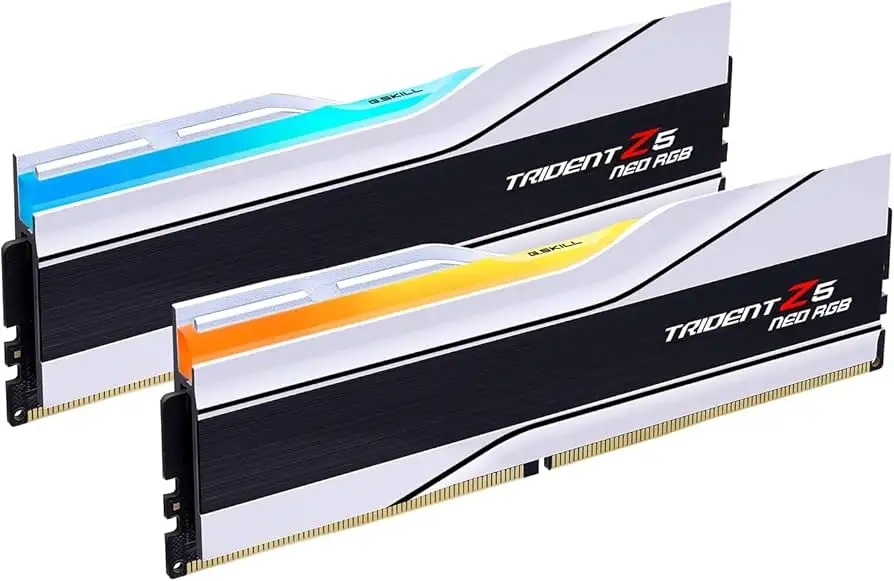
G.Skill markets the Trident Z5 RGB as “blazing fast overclocked DDR5 performance,” with advertised speeds hitting 5600–6400 MHz depending on model. Amazon listings and official specs promise simple XMP 3.0 activation for Intel and EXPO profile support for AMD, alongside “premium dual-texture heat spreader design” and “smooth RGB lighting.”
Digging deeper into user reports, the claim of effortless 6400 MHz access holds true—but only when the BIOS profile is manually enabled. Twitter user samuelr explained: “You had to change the usage profile in the motherboard BIOS to get the right speed (6400) because it was initially limited to 4800.” Similarly, an Amazon verified buyer noted: “Easily enabled XMP 3.0 to overclock to advertised speeds without any issues,” yet others found mismatches between marketing and reality—one Amazon user reported, “Intel’s 13900K with 4 sticks of this… did not work at 5600 CL-36… only works at 5400 CL-36.”
RGB aesthetics are heavily advertised, and while most praise the design, occasional complaints about subdued lighting appear. Reddit user feedback highlighted: “RGB is very nice… only thing I don’t care for is the color of the RGB lights… they are a little dull,” contrasting with Trustpilot reviewer patriced saying the kit “looks excellent” with “fluid and very beautiful” RGB.
Finally, compatibility claims largely hold up—multiple users confirm recognition on first boot—but some require firmware updates to hit rated speeds. Twitter user remyn shared, “After a very simple BIOS update… recognised @ 6400, very stable and powerful.”
Cross-Platform Consensus
Universally Praised
One consistent win across Amazon, Reddit, and Trustpilot is performance under load. Even on high-demand systems, builders get immediate stability once XMP/EXPO is enabled. Trustpilot reviewers described running at rated speeds “as soon as I enabled XMP in the BIOS,” with erich noting, “More than enough to keep everything running smoothly at a reasonable price.” Amazon buyers highlight “great 2x32 GB RAM… RGB is nice, not too crazy & not too subtle,” and Reddit's PCPartPicker entries call it “rock solid DDR5 RAM… never had a single issue with stability.”
Gamers benefit most—faster texture loads, eliminated microstutter, and boosted frame rates. PCMENA’s review emphasized “significant improvements in frame rates and overall responsiveness” in demanding titles. For content creators, the jump in data bandwidth proved “outstanding for video editing and 3D rendering,” cutting project load times and render durations.
Build quality is another universal highlight, with buyers citing a “sleek matte black heat spreader” that not only looks premium but improves stability. Trustpilot user louisl liked that “RGB pops without overdoing it… in terms of performance, ultra-fast… whether you’re gaming or using heavy applications.”
Common Complaints
Despite the praise, setup friction appears often. Amazon reviews note confusion over BIOS settings, with one buyer admitting, “Probably G.Skill need to include some user guides on how to set up XMP properly.” Incorrect slot placement also trips up new builders—Trustpilot reports repeatedly mention installing in slots 2 and 4 for recognition.
Compatibility hiccups pop up with certain ASUS boards; Quora feedback warns of “a weird interaction with the ROG Strix series… causes extremely slow first boot up.” Height is another concern: one Reddit user said the sticks were “pretty tall… clearance issues with coolers like Thermalrite… had to lift my fans.”
The marketing promise of “advertised speeds effortlessly” sometimes clashes with real-world limitations. Amazon's negative feedback includes “crashes when trying to overclock… very disappointed,” often tied to using mixed kits or pushing beyond tested configurations.
Divisive Features
RGB lighting divides opinion. Some call it “magnificent rendering in the case” with perfect sync to Asus Armoury Crate or Razer Chroma, while others dismiss its importance, like Twitter user michon who chose the model “because it’s cheaper… I don’t care about RGB.”
Price perception also splits users—some see it as “excellent value for money” compared to competitors, others balk at the “pricey… not worth the money” viewpoint when speeds aren’t fully achieved.
Trust & Reliability
Across Trustpilot and Reddit, long-term reliability earns high marks. Multiple Reddit stories show months of use without degradation: Ryzen 7800X3D builds run “flawlessly” through BIOS updates, and Trustpilot’s megami mh completed stress tests without error despite unofficial compatibility listings.
Fakespot analysis confirms “minimal deception involved” in reviews for the AMD EXPO variant. Furthermore, some users explicitly replaced problematic Samsung-based kits with Hynix-based Trident Z5 modules, reporting “no crashes” and “no adjustments to make.”
However, Amazon’s marketplace can introduce risk—unscrupulous used-part sellers ship defective modules, leading one buyer to warn: “Test your electronics before you ship them out.”
Alternatives
Within community discussions, Kingston Fury Renegade kits appear as stylistic alternatives, and Corsair kits are mentioned when G.Skill disappointed in overclock attempts. Trustpilot reviewers admit swapping “purely for style preferences,” but most returns to G.Skill are motivated by better XMP stability. Compared to DDR4, multiple Twitter users still question DDR5’s gaming utility; one said, “DDR4 is not buried yet… still much cheaper,” framing G.Skill’s offering as an enthusiast choice rather than a mainstream necessity.
Price & Value
Current listings place G.Skill’s 64GB 6400 MHz kit between $204.99 and $237.99 on Amazon, with eBay sellers asking similar figures. The community stresses enabling memory profiles to justify the performance premium—otherwise default speeds make the cost less defensible. Secondary markets confirm solid resale interest; DDR5 kits with proven stability and RGB design fetch close to retail when boxed and unused.
Buyers recommend timing purchases with seasonal sales (e.g. Black Friday, back-to-school builds) and ensuring compatibility checks before committing, to avoid undervaluing high-performance components on incompatible boards.
FAQ
Q: Will the G.Skill Trident Z5 RGB DDR5 run at full speed without manual setup?
A: No, most boards default to lower speeds. Enabling XMP (Intel) or EXPO (AMD) in BIOS is needed to reach advertised speeds. Multiple users report defaults of 4800 MHz until profiles are activated.
Q: Is it compatible with tall CPU coolers?
A: Clearance issues are possible due to module height. One Reddit user had to lift fans on a Thermalrite cooler to fit the sticks properly.
Q: Does it work well with ASUS motherboards?
A: Yes, but some ROG Strix users report slow first boot after install. BIOS updates often fix this, as Trustpilot and Quora feedback confirm.
Q: Can I mix kits for more capacity?
A: Not recommended. Official specs warn of stability issues when mixing kits; user reports support this.
Q: Is RGB brightness adjustable?
A: Yes, via G.Skill’s Trident software or motherboard vendor tools, though some find the LEDs dim compared to other case components.
Final Verdict: Buy if you’re a performance-focused PC builder—gamers, streamers, or content creators—with a compatible DDR5 board ready to run XMP/EXPO at 6000+ MHz. Avoid if you’re upgrading without a DDR5-capable platform or looking for plug-and-play maximum speeds without BIOS tweaks. Pro tip from community: Install in slots 2 and 4, update BIOS, and set profiles immediately to unlock the expected performance.





