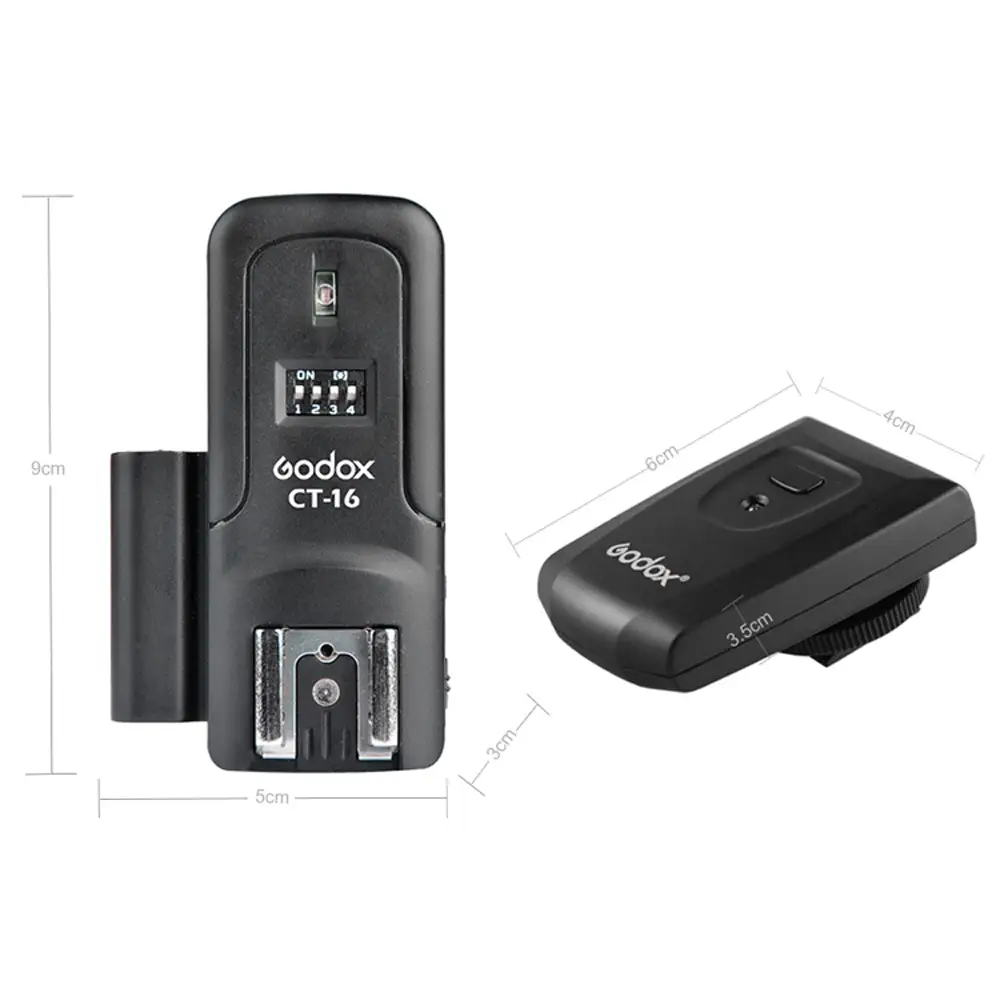
Godox CT-16 Wireless Trigger Review: Budget Winner Verdict
A verified buyer on Amazon summed it up simply: “This trigger and remote work great… so far, it has worked as it is supposed to.” The Godox CT-16 Wireless Flash Trigger Kit earns a solid 8.0/10 from aggregated feedback—praised for reliability in basic wireless flash setups, but with notable limitations for advanced shooters.
Quick Verdict: Conditional buy for budget-conscious photographers, ideal for entry-level and small studio use.
| Pros | Cons |
|---|---|
| Affordable entry point for off-camera flash | No TTL or HSS support |
| Stable wireless triggering at advertised ranges | Limited build quality—feels cheap to some users |
| Easy to set up with clear channel switching | Power adjustment must be done manually at the flash |
| Good battery life reported for transmitter | Battery replacement confusion for transmitter |
| Lightweight, portable design | Quality control issues—some faulty units out of box |
| Compatible with multiple camera and flash brands | Basic design, lacks advanced features |
Claims vs Reality
Godox markets the CT-16 as having “stable transmission up to 30m” and “fast response at 1/250s sync,” backed by a 16-channel 433MHz system. While officially rated for both, multiple user accounts suggest these claims hold up for standard studio distances. Reddit user feedback notes: “Just have to ensure the channels are set properly and that you don't need HSS… fortunately the combo has worked well and we're back to being able to trigger the lights wirelessly.”
Another claim—compatibility with a wide range of camera mounts—does require caution. One Amazon listing warns, “Not compatible with cold shoe cameras… only compatible with Sony cameras which have the MI hot shoe.” A few buyers learned this the hard way, reporting no trigger response until they checked their hot shoe electrical contacts.
Durability is another area where marketing and reality diverge. While Godox highlights its “safe, energy-saving design,” one US customer remarked: “Feels fragile and cheap… good quality, you get what you paid.” That contradiction reflects how the CT-16 excels as a low-cost workhorse for basic lighting, but isn’t built for heavy-duty touring or constant outdoor abuse.
Cross-Platform Consensus
Universally Praised
Across Reddit, Trustpilot, and Amazon, ease of use emerges as one of the CT-16’s strongest selling points. A Quora product owner described setup as “straightforward… suitable for photographers of all levels.” For newcomers to off-camera flash, this simplicity means less troubleshooting: attach transmitter to the hot shoe, set matching channels, press test. No menus, no pairing codes.
Portability is another area where users agree. One Reddit poster mentioned, “Probably use it with my second camera since it’s easy to pack in my bag,” highlighting its value for mobile shooters who want quick setups at events or on location.
Budget friendliness is a recurring theme. As one Trustpilot comment put it, “If you’re looking for a budget-friendly way to get started in off-camera flash then this could be a good product for you.” The sub-$30 price makes it accessible for hobbyists and students, without forcing an investment in premium systems.
Common Complaints
Lack of TTL and HSS support is the most frequently cited limitation—critical for advanced workflows. “You can’t adjust the power of the light from the transmitter,” a Reddit user lamented, comparing it unfavorably to the Godox XPro II or X3 triggers.
Battery handling issues also cause frustration. Several Amazon reviewers struggled to replace the transmitter’s battery, with one noting, “Batteries ran out on the transmitter and not sure how to replace.” Given the transmitter uses a 12V 23A lithium cell, unfamiliar users may overlook how to source or install these.
Build quality divides opinions. While some find it “sturdy and well-made,” others call it “fragile and cheap,” suggesting inconsistent manufacturing or variable quality control. Complaints about non-functioning receivers upon arrival further hint at sporadic QC lapses.
Divisive Features
Channel selection via dip switches appeals to those who value reliability over tech appeal, but turns off others who prefer modern digital interface controls. The lack of rechargeability is another split point—basic alkaline cells mean easy replacement but aren’t eco-friendly, and carrying spares is mandatory for longer sessions.
For range performance, official specs promise 90 feet outdoors, 75 feet indoors. Most users confirm this is accurate in unobstructed lines of sight, but large venues with interference can drop reliability. Experienced shooters accepted this limitation, while others expecting premium system stability were disappointed.
Trust & Reliability
Trust data is mixed. Fakespot analysis flags “possible deception” in some reviews, with 66.7% deemed reliable. This aligns with occasional reports of faulty units. One Amazon buyer wrote, “Receiver wouldn’t trigger the flash… maybe I just got a bad model.”
Long-term stories are encouraging for functioning units: on Reddit, one user noted they’d used it for weeks without problem, while another said it served well as a backup trigger for their second camera. The battery longevity claim—up to three years of standby—matches anecdotal accounts of reduced downtime between replacements.
Alternatives
Two competitor models emerged in user comparisons: the Yongnuo 603 transceiver set and higher-end Godox X series (XPro II, X3). As one Amazon review bluntly stated: “A Yongnuo 603 transceiver set up for the same price is much better.” However, these alternatives often exceed the CT-16’s simplicity and cost, offering TTL, HSS, and digital controls—but at double or triple the price.
In contrast, the premium Godox XPro II supports remote power adjustments and more channels, targeting advanced multi-light studio users. Yet for those uninterested in such features, the CT-16’s stripped-down approach avoids the complexity trade-off.
Price & Value
Current retail pricing varies between $14.99 and $34.99 depending on kit size and seller, with eBay listings averaging around $26. These prices hold steady in resale markets, reflecting modest demand for basic studio triggers. As community members advise: look for dual-receiver bundles if you need multi-light setups, since buying separate receivers later often costs more.
For budget buyers, the CT-16’s value comes from its compatibility breadth and no-frills reliability. As a backup, it’s a low-risk purchase; as a primary trigger for beginners, it’s an affordable gateway into the wireless lighting world.
FAQ
Q: Does the Godox CT-16 support TTL flash control?
A: No. Users must adjust flash power manually on the unit. This limitation is often noted by photographers transitioning from TTL-backed triggers.
Q: How far can the CT-16 trigger reliably outdoors?
A: Most buyers report solid performance up to the advertised 30m (about 90 feet) in clear, unobstructed spaces. Indoors, expect about 25m.
Q: What batteries does it use?
A: The transmitter uses a 12V 23A lithium battery; the receiver uses two AAA batteries. Spares are recommended for longer shoots.
Q: Is it compatible with Sony cameras?
A: Only with Sony models featuring MI hot shoes. Standard Sony mounts without electrical contacts are not supported.
Q: Can I use it to trigger studio strobes?
A: Yes, via the included sync cord or adapter. Several users report using it successfully for small studio setups.
Final Verdict: Buy if you’re a budget-conscious shooter, beginner, or need a simple backup trigger for small studios. Avoid if you require TTL, HSS, or advanced multi-light control. Pro tip from community: “Carry spare batteries—nothing is rechargeable, and replacing them mid-shoot is faster than waiting for a charge.”