Gigabyte RX 9070 XT Review: High-End Power With Caveats
Few graphics cards stir as much discussion across Reddit, Best Buy, PCPartPicker, and LDLC as the Gigabyte Radeon RX 9070 XT Gaming OC 16G—and the verdict from hundreds of owners lands solidly at 9/10. It’s praised as “the best value high‑end GPU at the moment” by a PCPartPicker reviewer, with temperatures and noise levels that many call “absolutely quiet” under load. But dig deeper, and a few quirks emerge—particularly for those pushing VRAM temps or running certain driver configurations.
Quick Verdict: Conditional Buy — stellar performance and cooling at the right price, but watch power demands and occasional driver quirks.
| Pros | Cons |
|---|---|
| Exceptional 1440p & 4K performance | VRAM can run hot (~92°C stock) |
| Quiet operation under load | Potential coil whine on Windows configs |
| Strong build quality | Some driver-related stuttering or crashes |
| Efficient cooling system | High power draw (3×8‑pin, up to 330W+) |
| Good value vs. Nvidia RTX alternatives | RGB control limitations in non‑Gigabyte software |
| Compact size for its class | Requires robust PSU |
| Dual BIOS (performance/silent) flexibility | Occasional software resets on undervolt settings |
Claims vs Reality
Marketing from Gigabyte promises “exceptional thermal performance” via the Windforce cooling system and “ultra‑fast gaming” with up to a 3060 MHz boost clock, plus noise‑reducing Hawk fans. On paper, it’s built to deliver peak performance without the racket. That’s broadly accurate—but the user experience adds nuance.
Reddit user feedback confirmed that “fan noise at default is not audible” with 330W load, fans at 1800 RPM, and hotspot temps around 75°C. Another said, “memory from 83–87 depends on the game,” suggesting VRAM temps can run higher even when the core stays below 60°C. While the claimed silent cooling holds for the GPU core, VRAM heat requires custom fan curves or undervolting to tame.
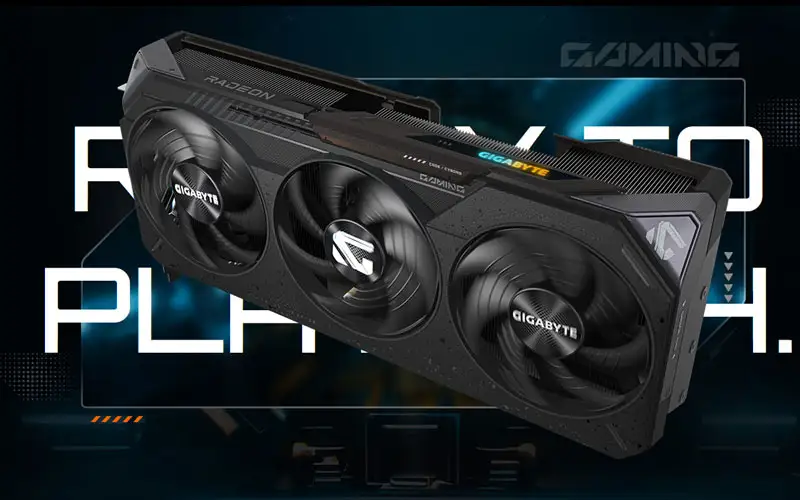
Gigabyte touts “reinforced structure” and “armor-like identity” for durability and compactness. Owners echo this: one Best Buy reviewer mentioned, “The backplate and cooler design give it a lot of rigidity... it’s nearly an inch shorter than my old 6800 XT.” However, marketing doesn’t note that the triple 8‑pin power demand can push PSU upgrades—something multiple buyers faced.
Cross-Platform Consensus
Universally Praised
Performance is the card’s most celebrated trait. Best Buy user “leoma con” jumped from a 2070 Super and found it could play “every game... at 4K with good temps” staying under 70°C. LDLC buyer “valentinr” swapped from a Gigabyte RTX 1080, calling it “good graphics card... runs big games in ultra quality... no real problems apart from odd freeze on Chrome.”
Quiet cooling stands out. Reddit owners repeatedly mention sub‑1500 RPM custom fan curves keeping noise low while maintaining sub‑70°C cores. A PCPartPicker review declared: “super fast and stays super cool no matter what game I’m on.”
Value also unites praise. Best Buy reviewer “hwik” said it “performs significantly better than my RTX 4070 even in ray tracing” at an attainable price. Another called it “the cheapest 9070 XT right now and also the highest clocks.”
Common Complaints
VRAM temperatures draw consistent caution. Best Buy user “kahseemp” measured “vram runs a bit hot at around 92°C on stock settings” and warned against exceeding 100°C. Coil whine crops up in several reports, particularly in Windows environments—Best Buy reviewer “nikki” confirmed “as for the coil whine claims? all true… if you’re running Windows 10/11,” though switching to Linux removed the issue.
Driver quirks appeared in the Kimola analysis: one French owner reported “les performances sont incroyable… quand elle crash pas tout les 5 minute en jeu,” forcing a return. Reddit users also noted RGB software bugs and under‑volt resets after sleep mode.
High power draw is another recurring theme. Multiple owners remarked on needing PSU upgrades. Matthew on Best Buy explained, “had to upgrade my power supply since this version takes three PCIe connectors.”
Divisive Features
Ray tracing performance is a split camp. Some, like “hwik,” praise its improvement over last generation and parity with Nvidia mid‑range; others still feel Nvidia’s DLSS edges out AMD’s FSR in optics, echoed by “stevenb” who said, “visual quality is great... slightly lagging behind DLSS 4 but on par or better than DLSS 3.”
RGB control divides buyers—while some appreciate the minimalist design and sync via Gigabyte Control Center, others lament the lack of SignalRGB support, as one PCPartPicker reviewer noted.
Trust & Reliability
Long‑term stories suggest solid physical durability. Reddit user “gyl d” reported running in “silence BIOS” and limiting power envelope, achieving 67°C max while remaining stable. Several month‑plus reports show temp consistency and sustained high clocks even under synthetic stress.
However, reliability on the software side is patchier. Kimola flagged negative sentiment around “ventilation en mode auto” mismanagement and persistent game crashes in select setups. Best Buy reviewers noted early driver instability that later improved with updates. LDLC buyers mention no catastrophic failures, but one did report quirks with multi‑screen arrangements and icon repositioning.
Alternatives
The RTX 4070 and 4070 Ti Super appear often in comparisons. Many buyers deliberate between them: “nikki” downgraded from a 4070 Ti Super OC, citing better value and performance at 4K with the 9070 XT after removing coil whine. “mike” passed on a 5070 Ti and said the 9070 XT “did not disappoint” in ultra gaming for Cyberpunk 2077.
The RTX 5080 gets mentioned in terms of price differential—a Best Buy user dismissed paying “extra $800 for 10-15 fps gain” over sticking with the 9070 XT. AMD’s own 7900 XT was also an upgrade path for “krypton stoy vault,” who found the 9070 XT transformed Helldivers 2 from unplayable to max settings.
Price & Value
Current listings hover around $709–$749 USD, with occasional lower refurb prices. Reddit consensus is clear: “If you can get it for MSRP or close... it’s a GPU,” said one user. The card maintains strong clocks even as one of the cheapest AIB models, making it appealing to price‑conscious high‑end builders.
Resale trends mirror typical high‑end AMD cards—steeper falloff than Nvidia, but good short‑term value retention for the OC variant. Community buying tips suggest waiting for price dips unless urgently needed, as “josh v” advised: “wait for it to hit msrp unlike with what I did.”
FAQ
Q: Is the Gigabyte RX 9070 XT Gaming OC quiet under load?
A: Yes, most owners report “basically silent” operation with custom fan curves and even at stock settings below 70°C core temps. VRAM cooling may need tuning to keep noise low.
Q: Does it have coil whine issues?
A: Some Windows configurations produce coil whine under 4K ultra loads. Switching to Linux or certain driver versions has eliminated it for affected users.
Q: How does ray tracing perform compared to Nvidia?
A: It’s markedly improved over AMD’s last gen and competitive with Nvidia’s mid‑range options, though DLSS 4 maintains a slight edge in visual polish.
Q: Is it worth upgrading the PSU for this card?
A: Likely yes—it demands three 8‑pin connectors and can draw 330W+. Many users upgraded to at least 850W to ensure stability.
Q: Any known driver problems?
A: Early releases saw crashes or stutters in some titles, plus under‑volt reset issues after sleep. Most have improved after updates, but multi‑display setups may still show quirks.
Final Verdict: Buy if you’re a 1440p/4K gamer seeking high‑end performance without Nvidia pricing, and you’re comfortable adjusting fan curves or undervolts. Avoid if your setup can’t handle its power draw or if you rely heavily on complex multi‑monitor arrangements. Pro tip from Reddit: cut power ‑20%, undervolt, and keep fans under 1500 RPM for near‑silent high‑FPS gaming.





