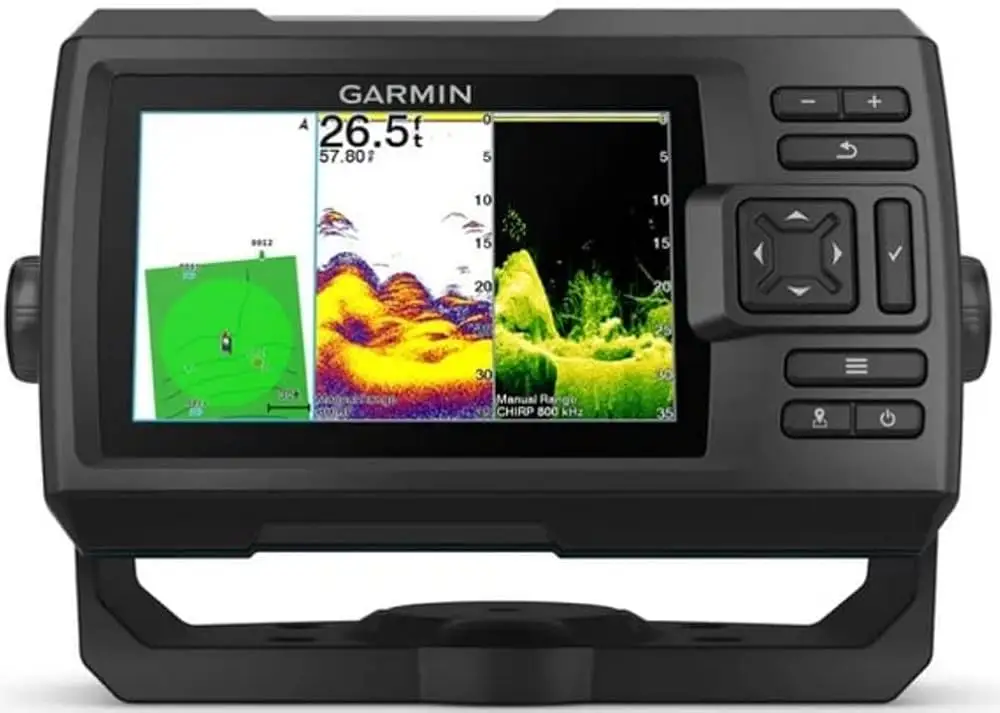
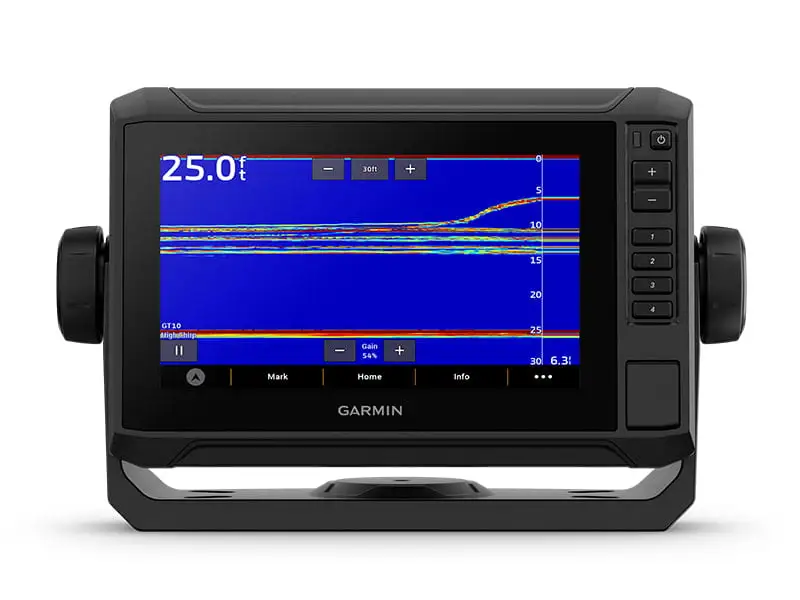
Garmin STRIKER 5CV Review: Great Value, No Charts (8.6/10)
“Not a chartplotter. There are no charts.” That single line from Fish Finder Tech frames the most consistent theme across the sources: Garmin STRIKER 5CV Fishfinder with Transducer is praised as a capable sonar-and-GPS fish finder at a friendly price, but it’s repeatedly defined by what it doesn’t try to be. Verdict: strong value-oriented pick with clear boundaries — 8.6/10.
Quick Verdict
Yes (Conditional) — buy it if you want CHIRP + ClearVü-style down imaging and waypoint GPS without needing built-in lake maps.
| What the feedback centers on | What people liked | What people didn’t like | Source |
|---|---|---|---|
| Value at ~$300 | “high-quality, affordable” | Not “bleeding edge” | Fish Finder Tech (review) |
| Display usability | “screen is bright and backlit” | Smaller than larger units for quick reading | Fish Finder Tech (review) |
| Sonar + transducer bundle | “wonderful out-of-the-box transducer” | Depth/imaging depends on conditions/transducer | Fish Finder Tech (review) |
| Controls/interface | “menus well laid out” and “buttons work” | “no touch screen” / “pushing buttons” feels dated | Fish Finder Tech (review) |
| Mapping expectations | Quickdraw contours is “good” | “doesn’t come with any maps…not compatible with maps” | Fish Finder Tech (review) |
| Market sentiment | 4.4/5 stars (71 reviews) | Not detailed in provided review text | Amazon listing (rating) |
Claims vs Reality
Garmin marketing copy leans hard into “easy-to-use,” “clear…detail,” and GPS waypoint utility. Digging deeper into the provided sources, those claims generally hold up—but only inside a specific lane: sonar clarity and basic navigation. The biggest mismatch isn’t that the device fails; it’s that some shoppers may assume “GPS fish finder” implies chartplotter maps, and the feedback warns that’s not the case.
Claim: “Easy-to-use 5-inch color fish finder”
A recurring pattern emerged in Fish Finder Tech’s write-up: the device is approachable because the interface is straightforward, even if it’s not modern. Fish Finder Tech wrote: “Are the menus well laid out? absolutely. do the buttons work? no question about it.” For beginners moving from “no electronics” to a first unit, that kind of button-driven certainty can be a plus—less fiddly than learning touchscreen gestures on a rocking boat.
But the same source also flags the flip side: “we ’re well past the ‘pushing buttons’ stage of the game.” For anglers accustomed to touchscreens or joystick hybrids, “easy-to-use” may still feel slower than newer UI styles. In other words, the learning curve may be gentle, but the interaction style is dated by comparison.
Claim: “Clear, colorful sonar detail / ClearVü scanning sonar”
Garmin positioning emphasizes vivid clarity, and the third-party review supports that—especially relative to price. Fish Finder Tech said the imaging is “quite good—not stunning…but good,” and emphasized the frequency tradeoffs: “higher frequencies mean less depth, but better imaging,” calling out the ability to switch to “800 khz…a lot clearer imaging.”
Still, they also underline reality: image quality and depth are conditional. Fish Finder Tech cautioned that sonar depth “will change depending on the salinity of the water you ’re fishing in,” and that different transducers change capability. So the marketing promise of clarity lands best when expectations are set around the included transducer and typical use cases, not worst-case depth scenarios.
Claim: “GPS to mark waypoints, create routes” (and mapping via contours)
Official product pages repeatedly highlight GPS marking and Quickdraw contours. Fish Finder Tech agrees that waypointing is genuinely useful even without charts: “you can set waypoints…set routes and tracks,” and “on-screen navigation is still available…the screen will be blank, aside from your waypoints.”
The gap shows up when “mapping” is interpreted as lake charts. Fish Finder Tech is blunt: “it ’s not compatible with maps at all. it ’s not a chartplotter. there are no charts.” Quickdraw contours is presented as the workaround—good for anglers who want to build their own 1’ contour map over time, but not the same as buying a detailed preloaded map card.
Cross-Platform Consensus
Universally Praised
The most consistent applause across the included review sources and official listings centers on the same trio: strong sonar for the money, a readable 5-inch screen, and waypoint GPS that makes a small boat setup feel more “serious” without paying chartplotter prices.
For budget-focused anglers rigging jon boats, kayaks, or smaller consoles, the value proposition is the headline. Fish Finder Tech called it “incredibly inexpensive,” arguing the included transducer makes it feel like you’re buying a full package rather than just a display head. They also highlight a practical “why it matters” breakdown, noting the transducer’s standalone cost and saying you’re effectively paying a modest amount for the head unit relative to bundle value.
Display readability also emerges as a practical win, especially for day-to-day use in variable weather. Fish Finder Tech wrote: “the screen is bright and backlit, meaning it can be used rain or shine - as well as in fog and darkness.” For anglers who launch early and stay late, that’s not a spec-sheet flex—it’s the difference between actually using the unit at dawn versus squinting and guessing.
Then there’s flexibility in how information is shown. Fish Finder Tech praised “combination screens,” explaining you can show “up to three panels simultaneously.” For someone learning sonar, that means you can keep traditional sonar as the anchor view while glancing at down imaging and your Quickdraw/waypoint page without constantly switching screens. That “at a glance” workflow is repeatedly framed as unusually capable for a 5-inch, ~$300-class unit.
After those narratives, the recurring praised points can be summarized cleanly:
- Strong value at around the $300 price point (Fish Finder Tech; Amazon pricing context)
- Bright, backlit 5-inch display suited to real-world conditions (Fish Finder Tech)
- Split/combination views support practical scanning and decision-making (Fish Finder Tech)
- Waypoint GPS + routes/tracks enable repeatable spot-finding even without charts (Fish Finder Tech; Garmin listings)

Common Complaints
The most repeated criticism is not about sonar “not working,” but about features some buyers expect at this price and don’t get: touchscreen control, real chartplotter mapping, and broader networking/expansion.
Control input is the first friction point. Fish Finder Tech is complimentary about reliability—“do the buttons work? no question about it”—but still paints the button-only interface as behind the curve: “we’ve seen touchscreens…we ’re well past the ‘pushing buttons’ stage.” For anglers who run electronics all day while moving between spots, that can translate to slower workflow: more taps, more menus, more time spent navigating settings instead of watching water and structure.
Mapping is the second and most consequential complaint—because it’s often a misunderstanding at purchase time. Fish Finder Tech spells it out: “doesn’t come with any maps…not compatible with maps at all.” For tournament anglers or travelers hopping between unfamiliar lakes, that limitation can feel like a deal-breaker. Quickdraw contours is praised as a DIY solution, but it requires time on the water to build a useful contour map. If you need detailed lake charts on day one, the user feedback here indicates you’ll feel boxed in.
Connectivity is the third recurring drawback. Fish Finder Tech notes “no ethernet…no nmea compatibility,” calling it “a real shame” for boats that are building toward a networked dashboard. They point to the “one saving grace” as phone connectivity via Wi‑Fi and the ActiveCaptain ecosystem, but the core critique stands: this unit is not designed to integrate deeply with other marine electronics.
After those narratives, the core complaints condense to:
- Button-only interface; no touchscreen (Fish Finder Tech)
- No built-in charts and no map-card compatibility (Fish Finder Tech)
- Limited networking/expandability (Fish Finder Tech)
Divisive Features
Quickdraw contours sits in the “love it or leave it” category depending on angler type. Fish Finder Tech calls Quickdraw “good,” emphasizing the ability to trace “1 ’ contours” and store “up to 2 million acres.” For anglers who fish the same lakes repeatedly—local reservoirs, home rivers, seasonal honey holes—that’s a powerful story: every trip improves your personal map, and waypoints become meaningfully tied to contours you created yourself.
But if you’re the kind of user who bounces between lakes and expects a polished chart experience, Quickdraw can feel like homework. The same source repeatedly reminds readers there are “no charts,” so Quickdraw doesn’t replace preloaded mapping; it substitutes it with self-made contours. That difference is subtle in marketing language but loud in user-oriented commentary.
ActiveCaptain-style phone pairing also splits opinions by setup style. Fish Finder Tech presents it as a meaningful workaround—use the phone for charts and use the unit for sonar/waypoints. For minimalist rigs, that’s fine. For users who want everything on one integrated marine display, it may feel like an awkward compromise.
Trust & Reliability
Across the provided “Trustpilot (Verified)” entry, there isn’t actual user feedback—only repeated Garmin product/spec copy—so there are no scam-pattern narratives or verified complaint clusters to compile from that platform. Similarly, the “Reddit (Community)” field contains product-page style text rather than community posts or usernames, so there are no “6 months later…” durability stories available in the data provided.
What can be grounded in the sources is a market-facing reliability signal from mainstream retail: Amazon shows 4.4 out of 5 stars with 71 reviews for the STRIKER Vivid 5cv listing, indicating generally positive buyer sentiment on that storefront. But without the review text, specific long-term failure modes (water intrusion, screen dimming, transducer issues) can’t be quoted or synthesized here.
Alternatives
Only a few alternatives are directly mentioned in the provided data, and they’re mostly adjacent models rather than competing brands.
Fish Finder Tech’s article focuses on the Garmin STRIKER Plus 5cv, framing it as a price-driven, capable unit but “not…bleeding edge.” Their criticism and praise map closely to the STRIKER 5cv family: great sonar and imaging for the money, but missing chartplotter mapping and modern UI.
On the used/refurb market, eBay listings show the Garmin STRIKER Plus 5cv as “certified-refurbished” at $249.99 (plus shipping), which suggests a meaningful savings route for buyers willing to trade “new-in-box” certainty for price. The same listing stresses it’s “manufacturer refurbished” and “direct from garmin,” presenting a lower-cost path into the same general feature class.
If you’re comparing within this ecosystem, the decision becomes less about “better sonar” and more about shopping strategy: new Vivid bundle versus refurb Plus bundle, and whether the included transducer package and warranty expectations matter to you.
Price & Value
Pricing signals in the sources cluster around the $300 level. Amazon lists $299.99 (with a “list price” of $319.99) for the STRIKER Vivid 5cv bundle, and Garmin’s own pricing excerpt also shows $299.99 USD on sale from $319.99 for the “with GT20-TM transducer” package.
Resale and deal-hunting narratives appear in the eBay data. One eBay refurb listing prices a STRIKER Plus 5cv bundle at $249.99 (plus $75.00 shipping) and notes “56 sold” with “more than 10 available,” implying steady demand for discounted units. Another eBay used listing shows a STRIKER Vivid 5cv at $235.00 plus shipping, described by the seller as “worked really well for the brief use” and “used in fresh water only,” suggesting that lightly used units can undercut new pricing.
Community buying tips aren’t directly quoted from forums here (no actual Reddit threads provided), but the market data implies a practical approach: if you don’t need the newest variant, certified refurbished can reduce entry cost; if you’re comfortable verifying completeness, used units can be even cheaper.
FAQ
Q: Does the Garmin STRIKER 5CV have built-in lake maps?
A: No. Fish Finder Tech stated: “it ’s not compatible with maps at all. it ’s not a chartplotter. there are no charts.” It can still save waypoints, routes, and tracks, and it supports Quickdraw contours to create your own contour maps as you drive.
Q: Is the screen usable in low light or bad weather?
A: Fish Finder Tech described the display as “bright and backlit,” adding it “can be used rain or shine - as well as in fog and darkness.” That’s a practical benefit for early-morning launches and overcast days when glare and visibility can be an issue.
Q: Is the interface touchscreen?
A: No. Fish Finder Tech lists “no touch screen” as a con and characterizes it as being in the “pushing buttons” category, even while saying the “menus [are] well laid out” and the “buttons work.” Expect traditional button navigation.
Q: What’s the big advantage of Quickdraw contours?
A: Quickdraw lets you build a contour map from your sonar. Fish Finder Tech called it “good,” explaining it traces “1 ’ contours” and can store “up to 2 million acres” of Quickdraw maps. It’s most useful for anglers who repeatedly fish the same lakes and want personalized contours.
Q: Can it connect to other boat electronics (NMEA/Ethernet)?
A: Fish Finder Tech reports limited networking: “there ’s no ethernet cable. there ’s no nmea compatibility.” They describe ActiveCaptain via Wi‑Fi as the “one saving grace,” mainly for storing/sharing Quickdraw maps and using phone-based chart options.
Final Verdict
Garmin STRIKER 5CV Fishfinder with Transducer fits best if you’re a value-driven angler who wants dependable CHIRP sonar, ClearVü-style down imaging, and waypoint GPS without paying for chartplotter mapping. Avoid it if your “must-have” list starts with built-in charts, map-card compatibility, or a touchscreen workflow—because Fish Finder Tech is explicit: “there are no charts.”
Pro tip grounded in the market data: if price is the deciding factor, eBay shows meaningful savings via “certified-refurbished” STRIKER Plus 5cv listings and lower-priced used Vivid units, which may be worth comparing against new $299.99 sale pricing on Amazon and Garmin.