Fujifilm INSTAX Wide 400 Review: Outdoor Winner with Limits
Kicking nostalgia into high gear, the Fujifilm INSTAX Wide 400 Instant Camera Sage Green earns a solid 8/10 from the community — praised for its large-format prints and dead-simple usability, but dinged for bulk, low-light struggles, and limited creative controls. Some call it “making taking pictures fun again” while others joke it’s “almost as big as a Mini Cooper.”
Quick Verdict: Conditional — best for outdoor group and landscape lovers, less ideal for low-light selfie shooters.
| Pros | Cons |
|---|---|
| Wide film captures double the scene | Bulky and heavy for small hands |
| Crisp, bright prints in daylight | Struggles in low-light without detail |
| Easy, intuitive analog controls | No double exposure or flash control |
| Self-timer with adjustable angles | Only available in dull green color |
| Rugged build for travel/adventure | Film cost remains high (~$1.11 per shot) |
Claims vs Reality
Fujifilm touts the Wide 400 as “automatic exposure and flash control — just aim and click for great photos every time.” Digging deeper into Best Buy and Reddit reviews, it’s clear that “great photos every time” is more context-dependent. In bright outdoor conditions, prints are “bright and detailed with a little extra saturation,” as Tom’s Guide found. But as TechRadar highlighted, closer indoor shots “came out dark” even when the flash fired.
Another claim, “perfectly angled with included accessory,” does check out. Multiple users, like Best Buy customer erivers, used the angle adjuster with the self-timer to frame graduation and family shots without a tripod — calling it “beautifully captured.” However, the accessory demands a stable surface and doesn’t solve the bulk problem for users like jeepe99, who returned it due to size.
Finally, Fujifilm emphasizes “self-timer fun for group shots.” This receives universal praise from those photographing events, with Reddit descriptions of full-table dinner shots and outdoor group portraits. Yet, TechRadar noted that selfies remain tricky unless you have “long arms” — the clip-on macro lens helps but requires trial-and-error for focus.
Cross-Platform Consensus
Universally Praised
Large-format Instax Wide film doubled the scene coverage compared to Instax Mini. Reddit descriptions painted vivid scenarios: “more of your friends, more of those gorgeous mountains, more of the deliciously aesthetic dishes on the table.” Outdoor users especially benefit — brighter prints of landscapes, campgrounds, or beach fronts capture context around the subject. Best Buy reviews reinforce this, with mk91 stating they “very much prefer this over the Instax Mini” for composition freedom.
Ease of use came up in almost every platform. Quora explanations aligned with Tom’s Guide’s “one-button simplicity”: twist to power on, twist further for landscape mode. For casual shooters or those new to analog, haroldt summed it up: “It works every time without messing around with settings.”
The self-timer and angle accessory combo became a standout feature. Whether for posed family shots at winter lakes (erivers) or salon keepsakes (haroldt), users found it eliminated the need for a tripod, enabling hands-free group photos.
Common Complaints
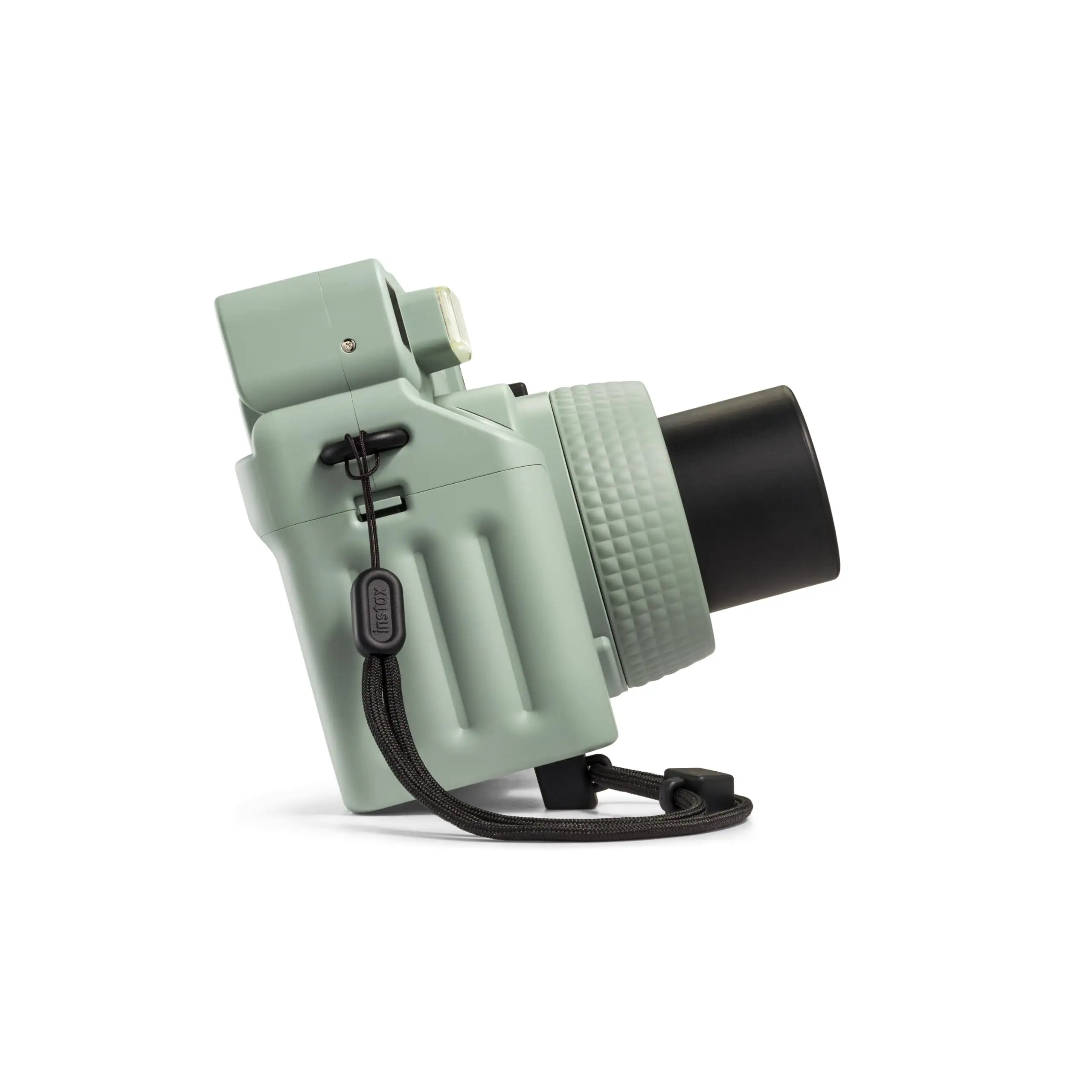
Bulkiness was a recurring issue. TechRadar called it “rugged and sturdy” but “larger and heavier than necessary,” and jeepe99’s humor about Mini Cooper proportions reflected frustration from small-handed users. Public shooting sometimes felt awkward; Beth Nicholls admitted to being “a little embarrassed” carrying it in urban areas.
Low-light performance suffers despite marketing emphasis on automatic flash. Dark prints from well-lit rooms, loss of background in selfies, and limited flash range (~3m) were widely reported, with Tom’s Guide noting narrow dynamic range yields blown highlights and deep shadows.
Film cost — approximately $1.11 per shot — also weighs on users. TechRadar reminded that “instant cameras aren't just a one-off purchase, they’re an investment,” and regular shooters must budget for ongoing packs.
Divisive Features
Design aesthetics split opinions sharply. The sage/army green earned praise from outdoorsy enthusiasts for blending with forest backdrops, but TechRadar and Reddit threads mocked it as “dull” or “juvenile,” wishing for alternative colors. Rugged build lovers saw durability; style-conscious city shooters saw a mismatch.
Manual control absence (no double exposure mode, no manual flash) is another divider. Casual users celebrated simplicity, while advanced photographers missed creative flexibility present in models like Instax Mini 99 or Lomography competitors.
Trust & Reliability
On reliability, long-term comments hinted at mostly consistent performance. haroldt noted “clear photos without bad exposure” for months of salon use. jazminec had a film ejection issue but resolved it under warranty — her case highlights why buyers often recommend extended protection plans. No widespread defects or scam behavior surfaced; most dissatisfaction stemmed from unmet delivery promises, as yolandal experienced, rather than product failure.
Durability under travel conditions is backed by TechRadar’s and Tom’s Guide’s praise for its sturdy build. Scratches and environmental wear don’t seem to affect imaging, reinforcing its appeal for field use.
Alternatives
The Lomography Lomo’Instant Wide sits as the primary competitor mentioned. At similar pricing, it offers creative tools like double exposure and optional flash, appealing to advanced users turned off by Wide 400’s constraints. Fujifilm Instax Mini 99 also came up in expert reviews as a better choice for exposure control and filters, albeit at a smaller print size.
For hybrid digital/analog shooters, Instax Mini Evo combines instant prints with digital saves, reducing film waste — valuable for social media users frustrated by Wide 400’s per-shot cost.
Price & Value
Prices range from $149–$198 depending on bundle. eBay listings show slight markdowns (~$139.99), suggesting modest resale depreciation. Given high film costs, community buy tips urge purchasing multi-packs during seasonal sales and factoring warranty into total cost, especially for travelers who may use it heavily.
Outdoor adventurers and event photographers see strong value in wide-format prints for storytelling, while casual indoor users may find cost-per-print prohibitive relative to image quality in low light.
FAQ
Q: Is the Fujifilm INSTAX Wide 400 good for selfies?
A: Only conditionally. The clip-on macro lens with selfie mirror helps, but focus and framing require practice. Many users rely on the self-timer and angle accessory instead of arm's-length shots.
Q: How long does the battery last?
A: Fujifilm claims ~100 shots per four AA batteries. Actual lifespan varies; heavy flash use can reduce it. Auto power-off after five minutes conserves energy.
Q: Can I use Instax Mini film with this camera?
A: No. It requires Instax Wide film, which is twice the width of Mini. Current packs cost about $18 for 20 shots.
Q: Is it suitable for low-light indoor events?
A: Only for subjects within 3m of the flash. Backgrounds often lose detail, and prints may appear dark in dim settings.
Q: Does it have creative modes like double exposure?
A: No. It’s a straightforward point-and-shoot for wide-format prints. Those wanting creative effects may prefer Lomography Lomo’Instant Wide or Instax Mini 99.
Final Verdict
Buy if you’re an outdoor event or travel shooter wanting large, tangible prints of group landscapes without fiddling with complex settings. Avoid if you prioritize low-light performance, selfie flexibility, or creative manual control. Pro tip from the community: pair it with the Instax Up! app to digitize and share your prints without losing the charm of instant analog.