Fellowes LX220 Micro-Cut Shredder Review: Conditional Yes
“Keeping the shredder bag in place…is frustrating” is the kind of detail that doesn’t show up in product listings—but it shows up fast in real buyer feedback on the Fellowes Powershred LX220 Micro-Cut Shredder - Black. Verdict: a strong performer for quiet, security-minded home/office shredding, with real complaints around the bin/bag design and at least one harsh durability report. Score: 7.8/10.
Quick Verdict
For the Fellowes Powershred LX220 Micro-Cut Shredder - Black, the most accurate call is: Conditional Yes—especially if quiet shredding and small particles matter more than “bag-friendly” disposal.
| What matters | What feedback suggests | Source |
|---|---|---|
| Noise level | Repeatedly described as “quiet” | Staples reviews |
| Cut/security | Praised for “micro-cut” and “tiny bits” | Staples reviews |
| Sheet capacity | Several users say it really does handle “20 sheets” | Staples reviews |
| Jam resistance | Many describe smooth feeding and not bogging down | Staples reviews |
| Bin/bag handling | Multiple complaints about bags not staying/nowhere to hang | Staples reviews |
| Durability risk | One buyer says it “gave out after less than 5 months” | Staples reviews |
Claims vs Reality
Marketing leans hard into “100% jam proof” and a high-capacity, productivity-first pitch. Digging deeper into user reports, the tone is mostly aligned with that promise—just not in the ways the spec sheet emphasizes.
One major claim is “100% jam proof.” Buyers didn’t always use that exact language, but several described the same outcome: the machine doesn’t bog down or stall when used heavily. A Staples reviewer framed it in a long cleanout project: “I have used it daily for about 1 hour per day…so far it has never over-heated even when i use it for well more than the 30 minutes of continuous use the specs rat…” That’s not a “jam proof” statement, but it’s a real-world signal for people shredding years of records.
Another promise is capacity—“20 sheets” per pass—and at least one experienced shredder owner said it finally matched the label. A Staples customer wrote: “It really does do 20 sheets and is fast.” That matters most to home-office users clearing bank statements and junk mail in batches, not one envelope at a time.
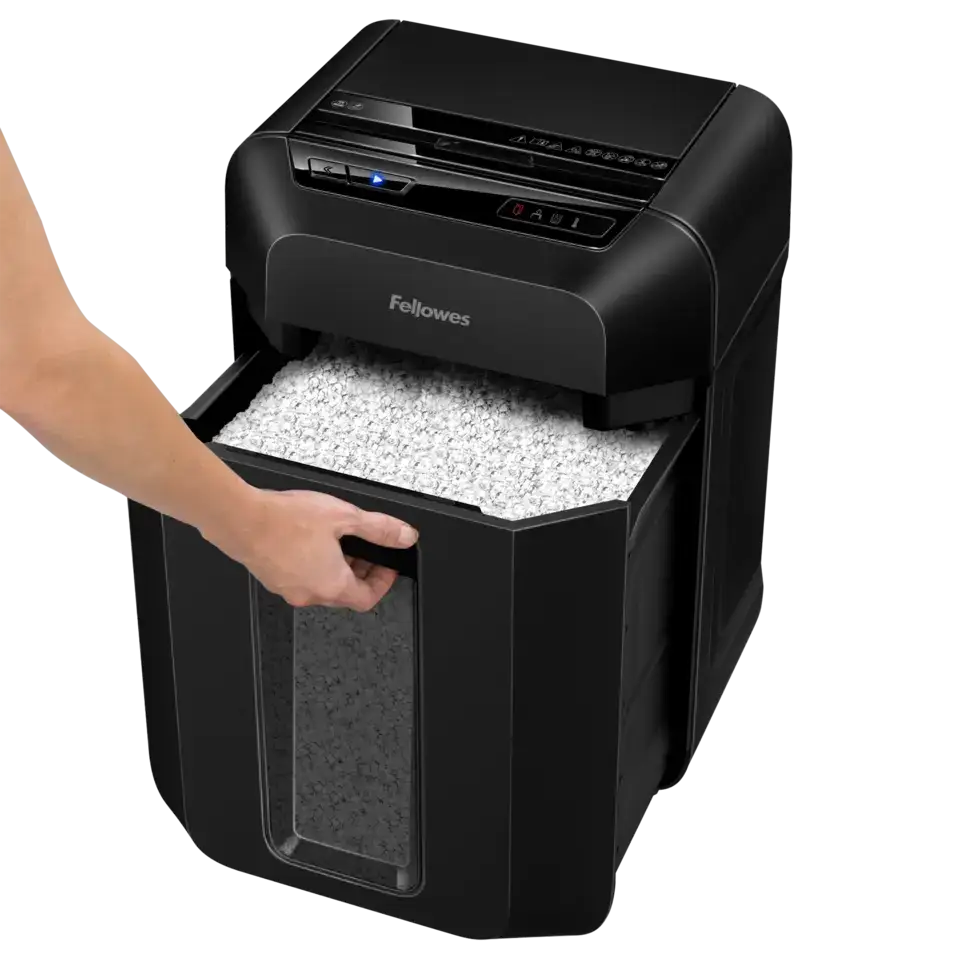
But the gap shows up around the disposal experience. The product pages talk about bin indicators and pull-out bins; users focus on what it’s like to actually empty it with bags. One Staples reviewer complained: “Keeping the shredder bag in place to capture the shredded pieces is frustrating…” Another was blunter about the design intent: “it’s like the shredder was not made to accommodate bags…the shredder bags have no where to hang.” In other words, even if shredding itself is smooth, the workflow can fall apart at cleanup—especially for users who rely on bags to keep fine micro-cut confetti from going everywhere.
Cross-Platform Consensus
Universally Praised
A recurring pattern emerged around how the shredder sounds in a real room. Quiet operation isn’t just a nice-to-have—it's the difference between shredding at night in an apartment and postponing the task for weeks. Staples buyers repeatedly used simple, confident phrasing. One said: “Works as advertised and quiet. Recommend…” Another went further on the experience upgrade: “This was an upgrade for us. It is very quiet and the micro-cut insures security…”
The micro-cut output itself is a second consistent win, especially for privacy-driven users handling sensitive mail or long-term financial files. One reviewer described the output as “tiny bits,” saying: “This shredder does an excellent job of cutting paper into tiny bits.” Another framed it as a security decision: “I wanted a shredder that kept my sensitive information was safe…shreds everything very small.” For anyone worried about dumpster-diving risks, that “very small” language is what they notice—not the DIN chart.
Capacity claims also get real support from user stories, not just specs. A buyer who had cycled through multiple shredders wrote: “I have had several since then that didn't shred as much as they said it would…It really does do 20 sheets and is fast.” Another reviewer compared it against a weaker unit and emphasized the motor staying strong even when fed heavily: “My previous 12 sheet…would bog down…not this 20 sheet…It took loads of sheets with hardly a noticeable change in motor speed.” For small offices or households doing periodic purge sessions, that’s the difference between “paper shredder” and “project tool.”
After those narratives, the most repeated praise themes look like this:
- Quiet enough for shared spaces (“quiet,” “amazingly quiet”)
- Small particle size for privacy (“tiny bits,” “micro-cut insures security”)
- Capacity that feels real (“really does do 20 sheets”)
Common Complaints
The most concrete pain point is the bin/bag experience. Several users describe a mismatch between the shredder’s performance and the mess-management system, which matters most to people shredding frequently. One reviewer, even while satisfied with shredding performance, said: “Keeping the shredder bag in place…is frustrating and would have been enough to research a good shredder with ease in placing and changing the bag!” Another described particles escaping the bag: “We’ve experienced issues with the paper shred to be running down in the bin outside of the bag.” For micro-cut machines, that “confetti” style output amplifies the problem—fine pieces scatter easily if disposal isn’t well-contained.
Design durability complaints also appear, but more specifically tied to the waste basket and casing. One buyer returned it immediately over a handle issue: “The waste basket handle is recessed…[and] the handle will separate from the plastic housing during normal basket removal.” Another mentioned physical fragility in a household setting: “When vacuuming i hit the wheel too hard which cracked casing.” These aren’t “the cutter broke” stories; they’re “the body and bin interface is the weak link” stories, which matters to users rolling it under desks or emptying it often.
Finally, there is at least one severe reliability warning. A Staples reviewer didn’t hedge: “Gave out after less than 5 months, save yourself the headache.” That’s the kind of outlier comment shoppers remember, even among mostly positive ratings, because it raises the question: is this a rare lemon or a pattern?
Common complaint themes, distilled:
- Bag retention and “nowhere to hang” frustration
- Waste bin/handle design complaints (including immediate returns)
- At least one serious early failure report
Divisive Features
The “20-sheet” promise is both praised and questioned depending on how a person interprets it. Some buyers say it truly handles the rated stack. Others imply they have to underfeed to stay happy. A Staples reviewer said: “Can only put in a few pieces at a time.” For light shredding, that might be fine; for backlog-clearing, that feels like a contradiction. The lived reality seems to be that paper type, staples, and how tightly sheets are aligned can change the “real” capacity.
Run time and heavy-use expectations also split opinions indirectly. Official descriptions highlight long sessions (often “up to 30 minutes” depending on listing). One user described exceeding that: “It has never over-heated even when i use it for well more than the 30 minutes…” But another reviewer expressed a desire for longer continuous operation: “I would prefer the running period to be longer than thirty minutes…” So the machine may satisfy some high-volume home cleanouts, while power users still wish for an even longer duty cycle.
Trust & Reliability
Trust signals here come mostly from retail-review volume and the specificity of complaints. Staples shows a strong rating distribution (4.5/5 with dozens of reviews), and many comments read like day-to-day ownership—quiet in shared spaces, shredding decades of records, and recurring disposal frustration.
However, reliability confidence is not absolute. The most alarming report is the early failure claim: “Gave out after less than 5 months, save yourself the headache.” At the same time, other users describe brand longevity in their personal history, which shapes expectations: “I had a previous fellowes cross-cut shredder that lasted 20 yrs.” Those two statements don’t reconcile neatly, so the safest interpretation is variance: many satisfied owners, with at least one buyer reporting a short lifespan.
On longer-term use stories, several reviewers speak in “so far” terms—useful, but time-limited. Examples include: “It’s only been 1 month, but so far…” and “So far, so good.” That’s meaningful for first impressions (noise, speed, cut), but it doesn’t fully settle the question of multi-year durability.
Alternatives
Only competitors mentioned in the provided data are other Fellowes shredders listed in a “shredders on sale” catalog (e.g., Fellowes Powershred LX200 and other Powershred models). There isn’t user feedback in the dataset for those alternatives—just pricing and product names—so comparisons should stay conservative.
If the LX220’s bag/bin complaints are your dealbreaker, moving within the Fellowes lineup may still help, but the data here doesn’t confirm which model fixes bag handling. What the dataset does show is that Fellowes markets multiple tiers (e.g., LX200 vs LX220), and the LX220 is positioned as higher capacity (20-sheet) with micro/mini-cut security.
For shoppers deciding within Fellowes:
- The LX220 is the one with multiple user stories praising “quiet” and “20 sheets,” plus repeated complaints about bag placement.
- The LX200 and other models appear as price-listed options, but there’s no direct user testimony here to validate tradeoffs.
Price & Value
Pricing in the dataset spans multiple sellers and regions, suggesting the LX220 can swing widely depending on retailer and whether it’s an office channel listing. For example, one listing shows about $332.84, while another page for the “mini cut” variant shows $729.00 (excluding GST). eBay shows a new unit around $315.22, and an auction record shows a much lower realized price ($30.20) but without detailed condition context beyond “good condition.”
Value perception in user feedback tends to track with performance and quietness. One Staples buyer explicitly justified the premium: “Definitely worth the extra cost, but we also shred daily.” Another echoed the same value logic: “My husband always said you get what you pay for and i think this shredder is worth every penney.”
Still, the value argument weakens if you’re the type of owner who insists on clean bagged disposal. The same reviewer who liked performance still warned the bag issue was significant enough to change their purchase decision in hindsight: “Would have been enough to research a good shredder with ease in placing and changing the bag!”
Practical buying signals from the data:
- If you shred daily and care about quiet, owners often feel it’s “worth the extra cost.”
- If you plan to use shredder bags, budget extra patience (or consider verifying bag fit/attachment before buying).
- Market prices vary a lot—checking multiple channels (office retailers vs marketplaces) appears to matter.
FAQ
Q: Does the Fellowes LX220 really shred 20 sheets at once?
A: Yes—some buyers explicitly say it meets the claim. A Staples reviewer wrote: “It really does do 20 sheets and is fast.” But another said they “can only put in a few pieces at a time,” suggesting real capacity may depend on paper type and how you feed it.
Q: Is it actually quiet enough for a home office?
A: Many owners say yes. Staples reviewers repeatedly call it “quiet,” including “works as advertised and quiet,” and “turns stuff to confetti and is amazingly quiet.” For shared spaces, that quiet operation seems to be one of the clearest strengths in day-to-day use.
Q: What’s the biggest real-world complaint people have?
A: Waste disposal with bags. One Staples reviewer said: “Keeping the shredder bag in place…is frustrating,” and another wrote it’s “like the shredder was not made to accommodate bags…[bags] have no where to hang.” This seems to affect frequent shredders most.
Q: Are there durability issues reported?
A: There’s at least one sharp warning: “Gave out after less than 5 months.” But other buyers describe positive early ownership (“so far, so good”) and even long-term brand history like “a previous fellowes…that lasted 20 yrs.” The dataset suggests mixed reliability experiences.
Q: Does it handle staples and credit cards in real use?
A: The listings claim it can shred staples, paper clips, and credit cards, and some user stories align with that heavy-duty feel. One Staples reviewer said it’s “tough enough to do up to 20 sheets…credit cards,” and described even shredding a “metal ruler” experiment at home.
Final Verdict
Buy the Fellowes Powershred LX220 Micro-Cut Shredder - Black if you’re a home-office user who prioritizes quiet shredding and small micro-cut particles for sensitive documents, and you’re willing to tolerate a fussy bin/bag setup. Avoid it if you rely on shredder bags for clean disposal or if an early-failure report like “gave out after less than 5 months” is a dealbreaker. Pro tip from the community: treat bag handling as a key “workflow” factor—one buyer said the bag issue alone “would have been enough” to choose differently.