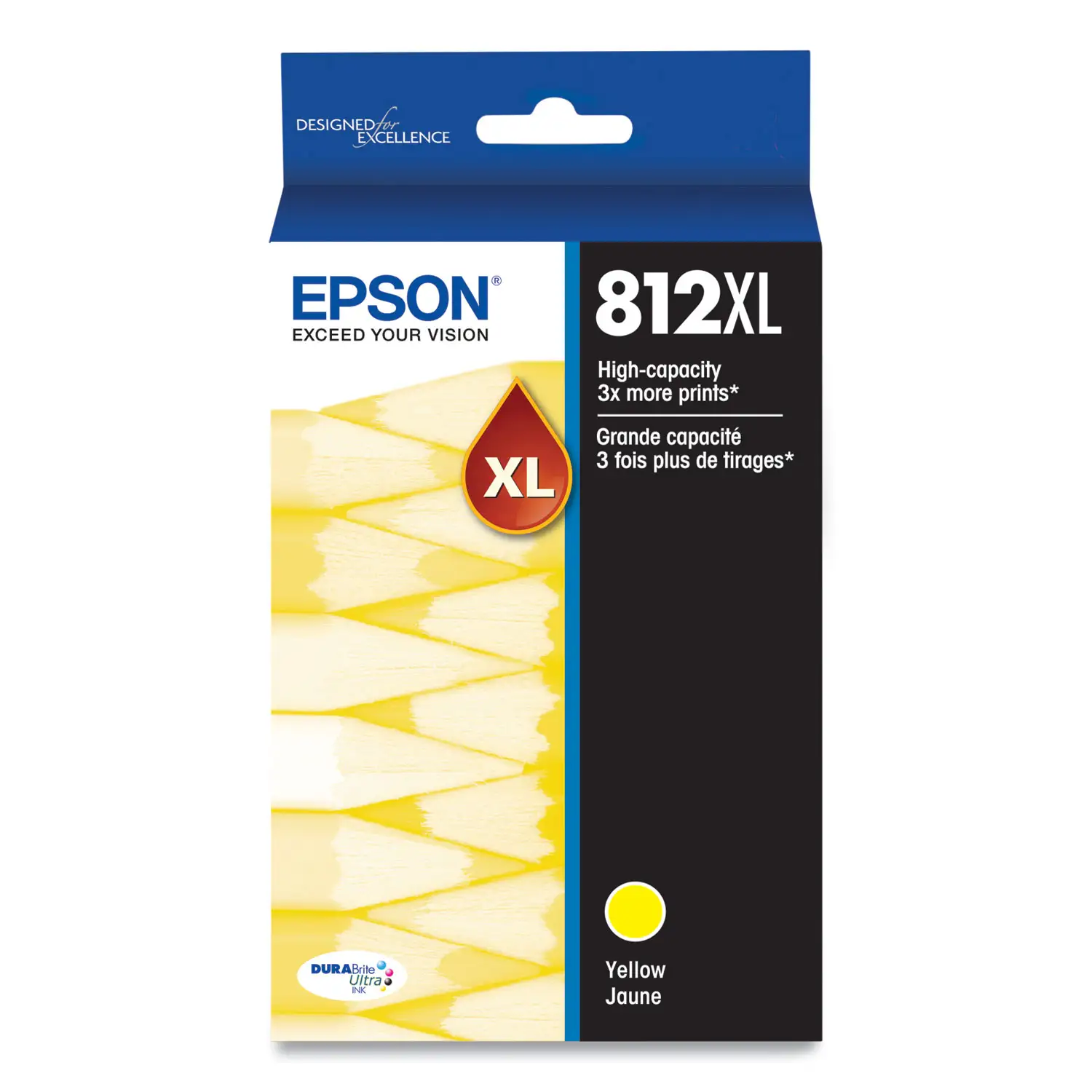
Epson T812XL420-S Yellow Cartridge: Conditional Buy (6.8/10)
A “high-yield” yellow cartridge that some people say runs dry after “a dozen copies” is the kind of contradiction that stops you mid-checkout. Epson DURABrite Ultra Ink High Capacity Yellow Cartridge (T812XL420-S) inspires both routine satisfaction and sharp frustration, often centered on whether it actually lasts like a high-capacity supply should.
Verdict: Conditional buy — 6.8/10. If you’re locked into compatible Workforce models and want genuine OEM pigment ink, many shoppers treat it as a straightforward reorder. But digging deeper into customer reviews, a recurring pattern emerged: a minority report dramatic underperformance (“dumping ink,” “worst purchase ever”), and the price sensitivity is real.
Quick Verdict
Conditional. Buy if you need OEM compatibility and can tolerate premium per-cartridge costs; avoid if you’re highly cost-sensitive or have had prior cartridge yield issues.
| What matters | What feedback suggests | Who it impacts most | Source |
|---|---|---|---|
| Fit/compatibility | Treated as “just what I needed for my printer” | Office/home users with compatible Workforce printers | Staples reviews |
| Ease of purchase | “Needed ink, ordered it, and got it. Simple as that!” | Anyone prioritizing convenience | Staples reviews |
| Yield consistency | Some report it’s “out… after printing a dozen copies” | High-volume printers expecting predictable yield | Staples reviews |
| Ink behavior | One reviewer says it “kept dumping ink” | Users seeing print defects/waste | Staples reviews |
| Price | “Quite expensive… but necessary” | Budget-conscious offices | Staples reviews |
| Delivery experience | “Thanks for prompt delivery” vs “was not delivered” | Time-sensitive replenishment | Staples reviews |
Claims vs Reality
Epson and retailers position this cartridge as a dependable, high-capacity, pro-quality consumable. Official listings repeatedly emphasize “high-yield,” “fast-drying pigment ink,” and crisp output for “high-speed and high-volume print jobs.” The spec most shoppers anchor on is yield: up to 1,100 pages in multiple listings (e.g., Genuine Ink and Toner Buzz product descriptions).
Digging deeper into user reports, the biggest gap isn’t color quality—it’s predictability. A Staples reviewer didn’t just feel disappointed; they framed it as shocking under-delivery: “this has been the worst purchase ever! i literally put new cartridges in and after printing a dozen copies it’s out of on! … ‘we are talking text not color photos.’” While officially rated as up to 1,100 pages, at least one buyer experience suggests dramatically lower real-world results, especially painful for offices counting pages and deadlines.
Another marketed expectation is controlled, professional performance—yet one account points to the opposite. A Staples reviewer described the cartridge as wasteful and messy: “this ink just kept dumping ink when i went to print.” For print-heavy users (invoices, school packets, client drafts), that kind of behavior implies not just cost but rework: ruined pages, troubleshooting, and potentially time lost to cleaning cycles.
Finally, “hassle-free” buying is both validated and undermined by logistics stories. One Staples customer kept it simple—“needed ink, ordered it, and got it. simple as that!”—while another focused on fulfillment failure: “this item was not delivered. i was here until 4:10 and no deliveries.” The cartridge itself can be fine, but replenishment reliability is part of the lived experience when supplies run out mid-job.
Cross-Platform Consensus
Universally Praised
The most consistent “praise,” interestingly, isn’t poetic raves about color—it’s the relief of getting the correct OEM cartridge for the printer you already own. When people are managing a compatible Workforce machine, success often looks mundane: it installs, it prints, life goes on. A Staples reviewer summed up that utilitarian win with: “just what i needed for my printer.” For small offices and home admins, that’s a meaningful outcome—no compatibility roulette, no time spent deciphering error messages.
Convenience is another theme that reads like a quiet endorsement. One buyer didn’t describe print quality at all, but the experience of getting operational again: “needed ink, ordered it, and got it. simple as that!” For teachers printing handouts the night before class, or admin staff refilling supplies between meetings, that frictionless restock is the “feature.”
There’s also appreciation for fast fulfillment when it goes right. A Staples reviewer explicitly credited shipping speed: “thanks for prompt delivery.” For anyone who treats cartridges like mission-critical inventory, that’s not small talk—it’s the difference between finishing a batch and postponing it.
Bullets (what “good” looks like in real use):
- Correct cartridge arrives and works as expected: “just what i needed for my printer” (Staples)
- Smooth purchase experience: “ordered it, and got it” (Staples)
- Fast fulfillment when successful: “prompt delivery” (Staples)
Common Complaints
The loudest complaints converge on value and yield—especially painful because this product is marketed as “high-yield.” A recurring pattern emerged in the harshest review language: a sense that the cartridge depleted far faster than expected. The strongest example is the Staples customer who wrote: “i literally put new cartridges in and after printing a dozen copies it’s out… ‘text not color photos.’” For high-volume households and office managers, that kind of shortfall isn’t just annoying—it breaks planning. You buy “high capacity” to avoid frequent interventions; the complaint is precisely that it required one.
Then there’s the allegation of wasteful output: “this ink just kept dumping ink when i went to print.” If that user experience reflects ink flooding or heavy consumption during prints/maintenance, it hits photographers and marketing coordinators differently than invoice printers—because color cartridges are often the bottleneck cost, and yellow dumping ink can compound quickly in graphics-heavy jobs.
Price sensitivity shows up as a standalone complaint, even when the cartridge is considered necessary. One Staples reviewer said: “quite expensive to buy but necessary for the printer i had.” That “necessary” framing matters—buyers aren’t always choosing it because they love it; they’re choosing it because the printer ecosystem demands it. The same reviewer later contrasted the economics after switching printers: “i’ve since upgraded to the et-16600 eco tank printer so my ink costs have dropped considerably… that’s a savings of about $1000 per year.” That’s less a critique of one yellow cartridge and more a warning about ongoing cost of ownership.
Bullets (what frustrates repeat buyers most):
- Reported extreme under-yield: “after printing a dozen copies it’s out” (Staples)
- Reported messy/over-ink behavior: “kept dumping ink” (Staples)
- High running costs: “quite expensive… but necessary” (Staples)
Divisive Features
What divides people isn’t the concept of OEM ink—it’s whether the experience feels dependable enough to justify the cost. On one side are buyers who treat the cartridge as a simple maintenance item: “ink! needed ink… simple as that!” For them, the product disappears into the workflow.
On the other side are customers whose experience is dramatic enough to label it a “worst purchase,” especially when usage was basic (“text not color photos”). That contrast is stark: the same product can either be invisible (it works) or infuriating (it drains fast or “dumps” ink). The data doesn’t show detailed troubleshooting steps, but the emotional gap is unmistakable.
Trust & Reliability
On reliability, the user feedback in this dataset is concentrated in retailer reviews rather than long-term community threads, and it reads like a split between “routine reorder” and “something went wrong.” A Staples customer’s account of rapid depletion—“after printing a dozen copies it’s out”—directly challenges the high-yield expectation. While officially described as yielding up to 1,100 pages (Genuine Ink; Toner Buzz), at least one reviewer experience suggests that in some cases performance may fall far short of that headline number.
Trust concerns also show up in shipping and handling narratives. One Staples review is purely a fulfillment complaint: “this item was not delivered. i was here until 4:10 and no deliveries.” That doesn’t accuse the product listing itself of fraud, but for buyers, non-delivery can feel like a trust failure—especially when ink is urgently needed for work.
Alternatives
Only one alternative product path is explicitly mentioned in the provided feedback: switching printer ecosystems to an EcoTank model. One Staples reviewer framed it as a direct response to cartridge cost: “i’ve since upgraded to the et-16600 eco tank printer so my ink costs have dropped considerably,” adding that over a year they used “about 6 cartridge refills” versus “one of the et bottles,” claiming “a savings of about $1000 per year.”
That story positions the “alternative” less as a different yellow cartridge and more as a strategic move for high-volume users. If you’re printing enough that yellow replacement frequency is a budget line item, the alternative described is changing to a tank-based printer system to reduce per-page ink expense. For low-to-moderate volume users, the dataset doesn’t include competitor cartridge recommendations—only this one buyer’s experience-based pivot.
Price & Value
Prices in the provided listings vary widely by seller, even before considering shipping or packs. The Epson US listing shows $29.49 for T812XL yellow, while other retailers in the dataset show amounts like $35.19, $41.96, and $44.76 (Epson US; Office Depot; Genuine Ink; Toner Buzz). For buyers, that spread means value perception can swing depending on where you shop and whether you’re replenishing one cartridge at a time.
Digging deeper into user commentary, the value debate is less about the sticker price and more about total cost over time. The Staples reviewer who called it “quite expensive” also contextualized annual spend, concluding that moving to EcoTank yielded “about $1000 per year” in savings. For heavy office printing—forms, copies, and recurring client docs—that kind of statement reads like a warning to calculate cost-per-page rather than buy impulsively.
At the same time, some buyers implicitly accept the price as the cost of keeping a specific printer running. “Necessary for the printer i had” captures a common cartridge reality: once you’re in a hardware ecosystem, consumables become non-optional.
Buying tips implied by the feedback and listings:
- Compare retailer pricing (Epson US vs office-supply stores) before reordering (Epson US; other listings)
- If you print high volume and resent cartridge costs, consider the EcoTank path mentioned by a reviewer (Staples)
- Treat delivery reliability as part of “value” if you’re ordering last-minute (Staples)
FAQ
Q: Is the Epson T812XL420-S really “high-yield”?
A: Official listings describe it as high-yield and cite “up to 1,100 pages” (Genuine Ink; Toner Buzz). However, one Staples reviewer reported it was “out” after “printing a dozen copies,” even for “text not color photos,” suggesting real-world results can vary sharply.
Q: What printers is T812XL420-S compatible with?
A: Product listings in the provided data list compatibility with Epson Workforce models including EC-C7000, WF-7310, WF-7820, and WF-7840 (Genuine Ink; Toner Buzz; Office Depot). For buyers, that OEM match is why some reviews simply say it’s “just what I needed.”
Q: Do people think this cartridge is overpriced?
A: Yes—price complaints show up clearly in Staples reviews. One buyer called it “quite expensive… but necessary,” and said they later switched to an EcoTank printer because “my ink costs have dropped considerably,” claiming “a savings of about $1000 per year.”
Q: Are there reliability issues like leaking or excessive ink use?
A: At least one Staples reviewer described abnormal behavior: “this ink just kept dumping ink when i went to print.” That’s not a universal theme in the dataset, but it’s a notable complaint because it implies waste, mess, or print defects.
Q: Is ordering and delivery generally smooth?
A: Some feedback is positive—“needed ink, ordered it, and got it” and “thanks for prompt delivery” (Staples). But one review reports a failed delivery: “this item was not delivered… no deliveries,” which can be a serious issue if you’re replenishing urgently.
Final Verdict
Buy Epson DURABrite Ultra Ink High Capacity Yellow Cartridge (T812XL420-S) if you’re a Workforce EC-C7000/WF-7310/WF-7820/WF-7840 owner who prioritizes OEM compatibility and wants the “just works” experience reflected in comments like “just what i needed for my printer” (Staples).
Avoid if you’re a high-volume, cost-sensitive printer who expects “high-yield” to be consistently predictable—because one buyer’s experience (“after printing a dozen copies it’s out”) clashes hard with the “up to 1,100 pages” positioning (Staples; Genuine Ink; Toner Buzz).
Pro tip from the community: if cartridge costs keep stacking up, one Staples reviewer’s path was to switch systems—“upgraded to the et-16600 eco tank printer”—claiming “a savings of about $1000 per year” on ink.