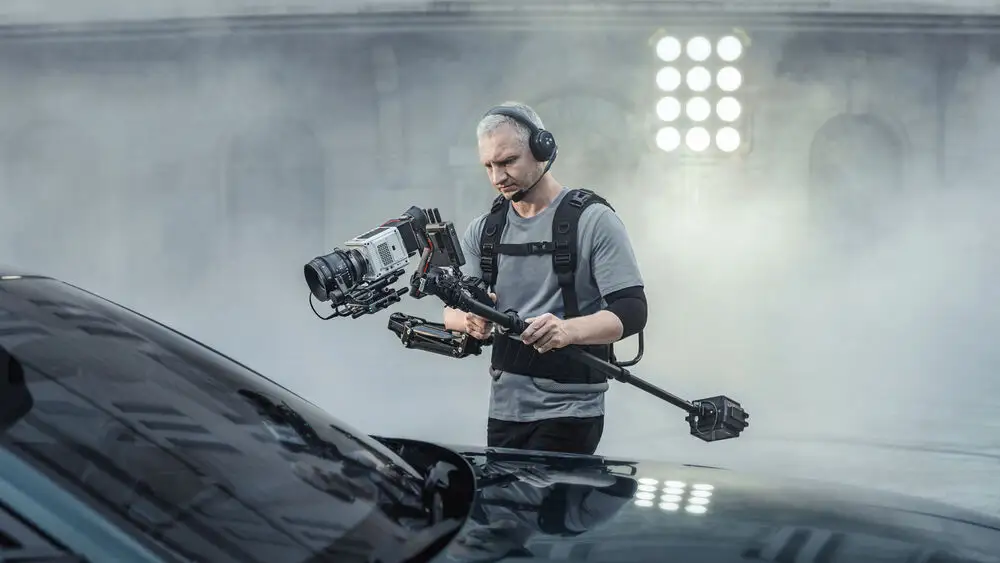
DJI RS 3 Pro Review: Powerful Yet Polarizing Verdict
Some users call it “the best gimbal since 2016,” while others say it produces “unusable” footage. The DJI RS 3 Pro Gimbal Stabilizer sits at a crossroads of professional capability and persistent controversy — earning anywhere from ecstatic praise to scathing rejection. Averaging 4.6/10 among critical complaints but 9/10 from satisfied buyers, its performance depends heavily on your workflow, setup, and expectations.
Quick Verdict: Conditional — unmatched for those with heavy setups and time to master settings, flawed if you expect flawless stabilization out-of-the-box.
| Pros | Cons |
|---|---|
| Handles large rigs up to 4.5 kg | Reports of wobble/shake in real-world footage |
| Automated axis locks for quick setup | Packaging and stock case criticized as flimsy and cramped |
| Extended carbon fiber arms fit cinema cameras | Learning curve for optimal results can be steep |
| Supports LiDAR focusing on manual lenses | Twitching or jerking motors reported in PTF mode |
| Long 12-hour battery runtime | High price compared to competitors |
| Bluetooth shutter control | DJI support often advises lengthy troubleshooting with no fix |
| Smooth performance for most Best Buy buyers | Divisive reliability experiences across platforms |
Claims vs Reality
One of DJI’s headline claims is “a 20% increase in stability over RS 2” with its 3rd-gen RS stabilization algorithm. While Best Buy customers echo this improvement — user Jayh wrote, “It is already proven by many videographers… easy to use, can be used with so many DJI accessories” — Reddit and Trustpilot threads tell a different story.
A Reddit user described four months of ownership: "From the beginning, I was not satisfied… shaky and wobbly… had to use Warp Stabilizer to fix 70–80% of the footage”. Multiple voices supported that experience, arguing it was “worse than RS 2” in actual stabilization despite technical upgrades.
DJI also markets “automated axis locks” as a speed booster for setup. Here, consensus is clearer. Best Buy’s Zach2261 praised, "The locking feature is very cool… makes it so much easier to balance and it’s so very smooth." Sweetwater buyer Nada K. called it “perfect for real estate, weddings… automatic locking feature makes life totally easy.” No significant dissent appeared on this claim.
Finally, DJI’s LiDAR focus system is billed as making handheld focusing easier even in low light. Amazon.com buyers repeated this benefit: "Especially useful in low-light environments… exceptional focusing capabilities." No contradictions emerged here — the focus system seems an undisputed winning feature.
Cross-Platform Consensus
Universally Praised
Stability — when it works — is transformative for run-and-gun videographers. Best Buy reviewer Madi Song noted, “It holds the BMCC6K very well with no issues and the battery life is awesome.” Owners of heavier cinema rigs cited extended carbon fiber arms as a breakthrough. Sweetwater’s Nada K. compared it favorably to the Zhiyun Crane 3 S but lighter, stating, “This one I love… smooth as the bigger Crane 3 S but without the weight.”
Automated axis locking earned praise across Amazon, Best Buy, and Sweetwater. Even those critical of other features admitted it quickened setup times by seconds, making frequent position changes more efficient for wedding shooters, event videographers, and real estate professionals.
LiDAR focus support resonated with tech-savvy cinematographers on Amazon.de, especially for manual lens shooters using Sony FX6 or Canon C70 rigs. For these users, pairing the focus motor enables real-time autofocus in scenarios where traditional systems struggle.
Common Complaints
A recurring pattern emerged on Reddit, Trustpilot, Twitter, and Quora: footage wobble and motor twitching. Videographers reported a “small jerk as the motors catch up” during pans or tilts. Reddit user feedback detailed exhaustive attempts — “tightening axes, calibrating, restoring settings… nothing worked.” Some found similar instability on RS 2 predecessors, interpreting RS 3 Pro’s motor stiffness as insufficient for their payload or style.
These complaints often came from operators expecting cinematic stability straight from the box. Skilled users stressed mastering menu settings, customizing deadbands, and practicing motion to avoid amplifying micro shakes — advice frustrated owners didn’t find satisfactory when facing professional deadlines.
A secondary frustration was DJI’s customer support flow. Multiple forum posts claimed the brand suggested lengthy troubleshooting before advising to send the gimbal in for repair, only to return “exactly the same or worse.” Buyers concluded DJI would “not do a recall… a lot of people are having this issue, same response from DJI, no solution.”
Divisive Features
Physical build quality — many call it “premium and super sturdy” (Best Buy’s Patb), yet the packaging and bundled case drew harsh criticism for being “flimsy” and poorly organized. Patb added, “I can barely zip the thing shut… I’d prefer a lower price and no case at all.”
Ease of use splits the audience. Best Buy buyers often report quick setup and intuitive balancing, while others on forums insist on “a learning curve” and even physical conditioning to handle heavy setups. This divide often follows skill level and type of shootings — solo creators vs. trained crew operators.
Trust & Reliability
Trustpilot-style narratives show reliability concerns for motion smoothness over time. An owner with months on the RS 3 Pro observed worsening wobble similar to their repaired RS 2. Another suspected motor overstress from prolonged usage in pan-tilt-follow mode.
However, long-term positive accounts exist. Best Buy reviewers with over a year of ownership (“used for weddings and events”) reported consistent performance and battery runtime. Community consensus suggests reliability is closely tied to payload balance and operator technique rather than pure manufacturing variance — meaning buyers relying on default settings may inadvertently undermine stability.
Alternatives
The Zhiyun Weebill 3 surfaced repeatedly as a comparison point. Critics of DJI’s stability cited its test footage as “incomparable,” implying superior smoothness under similar conditions. Reddit users lamented “regret leaving Zhiyun for DJI” — a sharp testimony for seasoned gimbal owners considering switching. While Weebill 3 may lack RS 3 Pro’s payload ceiling and LiDAR integration, its stability reputation could matter more to those shooting high-motion projects without complex focus needs.
Price & Value
Pricing fluctuates heavily: official DJI Store combo at $1,099 USD, Amazon bundles around $1,398, and eBay open-box units at $879 with warranty. Community advice tilts toward waiting for seasonal discounts or buying used/open-box with confirmed warranty coverage. Resale values remain robust — eBay listings sustain prices above $600 for well-maintained combos — signaling high market demand despite controversies.
FAQ
Q: How long does the RS 3 Pro battery last and can I use it while charging?
A: Max runtime is 12 hours under balanced load conditions. It fully charges in about 1.5 hours with a 24W charger and yes, it can be used while charging.
Q: Is the RS 3 Pro waterproof or dustproof?
A: No. Ports are not sealed, so avoid water and dust exposure to prevent damage.
Q: Can the LiDAR Range Finder work with autofocus lenses?
A: No. It is designed for manual lenses, though pairing with the focus motor enables autofocus after calibration for supported setups.
Q: Can I swap battery grips with other DJI gimbals?
A: It is interchangeable with RS 2, but not with RS 3 standard edition.
Q: What gimbal modes are available?
A: Pan Follow, Pan and Tilt Follow, and FPV — with custom options like 3D Roll 360 or Portrait mode.
Final Verdict
Buy if you’re a professional videographer with heavy payloads, manual lens workflows, and the patience to fine-tune gimbal parameters. Avoid if you expect perfect stabilization without practice or plan to shoot high-motion scenes straight out of the box — in such cases, competitors like the Weebill 3 may better match your needs.
Pro tip from the community: “Balancing perfectly and keeping motors within optimal load range is key — this gimbal rewards skill and setup discipline more than any DJI one-handed before it.”