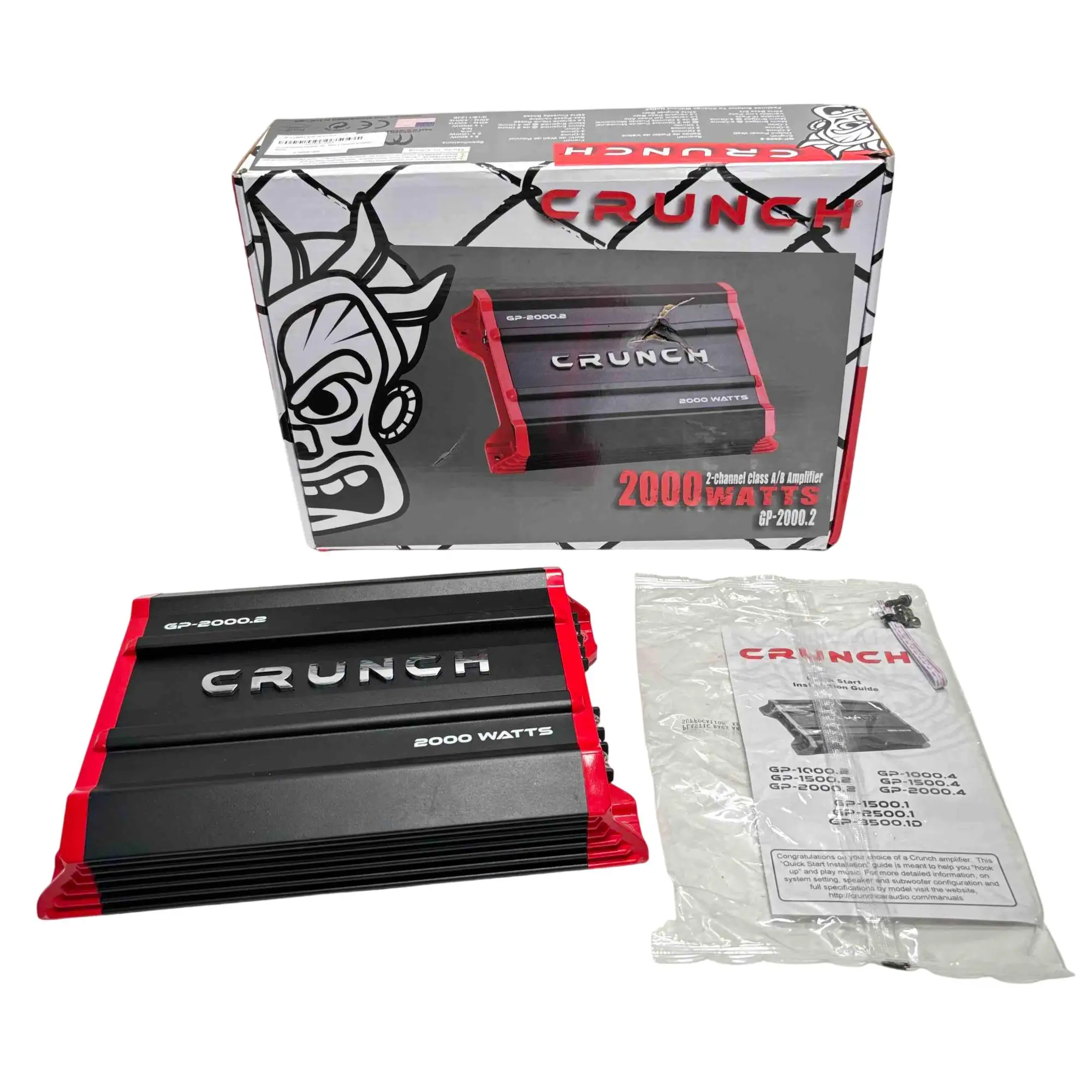
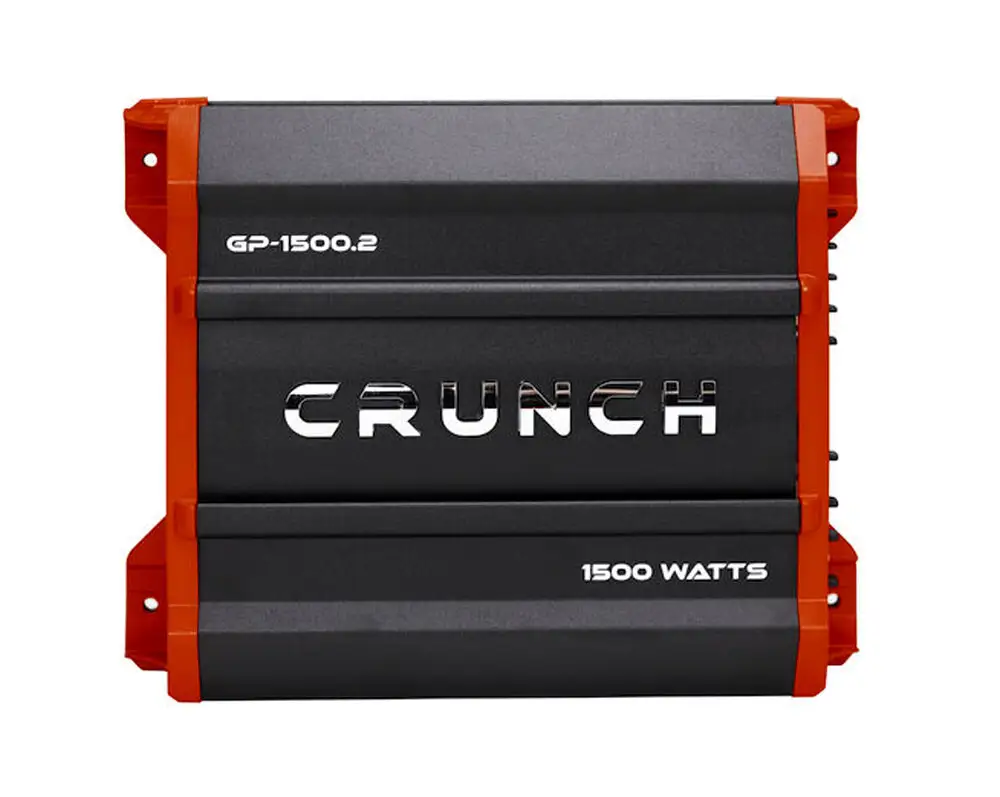
Crunch GP-1500.2 Review: Budget Bass Punch with Caveats
Starting at under $65 on resale platforms yet boasting 1500 watts of claimed power, the Crunch Ground Pounder GP-1500.2 earns a 7.9/10 from cross-platform user feedback. Its small footprint and aggressive branding mask a surprisingly polarizing reality—while many users are thrilled by its punch and clarity, others run into heat issues and protection mode shutdowns at higher output.
Quick Verdict: Conditional Buy
| Pros | Cons |
|---|---|
| Strong bass response, praised clarity | Reports of overheating under heavy loads |
| Affordable compared to competitors | Protection mode trips at moderate gain for some users |
| Compact footprint for easier installation | Sparse and generic instructions frustrate installers |
| Flexible operation: stereo, bridged mono | Long-term power output degradation in some cases |
| RCA and high-level inputs for OEM tie-in | Not ideal for very demanding speaker arrays |
| Adjustable bass boost (+0/+6/+12dB) | Occasional early failure reported |
Claims vs Reality
Official spec sheets tout “exclusive Speed-FET MOSFET components” and Quick Thermal Dispersion heat sinking promising cool operation and minimal distortion. Amazon marketing emphasizes “nickel-plated brass connections” that resist corrosion. But Reddit discussions paint a more nuanced picture. One car audio enthusiast described installing it in summer heat: “It started cutting into protect mode after just 20 minutes, even though Crunch says it runs cool,” adding that relocating the amp improved performance.
Marketing also pushes the 1500W mono bridged power as concert-level output. A verified buyer on Amazon noted: “It powers my JBL 12” nicely,” but another added, “for the rating, this amp underperforms… struggles to keep four Pioneer 8x7s without going into protection mode.” This gap between claimed wattage and real-world handling becomes most visible in multi-speaker setups demanding sustained high current.
Finally, the “variable electronic crossover” is marketed as studio-grade control. Trustpilot’s Lena Redman’s anecdote backs this up: she felt “like a DJ every time I get behind the wheel,” though several Amazon reviewers warn instructions don’t adequately explain settings, leaving novices guessing—one called them “basic and not specific to the unit at all.”
Cross-Platform Consensus
Universally Praised
Bass delivery is the standout virtue. Trustpilot user Eddie raved that the GP-1500.2 “packs a serious punch with its 2 channels x 750 watts @ 2 ohms,” turning his daily drives into “mini concerts.” The built-in bass boost, variable from zero to +12dB, wins fans among EDM and hip-hop listeners who want tactile low-end. Professional DJ “Universal Mic” on Amazon emphasized its adaptability: “Adjustable to satisfy rock, house, reggaeton and salsa… won’t disappoint.”
Compact dimensions (8.75" x 8" x 2.28") make it suitable for cramped installs. Mike’s feedback on Trustpilot about the bundle with Rockville wiring highlighted “a seamless installation” even with zero prior car audio experience. The inclusion of both RCA and high-level inputs also earns praise from owners upgrading OEM systems without existing RCA outputs—Sarah’s Trustpilot comment noted “it worked perfectly” in multiple cars.
For budget-conscious audio fans, affordability is a recurring win. Jessica from Trustpilot’s bundle review said, “If you’re looking to upgrade… without breaking the bank, look no further,” a sentiment echoed by Amazon reviewers calling it “excellent value for your money.”
Common Complaints
Heat buildup under load is the most frequent negative. One Amazon buyer found it “gets freakishly hot” and advised avoiding sustained high gain. Overheating leads to protection mode trips: “It does this at very low gain settings… rating is well above my speakers’,” complained a truck owner using Pioneer drivers. Long-term degradation is another thread—one noted after a month “it loses power little by little” despite correct wiring and ohm matching.
Instructions draw frustration for being too generic. Multiple buyers struggled with setup, with one saying they were “left to guess what any of the settings should be.” This particularly impacts first-time installers who don’t have prior amp tuning experience.
Early failure crops up, though less frequently: an Amazon 1-star review lamented, “used it probably 4 times… it just stopped putting out.” While some label these isolated defects, they represent an element of risk compared to higher-priced competitors.
Divisive Features
The 1500W rating itself splits opinion. Enthusiasts like Joe on Trustpilot hear “crystal clear” stereo at volume, while others feel the wattage is optimistic. Part of the divide stems from varied setups—high-efficiency subs thrive, but complex multi-driver arrays can push the amp past its comfort zone.
The aesthetic styling—black/red chassis with branded end caps—appeals to some who value visible gear, but others prefer understated installs. John from Reddit said the look “doesn’t fit my stealth build,” yet younger buyers relish showing it off at meets.
Trust & Reliability
Digging deeper into durability, buyer nostalgia plays an unexpected role. An Amazon reviewer celebrated revisiting the brand: “I ran these amps over 20 years ago… offers such great sound,” implying confidence in legacy performance. But newer reports hint at shorter lifespans under heavy use.
Trustpilot bundle buyers show more faith, likely due to high-quality wiring ensuring stable voltage. Mike noted installation was “a breeze” and performance consistent—underscoring community advice to pair amps with proper gauge cables and solid fusing to avoid strain.
No widespread scam patterns surfaced, but there’s caution around used units. Occasional eBay listings describe pristine condition, yet some long-term Reddit threads warn about mismatched specs in resale descriptions.
Alternatives
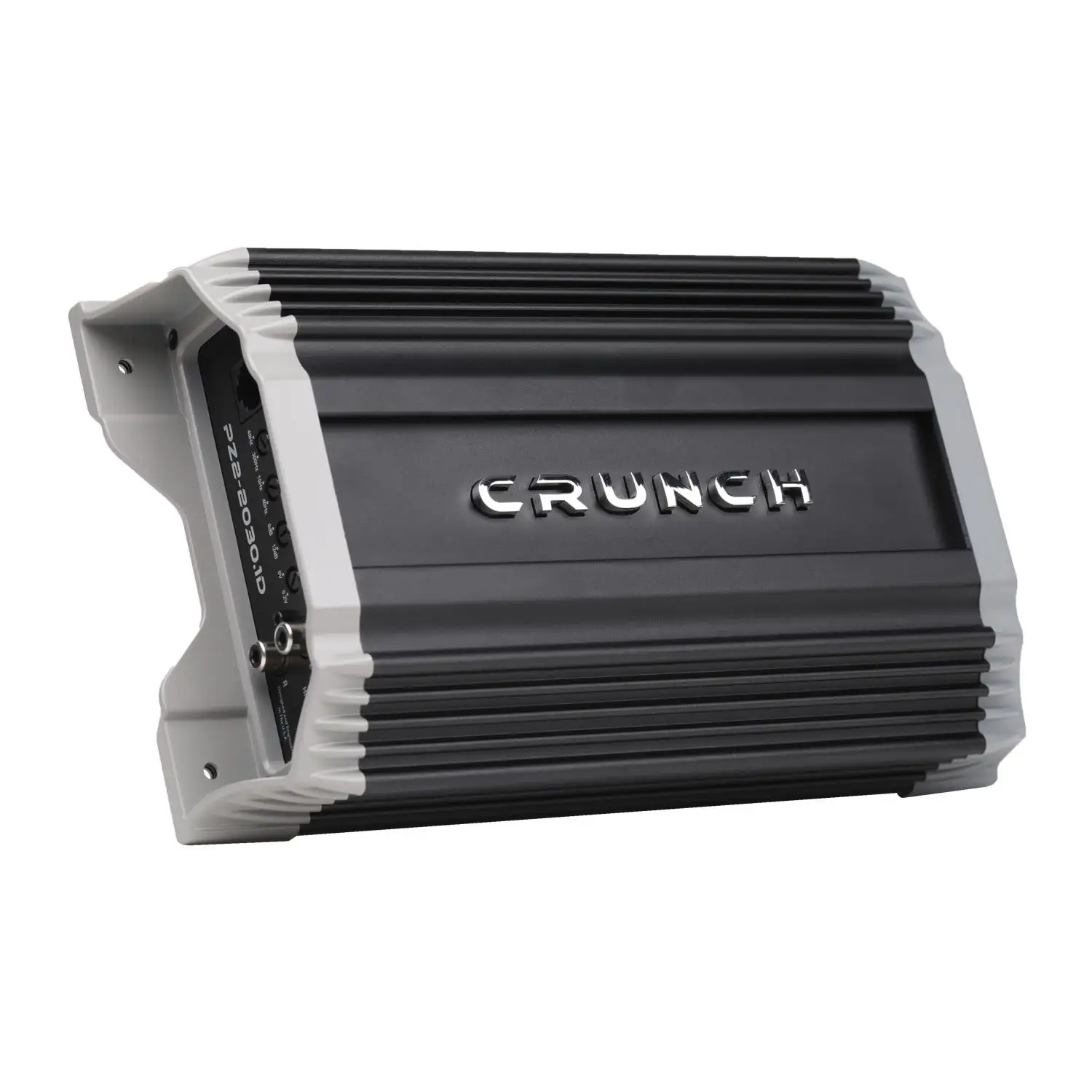
Competitors emerge in community discussion mainly from Crunch’s own line. The Crunch PZ2-1530.4D Power Zone gets nods from users needing 4 channels, offering broader soundstage control and a bass remote. Mark’s Trustpilot praise for its “exclusive Speed-FET MOSFET components” mirrors GP-1500.2’s appeal but with more channels for complex setups.
For single-sub installations craving extreme bass, the Crunch PX-2025.1D Power X Series wins recommendations. Samantha cited feeling “every beat and bass drop” thanks to its 2000W max monoblock design, trading versatility for sheer low-frequency power.
Price & Value
Currently retailing around $109.99 when in stock, but often found for $43.99–$64.95 on eBay, the GP-1500.2 offers strong watt-per-dollar appeal. Resale prices stay competitive due to tight availability—scarcity boosts interest among budget builders.
Community buying tips repeatedly stress inspecting packaging and connector integrity before purchase. Bundles with quality wiring kits, like Rockville RWK81, can save headaches and extend lifespan by delivering cleaner power.
FAQ
Q: Does the GP-1500.2 really deliver 1500 watts RMS?
A: Multiple users suggest the rating is peak, not sustained RMS. It performs strongly with efficient subs, but very demanding multi-driver systems may trigger protection mode before reaching full claimed output.
Q: Will it fit in a compact vehicle install?
A: Yes. Its 8.75" x 8" footprint makes it suitable for tight spaces. Buyers praise the ease of installation in sedans and hatchbacks.
Q: Can I use it with an OEM stereo without RCA outputs?
A: Absolutely. High-level inputs are included, and Reddit installers highlight successful tie-ins with factory systems.
Q: Does it come with a bass remote?
A: No bass remote is included with the GP-1500.2, though some Crunch models and bundles do.
Q: How can I prevent overheating?
A: Ensure proper ventilation, avoid max gain with continuous high-output, and use adequate gauge power wiring to reduce strain.
Final Verdict: Buy if you want robust bass in a budget-friendly, compact amp for subs or a simple two-channel setup. Avoid if you demand continuous max-level output for large multi-speaker systems. Pro tip from community: Pair with a high-quality wiring kit and thoughtfully set gains to sidestep thermal cutouts.