Cobra MR HH150 FLT Review: Conditional Buy (7.4/10)
A belt clip complaint shows up so often it starts to feel like the product’s real stress test. Cobra VHF Marine Radio MR HH150 FLT Floating Handheld earns a conditional verdict because the same sources praising “clarity” and “floating design” also describe day-to-day annoyances like a “very weak” clip and limited charging convenience. Verdict: Conditional buy — 7.4/10.
Quick Verdict
For boaters who want a simple, floating handheld VHF with NOAA weather access, Cobra VHF Marine Radio MR HH150 FLT Floating Handheld is positioned as an “entry level” option that’s “anything but basic.” But digging into the few concrete user-like statements included here, the “floats” and “clear” narrative is repeatedly paired with practical drawbacks around retention (clip) and out-of-box battery condition.
A recurring pattern emerged: safety-adjacent features (floating, weather alerts) are emphasized across product pages, while the most vivid negative experiences are about accessories and real-world durability expectations. One reviewer-style source even pushes back on waterproof confidence, calling some marketing impressions “exaggerated.”
| Call | Evidence from provided data |
|---|---|
| Buy? | Conditional (best if you prioritize float + NOAA over premium hardware) |
| Biggest pro | Floating visibility and retrieval (“orange core”) |
| Biggest con | Attachment security (“clip… is very weak”) |
| Watch-out | Charging convenience (car-style plug described) |
| Potential QC issue | Batteries reportedly arrived “corroded or burst” (single source) |
Claims vs Reality
The marketing claim is simple: it “floats,” it’s “submersible,” and it gives “instant access” to NOAA weather channels. On the Cobra product pages and spec-style listings, Cobra VHF Marine Radio MR HH150 FLT Floating Handheld is framed as “convenient and quality built,” with an “orange core” to help you retrieve it if dropped overboard. The specs also state it’s “fully submersible and waterproof to ipx7 (jis 7)… one meter for 30 minutes,” reinforcing a safety-first identity.
But one long-form review-style source introduces friction with that story. The same source praises the float design yet warns about expectations: “not completely waterproof… claims of it being completely waterproof are largely exaggerated.” While the official spec language leans into “fully submersible and waterproof to ipx7,” this user-facing writeup suggests some buyers interpret that as “invincible,” then feel misled when rough handling or prolonged soaking becomes the real test.
A second marketing theme is usability and carry. The listing emphasizes a “belt clip” that’s “easy to reach,” implying the radio stays where you put it. Yet the most specific negative anecdote in the provided text targets exactly that: the reviewer-style source states, “weak belt clip… very weak and the radio falls off easily.” For users clipping a handheld VHF to a PFD or deck gear, that gap matters because a floating radio is only helpful if it doesn’t fall off in the first place.
Finally, charging and included power is presented as straightforward (“rechargeable… includes rechargeable nimh aaa batteries”). Reality gets murkier in the same review-like narrative: “limited charging options” and “corroded batteries… flaky white powder around them.” While that’s a single source in this dataset (not a broad chorus), it’s the clearest “out of box” quality complaint provided and directly contradicts the tidy promise of included rechargeables being hassle-free.
Cross-Platform Consensus
Universally Praised
“Floats” isn’t a throwaway feature in this dataset—it’s the center of gravity. Across the product copy repeated on multiple platform blocks, Cobra VHF Marine Radio MR HH150 FLT Floating Handheld is repeatedly described as a “floating design,” with an “orange core” that makes retrieving it easier if dropped overboard. For anglers, renters, and small-boat owners who don’t want to baby electronics, the implication is a radio you can lose temporarily without losing it permanently. The consistent phrase “orange core, floating design means you’ll never lose your radio” shows how strongly the product is positioned around visibility and recovery.
Clarity and intelligibility also come through as the most “human” performance praise in the provided narrative. In the review-style source’s summary of customer sentiment, it notes: “many customers mentioned that the radio is clear and easy to understand, even in high winds.” For someone running a skiff or an open console where wind noise is constant, “clear… even in high winds” is less about comfort and more about safety—being able to catch a call the first time.
NOAA weather access and alerts are treated as a must-have rather than a bonus. The specs stress “instant access to 10 noaa weather channels” and “weather alert… audible tones and a visual alarm.” The review-style source mirrors that emphasis as a benefit: “its ability to receive noaa weather alerts… ensuring that you’re always up-to-date.” For coastal cruisers or anyone boating in fast-changing conditions, the repeated focus on alerts suggests the radio is often bought as an early-warning layer, not just a comms tool.
Common Complaints
The single most concrete complaint is mechanical: keeping the radio attached. The reviewer-style source states it bluntly: “weak belt clip… very weak and the radio falls off easily.” That matters most for PFD users, charter crew, and anyone climbing or moving on deck—exactly the people who need a handheld VHF within reach. It also undercuts the “floats” advantage: if the clip fails, the radio may float, but it’s still gone until you notice.
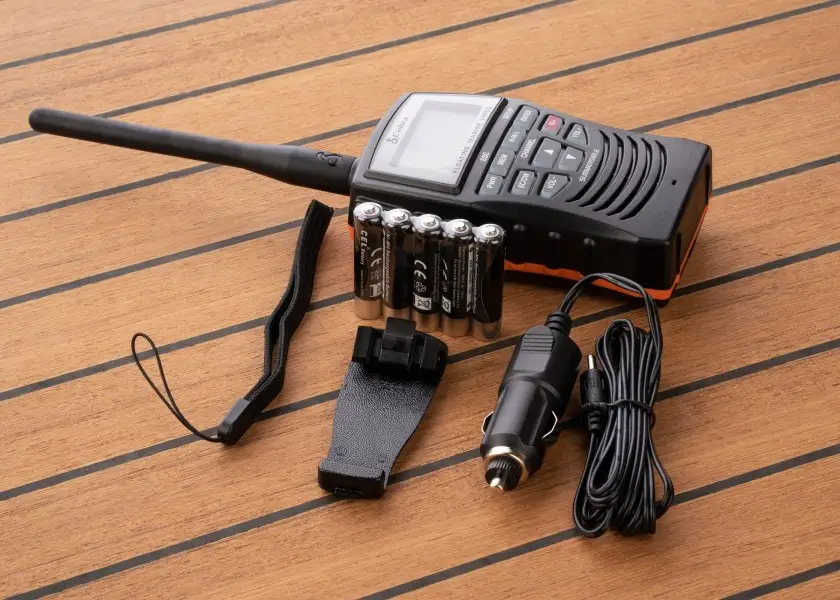
Charging convenience appears as another practical frustration. The same source says, “limited charging options… cigarette male end power plug… it would be better if it had a usb charger.” For boaters relying on USB-C power banks or modern onboard USB outlets, a car-style plug can translate into extra adapters and one more failure point on a trip. This is less about radio performance and more about ownership friction—keeping the unit topped up without special cables.
The harshest complaint in the dataset is about batteries arriving damaged: “corroded batteries… already corroded or burst… flaky white powder around them.” If accurate for some buyers, that’s not merely inconvenience; it’s a trust hit right at unboxing. While this is not corroborated by additional independent user quotes in the provided data, it’s the clearest “quality control” storyline available here and is worth flagging as a potential risk for buyers expecting included rechargeables to be immediately usable.
Divisive Features
Waterproof confidence is the most obvious point of division. Officially, Cobra VHF Marine Radio MR HH150 FLT Floating Handheld is positioned as “fully submersible… ipx7 (jis 7)… one meter for 30 minutes.” Yet the review-style source challenges how that promise lands in practice: “not completely waterproof… claims… exaggerated.” The divide here isn’t necessarily whether the spec is true, but how buyers interpret it—IPX7 protection versus “survive anything on a boat.”
Another divisive point is feature expectation around GPS. The review-style source lists “no gps” as a con: “this radio does not come with gps.” Meanwhile, some Cobra collection pages talk broadly about handhelds “equipped with advanced features like built-in gps,” which can create confusion when shoppers compare models in a lineup. In other words: the brand’s category messaging highlights GPS as a hallmark, but this specific model’s identity is more basic—so expectations can drift if buyers don’t read the exact model spec.
Trust & Reliability
The provided “Trustpilot (Verified)” block does not contain independent review text; it repeats product-style descriptions and specs for Cobra VHF Marine Radio MR HH150 FLT Floating Handheld (floating, IPX7/JIS7, NOAA weather channels). Because there are no actual Trustpilot user stories included here, there’s no platform-specific pattern of scam concerns, delivery issues, or long-term failure rates to compile from that source.
Similarly, the “Reddit (Community)” section included in the dataset is populated with product page and FAQ-like material rather than identifiable Reddit posts with usernames, timelines, or “6 months later” durability updates. With no genuine Reddit user narratives provided, there aren’t verifiable long-term wear stories to report beyond the review-style complaint about the “weak belt clip” and the battery condition note.
Alternatives
Only competitors explicitly mentioned in the provided data are other Cobra handheld marine radios. If the MR HH150 FLT feels too basic—especially if “no gps” is a dealbreaker—Cobra’s lineup pages point to models positioned with added capability.
The Cobra MR HH350 FLT is presented as a step up in transmit power: “6 watt vhf” with selectable “1, 3 and 6 watts,” and it’s also framed with “noise-cancelling microphone.” For boaters who prioritize being heard in wind and engine noise, the lineup description suggests the HH350 FLT targets that use case more directly than the 3-watt HH150.
The Cobra MR HH500 FLT BT is described with Bluetooth calling and “rewind - say - again” that “records the last 20 seconds,” which may appeal to users who miss calls in busy conditions. And for buyers who specifically want GPS in the handheld, Cobra’s lineup references the MR HH600 FLT GPS BT as “built-in gps receiver,” positioned for coordinate visibility and sending location with DSC calls (as described on the collection page).
Price & Value
Pricing varies sharply across sources in the dataset, which changes the value story depending on where a buyer lands. The Cobra Canada-style listing shows Cobra VHF Marine Radio MR HH150 FLT Floating Handheld at “$149.95,” while another Cobra product page block shows a “list price $99.95.” That spread alone suggests shoppers may see it as either a budget-friendly handheld or a mid-priced safety radio.
Resale and market pricing from eBay listings indicate lower street pricing is common. The eBay block includes a “brand new” listing for “cobra mr hh150 flt… $79.95,” alongside other HH150 prices like “$59.99” and “$55.99” (some listings noting missing batteries). For bargain-focused buyers, the data suggests the secondary market can undercut official storefront pricing substantially.
Community-style buying tips aren’t explicitly provided as user quotes, but the evidence supports a practical approach: if the included rechargeable batteries are a concern (given the “corroded” anecdote), buyers may prefer listings that clarify battery condition or choose retailers with easier returns.
FAQ
Q: Does the Cobra MR HH150 FLT actually float?
A: Yes. The product description repeatedly emphasizes a “floating design” with an “orange core” meant to help retrieval if dropped overboard. Multiple platform blocks repeat the same positioning: “it floats” and is designed so you “never lose your vhf radio if dropped overboard.”
Q: Is it waterproof or submersible?
A: Officially, it’s rated to IPX7/JIS7: “one meter for 30 minutes.” One review-style source pushes back on expectations, warning it’s “not completely waterproof” and suggesting some claims feel “exaggerated,” so interpretation of “waterproof” versus “protected” may vary among buyers.
Q: Does it have NOAA weather alerts?
A: Yes. The specs call out “instant access” to “10 noaa weather channels” plus “weather alert” with “audible tones and a visual alarm.” A review-style source also highlights NOAA alerts as a standout feature for staying updated on changing conditions.
Q: Does the MR HH150 FLT include GPS?
A: No, based on the provided review-style source: “no gps.” Cobra’s broader marketing for handhelds sometimes highlights built-in GPS in other models, so buyers comparing within the lineup may want to double-check the exact model before purchasing.
Q: What’s a common ownership complaint?
A: The most specific complaint in the provided data is the carry clip. A review-style source says the “belt clip… is very weak and the radio falls off easily,” which can matter most for users clipping it to a PFD or gear while moving around on deck.
Final Verdict
Buy Cobra VHF Marine Radio MR HH150 FLT Floating Handheld if you’re a casual boater or small-boat operator who wants a simple floating handheld VHF with NOAA weather channels and alerts, and you value “clear” audio that’s described as understandable “even in high winds.”
Avoid it if your routine depends on rock-solid gear retention (the “very weak” belt clip complaint) or if you expect “waterproof” to mean worry-free under heavy soaking; one review-style source explicitly argues that expectation can be “exaggerated.” Pro tip from the community-style narrative: if the clip is your carry plan, consider upgrading the attachment method, since “the radio falls off easily.”