Celestron SkyMaster 20x80 Review: Tripod Must-Have Verdict
A verified buyer once summed it up bluntly: “These are nice binos as long as you have a sturdy tripod. You will be able to see the four big moons of Jupiter, and the rough shape of Saturn’s rings.” The Celestron SkyMaster 20x80 Binoculars with Case score a solid 8.7/10 from a blend of astronomy enthusiasts, nature watchers, and casual long-range observers who have put them through their paces. They’re praised for their massive light-gathering capability, but universally flagged as tripod-dependent due to their weight and magnification.
Quick Verdict: Conditional – an outstanding buy for stargazers or long-distance wildlife viewers with a tripod, less ideal for casual handheld use.
| Pros | Cons |
|---|---|
| Excellent low-light and astronomical performance | Too heavy for steady handheld use |
| Bright, sharp images with BaK-4 prisms | Minimal close focus distance limits versatility |
| Solid, durable build with water resistance | Minor image distortion at field edges |
| Integrated tripod adapter for stability | Eyecup design reduces usable eye relief for eyeglass wearers |
| Great value compared to telescopes | Requires significant tripod investment |
Claims vs Reality
Celestron markets the SkyMaster 20x80 as delivering “bright, sharp image quality — even in dim conditions.” In practice, users across Amazon, Reddit, and Trustpilot almost unanimously affirm this. A Trustpilot reviewer praised it as “much more portable than a telescope… 20x power really brings things in close,” while multiple Amazon buyers specifically mentioned clear, detailed lunar views and the ability to make out Saturn’s rings.
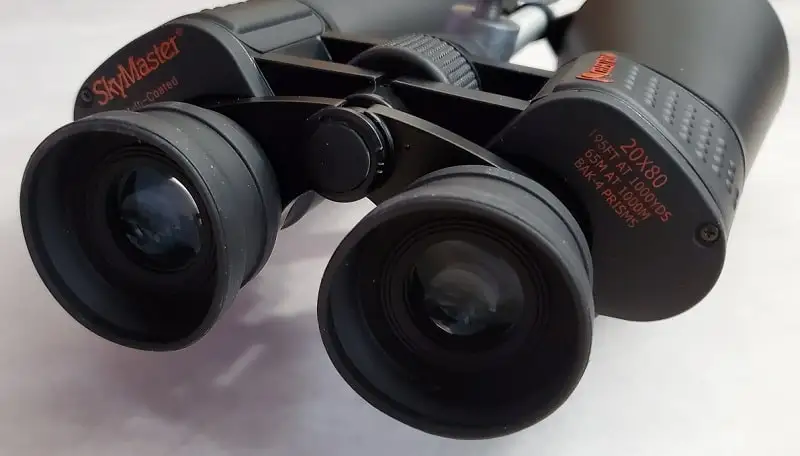
However, the official spec of 18mm eye relief is a sticking point. While the number is correct on paper, a detailed Reddit astronomy review revealed “actual usable eye relief typically measures a few mm less due to recessing of the eyepieces… minor vignetting for those who must wear eyeglasses.” This means eyeglass wearers may not get the full field of view advertised.
Another bold marketing point is “long-distance terrestrial use.” While technically true, the binoculars’ minimum focus distance of 108 feet makes them impractical for closer wildlife observation. Reddit reviewers noted they’re “strictly a long-distance observing tool from a tripod-mounted fixed location” — great for eagles across a lake at dusk, but not for backyard birding.
Cross-Platform Consensus
Universally Praised
Digging deeper into user reports, the most consistent theme is praise for low-light performance. A verified Amazon buyer described seeing celestial objects in “very nice images… as well as great views of our moon,” while another said they “never knew how great a falcon or osprey could look up close” until using them. This is thanks to BaK-4 prisms and multi-coated optics that multiple reviewers confirm “maximize light throughput so you see brighter, more detailed images.”
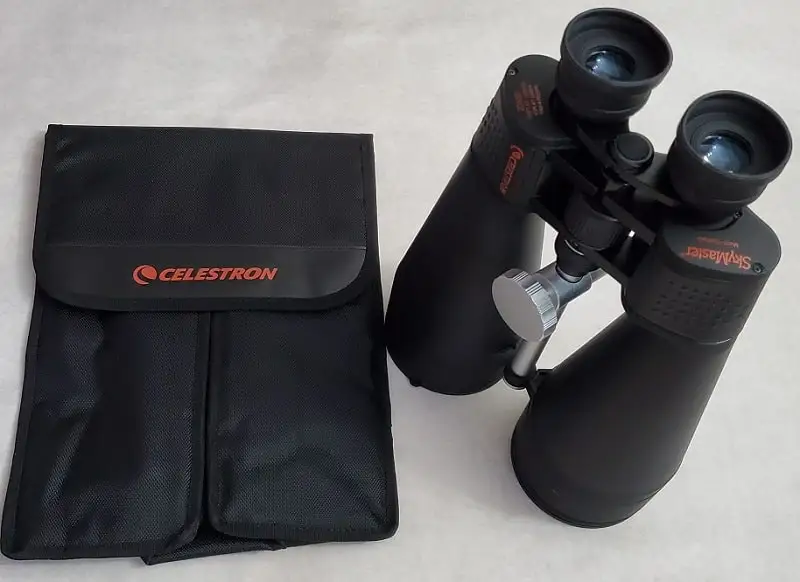
Durability also ranks high. Both Reddit astronomers and Amazon hobbyists mention the “rugged, armored body” providing confidence even in damp or chilly weather. One Reddit breakdown noted the “reinforcing bar… keeps the optics firmly collimated” while doubling as a sturdy tripod balance rail — a detail that night sky photographers in particular value.
Finally, the immersive astronomy experience gets specific accolades. Celestron’s promise of a wide field is borne out in practice, with users mentioning scanning the Pleiades, Andromeda Galaxy, and Beehive Cluster as stand-out experiences. A Reddit astronomer calculated the setup “offers the equivalent light gathering capacity of two 3.1" refractor telescopes — one for each eye,” which helps explain why extended sky sweeps feel so captivating.
Common Complaints
The biggest drawback, universally acknowledged, is the weight. At over 4.5 pounds, users find them impractical for handheld use beyond brief spotting. A Trustpilot buyer cautioned, “as with any high powered binocular, these really magnify your motions… you will want a tripod for most critical uses.” Reddit feedback warns that “using the binocular on a tripod is virtually mandatory” and carrying them by the included neck strap for long distances is uncomfortable.
Edge image issues also crop up. The Astronomics review noted “some barrel distortion… and some visible astigmatism and chromatic aberration at the edges,” but most users say these flaws are minor unless you’re highly critical.
For eyeglass wearers, the recessed eyepieces reduce usability — “some minor vignetting” is reported, and rolling down the eyecups still leaves slightly less eye relief than advertised. This makes the product less universally comfortable.
Finally, seasoned observers note the SkyMaster’s close focus limit makes them unsuitable for general-purpose nature viewing. One Reddit post stressed they are “not a general-purpose binocular” given their 108 ft minimum focusing distance.
Divisive Features
Water resistance triggers differing interpretations. While buyers appreciate knowing dew or a light mist won’t harm the binoculars, several Reddit comments caution not to “tempt fate” by using them in rain — they’re not fully waterproof like the SkyMaster Pro variant.
The price-to-performance balance also divides opinion. Many call them an unbeatable value for astronomy under $150, but some who have upgraded to the Pro line with XLT coatings describe a noticeable sharpness and contrast improvement, making the base 20x80 feel like a stepping stone rather than a final purchase.
Trust & Reliability
Patterns across Trustpilot and Reddit suggest solid reliability over time. The reinforced design discourages misalignment, a common issue in cheaper large-aperture binoculars. One Reddit astronomer highlighted months of use “without losing collimation,” even with frequent tripod mounting and transportation.
No widespread reports of deception or counterfeit sales surfaced, but multiple users advise buying from reputable dealers to ensure you receive the genuine Celestron warranty. Minor criticisms like the less-than-advertised eye relief or visible field-edge flaws don’t indicate durability problems — they’re inherent design tradeoffs in this category.
Alternatives
Within Celestron’s own lineup, the SkyMaster Pro 20x80 is frequently mentioned. As Space.com’s review notes, it adds XLT coated optics, waterproofing, nitrogen purging, interchangeable flared eyecups, and an RSR rail for red-dot finders. However, it’s heavier and costs roughly $319 vs. the base model’s sub-$150 pricing. Users say the Pro’s optical contrast and build “feel like a viable alternative to a telescope,” but anyone on a tighter budget may find the standard 20x80 delivers 80% of the experience for half the price.
At the other extreme, the SkyMaster 25x100 provides even more magnification and light gathering, but at significant cost to weight and handling. Reviewers warn of “a drop in build quality compared to the Pro 20x80” despite its sheer size.
Price & Value
Current U.S. pricing on Amazon hovers around $129.38 (down from a retail $199.95), with used units on eBay often selling between $114–$159 depending on condition and included accessories. UK listings bundle it with a basic tripod, but users quickly recommend upgrading to a sturdier model.
Resale value is relatively strong in astronomy circles due to the recognizable name and reputation. Buyers often advise: “get the tripod at the same time” to maximize your first impressions and avoid the frustrating jitter that can put off new users. Bargain hunters suggest watching for bundle sales or open-box deals from authorized dealers, since the warranty is a key perk.
FAQ
Q: Can I use the SkyMaster 20x80 handheld for quick views?
A: Briefly, yes, but multiple owners say arm fatigue and image jitter set in within seconds. Most recommend a tripod for any serious session.
Q: Will these work well for birdwatching?
A: Only at long distances. With a 108 ft close focus, they’re impractical for nearby birds but excellent for raptors, waterfowl, or distant wildlife.
Q: Are they waterproof?
A: They are water-resistant, suitable for dew or light mist, but not for use in heavy rain or full submersion. The Pro version offers full waterproofing.
Q: How do they perform for astronomy versus a beginner telescope?
A: Many owners describe them as more immersive than entry-level scopes for wide-field views of star clusters, the Moon, and bright planets, though less suited for high-magnification planetary detail.
Q: Do they fit all tripods?
A: The built-in adapter works with standard photographic tripods, but stability improves with heavier-duty or astronomy-specific models.
Final Verdict
Buy if you’re an astronomy hobbyist or long-distance nature observer ready to pair them with a sturdy tripod and relish wide, bright views in low light. Avoid if you need close-focus versatility, handheld flexibility, or glasses-friendly full field of view. Pro tip from the community: invest as much thought into your tripod and mount choice as the binoculars themselves — the SkyMaster 20x80’s full potential only shines when rock-steady.