Celestron Cometron 7x50 Review: Good Starter, 7.8/10
“Frankly, we expected to laugh at these binoculars. Instead, we ended up loving them for what they are.” That Space.com line captures the surprise factor behind the Celestron Cometron 7x50 Astronomy Binoculars—a budget stargazing tool that earns real affection when expectations are set correctly. Verdict: a smart starter pair for wide-field night-sky scanning, with clear limits. Score: 7.8/10.
Quick Verdict
Celestron Cometron 7x50 Astronomy Binoculars: Conditional yes.
Digging deeper into the feedback, the “yes” depends on what you want these binoculars to do. If your goal is wide-field “starhunting”—finding constellations, panning the Milky Way, or locating Messier objects before switching to a telescope—one Amazon reviewer describes exactly that workflow. A verified buyer on Amazon noted: “These binocs are great for finding messiers, nebulae and clusters… this will come in handy as I use my telescope to find objects in the sky, it will direct me to the right region I want to explore.”
Where the conditional part kicks in is when buyers expect telescope-like detail on faint deep-sky objects. That same reviewer cautioned: “You won’t be able to see much without a decent telescope,” and later, “So don’t fool yourself… if you are looking for something that will give you amazing views of messiers and nebula invisible… than these are not for you.” The more you treat these as a wide-field companion, the happier you’re likely to be.
Space.com framed the positioning sharply: “If you are looking for a very inexpensive entry to the joy of binocular skywatching, you can’t do much better than Celestron’s Cometron 7 x 50,” while also warning about compromises like being “water-resistant (not waterproof)” and “not drop-proof.”
| What matters | What people said | Who it’s best for |
|---|---|---|
| Wide field scanning | Space.com praised a “wide field of view” and “good optics at a great price” | Beginners learning the sky, casual Milky Way panning |
| Value | Space.com: “remarkable value for money” | Budget buyers, “second set” owners |
| Deep-sky expectations | Amazon reviewer: “you won’t be able to see much without a decent telescope” | Anyone expecting nebula detail should temper expectations |
| Eyeglasses comfort | Space.com warned: “relatively short 13 mm of eye relief” can “clamp your ability to see the full visual field” | Eyeglass wearers sensitive to eye relief |
| Weather toughness | Space.com: “water-resistant only” | Light damp use, not heavy rain |
Claims vs Reality
Celestron Cometron 7x50 Astronomy Binoculars are marketed around wide-field, bright views for comet watching and beginner astronomy. A recurring pattern emerged: the core claims are mostly supported—but buyers and reviewers keep circling the same trade-offs (BK7 prisms, eye relief, and durability).
Claim: “Wide field of view… perfect for panning the Milky Way.”
On paper, the positioning matches the experience. Space.com repeatedly emphasized the “wide field of view,” and even framed the emotional payoff: “A wide dome of starscape awaits you… letting you… get that ‘suspended in the sky’ feeling.” For beginners, that’s a concrete benefit: you can locate star fields more easily and keep objects in frame with less constant correction.
But the reality check is that “wide field” doesn’t automatically mean “dramatic detail.” The Amazon reviewer who liked them for locating targets still described objects as “extremely faint” and said they were “barely able to make out anything” when trying to observe clusters and nebulae rather than simply find them.
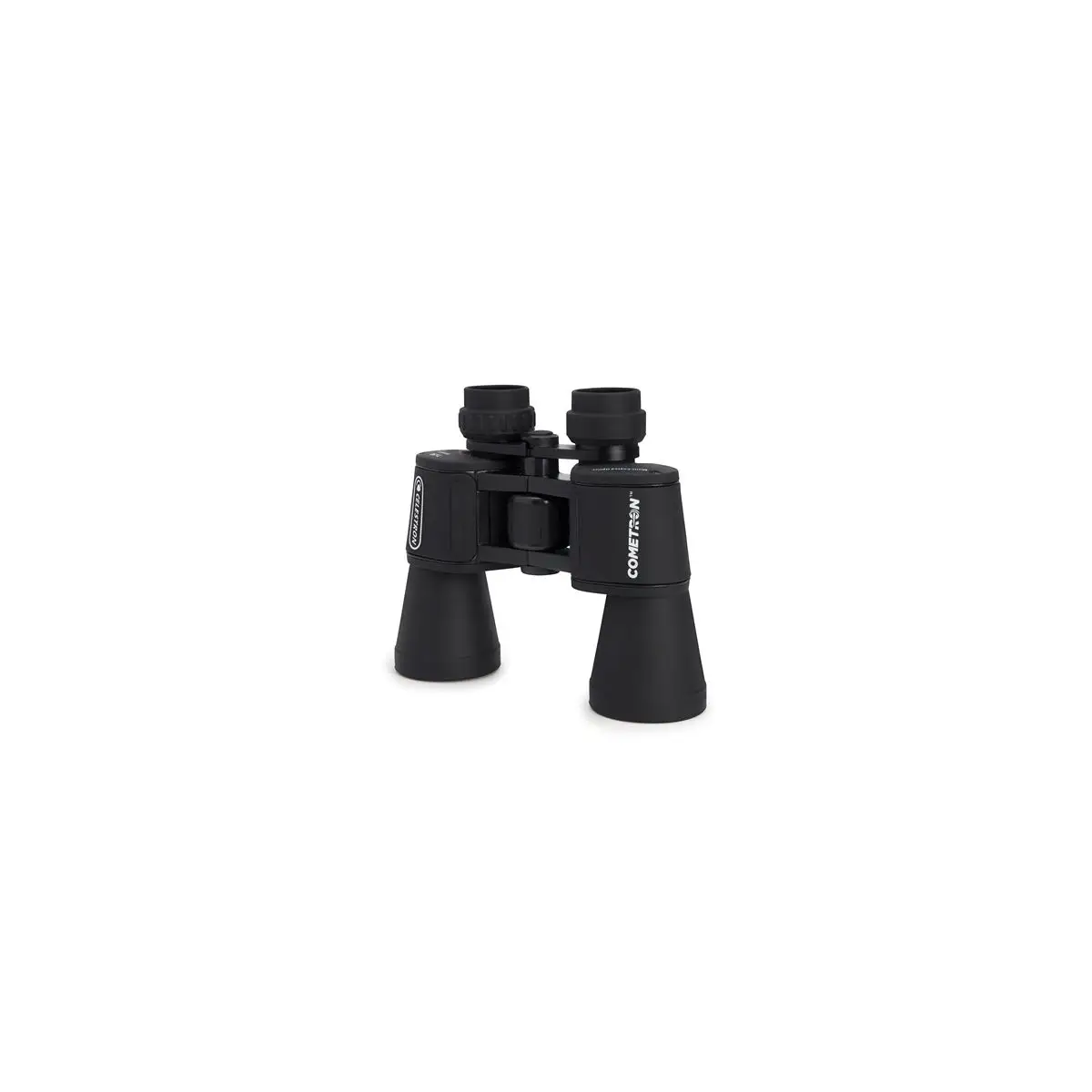
Claim: “Ideal for nighttime and low light situations” / big 50mm objectives and 7.1mm exit pupil.
Space.com connected that big exit pupil to real usability: “It’s more than 7mm across; unusually large,” and suggested it helps the “intended kid market” because “young folks’ eyes… can dilate wider,” making it easier to see in the dark. For a family buying a first astronomy optic, that’s not just a spec—it’s a comfort factor for aligning eyes and holding a stable view.
Still, Space.com also described the compromises of BK7 glass: comparing exit pupils to higher-quality BAK4 binoculars, they observed the Cometron’s exit pupil as “a fuzzy pseudo-circle” rather than a sharply defined disc. So while the binocular can feel bright and forgiving, image “purity” and edge performance won’t match pricier glass.
Claim: “Water-resistant” / durable housing.
Here the marketing language and reviewer reality align—mostly. Space.com agreed Celestron “claims only that the cometrons are water-resistant, not waterproof,” and pointed at “visible joints” as “suspect points for liquid entry.” In other words: fine for damp conditions, but not a storm-proof tool.
There’s also a quiet spec contradiction worth flagging. While Amazon’s listing includes “water resistance level: waterproof,” Space.com explicitly frames them as “water-resistant (not waterproof)” and even lists “water-resistant only” as a con. If you’re buying them expecting full waterproofing, the independent review suggests that expectation may not hold.
Cross-Platform Consensus
Celestron Cometron 7x50 Astronomy Binoculars generate unusually consistent “for the price” enthusiasm across sources, with the most detailed accounts coming from Space.com and a long-form Amazon review. Digging deeper into user reports, the story isn’t that these binoculars are secretly premium—it’s that they hit a sweet spot for a specific kind of observer.
Universally Praised
The first consistent win is the “cheap entry into skywatching” theme. Space.com summed it up with: “If you are looking for a very inexpensive entry to the joy of binocular skywatching, you can’t do much better than Celestron’s Cometron 7 x 50.” That matters most for beginners and families: it lowers the barrier to learning constellations and scanning bright targets like the Moon without committing to a telescope immediately.
A second repeated strength is the wide-field “starhunting” use case. The Amazon reviewer didn’t frame them as a main observing instrument; they framed them as a targeting tool: “These binocs are great for finding messiers, nebulae and clusters… it will direct me to the right region I want to explore.” For telescope owners, that’s a specific workflow benefit: binoculars first to orient, then telescope to study.
A third praised trait is usability for adults and kids—especially in handheld sessions. Space.com emphasized that the Cometron’s “small size and light weight… let you use them all day,” and positioned them as both “a first binocular for young astronomers” and a “grab ’n ’go… second set of binoculars for adults.” For a parent, that “don’t really care if they get trashed” framing is practically a purchasing rationale: you can hand them to a kid without the anxiety that comes with expensive optics.
Quick praise recap:
- “Very inexpensive entry” for beginners (Space.com)
- Wide field helps “find and track” objects (Amazon reviewer + Space.com)
- Lightweight, family-friendly use (Space.com)
Common Complaints
The biggest complaint theme is unrealistic expectations about what 7x50 binoculars can show on faint deep-sky objects. The Amazon reviewer laid out