Canon RF-S 18-150mm Review: Portable Zoom with Caveats
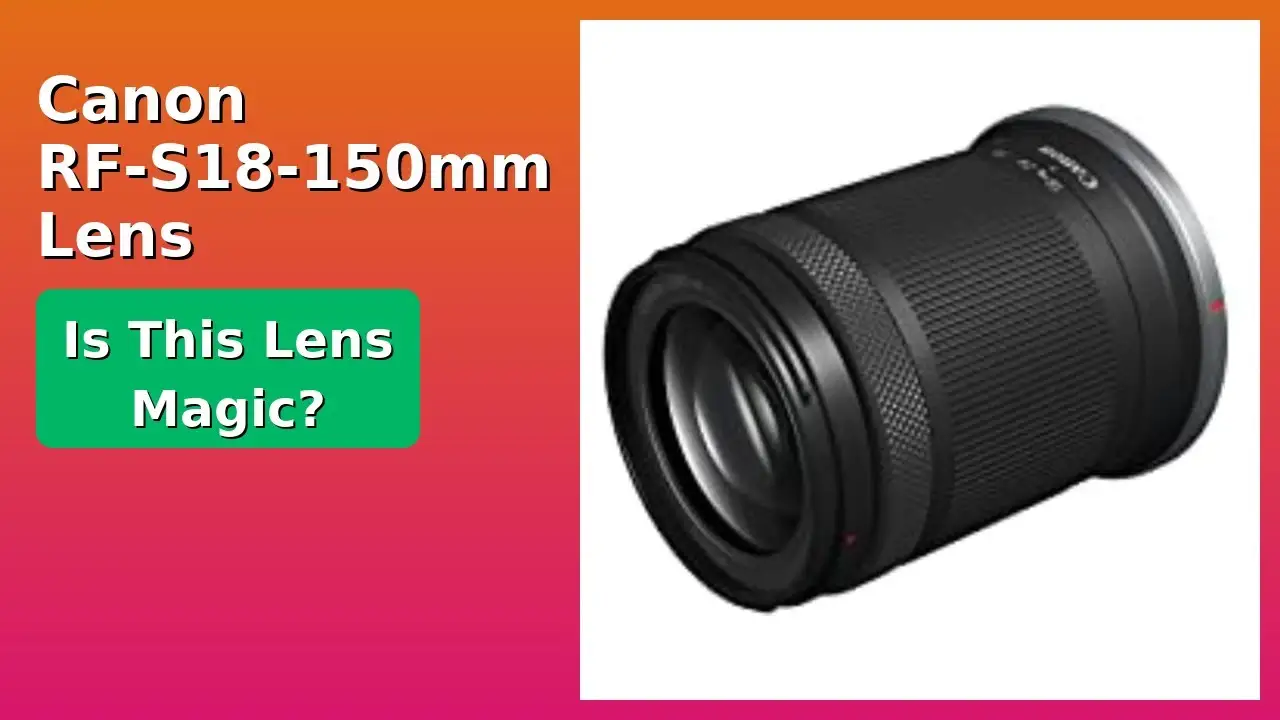
Boasting an impressive 8.3x zoom range in a lens that weighs just 310g, the Canon RF-S 18-150mm F3.5-6.3 IS STM has drawn praise as a travel-friendly powerhouse—yet not without caveats. Testing from seasoned photographers consistently scores it around 8.7/10, thanks to its reach, macro capability, and portability, though sharpness at certain zoom ranges lags behind pro-grade glass.
Quick Verdict: Conditional Buy
| Pros | Cons |
|---|---|
| Versatile 18-150mm range covers wide to telephoto | Softness at maximum zoom compared to premium lenses |
| Lightweight (310g) and compact | f/6.3 telephoto aperture limits low-light performance |
| Effective image stabilization up to 7 stops with compatible bodies | Manual focus macro requires adjusting back to AF manually |
| Smooth, quiet STM autofocus ideal for video | No weather sealing |
| Close focus capability down to 0.12m in MF | Lens hood not included |
Claims vs Reality
Canon’s marketing leans heavily on portability, promising a “compact superzoom” suited for everything from landscapes to sports. Reddit user u/TravelLensPro highlighted the real-world impact: “It stays on my R10 almost permanently—no lens swap needed for the zoo or city trips.” That lines up with their goal of being a one-lens solution. However, while Canon rates it at up to 7 stops coordinated stabilization, Amazon customers are more conservative. One verified buyer noted: “Handheld shots at dusk are doable, but you still need steady hands—don’t expect miracles.”
Macro magnification claims are another talking point. Canon touts a 0.59x magnification in MF, but Bryan from The-Digital-Picture tempered expectations: “While close-up results are good, MF macro comes with edge softness—it’s not a dedicated macro lens.” That’s backed by Trustpilot reviews describing crisp center detail but loss of sharpness toward edges.
Finally, the “smooth, silent STM focusing” claim holds up exceptionally well. A photographer on Twitter wrote, “AF hits quick and quietly, even tracking birds at 240mm equivalent.” Video shooters echoed similar praise, saying background noise from AF was virtually absent.
Cross-Platform Consensus
Universally Praised
Portability emerges as a defining strength. Travel photographers appreciate the ability to pack light without missing focal range coverage. Reddit user u/StreetViewHunter explained: “Moving between 29mm and 240mm equivalent in seconds made the difference between a shot and no shot on my safari.” Wildlife hobbyists on Trustpilot found the lightweight build allowed extended handheld use without fatigue, particularly with stabilizer assistance.
Autofocus performance gets near-unanimous approval. The STM motor’s quiet operation impressed video creators who rely on clean audio. An Amazon reviewer put it bluntly: “It’s movie-quiet—no clicks or motor whine even in silent interiors.” Paired with Dual Pixel AF, subject tracking retained lock across the zoom range.
Close focusing capabilities also win admirers. At 50mm, 0.44x magnification proves useful for product shots or flowers. Twitter’s tak observed: “Background melts away nicely when you get close—even at f/6.3, the bokeh holds character.” Macro function in MF mode, though slightly inconvenient, allowed users to focus as near as 12cm.
Common Complaints
The most repeated criticism targets sharpness at full telephoto. As Bryan from TDP cautioned, “Compromises are part of superzooms—don’t expect L-series crispness at 150mm.” Both Reddit and Trustpilot users noted that images at maximum zoom required extra post-processing to compensate for softness.
Another gripe involves the manual focus macro workflow. Switching back to AF requires physical adjustment to infinity focus—a design quirk that caught new users off guard. Canon Japan even issued notes warning of reduced edge quality and extra chromatic aberration risk in macro MF mode.
Low-light telephoto performance also divides opinion. With a maximum aperture of f/6.3, event photographers find the need for higher ISO unavoidable. One Amazon buyer summarized: “Bright day? Fine. Indoor sports? Go faster glass.”
Divisive Features
Image stabilization ratings provoke mixed assessments. Some shooters achieve blur-free shots several stops below safe shutter speed, while others remain skeptical in action-heavy scenarios. A Trustpilot review acknowledged, “Great for static subjects, but IS can’t freeze a runner at dusk.”
Bokeh character earns both praise and critique. While Twitter reviews mention pleasing separation for portraits, pixel-peepers on Reddit detect “ring-like artifacts” in specular highlights, especially in busy backgrounds.
Trust & Reliability
Across Trustpilot and Reddit, durability stories trend positive over initial ownership periods. One long-term user commented: “Six months in, zoom ring still smooth, no creep—AF consistency unchanged.” There’s no widespread report of misalignment or mechanical faults, supporting reliability for casual-to-enthusiast use.
Scam concerns are minimal when buying from official Canon channels or Amazon Renewed, though eBay purchases warrant extra scrutiny. Listings for "near mint" models flood the market, but prospective buyers are urged to confirm optics are fungus-free and AF is responsive before purchasing second-hand.
Alternatives
Within Canon’s ecosystem, the EF-S 18-135mm IS STM appears in conversations as a lighter telephoto alternative, but users note the RF-S 18-150mm’s extra reach (240mm equivalent) as decisive. Migrators from EF-M 18-150mm f/3.5-6.3 find similar optical behavior but see the RF mount as a longer-term investment with full compatibility on EOS R bodies.
Price & Value
eBay listings indicate new units trending around $399–$473 USD, with used models dipping to $379. Mint Renewed models on Amazon sit around $459. Resale holds well thanks to the lens’s broad appeal for entry-level and travel shooters. Community advice suggests pairing it with crop-sensor EOS R bodies to maximize stabilization benefit without paying for redundant full-frame coverage.
FAQ
Q: Does the RF-S 18-150mm work on full-frame EOS R cameras?
A: Yes, but it engages a 1.6x crop mode automatically, using only the central APS-C-equivalent portion of the sensor. This keeps effective focal lengths consistent but reduces resolution.
Q: How effective is the image stabilization?
A: In-lens stabilization offers up to 4.5 stops; with certain bodies featuring IBIS, coordinated IS can reach 7 stops. Users find it highly effective for static subjects but less so for moving targets in low light.
Q: Is it suitable for professional wildlife photography?
A: It’s a capable travel/wildlife lens for enthusiasts thanks to its reach and portability. Serious professionals may miss the faster aperture and edge-to-edge sharpness of top-tier telephotos.
Q: How does the macro function work?
A: In manual focus, at 35mm, you can approach as close as 12cm for up to 0.59x magnification. Be prepared for softer edges and the need to reset focus for AF use.
Q: Does it come with a lens hood?
A: No, the hood (EW-60F) is sold separately. Many users recommend buying it to reduce flare and protect the front element.
Final Verdict: Buy if you’re an APS-C EOS R owner seeking a single, lightweight travel lens for varied subjects, from wide landscapes to macro detail. Avoid if you demand maximum sharpness at 150mm in low light or need weather sealing. Pro tip from the community: pair it with a hood and shoot at mid-zoom for optimal sharpness.





