Canon Genuine 128 Black Toner Review: 8.4/10 Verdict
“Ran out of toner somewhere between 500 - 600” pages is the kind of line that makes people question everything about page-yield claims—especially on a cartridge officially positioned as a dependable OEM standard. Canon Genuine 128 Black Toner Cartridge gets a conditional verdict based on cross-platform feedback, landing at 8.4/10.
Quick Verdict
For many owners of older Canon imageCLASS and Faxphone machines, this cartridge is the “just works” option—easy to swap, reliably crisp, and less troublesome than knockoffs. But a smaller set of verified-review excerpts describe unexpectedly low yield, and price sensitivity shows up repeatedly.
| Decision | What users emphasize | Evidence from user feedback |
|---|---|---|
| Yes (most buyers) | Crisp, clear text output | Best Buy reviewers said prints are “clear and crisp” |
| Yes (busy home/office) | Easy, clean installation | Best Buy reviews: “easy to install… you do not need to get hands dirty.” |
| Conditional (value shoppers) | Only “worth it” on sale | Best Buy price-focused comments: “great price… shipping was fast and free!” |
| Conditional (high-volume users) | Yield varies in real use | ReviewIndex excerpt: “ran out… between 500 - 600.” |
| No (strict cost-per-page) | Expensive for a standard-yield unit | Best Buy review: “it is expensive… 4 cents per sheet.” |
Claims vs Reality
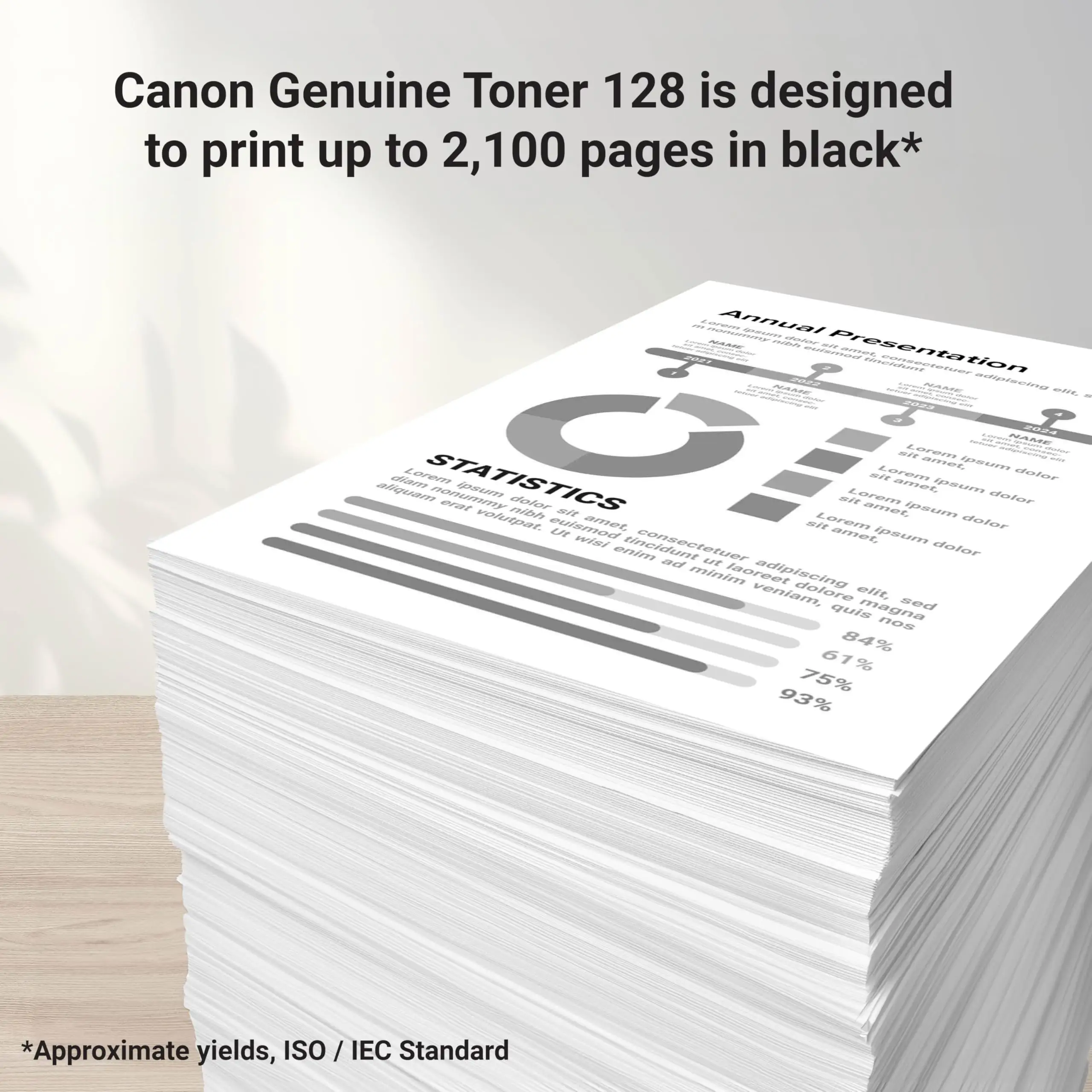
Canon’s official messaging centers on OEM engineering and consistent output, and retailers repeat the standardized yield figure. Amazon lists that Canon Genuine 128 “yields approximately 2,100 pages (ISO/IEC standard),” and Staples similarly highlights “up to 2,100 pages.” Canon’s own documentation frames replacement intervals around the same ISO/IEC 19752 method and notes results depend on environment and document types.
Digging deeper into user reports, the “2,100 pages” claim holds up for some people in spirit—several Best Buy reviewers describe it as “long lasting” and praise how many pages they get before replacement. One Best Buy customer wrote: “good capacity toner cartridge… i am actually impressed that i can get as many pages printed as i am.” Another added: “great long lasting ink… for mostly heavy printing works.”
But there’s a sharper contradiction in the verified-review analysis excerpts. The ReviewIndex compilation includes a particularly specific complaint: “the purchased cartridge, touted to print some 2,100 pages, ran out of toner somewhere between 500 - 600.” While that’s not a full review transcript, it is a direct quoted user line in the dataset—and it’s far below the ISO/IEC expectation. The gap suggests that for some document mixes (or possibly cartridge condition, storage, or usage patterns), real-world yield can diverge dramatically from the standard.
Canon and retailer descriptions also lean on the all-in-one cartridge convenience—toner, drum, and waste receptacle combined—positioned as a reliability win. User commentary broadly reinforces the convenience side. A Best Buy reviewer summed up the experience as: “toner was easy to install… you do not need to get hands dirty.” Another echoed “simple set up” and “easy to use with crisp printing.” The “reliability” piece, however, becomes more conditional once price and yield enter the conversation, with one Best Buy customer calling it “reliable but overpriced.”
Cross-Platform Consensus
Universally Praised
A recurring pattern emerged around print clarity: owners repeatedly frame OEM Canon 128 as the safe choice when they want clean, professional-looking monochrome pages. One Best Buy reviewer wrote: “good toner, print comes out clear and crisp. recommend to purchase.” Another described “consistently excellent print quality,” and others used similar language like “high quality printing” and “crisp printing.” For home offices printing text-heavy documents—class handouts, invoices, and forms—this kind of predictability is the core value.
Ease of installation is the second theme that shows up across the Best Buy review excerpts, and it’s described in practical, almost relieved terms. A Best Buy customer said: “toner was easy to install. you do not need to get hands dirty.” Another called it “straightforward,” and one framed it as the kind of consumable that doesn’t add friction: “printer ink is never a problem - works well all the time!” For users keeping older laser MFPs alive (like the MF4890dw mentioned in a review), low-maintenance replacement matters because it reduces downtime.
Longevity—at least for a large subset—is also framed as “years” of dependable ownership rather than a single cartridge story. One Best Buy reviewer described long-term satisfaction with the platform: “i have been using these since 2013 and have never had an issue.” Others emphasize that it “lasts longer than the cheaper knock-offs,” positioning Canon’s cartridge as a stability purchase, even when it costs more upfront.
Finally, buyers consistently treat “genuine OEM” as a meaningful category, not marketing fluff. One Best Buy reviewer stated plainly: “oem toner is better than any after market i have tried.” Another explained their buying philosophy: “i firmly believe in using authentic toner cartridges… i never have any issues with the canon cartridge. works perfectly every time.” For risk-averse office managers or anyone who has dealt with streaking and early failures, that trust signal becomes part of the product’s perceived performance.
After the narrative, the repeated praise clusters into a few takeaways:
- Crisp black text and clean output are cited directly as “clear and crisp” (Best Buy).
- Installation is described as simple and clean: “you do not need to get hands dirty” (Best Buy).
- OEM reliability is repeatedly contrasted with third-party cartridges that streak or run out faster (Best Buy).
- Long-term ownership confidence shows up in multi-year statements like “since 2013… never had an issue” (Best Buy).
Common Complaints
Price sensitivity is the loudest complaint, even among generally satisfied buyers. The same cartridge that earns praise for dependability is also described as expensive enough to trigger cost-per-page math. One Best Buy reviewer wrote: “the toner produces high quality print, though it is expensive. an $80.00 cartridge only prints around 2,000 sheets which is 4 cents per sheet.” Another calls it “reliable but overpriced,” and a long-term owner added: “only complaint is that these toner cartridges are getting really expensive.” For budget-conscious households, the friction isn’t performance—it’s the feeling of paying a premium for a necessity.
Yield inconsistency is the most serious performance complaint in the dataset because it challenges the central “standard yield” promise. ReviewIndex includes a stark report: “ran out of toner somewhere between 500 - 600.” While officially rated at ~2,100 pages (Amazon, Staples, Canon documentation), that quoted experience suggests a subset of users see far lower results. For high-volume users—teachers printing packets, small offices running invoices—this kind of variability can turn “OEM reliability” into an unexpectedly frequent replacement cycle.
There’s also a smaller but persistent “works fine, but…” sentiment: people like the output and installation, but resent the economics. Even positive Best Buy comments sometimes read like reluctant acceptance: “of course this is a necessity,” followed by praise for capacity. That tone matters because it indicates performance isn’t creating delight; it’s preventing problems.
After the narrative, the complaint pattern looks like this:
- Many buyers call it expensive even when they like it (Best Buy).
- Yield can be disputed in user quotes versus ISO/IEC claims (ReviewIndex vs Amazon/Staples/Canon).
- Value perception is often tied to promotions and retailer pricing (Best Buy).
Divisive Features
The “value” story splits sharply depending on where and when people buy. Some buyers describe it as a bargain for OEM: “great price for an oem printer cartridge… shipping was fast and free!” Others compare retailers and feel they had to hunt for fairness: one Best Buy reviewer said: “went to staples first and they would not honor there online price. went to best buy and their regular price was lower than staples online price.”
Another divisive angle is how users compare OEM to off-brand alternatives. A Best Buy customer wrote: “lasts longer than the cheaper knock-offs… we went through them so much faster and they were streaking sooner.” That frames Canon’s premium as justified through reduced hassle. But the existence of very low-priced third-party listings on eBay (multi-packs and budget cartridges) creates an alternative path for shoppers who prioritize upfront cost, even if they accept higher risk.
Trust & Reliability
A recurring pattern emerged around “genuine vs counterfeit” anxiety, but in this dataset it’s shaped more by Canon’s warnings than by user scam stories. Canon’s anti-counterfeit messaging emphasizes risks like “toner leakage” and “lower cartridge (page) yield” from counterfeits, and Canon Europe even cites tested counterfeit print capacity “ranges from 28% to 69% compared to original canon cartridges.” Those are official claims, not user anecdotes, but they intersect with the community’s repeated “OEM vs after market” framing.
On long-term durability, the strongest user story comes from Best Buy’s older-owner perspective: “i have been using these since 2013 and have never had an issue.” That kind of multi-year continuity implies a stable experience for users who stick with genuine cartridges—especially those running compatible legacy machines like the MF4890dw noted in another review.
Alternatives
The dataset’s clearest “alternative” isn’t another Canon model—it’s the off-brand cartridge ecosystem. Best Buy reviewers directly compare against “after market” and “cheaper knock-offs,” with one stating: “oem toner is better than any after market i have tried,” and another reporting that off-brand units were “streaking sooner” and being replaced “so much faster.” For buyers who tried generics and came back, the alternative story is less about specs and more about avoiding print defects and frequent swaps.
On the market side, eBay listings show both “genuine canon 128” options (including open-box) and many compatible multi-packs priced far below typical retail. That creates a practical choice: pay more for OEM consistency, or gamble on lower-cost compatibles that some users say streak and burn out earlier.
Price & Value
Pricing context shapes almost every “should I buy” decision here. Amazon’s listing shows a discounted price point in the provided snapshot ($63.00 listed, with additional shipping/import fees for Canada shown in the data). Best Buy reviewers repeatedly reference catching it at a “great price,” and some explicitly frame the purchase as a sale-driven win: “purchased on sale… works great,” and “best buy just happened to have had it at a discounted price when i needed it.”
Staples’ listing in the dataset shows a much higher number ($112.99), which helps explain why one Best Buy reviewer felt vindicated after a retailer comparison: “went to staples first… went to best buy and their regular price was lower.” Meanwhile, eBay market listings show a wide range, including “open box” genuine cartridges and many third-party compatibles. That spread implies resale and secondary-market value exists, but it also increases the risk of confusion between OEM and non-OEM listings.
Community “buying tips” are mostly implicit: people talk about timing, retailer rewards, and minimizing pain. One Best Buy reviewer wrote: “love using best buy dollars… it’s a lot less painful,” and another said: “the rewards make it even better.” For deal-driven buyers, the cartridge becomes acceptable when paired with discounts, points, or clearance pricing.
FAQ
Q: How many pages does the Canon 128 toner cartridge actually print?
A: Official listings cite about 2,100 pages under ISO/IEC standards (Amazon, Staples, Canon documentation). Real-world results vary by document type and density. One ReviewIndex excerpt quotes a user who said the cartridge “ran out… between 500 - 600,” while other buyers call it “long lasting” (Best Buy).
Q: Is it easy to install the Canon Genuine 128 cartridge?
A: Yes. Best Buy reviewers repeatedly describe it as simple and clean to swap. One reviewer said: “toner was easy to install. you do not need to get hands dirty.” Others mention “simple set up” and “easy to install and remove,” suggesting it’s manageable for home users without technical help.
Q: Is OEM Canon toner really better than aftermarket cartridges?
A: Many buyers think so, mainly to avoid streaking and early replacement. A Best Buy reviewer said: “oem toner is better than any after market i have tried.” Another wrote that cheaper knock-offs were “streaking sooner” and were used up “so much faster,” prompting them to return to Canon.
Q: Why do some people say it’s overpriced if they still recommend it?
A: The complaint is about cost-per-page and rising prices, not basic functionality. One Best Buy reviewer wrote: “high quality print, though it is expensive… 4 cents per sheet.” Another called it “reliable but overpriced,” suggesting the cartridge’s reliability earns approval even when the price feels hard to justify.
Q: Where do shoppers find the best deal on this cartridge?
A: Based on the dataset, buyers cite discounts and retailer price differences. Best Buy reviewers describe buying at a “great price,” sometimes comparing against Staples pricing. eBay listings show a broad range, including “genuine” open-box options and many low-cost compatibles, which may change the risk/value tradeoff.
Final Verdict
Buy if you’re a home office or small office user who prioritizes crisp text, easy installation, and the reduced hassle that multiple buyers associate with genuine OEM cartridges—especially if you can catch it on sale. Avoid if you’re printing high volume on a strict budget and can’t tolerate yield uncertainty, given one verified-review excerpt claiming it “ran out… between 500 - 600.” Pro tip from the community: wait for discounts and rewards—one buyer called it “a lot less painful” with Best Buy dollars.